Part 2: The Price of Patience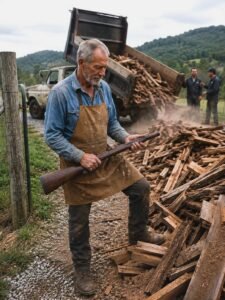
The check was made out for $7,400.
Not $740. Seven thousand, four hundred.
I flipped it over, looking for a mistake. Found none. Then I read the letter—handwritten on heavy cream paper, the kind you don’t see anymore.
Mr. Harvell,
I’m not interested in four stocks. I’m interested in your entire woodpile. The photos show crotch figures and blister curl that haven’t come out of California in twenty years. That “worthless” casket wood is Claro walnut, old-growth, and the casket company was paying you to take what custom rifle makers would kill for.
The check is for the four stocks at $1,850 each—that’s my retail price, not yours. You undervalued yourself by a factor of ten. I’m flying to Omaha next Thursday. If you have even half a cord of what these photos show, I’ll bring a contract.
Respectfully,
Augustin Rook
Rook Custom Firearms, Montana
I read it three times. Then I walked out to the barn, pulled back the tarp, and looked at sixteen years of discarded walnut stacked to the rafters. Crooked slabs. Forked boards. Knots that looked like maps of rivers I’d never seen.
I had roughly two tons of it.
That night, I didn’t sleep. I sat at Ellen’s kitchen table—Ellen was the widow next door who let me use her good light for photographs—and I calculated. If Rook was right, if even a fraction of that pile was worth what he’d just paid for four stocks, I wasn’t looking at debt relief.
I was looking at a second chance.
But something gnawed at me. All those years, I’d given most of my stocks away to neighbors, to soldiers’ families, to a boy down the road whose father had died in Vietnam. I’d never charged a fair price because I never knew what fair was. And now a stranger was telling me I’d been sitting on a fortune while the bank circled my land like a vulture.
I wrote Rook back. Not to accept. To ask him one question:
Why didn’t you just buy the wood and leave me out of it?
His return letter came two days later, airmail.
Because you shaped those stocks by hand, Mr. Harvell. I can buy wood anywhere. I cannot buy the eye that sees a rifle’s soul before the barrel is even fitted. You’re not a farmer with a hobby. You’re a stockmaker who happens to grow corn. See you Thursday.
Part 3: The Inventory
Augustin Rook arrived in a battered Ford pickup with Montana plates and a wooden case that held four of his own rifles. He was seventy-two, with hands like weathered roots and the kind of quiet that made you listen before you spoke.
We walked into the barn. He didn’t say a word for forty minutes. Just moved through the stacks, running his palm over grain, holding slabs to the light, tapping knots like a doctor listening to a chest.
Finally, he turned.
“You have 2,100 board feet of exhibition-grade walnut. At current market, that’s roughly $180,000 raw. Shaped and finished as stocks, it’s closer to half a million—but that takes years and skill you already have.”
I leaned against a post. $180,000. My operating debt was $176,400.
For sixteen years, the casket company had paid me fifty dollars a month to store their garbage. They’d signed a contract in 1971 that said the wood became mine after five years. They’d forgotten. I’d reminded them once, and they’d laughed.
I wasn’t laughing now.
Rook offered me a deal: he’d buy half the pile outright for $90,000, and he’d consign the other half—I’d shape the stocks, he’d sell them through his catalog, split the profit sixty-forty in my favor. But there was a condition.
“You have to stop thinking of this as rescue,” he said. “This isn’t a lifeboat. It’s a workshop. You take this money, you pay the bank, you fix your tractor—and then you build a proper drying shed. You learn the trade for real. You become the man who makes these stocks, not the man who lucked into the wood.”
I agreed.
The bank manager, when I walked in with a cashier’s check for the full balance, actually asked me if I’d won the lottery. I told him no. I told him I’d just been paid for sixteen years of paying attention.
He didn’t understand. Most people don’t.
—
Part 4: What the Grain Holds
That was 1987. By 1991, Rook Custom Firearms had a dedicated “Harvell Grade” in their catalog—stocks made from that Nebraska walnut, each one signed on the barrel channel with a small H burned into the wood. I built the drying shed. I bought better tools. I stopped growing corn altogether in ’93 and let the fields go back to prairie.
But here’s the part I didn’t expect.
The boy down the road—the one whose father died in Vietnam—he came back from college in ’95 with a degree in forestry. He asked if he could apprentice with me. I said yes. Two years later, he brought his own apprentice, a young woman from Oklahoma whose grandfather had been a stockmaker before the war.
We weren’t a factory. We were a shop. Three people, sometimes four, shaping wood that the world had called worthless, turning it into something that would outlast us all.
And then, in 2001, Augustin Rook died. His daughter took over the company. She flew out to Nebraska for the funeral they held in my barn—Rook had asked for that, in a letter he’d sent me six months prior. Bury me where the wood is, he’d written. I spent my life chasing rare grain. I only found home once.
I stood at the service, surrounded by rifles I’d helped create, held by men and women I’d never met. Their fathers, their sons, their daughters. Hunters. Competitors. Veterans who’d been given a custom stock as a gift of gratitude.
And I thought about that night in 1987, sitting at Ellen’s table with the ledger and the debt and the thirteen years of notes. I had written: Find out what the stocks are actually worth.
But that wasn’t the right question.
The right question was: Find out what I’m actually worth. And the answer wasn’t in the check, or the contract, or even the wood itself. It was in the patience of learning. The humility of giving most of my work away for free, because I didn’t know its value—and in not knowing, I’d kept my hands humble and my eyes open.
Ellen and I married in ’92. She still makes me photograph every new stock under her kitchen lights. The farm is gone now—sold to a conservation trust, turned back to tallgrass. But the shop remains, nestled in the old barn, with a sign above the door that Rook painted himself before he left that first week:
“Worthless wood, worthy hands.”
I’m seventy now. The boy from down the road runs the business. I still come in most mornings, just to feel the grain. Just to remember that sometimes the world throws away its treasures, and it takes sixteen years of loving what others reject to finally understand:
Value isn’t in the object. It’s in the relationship. The time. The care. The refusal to call something worthless just because you can’t yet see what it’s becoming.
The casket company went bankrupt in ’94. They’d been throwing away the good wood for decades, chasing uniformity, terrified of imperfection.
I built a life from their leavings.
And I never once felt like I’d gotten the better end of the deal.
Because I got to learn the wood. And the wood—slowly, patiently—taught me to value everything I’d almost given up on.
Myself included.