PART 1
“Don’t come this year,” my father said three nights before Christmas.
There was no greeting. No question about my flight. “Jason’s going to be here,” he explained. My stepbrother, recently married, his new in-laws joining the annual dinner. “People will ask about the Army. Your deployments. Your rank. Jason just got promoted, and this is important to him.”
For eighteen years, I’d served without asking my family to rearrange their lives around me. Now my father was worried that simply sitting at his table might overshadow the son he’d chosen to celebrate.
“I understand,” I said. I didn’t argue. I went home and canceled my flight.
Two days later, Sergeant Alvarez asked when I was leaving for the airport. “Plans changed,” I told her. When she offered me a seat at her sister’s table, I said I’d probably take overnight duty instead. “Half the unit has children waiting at home.”
Two young soldiers made it home for Christmas because I covered their shifts.
By Christmas Eve afternoon, Colorado’s forecast had turned into a full winter emergency. At 1800 hours, our unit was activated. As I geared up, I pictured my father’s dining room — the good china, Jason talking about his promotion, my father’s warm attentive smile.
I put the image away. The mission came first.
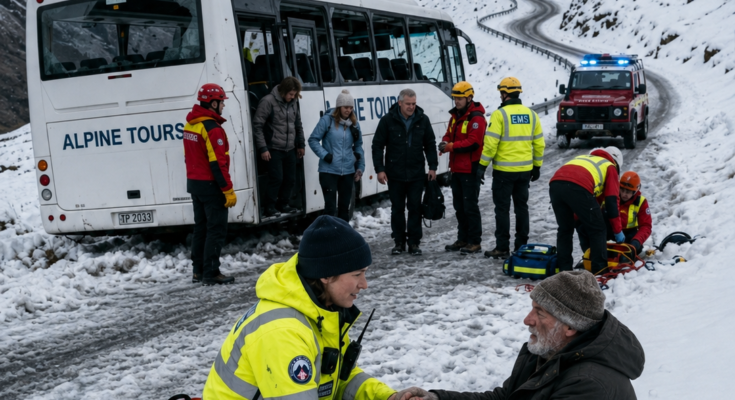
We reached mile marker 214 just after a charter bus carrying nearly forty passengers slid off the highway and rolled onto its side. A tanker leaned dangerously toward the frozen shoulder behind it. We were first on scene.
I climbed onto the exposed side of the bus, opened the emergency exit, and passed passengers down one by one. A boy of about six gripped my sleeve until his knuckles went white. “You’re safe now,” I told him.
Then someone shouted from the tanker. The driver, Walt, was pinned, the cab shifting with every gust of wind.
“Stay with me,” I said, working his leg free while he told me about his four grandkids. We cleared the cab just before the undercarriage shifted further.
I didn’t notice the news crew filming from behind the perimeter.
We got back to base past eleven. Sergeant Alvarez was staring at the television mounted in the corner.
“Major.” My face was on the screen. Breaking: Army officer leads highway rescue during Colorado blizzard.
Forty minutes away, my father’s dinner had moved on to pie and coffee. Someone turned on the national broadcast. Jason lowered his phone, leaned toward the television, and whispered one word.
✨ Don’t stop at the best part! Facebook limits long stories, so switch “Most Relevant” to “All Comments” and continue reading below. 👇 to Part 2.
(This is a fictional short story, written for pacing purposes.)
PART 2
“Rachel.”
That was the word Jason whispered — my name — before the rest of the table understood what they were looking at. The anchor’s voice caught up a second later, reading off the name and rank the base’s public affairs office had provided: Major Rachel Whitfield, U.S. Army, who led the response that saved all forty passengers aboard the overturned charter bus.
My father’s wineglass slipped from his hand and shattered against the good china.
According to my cousin, who called me later that night still half in shock, the entire table had gone silent. Jason’s new mother-in-law, Erica’s mother, turned to my father and asked, carefully, “Is that your daughter?”
My father didn’t answer right away. Jason answered for him. “Yeah,” he said. “That’s Rachel.”
The broadcast ran the full segment — the bus, the children passed hand to hand through the snow, Walt being pulled from the shifting tanker cab. The anchor mentioned, almost as an aside, that the rescue had taken place on Christmas Eve, that the officer leading it had reportedly given up her own holiday leave to cover shifts for junior soldiers with young families.
My cousin told me my father sat completely still through the entire segment, his shattered wineglass still on the tablecloth, saying nothing.
I didn’t know any of this yet. I was still at the base, checking on my soldiers, filling out my after-action report, drinking coffee that had long since gone cold. My phone had started buzzing with calls from people I hadn’t spoken to in years — a cousin, an old classmate, then, eventually, reporters who’d tracked down the base’s public affairs contact and were now working their way outward.
At 11:47 p.m., my father called.
I let it ring twice before I answered.
“Rachel,” he said, his voice unsteady in a way I hadn’t heard from him in years. “We just saw you on the news.”
“I was working,” I said simply.
“You were saving people’s lives while we were eating pie.”
I didn’t have an easy response for that. I didn’t try to make it easier for him.
✨ Don’t stop at the best part! Switch to “All Comments” and continue below. 👇 to Part 3 — the ending.
(Fictional short story, continued.)
PART 3
“I called you three nights ago and told you not to come home,” my father said, “because I was worried you’d make Jason’s night about you. Rachel, I’ve spent the last hour watching you pull a man out of a tanker that was about to roll, and I don’t know what to say to you except that I got it completely wrong.”
“You’ve been getting it wrong for a while,” I said, not cruelly, just honestly, eighteen years of quiet, uncomplaining absence finally finding a voice. “I didn’t come home for funerals because duty required it. I missed birthdays, Thanksgivings, Jason’s wedding shower, because that’s what the job asks of you, and I never once made you choose between celebrating him and acknowledging that I existed. I just accepted, every time, that there wasn’t room for both.”
He was quiet for a long moment. “I don’t have a good explanation,” he finally said. “I think somewhere along the way, I got used to Jason needing more attention, and it became easier to just keep giving it to him than to figure out how to make room for both of you. I told myself you didn’t need it the way he did. I think I was wrong about that too.”
Jason called the next morning, his voice rough, clearly having not slept much either. “I need you to know I didn’t ask Dad to keep you away,” he said. “I found out what he said to you about an hour before the broadcast, actually, when Erica’s mom finally got him to admit it after we saw the news. I’ve spent my whole adult life feeling like I had to compete with a sister who was busy actually saving people, and I never once asked myself what it cost you to keep quietly stepping back so I could have the spotlight.”
“I don’t need the spotlight,” I said. “I never did.”
“I know,” he said. “That’s kind of the problem, isn’t it. You never asked for it, and we still managed to make you feel like you weren’t allowed near it.”
The following weeks brought an unexpected amount of public attention — interview requests, a formal commendation from the state, a letter from Walt’s daughter thanking me for keeping her father talking about his grandchildren instead of letting him go quiet in that cab. I didn’t seek any of it out. Most days, I turned it down entirely, uninterested in becoming a headline for a job I’d have done exactly the same way with cameras or without them.
What did change was Christmas the following year. My father called in October, months early, awkward in a way he’d never been with me before, asking what dates I could get leave, whether I had a preference for the menu, whether I thought Jason and Erica’s schedule would work around mine or if we should build the day around whatever I could manage given deployment unpredictability.
It wasn’t a grand gesture. It was just a father, finally, asking the same question of both his children instead of just one.
I made it home that Christmas, in uniform for part of the day because I’d come straight from base, and sat at the same table with the same good china, no longer wondering whether my presence was taking up space that belonged to someone else.
Sometimes the people who overlook you the longest only truly see you once the rest of the world already has — and sometimes, if you’re fortunate, that’s still enough for them to finally get it right.
— The End —