Part 1: “You Haven’t Earned That Place”
My daughter was seven when her mother moved her six hundred miles away.
She was twenty-six when she called to tell me she was getting married.
For nineteen years, I had imagined that moment differently.
I pictured Emily laughing as she told me about the proposal. I imagined helping her choose a venue, embarrassing her with childhood stories, and walking beside her while she tried not to cry.
Instead, she called me on a Tuesday evening and spoke as if she were notifying a distant relative.
“His name is Noah,” she said. “We’re getting married in September.”
“That’s wonderful, sweetheart.”
There was a pause after I called her that.
Sweetheart.
I had used the word in every birthday card and every unanswered letter. But hearing it from me now seemed to make her uncomfortable.
“The wedding is in Nashville,” she continued. “Mom and David are helping us organize it.”
David was her stepfather.
He had married my ex-wife, Karen, three years after our divorce. From what little I knew, he was a decent man. He coached Emily’s softball team, taught her to drive, and attended her college graduation.
He had been present for the years I missed.
“I’d like to help too,” I said.
“We already have most things covered.”
“At least let me pay for something.”
Another pause.
“You don’t have to.”
“I want to.”
Eventually, she allowed me to pay for the photographer. It cost $4,800—more than I could comfortably afford—but I accepted every overtime shift available at the printing plant.
I wanted Emily to have beautiful photographs.
Even if I only appeared in the background of them.
A month before the wedding, she invited me to the rehearsal dinner. I bought a new suit, drove nine hours from Pennsylvania, and arrived at the hotel early.
Emily was in the lobby with her fiancé when I walked in.
For a second, she simply stared.
Then she gave me a quick, awkward hug.
Noah was warmer. He shook my hand and thanked me for coming.
“You must be excited to walk her down the aisle,” he said.
Emily’s face changed.
“Noah.”
“What?”
She looked at me.
“Can we talk privately?”
We went outside to a small courtyard behind the hotel. Emily folded her arms while I waited.
“David is walking me down the aisle,” she said.
The words hurt, but they didn’t surprise me.
“He raised me,” she continued. “He was there.”
“I understand.”
“Do you?”
“I think so.”
Her shoulders loosened slightly.
Then she said, “Mom thought you might make a scene.”
I looked at her.
“Have I ever made a scene?”
“I barely know you.”
That was the sentence that broke something inside me.
Not because it was cruel.
Because it was true.
Emily knew almost nothing about me.
She didn’t know I had attended every custody hearing.
She didn’t know I had driven twelve hours round-trip for visits, only to arrive and find the house empty.
She didn’t know I had sent letters every month until she turned eighteen.
According to Karen, Emily refused to see me.
According to Emily, I had disappeared.
For years, I convinced myself there had been misunderstandings. A resentful ex-wife. A confused child. Too much distance.
But standing in that courtyard, I understood that my daughter had been given an entirely different history.
“When you were nine,” I said, “I came to see your school play.”
Emily frowned. “What?”
“You were a tree in The Wizard of Oz. Your mother told me you didn’t want me there, so I watched from the back and left before you saw me.”
“That never happened.”
“You wore green face paint. One of your branches fell off.”
Her face went pale.
“How would you know that?”
“Because I was there.”
Before she could respond, Karen stepped into the courtyard.
“There you are,” she said. “Everyone is waiting.”
Emily turned toward her.
“Mom, did Dad come to my school play?”
Karen looked at me, and I saw panic flash across her face.
“That was almost twenty years ago. Who remembers?”
“I remember,” I said.
Karen’s expression hardened.
“Don’t do this here.”
“Do what?”
“Rewrite history because you suddenly feel guilty.”
Emily looked between us.
“What history?”
Karen placed an arm around her.
“Your father had endless opportunities. He chose not to take them.”
I wanted to argue.
Instead, I reached into my jacket and removed an old photograph.
It showed nine-year-old Emily onstage in green face paint.
I had taken it from the back row.
Her hands began to shake.
“Where did you get that?”
“I’ve carried it in my wallet for seventeen years.”
Karen grabbed Emily’s hand.
“We need to go.”
As they walked away, David stepped out of the hotel.
He had heard everything.
He stared at the photograph in my hand, then at Karen disappearing through the lobby doors.
Finally, he said something I never expected.
“Meet me in my room after dinner.”
“Why?”
His jaw tightened.
“Because I think I know where the rest of your photographs are.”
Part 2: The Box in the Attic
David’s hotel room was on the fourth floor.
When I arrived, he opened the door and let me in without speaking. A cardboard box sat on the bed.
It was old, crushed at the corners, and sealed with yellowed tape.
My handwriting covered the top.
FOR EMILY.
My knees nearly gave out.
“Where did you find that?”
“In our attic,” David said. “About six months ago.”
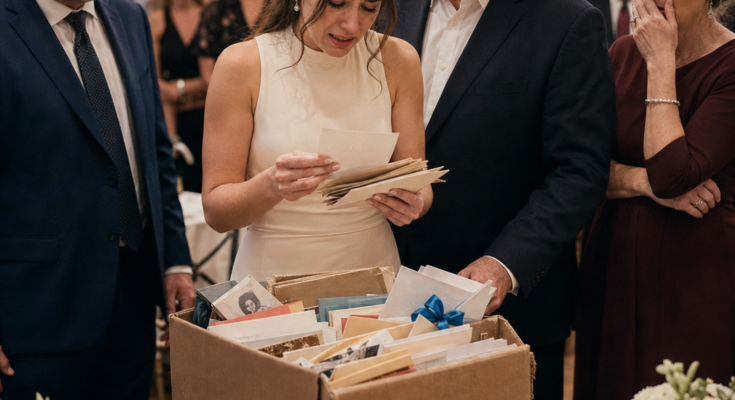
Inside were nineteen years of my daughter’s life.
Birthday cards.
Christmas presents.
Copies of airline reservations.
Receipts from child-support payments.
Photographs I had taken during the few visits Karen allowed.
And letters—dozens of them—still sealed.
I picked up the first envelope.
Emily’s eighth birthday.
The next was from Christmas that same year.
Then Valentine’s Day. Her ninth birthday. Her tenth.
Each envelope had been addressed correctly.
None had been opened.
“I asked Karen about them,” David said. “She said you used to send abusive letters and that she kept them to protect Emily.”
“Why didn’t you throw them away?”
“Because I opened one.”
He handed me a letter.
It was the one I had written after Emily’s twelfth birthday.
There was nothing abusive in it.
I told her about the stray cat living behind my apartment. I asked whether she still loved strawberry ice cream. I said I was proud of her spelling-bee trophy.
At the bottom, I had written:
I don’t know if you’re reading these, Emmy. But I will keep writing until you tell me to stop yourself.
David sat in the chair by the window.
“I should have told Emily when I found the box.”
“Why didn’t you?”
He stared at the floor.
“Because I was afraid of what the truth might cost me.”
He had spent nineteen years believing Karen’s story too.
She told him I was unreliable. That I avoided child support. That I only contacted Emily when I wanted to upset their family.
David had stepped in because he believed a little girl had been abandoned.
“I love her like my own daughter,” he said. “I didn’t want her to think everything we built was based on a lie.”
“It wasn’t,” I told him. “You were there. That part is real.”
He looked up.
“But I wasn’t the only father who wanted to be.”
The rehearsal dinner began at seven.
Karen sat at the center table, laughing with relatives. Emily was beside her, but she barely spoke.
I stayed near the back.
Halfway through dinner, Noah’s father raised his glass to give a toast.
Before he could begin, David stood.
“Emily, there’s something I need to show you.”
Karen’s smile disappeared.
“David, sit down.”
He carried the box to Emily’s table.
“What is that?” she asked.
David removed the first bundle of letters.
“These belong to you.”
Karen stood so suddenly that she knocked over her wine.
“This is inappropriate.”
“No,” David said. “What happened to her was inappropriate.”
The room went silent.
Emily picked up one of the envelopes.
She recognized my handwriting from the birthday card I had sent that year.
Then she began reading.
The first letter was from when she was eight.
She read the next one.
And the next.
Karen tried to take them from her, but Emily pulled the box closer.
“Did you hide these from me?”
“I was protecting you.”
“From birthday cards?”
“You don’t understand what he was like.”
I stepped forward.
“Then show her.”
Karen turned toward me.
“Show her the abusive letters,” I said. “Show her the unpaid child support. Show her the court order saying I couldn’t see my daughter.”
She opened her mouth.
Nothing came out.
I placed another folder on the table.
It contained copies of every support payment, every court filing, and every request for visitation my attorney had submitted.
Emily looked at her mother.
“You told me he stopped paying when I was ten.”
Karen began crying.
“I did what I thought was best.”
“No. Tell me why.”
“Because every time you came home from visiting him, you talked about him for days!”
Her voice echoed through the room.
“You wanted to call him. You wanted him at your games. You kept asking when he was moving closer. I was the one raising you while he got to be the exciting weekend parent.”
“So you made me believe he didn’t want me?”
“I was scared you would choose him.”
Emily stared at her mother as if she had never seen her before.
Then she looked at me.
Her face crumpled.
“Nineteen years,” she whispered. “You let me hate him for nineteen years.”
Karen reached for her.
Emily stepped away.
But the night wasn’t finished.
David removed one final envelope from the bottom of the box.
It was addressed to Emily in Karen’s handwriting.
And unlike the others, it had already been opened.
Part 3: The Man Who Walked Beside Us
The letter was dated three months after the divorce.
Karen had written it but never sent it.
It wasn’t addressed to the child Emily had been.
It was meant for the adult she would someday become.
David handed it to her.
Emily read silently at first. Then she covered her mouth.
“What does it say?” Karen whispered.
Emily looked up.
“You wrote that Dad never abandoned me.”
Karen sank into her chair.
The letter explained everything.
Karen admitted that I had asked for shared custody. She admitted that I had offered to relocate. She admitted that she moved to Tennessee after receiving a better job offer—and because she wanted distance between Emily and me.
She had apparently written the confession during a moment of guilt.
But she never gave it to our daughter.
“I couldn’t destroy it,” Karen said. “I thought one day I might be brave enough.”
“You weren’t,” Emily replied.
She left the dinner before dessert.
I found her sitting on a bench outside the hotel, still holding the first birthday letter.
I sat beside her but kept some distance between us.
“I’m sorry,” she said.
“You were a child.”
“I believed her.”
“You were supposed to believe your mother.”
“I said you hadn’t earned the right to walk me down the aisle.”
I swallowed the ache in my throat.
“You weren’t wrong about David. He raised you. You don’t have to take that away from him to give something back to me.”
She began crying.
“I don’t know you.”
“No.”
“What do we do now?”
“We start with something small.”
“Like what?”
“Coffee.”
She laughed through her tears.
“You waited nineteen years, and you’re asking me for coffee?”
“I’m trying not to overwhelm you.”
For the first time since she was seven, my daughter rested her head on my shoulder.
The wedding was scheduled for the following afternoon.
Karen did not attend.
She told relatives she was too humiliated to show her face. Emily replied that humiliation was not the same thing as accountability.
I expected to sit quietly in the third row.
A few minutes before the ceremony, however, David entered the small waiting room where I was fixing my tie.
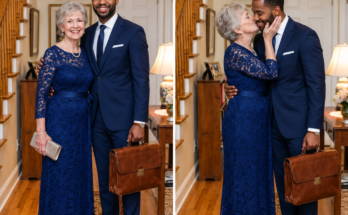
He was wearing a gray suit with a white rose pinned to the lapel.
“Emily needs us,” he said.
“Us?”
When the doors opened, Emily stood between us.
She took David’s arm with her left hand and mine with her right.
The guests rose.
I looked at David.
“I don’t want to take your place.”
He shook his head.
“You’re not taking it. We’re making room.”
So we walked her together.
David had been there for the scraped knees, softball games, school dances, and college applications.
I had been there in courtrooms, empty parking lots, unanswered letters, and the back row of an elementary-school auditorium.
Neither story erased the other.
At the altar, Emily hugged David first.
Then she held onto me for several seconds.
“I found the cat letter,” she whispered.
“You did?”
“Did you ever adopt him?”
“I did. He lived seventeen years.”
She smiled.
“We have a lot to talk about.”
“Yes, we do.”
After the wedding, Karen and David separated.
I didn’t celebrate their marriage ending. David was heartbroken, and despite everything, Karen was still Emily’s mother.
But David told me he could not stay with someone who had built their family by stealing another parent’s place in it.
Emily did not forgive Karen immediately.
She agreed to family counseling, but she set firm boundaries. No excuses. No rewriting what happened. No asking Emily to comfort her for the consequences of her own choices.
As for me, I began flying to Nashville once a month.
Emily and I drank coffee. We looked through old photographs. I told her about her grandparents, the camping trip she barely remembered, and the time she insisted on wearing rain boots to church.
She told me about high school, college, and the years I had known only through social-media photographs.
We could not recover the childhood that had been taken from us.
But slowly, we stopped letting the stolen years take the ones we had left.
The following Father’s Day, a package arrived at my house.
Inside was a framed wedding photograph.
Emily stood in the center, holding both our arms.
On the back, she had written:
One father raised me.
One father never stopped reaching for me.
I was lucky enough to find the truth before it was too late.
Below that was a reservation confirmation for two plane tickets.
Emily and Noah were coming to spend Christmas with me.
I placed the photograph beside the old picture of her dressed as a tree in The Wizard of Oz.
For nineteen years, that child had been frozen in my memory beneath green face paint and cardboard branches.
Now there was a new photograph beside it.
My daughter wasn’t looking away from me.
She was looking directly at the camera, smiling, while both her fathers stood proudly at her side.