Part One: The Question at the Table
My son pushed his chair back and looked at me like I was a bill he was tired of paying.
“Mom,” Daniel said, “when are you finally going to move out?”
I was passing dinner rolls at 6:18 p.m. when he said it. The ice in Renee’s water glass cracked once, sharp, like the room itself had split.
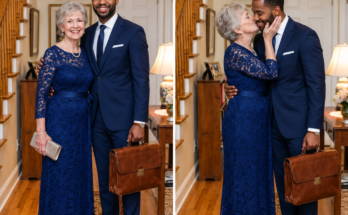
I’m Margaret Briggs, seventy-one. Two years earlier, my husband Harold died, and Daniel told me I shouldn’t live alone. “For a little while,” he said. So I sold my yellow kitchen, my rosebushes, the porch where Harold drank tea at sunrise, and moved into Daniel’s Scottsdale house — white cabinets, black fixtures, a spare room Renee called “the guest room” but told me not to move the chair in because “it photographs well.”
For two years I folded towels, packed lunches, drove the kids to soccer. I learned which pan Renee liked for eggs. That was the trust I offered them — access, help, silence, the soft parts of my grief.
Then a note beside the coffee maker replaced an invitation to brunch. Then, through a bedroom door: “She eats our food, uses our utilities, and contributes what exactly?” Daniel never corrected her.
The night he finally asked me to leave, my grandson stopped scrolling. The room froze the way families freeze when cruelty has finally been spoken out loud.
I set the basket down. I folded my napkin once, then again. “Excuse me,” I said.
What none of them knew: in February, at a gas station after a Medicare appointment, I’d bought a lottery ticket because the clerk smelled like cigarette smoke and cinnamon gum, and Harold used to say luck sometimes wore dirty shoes.
Monday morning, alone in the house, coffee gone lukewarm, I checked the numbers.
$89 million.
I didn’t scream. I folded the ticket into my Bible, between Psalms and a church bulletin Harold had saved.
Money doesn’t always make you louder. Sometimes it makes you careful. Sometimes it gives you the one thing nobody can take back: options.
That night, at 2:13 a.m., I wrote five lines in my nightstand notepad. Keep silent. Hire attorney. Claim privately. Separate assets. Find a home. Not a room. A home.
By 7:30 the next morning, I had three estate attorneys booked under my maiden name.
Part Two: The House on the Quiet Street
My attorney, Patricia Holloway, was sharp-eyed and calm enough to make panic feel unnecessary. Her first question: “Have you told anyone?”
“No.”
“Good. Keep it that way.”
Within days, the trust existed. The claim was filed privately. Every document Daniel might someday assume he had a right to had a wall built quietly around it before he even knew there was anything to want.
Then I saw the house. Four bedrooms, an east-facing sunroom, a real yard, a porch wide enough for morning tea — exactly the kind of house Daniel and Renee had described for years when they talked about their “next chapter.” More charm. Better neighborhood. More status.
I toured it alone. The front hall smelled of cedar and lemon oil. A brass key lay on the counter for the showing. I picked it up with two fingers and remembered who I’d been before grief taught me to ask permission for things.
The next morning, I made a full-price cash offer through the trust. Clean close. No Daniel. No Renee. No explanation.
By the end of that week, breakfast started appearing before I asked. Renee smiled too warmly. Daniel offered to run errands for me. The grandchildren were suddenly told to “spend more time with Grandma.”
Kindness that arrives that suddenly usually has paperwork behind it.
Saturday morning, Renee walked into my room without knocking, shut the door, and her eyes dropped to the envelope on my dresser — the brass key half-visible beneath my Bible.
“You bought a house?”
I placed my hand over the key.
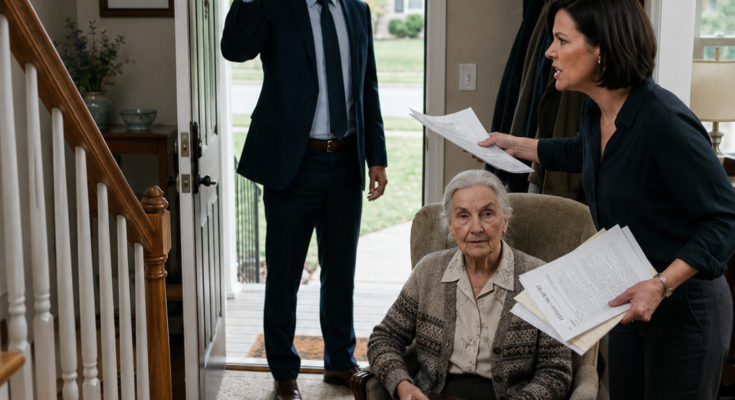
Then the doorbell rang. A man in a suit stood on the porch, a folder in his hand with Renee’s name printed on it.
Part Three: The Folder in His Hand
Daniel came down the stairs barefoot, still half-asleep. Renee stopped breathing through her nose entirely.
“Mrs. Renee Briggs?” the man asked. “I’m with Holloway & Associates. I have documents regarding a residency notice.”
I stepped into the hallway before either of them could ask another question. “It’s alright,” I told him. “I’ll explain.”
I invited him in, sat everyone at the same table where Daniel had asked when I’d finally be leaving, and laid out, calmly, exactly what Patricia and I had spent the past week building.
“I won the lottery in February,” I said. “Eighty-nine million dollars, claimed privately through a trust under my maiden name. I’ve purchased a house — the house, as it happens, that the two of you have described as your dream for years. It closed yesterday. It’s mine.”
Renee’s face went through several expressions before settling on something between disbelief and fury. “That’s — that house was listed at four-point-two million. You’ve had that kind of money this whole time? While I was buying groceries for you?”
“You were buying groceries for a woman raising your children five days a week,” I said. “I’ve calculated exactly what that labor was worth over two years, and I intend to compensate you for it fairly and separately, because I don’t believe in owing people quietly the way I was quietly owed for two years myself.”
Daniel finally found his voice. “Mom, why didn’t you just tell us? We’re your family.”
“Because three nights ago,” I said, “my own son asked me, at his dinner table, in front of his children, when I was finally moving out. I decided, somewhere around 2 a.m. that same night, that I wasn’t going to hand a fortune to people who’d made it clear they saw me as an expense rather than a mother.”
The folder the attorney had brought wasn’t for me. It was a formal notice, requested by Patricia at my direction, informing Daniel and Renee that any future financial assistance from me — the modest amounts I’d been quietly contributing toward groceries and utilities for two years, money they’d apparently never realized came from more than my Social Security — would need to be formally requested and reviewed, rather than assumed.
I moved into the new house the following week. Sunlight on old floorboards. A porch wide enough for morning tea, the way Harold used to take his.
Daniel and Renee’s relationship with me shifted slowly after that — not severed entirely, but rebuilt on considerably more honest footing, with actual boundaries instead of quiet resentment disguised as hospitality. I still see my grandchildren regularly, on my terms now, in a home that’s fully mine, where nobody tells me not to move the chairs.
I think about that dinner table sometimes — the cracked ice, the folded napkin, the exact moment I understood that I could either keep shrinking to fit the space they’d left me, or finally take up the room I’d earned.
I chose the room.
Sometimes the family that makes you feel smallest is simply waiting for you to remember you were never actually required to stay that size.
— The End —