PART 1
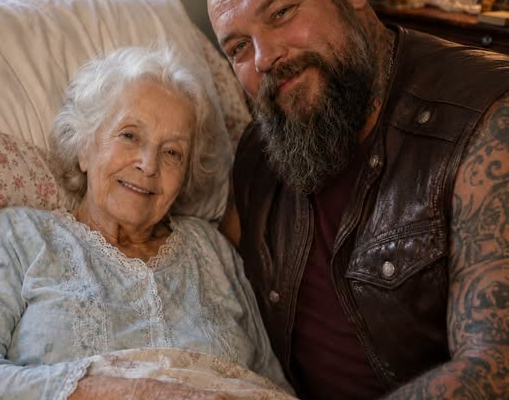
When I saw him for the first time, sitting beside my eighty-one-year-old mother’s bed, I thought I’d arrived too late in life.
A huge man in a black leather vest, tattoos from neck to fingertips, was feeding my mother soup with a spoon. And my mother was smiling at him in a way she hadn’t smiled at me in years.
“Mom… who is this man?”
“Margaret… you came back early.”
Those words pierced through me. For twelve years I’d been her caregiver — working days, sitting by her bed at night, washing her, feeding her, calling ambulances in the dark. My whole life had shrunk to the size of her room.
And now a stranger sat in the place I was supposed to be.
“I’ll be in the garden, Miss Margaret,” he said, and left. He knew my name. That frightened me more than anything.
“His name is Louis,” Mom said, watching him kneel in the garden through the window.
“Mom, you can’t bring a biker off the street into this house.”
“He will never hurt me,” she said, her voice suddenly hard as iron.
“How can you know that?”
She stayed silent. And in that silence, I understood something enormous was being hidden from me.
The weeks that followed were torture. Louis knew how she liked her tea, which songs made her cry. Every time I entered a room, they stopped talking.
One night, I found a small leather notebook in his jacket pocket, and beneath it, an old photograph — a young woman in a hospital gown, holding a newborn, her face turned away, only her shoulders visible.
Those shoulders looked familiar.
Three days later, my mother had a seizure. At the hospital, I finally confronted Louis in the hallway. “I’ll pay you three times what my mother gives you. Just leave.”
He handed me the leather notebook. “She asked me to stay silent. But I can’t anymore.”
“Sixty years ago, your mother had a baby. A boy. She was nineteen, unmarried, and her family forced her to give him up for adoption.”
The hallway started spinning around me.
PART 2
“You’re saying…” I could barely make my mouth form the words. “You’re saying you’re that baby?”
Louis nodded slowly, his enormous hands trembling around the edges of the notebook I now held. “I found out four years ago. A DNA test, one of those kits my daughter bought me for Christmas as a joke. I never expected it to actually connect me to anyone.”
He explained that the search had taken over a year — adoption records were sealed, and the trail nearly went cold twice before a distant cousin’s DNA match finally led him to our family name, and eventually to my mother.
“I didn’t come here as a caregiver by accident,” he admitted. “I found an ad she’d posted for in-home help. I applied under my own name, hoping, honestly not expecting anything to come of it. When she opened the door and saw my face, she went completely white. She knew immediately. She said I had her father’s eyes.”
“Why didn’t she tell me?” I asked, my voice breaking. “Why didn’t either of you just tell me?”
“She was terrified,” Louis said. “Not of me. Of you. She said she’d spent sixty years carrying the shame of what her family made her do, and she didn’t know how to tell her daughter that she’d had another child first, given him away, and never told anyone. She asked me for time. She wanted to know me first, quietly, before figuring out how to explain any of it to you.”
I sat down hard on a hospital bench, the notebook still in my hands. Inside, in careful, deliberate handwriting, was Louis’s own account of the search — dates, DNA matches, the moment he’d finally worked up the courage to knock on her door, and page after page of small, private observations about a mother he was only beginning to know. She hums when she thinks no one’s listening. She still remembers every word to a lullaby. I think she might have sung it to me once.
“She’s been trying to give both of us time,” Louis said quietly. “I don’t think either of you ever knew how much you needed her to.”
PART 3
I didn’t sleep that night, sitting beside my mother’s hospital bed while she rested, the leather notebook still on my lap. When she finally woke near dawn, weak but lucid, I didn’t wait.
“Louis told me,” I said simply.
She closed her eyes. For a long moment, I thought she might not answer at all. Then, slowly, she began to speak — the whole story, sixty years held tight, finally loosening.
She’d been nineteen, in love with a boy her parents considered beneath our family’s standing, and when she became pregnant, they’d sent her away to a home for unwed mothers three states over, told everyone she was studying abroad, and arranged the adoption before she’d even been allowed to hold her son for more than a few minutes.
“They told me it would be easier if I didn’t look at him too long,” she whispered. “They were wrong. I looked at him the whole time. I’ve never stopped seeing his face.”
She married my father two years later, had me, and carried the secret through every year of both our lives, terrified that telling me would mean admitting she’d once been forced into a decision that still haunted her every single day.
“When Louis showed up at my door,” she said, “I thought I was dreaming. I recognized him instantly. I know that sounds impossible, but I did.”
“Why didn’t you just tell me the truth from the beginning?” I asked. “Why let me think you’d replaced Brenda with a stranger, let me spend weeks feeling pushed out of my own mother’s life?”
“Because I was ashamed,” she said, tears finally falling freely. “Ashamed of what I did at nineteen, ashamed I never told you, and terrified that if I told you both at once, I might lose you both trying to explain something I still don’t fully understand myself.”
I sat with that for a long time, the anger and hurt of the past few weeks slowly reshaping itself into something far more complicated — grief for a decision made before I was even born, and something unexpectedly tender toward a brother I’d never known existed.
Louis stood quietly in the doorway throughout most of this conversation, giving us space, until my mother finally reached her hand toward him.
“Come here,” she said. “Both my children should be in this room.”
I looked at him — the tattoos, the leather vest, the enormous hands that had spent weeks feeding our mother soup with more patience than I’d managed in months — and understood, finally, why she’d smiled at him the way she had that first afternoon.
“I’m sorry,” I told him. “I tried to pay you to disappear.”
“You didn’t know,” he said simply. “I understand why you were scared. I would have been too.”
My mother recovered slowly over the following weeks, and the three of us built something none of us had expected — Louis moved into a spare room properly, no longer just “the caregiver” but her son, my brother, a huge, gentle man who turned out to have spent thirty years running a small motorcycle repair shop and raising two kids of his own, kids I met for the first time at a family dinner that felt, remarkably, like it had always been meant to happen eventually.
My mother passed away two years later, peacefully, with both her children beside her — the daughter who’d spent twelve years caring for her, and the son she’d spent sixty years quietly grieving. In her final weeks, she told me she’d never once regretted hiring Louis, only regretted taking so long to trust either of us with the truth.
I still have his notebook. I added a final page myself, after she passed, describing the family we became once the secret finally stopped being one — not despite the years of silence, but somehow, impossibly, because of the courage it eventually took to end them.
Sometimes the stranger who frightens you most is simply family you haven’t recognized yet — and sometimes the truth that terrifies you the longest turns out to be the thing that finally makes your family whole.
— The End —