Part One: The Boy Who Walked Ahead
For a long time, I told people I started boxing because I wanted to become stronger. That was true, but it wasn’t the whole truth.
My brother Luke was four years younger than me. He understood everything — every joke, every conversation, every look. But his body didn’t always obey him. His arms moved involuntarily. His words came out slow and broken, clear in his mind but unclear to anyone who didn’t know how to listen.
At home, I loved him completely. Outside, I became someone else — walking a few steps ahead when we ran into my friends, answering “is he your brother?” quickly and changing the subject.
Then came the afternoon three of my classmates imitated the way Luke walked, the sounds he made, laughing across the street. Luke stopped mid-sentence, grabbed my sleeve. “Ja… Jake… go… home…”
I said nothing. I just took his hand and walked us home as fast as I could.
That night, staring in the bathroom mirror, I understood I wasn’t crying because of what those boys did. I was crying because when Luke needed me most, my fear had been stronger than my love.
A week later, I walked into a boxing gym and told the coach, “I want to learn how not to run away when I’m afraid.”
Part Two: The Glove That Fit
Boxing didn’t teach me how to hit anyone. It taught me how to stay when every part of me wanted to run.
A year in, I hung a punching bag in our garage. Luke watched from the doorway, then pointed at my gloves, at himself, at the bag. His face lit up when he understood I’d caught his meaning.
I almost said no — afraid he’d fall, get hurt, get frustrated. Then I remembered how much I hated people who looked at Luke and decided, on sight, what he couldn’t do. I wasn’t going to be one of them.
His first punch missed entirely. His second nearly knocked him over. His third landed — a soft thump against the bag — and he froze, looked at it, looked at me, and celebrated so loudly Mom came running from the kitchen, certain something had gone wrong. Instead she found the two of us laughing, and she stood in the doorway and cried.
We trained every evening after that. I learned I couldn’t force his body to move like mine — I had to find the way his body could move. Some nights we repeated one motion twenty times. Some nights he got frustrated and hit the floor with his glove. I waited. “Nothing bad happened. Let’s try again.”
One evening I filmed us — Luke missing the bag, trying again, finally landing three small punches in a row. I posted it for one reason: for the first time in my life, I wanted to show my brother to the world without shame.
Part Three: The Message That Broke Me Open
By morning there were thousands of messages. One stopped me cold — a mother writing that her son, so much like Luke, had watched the video five times and started imitating the punches with his own hands that very morning. She asked if he could come to our garage. Just to watch.
I hadn’t planned on any of this. But the following Saturday, I opened the garage door to a boy named Dominic, nine years old, gripping his mother’s hand so tightly his knuckles had gone pale.
Luke saw him before I did. He didn’t hesitate the way I once had. He walked straight over, picked up the smallest pair of gloves from the shelf, and held them out.
Dominic looked at his mother, unsure. She nodded, blinking fast. He took the gloves.
It took him almost ten minutes just to get comfortable holding his hands up. Luke stood beside him the whole time, patient in a way I’d had to learn and Luke had simply always known, tapping his own glove against the bag to show him it was safe, that nothing bad would happen if he missed.
When Dominic finally landed a punch — small, off-balance, barely a tap — he didn’t celebrate the way Luke had. He just stood very still, staring at the bag like it had told him something he’d needed to hear his whole life.
His mother told me afterward, quietly, by the driveway, that it was the first time she’d ever seen another child treat her son like he belonged somewhere instead of like he needed to be managed.
That was the first Saturday. It wasn’t the last.
Part Four: What the Garage Became
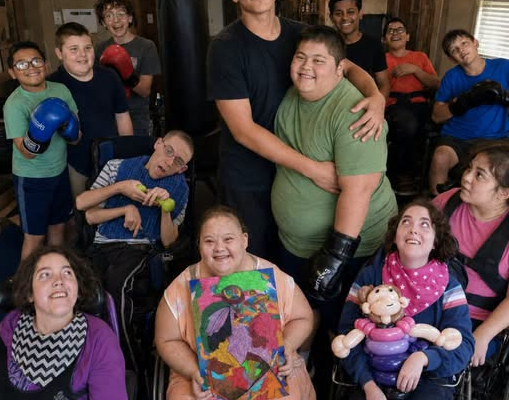
Word spread the way these things do — a shared post, a parent telling another parent, a pediatric therapist who found the video and asked if she could bring two of her patients. Within two months, our garage stopped being big enough. A local community center offered us a room three evenings a week, free of charge, once the director watched five minutes of Luke helping a seven-year-old girl named Priya find her balance.
I never called it a program. It never had a name until the parents started calling it one themselves — Luke’s Gym, even though I was the one holding the mitts and running the sessions. Luke was always the reason kids came in the door and, more importantly, the reason they kept coming back. He never once looked at a struggling kid the way I used to look at him from a few steps ahead. He only ever looked at them the way I’d finally learned to.
Almost a year after that first video, Luke and I were closing up one evening, gloves stacked, bag swinging slightly from the last kid’s final punch. He tugged my sleeve the way he had that day on the sidewalk, except this time his face wasn’t scared.
“Jake,” he said, slower than most words but clearer than I’d ever heard him say anything. “Why… you… hide me… before?”
I sat down on the old bench, and for a long moment I didn’t have an answer that felt big enough for what he’d actually asked.
“Because I was afraid of what people would think of me,” I finally said. “Not of you. Never of you. I was afraid of me.”
Luke thought about that for a while, the way he always did before he spoke, letting the words assemble themselves in whatever order his mind needed. Then he smiled — the same smile from the day his glove first touched the bag — and rested his head against my chest, exactly like he used to when we were kids on the couch and I’d said something stupid enough to make him laugh with his whole body.
“Not… afraid… now,” he said.
“No,” I said. “Not anymore.”
Some of the bravest fights I’ve ever been part of never happened inside a ring. They happened in a garage, in gloves two sizes too big, in a brother who’d been waiting years for me to stop walking ahead of him and finally just walk beside him instead.
— The End —
(This is a work of fiction, inspired by real stories of siblings and disability advocacy.)