PART 1
My daughter-in-law Khloe walked into my kitchen that Saturday and announced, “Harper and Sloan are moving in today. Rent-free, obviously.”
Behind her, my son Caleb stared at the tile floor.
I was sixty-five. My late husband David and I had spent thirty years paying off that house, turning the backyard into what he called our retirement kingdom. Caleb and Khloe had moved in a year earlier — “just six months,” Caleb promised. Twelve months later, they’d paid no rent, bought no groceries, and unfamiliar charges had started appearing on my credit card.
“Where will Harper and Sloan sleep?” I asked.
“They need the larger room,” Khloe said. “Yours makes the most sense. You barely use it during the day. You can sleep on the couch.”
I turned to Caleb. “Do you agree with this?”
“Mom, it’s temporary,” he muttered, not meeting my eyes.
No objection. No apology.
Something inside me went perfectly still. “All right,” I said.
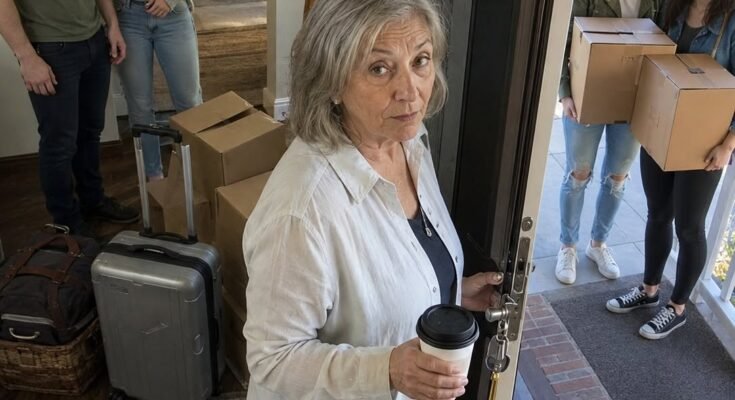
Khloe brightened instantly. “The girls and I are going to brunch. We’ll start bringing boxes over this afternoon.”
The moment their SUV backed out of the driveway, I picked up my phone.
My first call was to an emergency locksmith. “I need the front and back locks replaced today.”
“Did you lose your keys?” the dispatcher asked.
“No. I’ve finally found them.”
My second call was to a same-day moving company — professional, careful, full inventory, nothing damaged or discarded.
By early afternoon, the movers had carefully packed and removed every last thing belonging to Caleb and Khloe. I paid three months in advance on a climate-controlled storage unit and taped the key, the receipt, the address, and a full inventory inside a document sleeve to the front-door glass, right at eye level.
Then I cleaned the floors, opened the windows, and made tea.
At 4:15, my phone started buzzing. The key won’t turn. Then it wouldn’t stop. Where is our stuff?
I let it ring for a while. Then I answered.
PART 2
“Mom, what is going on?” Caleb’s voice cracked through the phone, half panic, half fury. “Our stuff is gone. The locks are changed. Khloe’s losing her mind.”
“There’s an envelope taped to the glass,” I said. “It has the storage facility’s address, a key, and a full inventory of everything the movers packed. Nothing was damaged. Nothing was thrown away.”
“You can’t just lock us out of our own house.”
“It’s not your house, Caleb,” I said. “It never has been. It’s mine. I let you and Khloe stay in it out of love, and I let that love get quietly mistaken, over the last year, for an arrangement neither of you ever actually asked me about.”
I could hear Khloe in the background, her voice rising sharply, demanding the phone. Caleb didn’t hand it over.
“This is insane,” he said. “Where are we supposed to go? Harper and Sloan are standing right here with their suitcases.”
“I imagine that’s a conversation for the four of you,” I said. “It’s not one I’m responsible for solving.”
“You’re really doing this over a bedroom?”
“I’m doing this,” I said, “because this morning, in my own kitchen, my daughter-in-law told me where I’d be sleeping in my own house, and you stood there and let her. That wasn’t about a bedroom, Caleb. That was the moment I understood exactly how much this last year had quietly become.”
There was a long silence on the line.
“I didn’t think you’d actually—” he started.
“I know,” I said. “That’s rather the point. Nobody in that kitchen this morning thought I’d do anything at all. You’ve all gotten very comfortable with that assumption.”
I told him the guest room at his Aunt Rosalind’s, forty minutes away, might be available if he called her directly and explained things honestly — not the version Khloe would tell, the real one. I told him I loved him, that this wasn’t about erasing him from my life, but that the house needed to go back to being mine, fully, starting today.
PART 3
Caleb didn’t call Rosalind that night, at least not that I know of. He and Khloe ended up at a motel off the highway, Harper and Sloan going their own separate direction once it became clear the “permanent sleepover” they’d been promised had evaporated before it ever started.
The messages continued for several days — Khloe’s furious, accusing me of “elder cruelty” and threatening, at one point, to call the police to report I’d stolen their belongings, a claim that fell apart the moment I calmly explained I had a professional, itemized inventory and a paid storage receipt with both their names listed as authorized to retrieve everything, undamaged, whenever they chose.
Caleb’s messages were different — quieter, more searching, the anger giving way within a few days to something that read more like genuine confusion about how he’d let an entire year slip by without once asking himself the questions I’d apparently been the only one asking.
He came by alone, five days later, without Khloe, and knocked instead of trying his old key. I let him in, made two cups of coffee, and we sat at the kitchen table where all of this had actually started.
“I don’t know how it got that far,” he admitted. “Letting her decide things about your house like it was ours to give away. I told myself I was keeping the peace. I think I was just avoiding a fight I didn’t want to have with her.”
“You avoided it with her,” I said, “by having it with me instead, without ever saying a word.”
He didn’t have an argument for that. We talked for almost two hours — about the year, about David, about what it had actually cost me quietly covering utilities and groceries and unexplained credit card charges while telling myself it was temporary, the same word he’d used to describe an arrangement that had clearly stopped being temporary the moment nobody bothered to revisit it.
Caleb moved into a small apartment three weeks later, on his own, taking a second job to cover the deposit rather than asking me for help, a choice I hadn’t demanded but noticed, and appreciated, more than he probably realized. Khloe, from what I understand through mutual family, moved in with one of her sisters. Caleb and I still don’t fully know, or discuss, what became of that relationship, and I’ve decided I don’t need the details.
He visits now, regularly, on his own terms and mine — dinner most Sundays, sometimes just coffee on a weeknight. He asked me once, a few months later, whether I’d actually meant it, that morning in the kitchen, when I said “all right” so calmly that Khloe mistook it for surrender.
“I meant every word,” I told him. “I just didn’t mean the version she thought I meant.”
The house is quiet again now, in the good way, the way David and I always meant for it to be — full of sunlight and space that belongs to exactly the person whose name is on the deed. I still keep that photograph of the two of us on the lawn, the day we made the final mortgage payment, hanging exactly where it’s always been.
Some lessons, I’ve learned, don’t require raised voices at all. Sometimes the calmest word you say is the one that changes everything — because the people who assumed your silence meant surrender never once considered what you might quietly do with your keys.
— The End —