Original Fiction: This story is fictional. Names, characters, dialogue, locations, and events were created for storytelling purposes.
PART 1 — THE NOTE BEHIND THE GLASS
The package in my hand weighed almost nothing.
So had the one I delivered the day before.
And the one before that.
By the middle of December, I had brought Thaddeus Harper nine flashlights, four pairs of reading glasses, three packs of pens, two bottle openers, and a single pair of brown socks.
At first, I assumed the old man was forgetting what he had ordered.
I was wrong.
Thad remembered every package.
He simply wasn’t buying what was inside them.
I discovered that on a freezing Tuesday afternoon while standing outside his little white house on Elm Street, forty-three deliveries behind schedule.
Rain struck the roof of my truck like handfuls of gravel. My boots were soaked, my gloves were useless, and the scanner clipped to my belt kept flashing red.
ROUTE DELAY: 47 MINUTES
Dispatch had already called twice.
The first call had been polite.
The second had not.
I grabbed Thad’s package from the shelf behind my seat and ran toward his porch with my head lowered against the wind.
I knew the house well.
More importantly, I knew the man who lived inside it.
Thaddeus Harper was eighty-two years old, a retired mechanic with silver hair, thick glasses, and hands permanently darkened by decades of grease that no amount of soap had ever completely removed.
His wife, Margaret, had died four years earlier. Their only son had been gone even longer.
Thad lived alone.
When I first took over the route that spring, he waited for me on the porch almost every afternoon. He wore a collared shirt tucked neatly into brown trousers, even when the temperature climbed above ninety.
Beside his chair, he kept a small table with something he had decided I needed.
A bottle of cold water in June.
Lemonade in July.
A peach from the farmers’ market in August.
Butterscotch candies when the weather turned cool.
“Delivery people keep the world moving,” he told me once. “The least the world can do is offer them a drink.”
Back then, my route was lighter.
I had time to lean against the railing and listen while he told me about rebuilding old Chevrolets, meeting Margaret beside a broken Ferris wheel, or ruining their first Thanksgiving turkey so badly that they ate peanut-butter sandwiches instead.
Those conversations rarely lasted more than five minutes.
But on difficult days, they were the best five minutes of my shift.
Then the holiday season arrived.
Our package count nearly doubled. Management began tracking every stop through GPS. If the truck remained in one place too long, dispatch called.
Two minutes per delivery.
That was the new target.
Two minutes to park, find the package, scan it, reach the door, take a photograph, and leave.
There was no time for lemonade.
No time for old stories.
No time for Thad.
At first, I still knocked.
Whenever he opened the door, his face brightened.
“Got a minute, Kaelen?”
I hated telling him no.
So eventually, I stopped giving him the opportunity to ask.
I began approaching his house quietly. I left each package behind the flowerpot, photographed it, and hurried back to my truck before he could reach the door.
Sometimes the living-room curtain moved.
Once, I saw his shadow standing behind it.
I told myself he understood.
Everyone became busy during the holidays. He had lived through eighty-two of them. Surely he knew how life worked.
But the packages kept coming.
Cheap, unnecessary things that could not possibly be worth the shipping cost.
Nearly every day, another small box appeared on my truck with Thad’s address printed across the label.
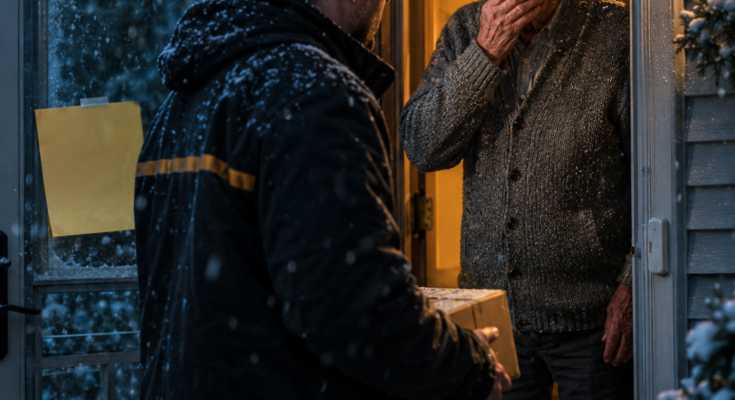
That Tuesday, as I bent to place his latest package on the mat, I noticed a piece of yellow paper taped inside the storm door.
My name was written across the top.
The handwriting was shaky.
I stepped closer and read it through the glass.
Kaelen,
I hope you’re keeping warm.
I should probably admit that I don’t need most of the things I’ve been ordering.
I kept thinking one of the packages might give you a reason to knock again.
Please don’t feel guilty. I know you’re busy.
Drive safely, kiddo.
—Thad
For several seconds, the rain, the traffic, and the angry beeping of my scanner seemed to disappear.
I looked down at the small box in my hand.
Thad had not been buying flashlights.
He had been buying the sound of footsteps on his porch.
He had been buying the possibility that someone might say his name.
And I had left every one of those possibilities outside.
I thought about my grandfather, who lived almost a thousand miles away.
He had called me three times that month.
I had sent every call to voicemail.
I always intended to call back when work became less hectic, when I was less tired, when life finally slowed down.
But life never slowed down.
It simply taught people to stop waiting for you.
My scanner beeped again.
This time, I switched it off.
Then I raised my fist and knocked.
Nothing happened.
I knocked again.
“Thad?”
The terrible thought arrived before I could stop it.
What if the note had been there for days?
What if I had been so busy photographing packages that I had failed to notice something worse?
Then I heard the scrape of a chair.
Slow footsteps crossed the living room. The deadbolt turned, and the door opened a few inches.
Thad stood behind it wearing a thick wool cardigan. He looked smaller than he had in summer. His cheeks were pale, and one hand gripped the doorframe.
But when he saw me, a smile slowly spread across his face.
“Well,” he said, “I was beginning to think you’d forgotten how doors worked.”
I tried to smile, but my throat tightened.
“I’m sorry, Thad.”
His expression softened.
“For what?”
“For avoiding you. For leaving all those packages outside. For making you order things you didn’t need.”
He glanced at the yellow note.
“I suppose it was a foolish way to get someone’s attention.”
“No,” I said. “It wasn’t foolish.”
I handed him the box.
Then, despite the forty-three deliveries waiting on my truck, I asked the question I should have asked weeks earlier.
“Do you have coffee?”
Thad opened the door wider.
His eyes were shining.
“Kid,” he said, “I’ve had coffee ready since October.”
PART 2 — TWO MUGS
Thad’s house smelled of coffee, furniture polish, and the cinnamon candles Margaret had once loved.
Two mugs were waiting beside the coffee maker.
Not one.
Two.
I looked at them, then at Thad.
He gave a small shrug.
“Habit.”
He poured instant coffee into both mugs and carried them to the kitchen table.
Four chairs surrounded it, but only one appeared to be used regularly. The others were pushed in perfectly, as though the people who once sat there might return if nothing was disturbed.
For the first few minutes, neither of us spoke.
The silence inside that house felt different from ordinary silence.
I could hear the refrigerator humming, the pipes clicking inside the walls, and the slow ticking of a clock in the hallway.
It was not peaceful.
It was the sound of a house waiting for someone.
Thad pointed toward the package I had placed on the table.
“What did I buy this time?”
“Probably another flashlight.”
“I already have nine.”
“That has never stopped you before.”
He opened the box.
Inside was a small plastic magnifying glass.
Thad held it up and examined me through it.
“Good news,” he said. “You look even more tired when magnified.”
I laughed.
He laughed too.
And just like that, we began talking again.
He asked about my mother. I asked about his mechanic shop. He told me Margaret used to complain that he came home smelling like motor oil.
“When I started wearing cologne, she complained about that too,” he said.
“Maybe she just enjoyed complaining about you.”
“It was her favorite hobby.”
Behind him hung an old photograph.
A much younger Thad stood beside a smiling woman in a summer dress. Between them was a little boy holding a red wooden truck.
“Is that your son?” I asked.
The warmth in Thad’s face changed.
“My boy, Daniel.”
“Does he live nearby?”
Thad stared into his coffee.
“He died when he was twenty-nine.”
“I’m sorry.”
“Drunk driver.” His thumb moved slowly around the rim of his mug. “Margaret and I never had another child.”
I did not know what to say.
There are moments when words do not comfort anyone. They only prove that silence makes you uncomfortable.
So I waited.
After a while, Thad looked up at the photograph.
“You reminded me of him when I first met you.”
I shifted in my chair.
“Is that why you always waited for me?”
“At first, perhaps.”
He looked directly at me.
“But after a while, you reminded me of yourself.”
I did not understand.
Thad nodded toward the front window.
“You eat lunch alone in your truck.”
“How do you know that?”
“I have windows.”
I smiled faintly.
“You rush all day. You apologize whenever your phone rings. You look at it like you’re afraid someone might need something from you.”
His voice was gentle, but the words landed harder than I expected.
“That doesn’t mean I’m lonely.”
“No,” Thad said. “But lonely people get very good at recognizing one another.”
I lowered my eyes.
Until that moment, I had believed Thad was the only one waiting for those deliveries.
I had imagined myself as the busy young man being inconvenienced by an old man’s need for conversation.
But Thad had seen something I had not.
I was twenty-eight years old, lived alone, ate most meals in my truck, and had trained everyone who loved me not to expect an answer when they called.
“You saw me avoiding you,” I said.
Thad gave a quiet nod.
“I saw.”
“And you still left that note telling me not to feel guilty?”
“Guilt is a poor reason to sit with someone.”
My scanner began vibrating inside my jacket.
Dispatch.
I ignored it.
“You should go,” Thad said.
“I can stay a few more minutes.”
He shook his head.
“No. I got what I wanted.”
“What was that?”
“To know you were all right.”
He had ordered packages for weeks because he wanted me to knock.
Yet when I finally sat at his table, the first thing he worried about was me.
Before leaving, I programmed my personal number into his cordless phone.
“Call if you need anything.”
Thad studied me over the top of his glasses.
“Do you answer this number?”
The joke hurt because I deserved it.
“I’m trying to get better at that.”
I completed my route almost two hours late.
The next morning, my supervisor called me into his office.
“You were parked at one address for twenty-six minutes.”
“Yes.”
“Was there a delivery problem?”
“No.”
“Vehicle trouble?”
“No.”
“Then what were you doing?”
I considered inventing an explanation.
Instead, I said, “Having coffee.”
He stared at me as if I had confessed to abandoning the truck in a river.
I received a written warning.
The following day, I took my lunch break at Thad’s house.
At 12:15, I carried my lunchbox onto his porch and knocked.
He opened the door immediately.
“I thought coffee was a one-time apology,” he said.
“I brought sandwiches.”
“That changes everything.”
From then on, I spent most weekday lunches with him.
Thad stopped ordering flashlights.
We ate sandwiches on the porch when the weather was warm and at the kitchen table when it was cold.
Some days he talked about old cars.
Some days he talked about Margaret.
Some days we sat quietly.
The silence no longer felt heavy.
It felt shared.
I began bringing groceries on Sundays. Thad helped me replace the brake pads on my car, although he spent most of the afternoon sitting on a stool and announcing that I was holding every tool incorrectly.
He also made me call my grandfather.
The first time, I tried to make the call from my car.
Thad tapped on the window.
“No hiding.”
So I sat at his kitchen table while my grandfather answered.
“Kaelen?”
The surprise in his voice made me ashamed.
“Hey, Grandpa.”
We spoke for almost an hour.
Afterward, Thad placed a mug of coffee in front of me without saying anything.
Nearly a year passed.
Then, on a freezing morning in January, I turned onto Elm Street and saw an ambulance outside Thad’s house.
His front door stood open.
The yellow porch light was still burning.
And his chair was empty.
PART 3 — THE FINAL DELIVERY
I left my truck running and rushed toward the house.
A paramedic met me at the porch.
“Are you family?”
The question stopped me.
Legally, I was not.
There was no shared name, no shared blood, and no document that explained what those lunches had come to mean.
“I’m his delivery driver,” I said.
The words sounded painfully small.
Then I corrected myself.
“I’m his friend.”
Thad had fallen in the kitchen during the night and broken his hip. He had managed to reach the telephone, but he had been on the floor for several hours before help arrived.
At the hospital, I found him pale and exhausted beneath a thin blanket.
He opened his eyes when I entered.
“You’re late,” he whispered.
“For what?”
“Lunch.”
I pulled a flattened sandwich from my jacket pocket.
“I brought one.”
He laughed, then winced.
During his recovery, I visited whenever I could.
Without Thad on my route, Elm Street felt strangely empty. I still slowed outside his house at 12:15. Sometimes I parked beside the curb and ate alone in the cab.
A month later, he called from the rehabilitation center.
“I need a favor.”
“What do you need?”
“There’s a box on the top shelf of my bedroom closet. Blue lid. Bring it to me.”
The box was heavy and covered in dust.
Inside were photographs, Margaret’s handwritten recipes, Daniel’s school drawings, old birthday cards, and envelopes tied together with faded string.
At the bottom was a small wooden truck with chipped red paint.
When I brought the box to the rehabilitation center, Thad lifted the toy carefully.
“I made this for Daniel when he was five.”
“It’s beautiful.”
“It’s crooked.”
“That too.”
He smiled, but his eyes had filled with tears.
Then he held the truck out to me.
“I want you to have it.”
I did not take it.
“Thad, I can’t.”
“You can.”
“It belonged to Daniel.”
“I know.”
“Then you should keep it.”
Thad looked down at the truck.
“For years, I kept everything exactly where Daniel left it. I thought putting something away meant I was protecting the memory.”
His thumb moved over one of the wooden wheels.
“But memories aren’t meant to be locked in boxes. They’re meant to be carried by someone.”
He placed the truck in my hands.
“I know you aren’t Daniel,” he said. “And I’m not trying to make you into him.”
His voice trembled.
“But somehow, without either of us planning it, you became family.”
I sat beside his bed holding the little wooden truck.
Then I leaned forward and hugged him.
Thad held on tightly.
He returned home two months later.
He walked with a cane and moved more carefully, but every weekday at 12:15, he was back on the porch waiting for me.
Our lunches continued.
That December, almost two years after I found the yellow note, Thad gave me a sealed envelope.
“Open it on Christmas.”
“What is it?”
“If I told you, envelopes would have no purpose.”
On Christmas morning, I opened it at my kitchen table.
Inside was a letter.
Kaelen,
You still believe you rescued a lonely old man.
That is the only part of our story you have misunderstood.
Yes, I ordered those ridiculous things because I hoped you would knock.
But I did not only miss your company.
I saw a young man racing through every day as though stopping would give life time to catch him.
I saw you eating alone.
I saw you staring at your ringing telephone and putting it away.
I recognized you because I had spent years doing the same thing after Daniel died.
You thought I needed someone.
The truth is, we needed each other.
Thank you for finally knocking.
—Thad
Beneath the letter was another sheet of paper.
At the top, Thad had written:
People on your route who may need a knock.
There were seven names.
Mrs. Patterson, whose husband had died that spring.
Mr. Lee, whose children lived overseas.
Miss Evelyn, who still ordered cat food months after her cat died because the delivery driver was one of the few people who came to her door.
Thad had noticed all of them.
Even while feeling forgotten himself, he had been watching for others who might feel the same way.
So I began knocking.
Not at every house.
Not for twenty minutes.
Sometimes only long enough to hand over a package and say someone’s name.
“Good morning, Mrs. Patterson.”
“How is your knee today, Mr. Lee?”
“Cold out here, Miss Evelyn. Are you keeping warm?”
My route did not collapse.
The world did not stop because I spent thirty extra seconds treating someone like a person.
I still drive the same route.
Every weekday at 12:15, I park outside the little white house on Elm Street.
Thad is eighty-four now. He misplaces his glasses, complains about my driving, and insists that sandwiches taste better when cut diagonally.
Some days we talk about old cars.
Some days we talk about Margaret and Daniel.
Some days we do not speak at all.
I also call my grandfather every Sunday evening.
I no longer send him to voicemail.
For a long time, I believed Thad had ordered those packages because he wanted someone to deliver something to him.
But that was not what happened.
The most important delivery went in the opposite direction.
Thad gave me a place to stop.
A person to call.
A reason to look beyond the labels and barcodes in my hands.
My job is to deliver things people need.
Most of them arrive sealed inside cardboard boxes.
But the most valuable things I have ever delivered had no tracking numbers.
A twenty-minute lunch.
A remembered name.
A knock on a quiet door.
And the simple reminder that sometimes the person we stop to save is the person who has already begun saving us.