Part One: The Line at My Gate
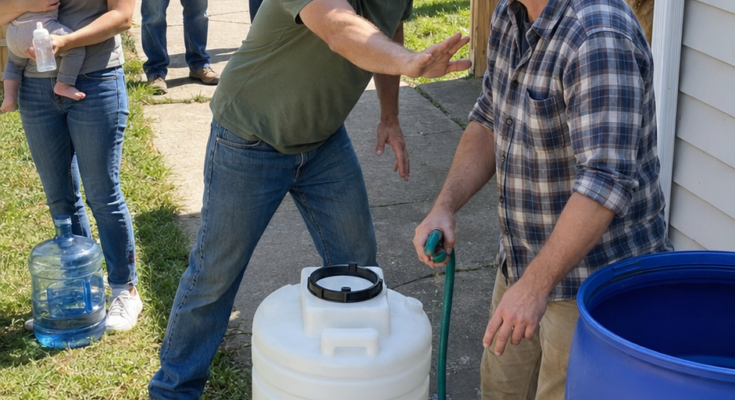
The woman at my back gate was holding an empty baby bottle in one hand and a five-gallon bucket in the other.
“Which tank is safe for drinking?” she asked. “The white one or the blue one?”
I stopped walking.
“Who told you either tank was available?”
She looked embarrassed.
“Your brother said you had more than two hundred gallons. He posted that anyone who needed water could come by.”
Behind her, four more people stood beside the alley with buckets, cooking pots, and plastic storage totes. One man had backed a pickup against my fence and was unloading two thirty-gallon trash cans.
Then I saw my brother, Evan, beside the shed.
He had connected a garden hose to the blue rain barrel.
“Turn that off!” I shouted.
Everyone looked at me.
Evan closed the valve, but not before water ran across the driveway and pooled around his shoes.
“What’s your problem?” he asked.
“That is rainwater.”
“I know.”
“It is not drinking water.”
“It goes through a screen.”
“A leaf screen. It keeps twigs out. It doesn’t make roof runoff safe to drink.”
The woman looked down at her baby bottle.
“Your brother said it was filtered.”
“It is screened for garden use and toilet flushing,” I said. “Please don’t use it for formula.”
Evan crossed his arms.
“You’re making it sound like sewage.”
“I’m saying water collected from a roof can contain bird droppings, insects, roofing residue, dirt, and anything else that landed up there.”
“But it looks clean.”
“So does water with bacteria in it.”
The city had issued a boil-water advisory the previous afternoon after a construction crew ruptured a major water main. Pressure dropped across three neighborhoods, and officials warned that contaminants might have entered the system.
Most people expected the advisory to last a few hours.
Then the city announced that replacement parts would not arrive until the next morning.
Stores sold out of bottled water before sunset.
By breakfast, the neighborhood group was filled with people asking where they could find drinking water.
I had prepared for exactly that kind of problem.
Inside my garage were twelve sealed seven-gallon containers filled with treated municipal water and labeled with the month they had been stored. In a dark closet inside the house, we kept several cases of bottled water for immediate use.
The white tank beside the shed held another sixty gallons of potable water. It was food-grade, opaque, protected from sunlight, and fitted with a dedicated drinking-water hose that was stored off the ground.
The blue barrels served a different purpose.
They collected roof runoff for the vegetable garden, emergency toilet flushing, and cleaning tools. Each barrel was marked in large black letters:
NON-POTABLE — DO NOT DRINK
Evan had placed his jacket over the nearest label.
“Why did you cover the warning?” I asked.
“I didn’t cover anything. I hung my jacket there.”
“Directly over the words ‘Do Not Drink.’”
“It was cold.”
The woman with the baby bottle began stepping away.
“Wait,” I said. “I can give you safe water.”
I brought her inside and filled two clean containers from our potable supply. She tried to pay me, but I refused.
The others received smaller amounts—enough for drinking and basic food preparation until the city’s distribution point opened that afternoon.
The man with the trash cans was less understanding.
“I drove over because the post said there was plenty,” he said.
“There isn’t enough to fill sixty-gallon containers for one household.”
“That’s false advertising.”
“I didn’t advertise anything.”
He looked at Evan.
Evan suddenly became fascinated by the hose nozzle.
After everyone left, I found the post on his phone.
If anyone near Oak Ridge needs emergency water, my brother has over 200 gallons stored. Bring your containers. Nobody should go without when some people have more than enough.
The post included my address, a photograph of both tanks, and a sentence claiming the rain barrels were connected to a “natural filtration system.”
There were already forty-three comments.
“Take it down,” I said.
“People need help.”
“Then you should have asked me what was safe before inviting strangers to drink roof water.”
“You have all this prepper equipment, but the minute there’s an emergency, you start guarding it.”
“I just gave water to six families.”
“Only after I made you.”
“No. You created a crowd without knowing how much water was drinkable, how long the outage would last, or what each family actually needed.”
Evan shook his head.
“You always do this. Everything has a label, a schedule, a rule.”
“That is why the water is still safe.”
Our mother stepped into the garage before he could answer.
She was seventy-four and had been staying with me since hip surgery. She leaned on her cane and looked from Evan to the containers lining the wall.
“How much drinking water do we have left?” she asked.
“Enough if we manage it.”
Evan laughed bitterly.
“There it is. Manage it.”
Mom looked at him.
“Your brother has four people and a dog in this house. How much did you store at your apartment?”
Evan didn’t answer.
He had arrived the night before carrying two empty sports bottles and half a case of soda.
Mom turned around and went back inside.
I removed Evan’s post and replaced it with accurate information: the location and opening time of the city distribution center, the boil-water instructions from the utility department, and an offer to help elderly or disabled neighbors transport water.
Then I locked the valves on both outdoor tanks.
I thought that ended it.
At eleven that night, I woke to the sound of a small electric pump running behind the garage.
Through the bedroom window, I saw Evan standing between the tanks.
A hose ran from the blue rain barrel to the opening at the top of the white potable-water tank.
He wasn’t giving away the rainwater anymore.
He was pumping it into our drinking supply.
Part Two: The Water We Could No Longer Trust
I reached the shed before Evan could disconnect the hose.
“What did you do?”
He switched off the pump.
“The white tank was getting low.”
“So you filled it with roof runoff?”
“I was going to add bleach.”
“How much?”
He hesitated.
“I was going to look it up.”
My anger disappeared for a second.
What replaced it was worse.
“You contaminated the entire tank before knowing how to treat it?”
“Contaminated is a dramatic word.”
I opened the white tank’s inspection cap. The water level was almost at the top.
Earlier that evening, it had been less than half full.
Evan had transferred roughly thirty gallons of untreated rainwater into the potable supply.
The hose he used was the same ordinary garden hose that lay beside the compost pile. One end had been resting on the ground.
“This water was for Mom,” I said.
“We can boil it.”
“We can probably make some of it usable with proper treatment, but we no longer get to assume it’s safe. You turned a reliable drinking supply into questionable water because the tank looked half empty.”
“You were rationing it like we were crossing a desert.”
“We don’t know how long the advisory will last.”
“It’s a broken pipe.”
“It’s an emergency when clean water stops coming out of the tap. The cause doesn’t change what our bodies need.”
Evan stared at the tank.
For the first time, he seemed to understand that water storage wasn’t about owning the largest container. It was about keeping a known supply protected from an unknown one.
I labeled the white tank DO NOT DRINK — TREAT BEFORE USE.
The mixed water could still be used for toilets, washing, and other non-consumption needs. With appropriate filtration and disinfection, we might reclaim some for drinking, but I would not serve it to Mom—or anyone else—without careful treatment.
We counted our remaining sealed water.
Eight seven-gallon containers.
Three cases of bottles.
Several one-gallon jugs in the pantry.
Enough for disciplined drinking and cooking, but no longer enough to distribute casually if the advisory stretched for days.
At six the next morning, the city announced that repairs had been delayed again.
The advisory would remain in effect for at least another forty-eight hours.
Evan read the alert twice.
“Okay,” he said quietly. “I made this worse.”
“Yes.”
“I was trying to replace what I gave away.”
“You don’t fix one mistake by hiding another one inside a clean tank.”
He sat on the garage step.
“What do we do now?”
It was the first useful question he had asked since the water main broke.
We started with an inventory.
We calculated drinking and cooking needs for four adults and a dog. We separated the sealed potable containers from the questionable water. We filled buckets with contaminated tap water for toilet flushing and marked them clearly.
Then we made a list of neighbors who might have difficulty reaching the distribution center.
Mrs. Alvarez lived alone and no longer drove.
Mr. Bennett used a walker.
The woman with the baby had no car until her husband returned from work.
Evan volunteered to make the deliveries.
At the distribution center, workers placed sealed cases of water into my truck. Each household received a limited allocation. The system was slow, but it was organized, and everyone knew the water was safe.
Evan spent the morning carrying cases to porches.
That afternoon, he deleted his original post and wrote a new one.
Correction: The blue tanks pictured yesterday contain untreated roof runoff and are not safe to drink without proper treatment. I mistakenly described them as filtered drinking water. Please do not use collected rainwater for drinking or infant formula just because it appears clear. The city distribution center is open until 7 p.m. Message me if you need help collecting your allocation.
He showed it to me before publishing it.
“Add that boiling does not remove every possible chemical contaminant,” I said. “Rainwater safety depends on the roof, collection system, maintenance, and treatment method.”
He added it.
By evening, he had delivered water to nine households.
Nobody arrived at my gate carrying a trash can.
The advisory ended two days later. We flushed the household plumbing according to the city’s instructions and replaced the refrigerator filter.
I drained the compromised white tank into the garden and cleaned and sanitized it before refilling it with potable water.
Evan helped with every step.
He scrubbed the tank, replaced the old garden hose with a drinking-water-safe hose, and installed separate color-coded fittings so the rainwater equipment could not easily be connected to the potable system again.
When we finished, he handed me two new signs.
The white one read:
POTABLE WATER — CLEAN EQUIPMENT ONLY
The blue one read:
RAINWATER — TREAT BEFORE ANY HUMAN CONSUMPTION
Three months later, Evan sent me a photograph from his apartment.
He had stored fourteen gallons of drinking water in two food-grade containers. Each one was labeled with the filling date. Beside them sat a basic gravity filter, unscented household disinfectant, and a printed page of emergency water instructions.
It wasn’t two hundred gallons.
It didn’t need to be.
It was safe, documented, and entirely his responsibility.
That was the lesson the broken water main taught both of us.
Generosity matters during an emergency—but generosity without knowledge can create a second emergency before the first one is over.
Preparedness Knowledge Behind the Story
- Store at least one gallon of water per person per day for drinking and basic sanitation. Keep more for hot weather, illness, pets, and longer disruptions.
- Use food-grade water containers. Never reuse containers that previously held fuel, pesticides, cleaners, or unknown chemicals.
- Clearly separate potable water from water intended for gardening, cleaning, or toilet flushing. Color-coded containers and large labels help prevent dangerous mistakes.
- Keep drinking-water hoses, pumps, funnels, and siphons clean and separate from garden equipment. A dirty hose can contaminate an otherwise safe supply.
- Clear water is not necessarily safe water. Bacteria, viruses, parasites, and chemical contaminants may be invisible.
- Rain barrels usually collect water from roofs where animal waste, dust, insects, roofing material, and airborne pollution can accumulate. Do not assume a screen or basic sediment filter makes that water drinkable.
- Boiling is effective against many disease-causing organisms, but it does not remove fuel, toxic chemicals, heavy metals, salts, or every contaminant that may be present.
- Follow current instructions from local health or utility authorities during a boil-water advisory. Treatment guidance can differ depending on the contamination involved.
- Keep several smaller sealed containers rather than relying entirely on one large tank. If one container becomes contaminated or leaks, you will not lose your entire supply.
- Inventory water before sharing it. Help vulnerable neighbors when possible, but calculate your household’s essential needs and the expected duration of the emergency first.
The best emergency water supply is not simply the largest one.
It is the supply you can identify, protect, safely dispense, and trust when the tap stops running.