Thirteen years after my husband abandoned our marriage for another woman, he saw me at the entrance of a university auditorium and looked at me as if I were the one who did not belong.
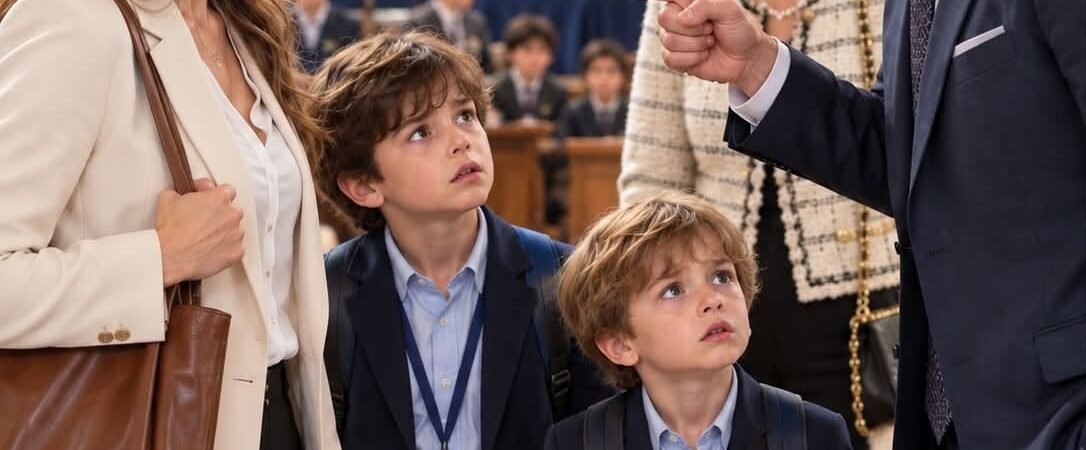
We were standing in the entrance hall of a university auditorium in Austin, Texas, surrounded by students, parents and families waiting to register, when Daniel looked straight at me and demanded, “How dare you show your face here?”
I was forty-five years old. I thought I had learned not to flinch at the sound of his voice.
I had not.
Daniel stood beside Vanessa in an immaculate navy button-down shirt, wearing the same posture of confidence I remembered from our marriage. Vanessa looked me over from my modest beige blazer to my worn flats and the clear plastic folder tucked beneath my arm.
“Claire,” Daniel said. My name sounded bitter in his mouth. “What are you doing here?”
“I came for the competition.”
Vanessa took a small step forward. “This is a private, invited academic showcase,” she said, with a smile that did not reach her eyes.
“It’s the Texas State STEM Championship,” I replied. “It’s open to public and private school qualifiers.”
A few parents in the registration line turned to look at us. Daniel noticed them and lowered his voice.
“Don’t start this,” he said. “This weekend is huge for Mason.”
Behind me stood Eli and Owen.
My sons. His sons.
They were sixteen years old, almost exactly Daniel’s height, with the same quiet habit of studying a room when something made them uncomfortable.
They wore plain gray hoodies with official contestant badges and backpacks whose shoulder straps I had restitched twice because they still had plenty of life in them.
Daniel looked directly at them.
He did not recognize them.
That hurt more than the insult. Daniel had missed birthdays, school plays, late-night fevers, science projects built at our cracked kitchen table and small local fairs in crowded classrooms. He had stopped calling long before the boys stopped asking whether he ever would.
Now he was six feet away from them and had no idea who they were.
“I’m here for my sons,” I said.
Daniel gave a short, disbelieving laugh. “Your sons?”
“Yes.”
Vanessa crossed her arms. “I hope you didn’t bring them here with unrealistic expectations. Mason has been working with private university tutors for six months.”
I did not answer her. Inside my folder were two official registration receipts, two preliminary scoring sheets and a faded photograph of Eli and Owen leaning over our dining table while they built a circuit board from recycled computer parts. I had packed the photograph without thinking. Some habits stay with you even after the children no longer need you to carry every piece of proof.
Owen touched my sleeve.
“Mom, registration closes in ten minutes.”
I nodded. “You’re right.”
I walked past Daniel.
“Claire,” he called.
I stopped and turned.
“Don’t make this about us,” he warned.
I looked at him properly for the first time in thirteen years. “I didn’t come here for us.”
Eli and Owen followed me through the registration doors.
Inside the auditorium, poster boards covered the walls. They displayed physics equations, advanced calculus problems and robotics schematics. We had gone only a short distance when Owen lowered his voice.
“Mom,” he said, “that was him, wasn’t it?”
I did not pretend to misunderstand. “Yes.”
Eli glanced toward the glass entry doors. “Our dad?”
“Yes.”
Neither boy said anything for several seconds.
Then Owen adjusted the badge on his hoodie. “Okay.”
That was all. No outburst. No demand for an explanation. They simply moved toward their assigned tables.
I wanted to tell them that Daniel had once known every small thing about them. I wanted to explain that he had held them as infants, that he used to complain when they cried at the same time, that he had once promised he would never miss what mattered.
But those facts belonged to a part of their lives he had chosen not to see. I did not want to make them carry his absence into a room where they had come to do their work.
The preliminary rounds lasted nearly three hours. The students worked through complex logic problems and applied physics calculations before defending their solutions before a panel of judges. Eli and Owen debated in hushed voices, corrected each other without turning it into a contest and kept working whenever another team began to pack up.
I sat in the back row with a paper cup of coffee that went cold in my hand.
At lunch, I saw Daniel across the concourse with Vanessa and Mason. He was speaking easily with other parents, smiling as if he had never raised his voice at me.
Mason looked nervous and kept checking the folder he carried against his chest.
I felt sorry for him. He was a teenager standing inside expectations built by adults.
The finalist board was posted at noon.
Mason had qualified.
So had Eli.
So had Owen.
Daniel stood only a few yards from the board, but the crowd was thick, and I doubted he had taken the time to read every name under the public school brackets. Eli and Owen did not mention him. They returned to the assigned tables and kept preparing for the final defense.
By five in the afternoon, the final round was over. The auditorium filled for the awards ceremony. Vanessa had reserved two prominent seats in the third row, and Daniel sat beside her with his suit jacket buttoned and his attention fixed on the stage.
My sons and I sat farther back near the middle aisle.
The lead professor announced the honorable mentions, followed by the bronze and silver medals. Families applauded. Students hugged their teammates. Phones rose throughout the room.
Finally, the professor held up a gold-embossed envelope.
“And this year,” he announced, “for the first time in the recent history of this state championship, the highest overall cumulative score ended in an absolute, perfect tie between two teammates from the exact same school.”
I felt Eli take my hand.
Owen held his breath.
In the third row, Daniel sat up and adjusted his jacket.
The professor opened the envelope and looked out at the students.
“The two students sharing the top score are Eli and Owen.”
For a second, I heard only the applause.
Then the people around us stood. Owen covered his mouth. Eli looked at me as if he needed to check that he had heard correctly.
“Go,” I whispered.
They walked toward the stage together.
The applause grew louder when their names appeared on the screen above the podium. It was not a private-school room or a public-school room anymore. Parents were standing, students were shouting and the judges were smiling at the two boys in gray hoodies who had arrived with repaired backpack straps and a circuit board made from recycled parts.
Daniel did not stand.
Vanessa turned toward him. “Daniel.”
He kept staring at the stage. “They’re Claire’s boys.”
“They’re your sons,” she said.
He looked at her sharply. “I know that.”
“You didn’t know them.”
Mason had turned around in his seat. “Dad, are those the twins?”
Daniel did not answer him.
The professor asked Eli and Owen to come back to the microphone. They accepted the gold envelope together, then stood on either side of the podium while the audience applauded again.
One of the judges asked how they had prepared for the competition.
Owen leaned toward the microphone. “We built most of our practice projects from parts we already had.”
Eli added, “And we argued a lot about the design.”
The professor smiled. “That seems to have worked.”
“Mom helped us stay on schedule,” Owen said.
He said it simply, without looking toward Daniel. That was the part that made my throat tighten. He did not say I had done everything. He did not need to. He named the fact that mattered.
When the ceremony ended, people gathered around the boys. Their school coordinator hugged them. Other contestants congratulated them. A parent I had never met asked whether they would be willing to explain how they had built their circuit board.
Daniel waited until the small crowd thinned.
“Claire,” he said.
Eli and Owen stood beside me. Neither moved away.
“We need to talk,” Daniel continued.
“You can talk here.”
His eyes moved to the boys. “I didn’t know they would be here.”
“They were registered contestants.”
“That isn’t what I mean.”
Owen held the gold envelope against his chest. “You didn’t know who we were.”
Daniel looked at him, then at Eli. “I knew you were my sons.”
Eli’s face stayed still. “You asked Mom who we were.”
“I didn’t recognize you.”
“That’s what he said,” Owen replied.
Vanessa stepped closer. She had left Mason near the seats, where he was speaking with another student.
“Daniel, this is not the place,” she said.
He turned on her. “You told me this was private.”
“It was an invited showcase. I was explaining what I thought.”
“You made it sound like she was looking for us.”
Claire’s name was not in that sentence, but I heard what he was trying to do. He was moving the responsibility from one person to another, hoping the room would accept confusion as an excuse.
Vanessa’s arms dropped to her sides. “You were the one who asked her what she was doing there.”
“I thought she came because of Mason.”
“Why would she?”
Daniel looked back at me. “You could have told me.”
I almost laughed, but there was nothing funny in it. “I tried to tell you at the entrance. I said I came for the competition.”
“You knew what I meant.”
“I knew you thought I was intruding.”
“You always make things difficult.”
Eli glanced at me. It was the first time that afternoon I saw anger cross his face.
I took the two registration receipts from my clear folder. The paper was creased from being carried all day, but the names and school were still easy to read. I held them out to Daniel.
“You asked for proof that I belonged here,” I said. “These are the registrations. The preliminary scores are behind them. They qualified on their own.”
Daniel looked at the papers but did not take them.
“I never said they didn’t qualify.”
“You said I brought them here with unrealistic expectations.”
Vanessa looked at him. “You did say that.”
“I was trying to protect Mason.”
“From what?” I asked. “Two sixteen-year-olds doing well?”
Daniel’s mouth tightened. “You know what I meant.”
“No. I don’t.”
He reached for the receipts then, but I lowered them before he could take them. I was not going to let him turn the papers into something he could wave away later.
“These boys have been doing this work for years,” I said. “You just didn’t see it.”
“I didn’t know how to contact you.”
Eli gave a small, humorless breath. “You had Mom’s number.”
Daniel looked at him.
“You called once,” Owen said. “You asked if we were still in school.”
“That was a long time ago.”
“You never called back.”
Daniel’s voice rose. “I was trying to handle a lot of things.”
Vanessa stared at him. “You told me you had spoken to them.”
“I said I had tried.”
“You said they didn’t want contact.”
The statement settled between them.
I looked at Vanessa. “I never told him that.”
Daniel rubbed his forehead. “They were young. It was complicated.”
“No,” I said. “It was not complicated for thirteen years. You left, and you stayed gone.”
He looked toward the stage, where the professor was speaking with the judges. “I thought Claire had moved on.”
“I did. That does not erase the boys.”
Mason had come closer. He was holding the folder he had carried earlier, but he was no longer looking at it.
“Dad,” he said, “did you know they were my age?”
Daniel turned. “Mason, go wait with your mother.”
“I’m asking you.”
Vanessa stepped between them slightly. “Mason.”
“No,” he said. “You said Dad knew everything about the competition.”
Daniel’s face changed, not dramatically, but enough for the confidence to leave it. He had spent the afternoon presenting himself as the parent who belonged in that room. His son had just realized how much of that performance was built on information Daniel did not possess.
Daniel looked at Eli and Owen. “I’m proud of you.”
Eli answered before I could. “You don’t know us.”
“I can get to know you now.”
Owen’s fingers tightened around the envelope. “Why now?”
Daniel opened his mouth and stopped. Around us, families were still gathering coats and folders. No one was pretending not to hear anymore.
He tried again. “Because I saw what you did today.”
“That’s not the same as knowing us,” Eli said.
“I’m still your father.”
“You’re the man who left,” Owen replied.
Daniel looked at me as if I had taught them the line. I had not. They had arrived at it themselves.
“I made mistakes,” he said.
Vanessa spoke quietly. “You didn’t make one mistake.”
He turned toward her. “Not now.”
“You told me she was unstable. You told me the boys were better off without the confusion.”
“Vanessa.”
“You said they had no interest in seeing you.”
“I said I didn’t know if they did.”
She shook her head. “You never asked them.”
The boys stood still. I could see that they were listening, but I did not want their history turned into a public argument between adults. I put the receipts back into the folder.
“That is enough,” I said.
Daniel looked at me. “You’re just going to walk away?”
“I came here for them. The ceremony is over.”
“I’m asking for a chance.”
“You can ask them directly when they are ready. You do not get to demand one because they won.”
His face hardened again. “You’ve kept them from me.”
“No. I stopped making excuses for you.”
That was the first time he did not answer immediately.
Vanessa looked away. Mason stood beside her, no longer touching the folder against his chest. I could not tell what he thought of me, and I did not need him to take sides. He was a boy caught in the truth of his family, just as Eli and Owen had been years earlier.
Daniel lowered his voice. “What do you want me to do?”
“For once, do not ask me to arrange your relationship with your sons.”
“I don’t know where to start.”
“Start by accepting that they are allowed to decide whether they want one.”
Owen turned to me. “Can we go?”
“Yes.”
Eli looked at Daniel. “We have an early bus tomorrow.”
Daniel nodded quickly. “I can drive you.”
“No,” Eli said.
“I meant I could take you to the station.”
“We can manage.”
Daniel glanced at me again, searching for the answer he had once expected me to provide. I said nothing.
We walked toward the exit. Behind us, Daniel called the boys’ names.
They stopped, but neither turned around.
“I am sorry,” he said.
The words were plain and late. They did not repair anything, but he had finally said them without blaming me.
Owen looked back first. “You should have said that before today.”
Daniel nodded.
Eli added, “We’re not promising anything.”
“I understand.”
It was the first answer he gave that did not try to take control of the conversation.
Outside the auditorium, the boys walked on either side of me. The gold envelope was tucked safely into Owen’s backpack, between his notebook and the old calculator he refused to replace. Eli carried the clear folder because my hands were full of the papers they had earned.
For years, I had imagined what it would be like for Daniel to see what he had missed. I had assumed I would need to explain every birthday, every project, every hard night and every small victory.
I did not have to explain it.
He had stood in the entrance hall and failed to recognize his own sons. Then he watched the entire room stand for them.
At the curb, Owen looked at me. “Are you okay?”
I thought about answering automatically. I almost said yes.
Instead, I said, “I’m proud of you both.”
Eli leaned his shoulder against mine as we waited for the bus.
That was the part I took home with me. Not Daniel’s apology, and not the look on his face when the professor read their names.
My sons knew exactly where they belonged.