In 1970, Roland Upshaw’s mother ended our piano duets with one sentence. “My son will not sit that close to a girl whose mother irons other people’s clothes,” she said.
I didn’t see him again for fifty-six years.
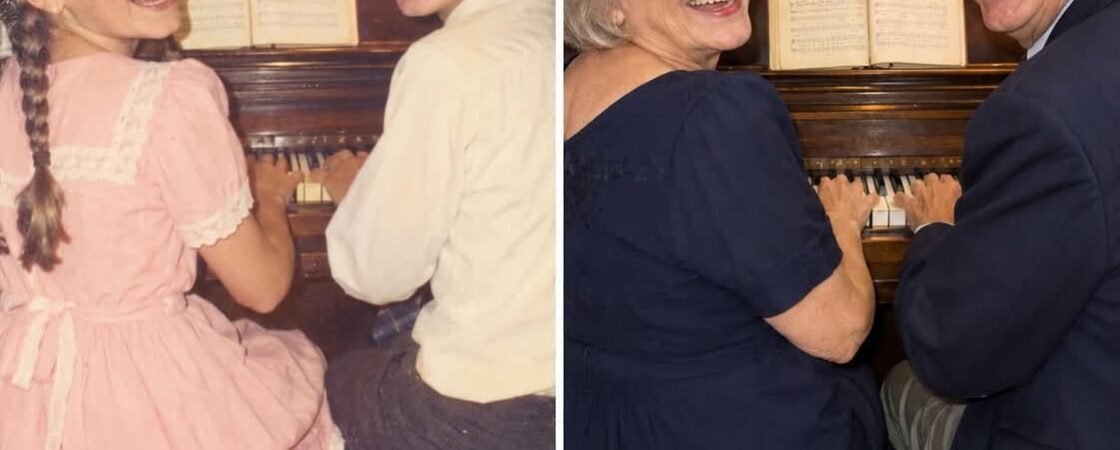
Every Sunday night, the Methodist youth fellowship met in the church basement in Greensboro. There was an upright piano against the wall and a cracked hymnal on the stand. Roland played the top part of “Fairest Lord Jesus.” I played the bottom. We practiced that four-hand arrangement for a year.
I was twelve. He was thirteen, with a cowlick and a clip-on tie. Our elbows bumped on the third line, every time.
“Your elbow’s in my music,” he’d say.
“Then play it in tune,” I’d tell him.
Whoever lost count bought the other a Co-Cola from the machine. I lost count on purpose sometimes. I never told him that.
In September, Mrs. Upshaw came down the basement stairs wearing a good hat to collect her son. The mothers were there with cookies. She stopped at the piano and looked at us sitting on the bench.
Then she said it loud enough for every mother in the room to hear.
“My son will not sit that close to a girl whose mother irons other people’s clothes.”
Nobody answered her. My mother was standing right there with a plate of tea cakes. She didn’t say anything either. She set the plate down carefully and folded her hands.
Roland looked at the floor.
“Mama,” he whispered. “Please.”
Mrs. Upshaw didn’t answer him. She took his arm and led him away. I stayed on the bench. I could see the keys, but I couldn’t make myself move my hands.
That was the last Sunday I sat beside him.
My mother ironed shirts for half the town. Mr. Upshaw’s shirts from the bank came to our house every Tuesday in a laundry basket. The money she earned paid for my piano lessons. I understood the insult. I didn’t understand how to answer it. Neither did my mother, not where anyone could hear.
Within the month, the Upshaws sent Roland to a military academy up in the mountains. I wrote him twice at their house, the only address I had. Nobody wrote back. I was twelve, and I figured that was an answer.
I kept taking lessons. I went on to nursing school, quit, and became a ward clerk at the hospital instead. I married Elam, a good, steady man who farmed soybeans. For thirty-five years, I hummed the bass line of whatever was on the radio.
“What’s that you’re humming, Cora?” Elam would ask, looking up from the paper.
“Nothing.”
It was always the same eight bars.
Elam died three years ago, in March. His recliner is still in the front room. Nobody sits in it, including me. My daughter calls every Sunday night. I have kept those parts of my life moving, more or less, and I don’t often explain what still catches in my throat.
Last month, my sister Berniece, who lives in Thomaston, mailed me a plain envelope. Inside was a church bulletin from a funeral she had attended. One line was circled in pen: after forty-one years as the church pianist, Roland Upshaw would play his final service that Sunday.
Berniece had written underneath it, “Isn’t this your piano boy?”
I put the bulletin on the refrigerator and looked at it for a week. That’s a long time to stare at a church notice. I still didn’t know what I thought I’d find by going.
My daughter came over and read it.
“Mama, he’s a stranger,” she said.
“He’s somebody’s widower,” I said. “His wife passed two years ago. It says so on the back.”
“You haven’t seen him since you were twelve.”
“I know.”
“What do you think is going to happen?”
“I don’t know,” I told her. That was the honest answer.
She looked at the bulletin again. “You could just call the church.”
“I’m not asking permission, honey. I’m telling you where I’ll be.”
She hugged me and said she’d call at suppertime. I drove the ninety minutes by myself, in my navy church dress, with the radio off. I parked in the back of the lot, so nobody would see me sitting there.
“Cora, you’re sixty-eight years old,” I told myself. “Turn around.”
My knees shook when I got out of the car. I went in anyway.
In the narthex, a young pastor in a gray suit shook my hand.
“Are you family of Roland’s?”
“I knew him as a girl,” I said.
He studied my face for a moment. His voice softened.
“Then you’ll want to sit near the front for the last hymn.”
“Why’s that?”
“Every Sunday for forty-one years, he’s closed the service the same way, on the old upright by the pulpit.”
“‘Fairest Lord Jesus,’” I said.
He looked at me for a long moment. “Maybe don’t sit in the back.”
I sat in the very last pew anyway, holding the bulletin in both hands. I didn’t know the people around me, and I didn’t want to explain myself before I had to. The service went by like water. I could hear the words, but I wasn’t following them.
Then the congregation stood. Roland moved to the old upright by the pulpit. I knew that piano. Somebody had carried it up from the basement.
He was sixty-nine, with short white hair, a navy blazer, and glasses on a cord. I recognized him by the way his shoulders rocked.
He put his hands on the keys. The first notes drifted down the aisle.
The top part. Only the top part.
I was already standing. I don’t remember deciding to. I walked up the aisle in my church shoes, past forty pews, with every head turning. I heard my mother’s voice in my ear: Don’t make a fuss, Cora.
I made one anyway.
The bench was wide enough for two. I sat on his left, where I had always sat. His hands didn’t stop, but his shoulders went stiff. I set my left hand on the keys where the bass begins. My fingers remembered everything.
We reached the third line. Our elbows bumped.
He stopped in the middle of the eighth bar and turned his head. He looked at me and said, “Cora Pate.”
Then he swallowed. “I got your letters. I’m sorry I never answered.”
The congregation stood behind us, waiting. I kept my hand on the keys.
“You got them?” I asked.
“Both of them,” he said. “I read them. I was thirteen, and I was scared to go against my mother. Then I got older, and I was ashamed that I’d let so much time pass.”
He looked down at the piano. “I kept telling myself I’d answer when I knew what to say. That wasn’t a reason. I should have written.”
For years I had treated silence as an answer. Now I knew there had been another one, and it was not the answer I would have chosen for either of us.
“Why didn’t you tell me?” I asked.
“I didn’t know you were coming.”
“No. Before today.”
He pressed his lips together. “Because I was a coward about it. I wanted to think the years had made it less important. They didn’t.”
Behind us, the congregation remained on its feet. The pastor had come close enough to hear. Roland looked toward him.
“I need to say this plainly,” he said. “Cora wrote to me after my mother took me away. I didn’t answer. That was my choice, even if I was a boy when I first made it.”
The pastor nodded. He didn’t interrupt. I heard a few people shift in the pews. Nobody spoke for us.
I turned back to Roland. “You could have answered with one line.”
“I know.”
“You didn’t have to fix anything. You could have just written.”
“I know,” he said again. This time, he didn’t try to add a reason.
That was the part I had needed him to understand. Not that he had been a child. I had been a child too. Not that his mother had made the decision in front of everyone. She had. But after that, I had sent two letters, and he had left me without even a sentence.
I had no old letters to show him. I had only the years I had carried them in my mind, the address I had written on the envelopes, and the answer he was giving me now. He had heard me. He wasn’t saying his mother had hidden them or that some other person had kept us apart. He said he got them, read them, and did not reply.
The pastor stood nearby, as did the congregation that had watched me walk up the aisle. Roland had said it in front of them, not just to me. There was no version left where I had made up the letters or misunderstood his silence.
The pastor asked quietly, “Would you like us to wait?”
Roland glanced at me. “If Cora wants.”
I looked at the keys. The hymn was still open in front of us. I had imagined many things on the drive over, though none of them clearly. I hadn’t imagined sitting here with his confession laid out in a church full of people.
“Finish the hymn,” I said.
He shifted his hands, leaving the bass part open for me.
“From the beginning?” he asked.
“From where we were.”
He started again. I found the lower notes, and for the first time since the basement, the two parts met. Our elbows touched on the third line. His shoulder moved, just slightly, as if he remembered it too. The congregation sang with us.
When the hymn ended, people began to sit. Roland took his hands off the keys.
“Would you talk with me?” he asked.
“I’ll talk,” I said. “I’m not promising that fifty-six years can be made up in an afternoon.”
“I’m not asking you to.”
“You are asking me to believe you now.”
“Yes,” he said. “I am.”
I stood. The pastor waited nearby, and a couple of church members lingered at the end of the pew. Roland didn’t reach for me or ask me to say it was all right. I was grateful for that.
The pastor introduced himself again, though I had already forgotten his name. Roland stayed beside me while we spoke, not trying to hurry me toward a private conversation. The people who had heard him could see that I wasn’t there to make a scene or to claim some place in his life. I had come because a song and a name on a bulletin had brought me to a question I had carried since childhood.
At the end of the service, Roland asked, “Could I write to you now?”
I took a breath. “You can write. Don’t ask me to pretend you did it then.”
“I won’t.”
“And don’t tell me your mother made every choice for you.”
“I won’t,” he said. He looked at the keys. “I did make one of them.”
That was as close to an apology as I was willing to accept that day. It didn’t return the years or change what happened to my mother in that basement. It did let me stop guessing about the letters.
My daughter called at suppertime, as she had promised. I was back in the car when I answered.
“Did you see him?” she asked.
“I did.”
“What happened?”
“He remembered me. He got my letters.”
There was a pause. “And?”
“He didn’t answer them. He told me why.”
“Are you all right?”
“I’m all right enough to drive home.”
She let that sit between us. Then she said, “I’m glad you went.”
“So am I,” I said. I meant it, though I wasn’t ready to call what had happened forgiveness. It was a first conversation after a very long silence. That was enough for one day.
Roland wrote to me afterward. He kept the letter plain. He apologized again and didn’t ask me to comfort him about it. I wrote back. I told him what I remembered about the piano, and that I still knew the bass line. We began with letters because that was where our unfinished conversation had been left.
I didn’t get my childhood friend back as if nothing had happened. He didn’t get to erase the part where I waited for an answer. But we were no longer a girl at a piano bench and a boy looking at the floor. We were two adults who had finally said what each of us had done.
I had gone to hear him play one last hymn. I left knowing why he never answered.