My parents abandoned me at Grandpa’s house when I was five and never came back. The morning after his funeral, they showed up with a moving truck. My sister stepped inside, looked around the house, and casually said, “I’ll take the master bedroom.”
Mom shoved two black garbage bags into my hands.
“You were Grandpa’s responsibility,” she said. “Now that he’s gone, this house belongs to us.”
I didn’t argue. There was no need. Before Grandpa died, he had already told me exactly what to do when they came back. And a few minutes later, when the door to his study opened, the garbage bags slipped from Mom’s hands.
It happened the morning after we buried him. Seventeen years after my parents had dropped me off at Grandpa’s house and disappeared, they came back. Not with flowers. Not with condolences. With a moving truck idling in the gravel driveway, its diesel engine vibrating through the floorboards of the front porch.
My sister Chloe climbed out behind them wearing oversized designer sunglasses despite the gray autumn drizzle. She looked past the black funeral wreath still hanging on the front door, glanced up at the second floor, and smiled.
“I call the master bedroom,” she said, her voice bright and sharp in the quiet morning air.
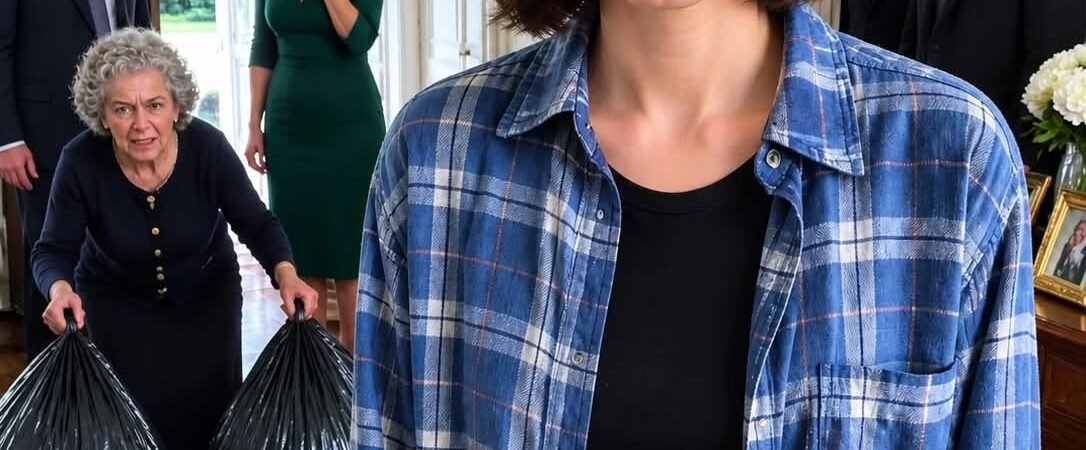
I stood on the porch wearing one of Grandpa’s old flannel shirts and holding a cup of coffee I hadn’t touched.
The house still smelled like funeral lilies and damp autumn air, and underneath it was that familiar trace of pipe tobacco. Grandpa had quit smoking ten years earlier, but somehow the scent had never fully left his coat pockets or the wood paneling of that hallway.
Mom climbed the steps like she already owned the place, her heels clicking hard against the freshly swept porch boards. She looked me up and down with that familiar expression of mild irritation she used to wear when my shoelaces were untied.
“You look awful, Clara,” she said.
She said it like she was criticizing my clothes at a family gathering we were already late for. Dad didn’t hug me. He didn’t ask how I was holding up after the longest week of my life. He didn’t say he was sorry Grandpa was gone. Instead, he turned toward the two movers who were standing by the back of the truck waiting for instructions.
“Start upstairs,” Dad told them. “Take the furniture first. Be careful with the cherry wood dresser in the guest room.”
Chloe pushed past me into the foyer without wiping her boots on the coir mat. She wrinkled her nose and dropped her leather tote bag onto the side table.
“Seriously?” she asked, looking around the hallway. “This place smells like an old man.”
Something inside me became very still, locking down every restless impulse. I had been five years old when my parents brought me to Grandpa’s house for what was supposed to be a single weekend. They told him they had a work trip out of state and needed someone to watch me for two days. That weekend became seventeen years.
There were no birthday calls. No Christmas cards. No summer visits to see how I was growing up. No explanation given to the school or the neighbors when my enrollment records were quietly transferred to Grandpa’s address.
Grandpa raised me instead. He did it with a retired machinist’s pension, vegetables from his backyard garden, mismatched secondhand furniture, and bedtime stories about people who meant what they said. He taught me how to change the oil in the lawnmower, how to balance a checkbook to the penny, and how to look someone in the eye when you shook their hand.
Yesterday, I stood by a freshly dug hole in the local cemetery and buried him. Today, the people who had erased me from their lives sixteen years ago had come back to claim everything he left behind.
Mom snapped her fingers in front of my face to pull me out of my thoughts. Then she shoved two heavy black garbage bags into my arms, nearly spilling my cold coffee.
“Pack your things,” she said, her voice dropping into that familiar tone of administrative command. “Clothes, your toothbrush, that ugly quilt from the spare room, whatever belongs to you. We are having the whole place gutted by Monday.”
I stared at her, not moving an inch.
Her voice dropped further, hardening at the edges. “You were Grandpa’s burden, Clara. He took you in because he felt sorry for us. But he’s gone now, and this house is ours by right of blood and inheritance.”
From upstairs, Chloe shouted down through the open stairwell.
“Mom! Can I paint the master bedroom white? This dark wood paneling is completely depressing.”
Dad finally looked at me, his expression flat and transactional. “Don’t make this difficult, Clara. Your grandfather always wanted the property to stay in the family, and we are the remaining family.”
Family. The word tasted like copper in my mouth. I almost laughed out loud at the sheer audacity of it. Instead, I carefully set the black garbage bags on the floor, making sure not to spill a drop of my coffee. Because I remembered Grandpa’s last instructions.
A few days before he died, I had been sitting beside his narrow hospital bed in the downstairs parlor. His hand was thin and pale, his skin like old parchment under the blanket, but his voice was still as steady as a plumb line.
“When they come, don’t argue with them at the door,” he had told me, his clouded eyes fixed on the ceiling fan.
I frowned, squeezing his dry fingers. “When who comes?”
He already knew. He had known since the first time they stopped answering his phone calls back when I was in elementary school.
“Your parents,” he said, coughing softly. He squeezed my hand back with whatever strength he had left. “Let them in.”
I leaned closer over the metal rail of the bed. “Why should I let them in after everything they did?”
“Let them talk,” he paused, drawing a shallow breath. “Let them show everyone exactly who they are.”
I swallowed the lump in my throat. “And then?”
Grandpa looked straight at me, a faint, stubborn spark lighting up his eyes. “Open my study.”
That was all he said before he closed his eyes to rest. So when my parents arrived with a moving truck and hauled their entitlement onto the porch, I followed his instructions to the letter. I didn’t yell. I didn’t tell the movers to turn around and leave. I didn’t argue when Chloe claimed the master bedroom as if she had earned a single brick of this house.
I didn’t respond when Dad started giving orders to strangers in our hallway, and I said nothing when Mom called me a burden in the very rooms where I had learned to read and ride a bicycle. I just let them talk. I let them assume. I let them reveal exactly who they were before witnesses who wouldn’t forget it.
Then a soft, deliberate click came from the dark hallway behind the staircase.
Everyone stopped moving. The lead mover paused halfway up the stairs with a mahogany end table in his hands. Chloe froze with her hand on the banister, her designer sunglasses pushed up onto her forehead.
The heavy oak door to Grandpa’s study slowly swung inward on its brass hinges.
Mom turned sharply toward the doorway, her mouth half-open to give another command. And the second she saw who was standing on the other side, the black garbage bags fell from her hands, hitting the hardwood floor with a dull thud.
A tall man in a charcoal wool suit stepped out from the dim interior of the study. He had a leather binder tucked under one arm and a pair of reading glasses in his hand. It was Mr. Vance, the senior partner from the local town law firm who had handled Grandpa’s modest affairs for thirty years.
Mr. Vance looked around the foyer, taking in the movers, the open door, and my parents’ stunned faces with absolute professional calm.
“Good morning,” Mr. Vance said, his voice carrying clearly across the quiet room. “I trust everyone is here for the reading and execution of the primary estate documents.”
Dad took half a step backward, his hand twitching toward his jacket pocket. “What is this? Who are you? This is a private family matter. We are the legal next of kin.”
Mr. Vance did not blink. He stepped further out into the hallway, standing right beside me as if taking up a post.
“I am Arthur Vance,” the lawyer said evenly. “And I have represented Robert Hayes for over three decades. I drafted every document concerning this property and his legal guardianship of Miss Clara Hayes.”
Mom found her voice, though it came out shrill and breathless. “Guardianship? She’s our daughter! We simply left her here temporarily during a difficult transition period, and now we are reclaiming our family home.”
I picked up my coffee cup, took a calm sip, and looked straight at her. “You didn’t leave me for a transition, Mom. You dropped me off on a Tuesday afternoon, changed your phone numbers by Wednesday, and moved three states away by Friday.”
Mom’s face flushed a dark, angry red. “We were young! We had our reasons! You have no right to stand there and judge us after your grandfather poisoned your mind against us.”
Mr. Vance opened his leather binder and pulled out a thick set of stapled papers bearing the raised seal of the county courthouse.
“There is no question of poisoning, Mrs. Hayes,” Mr. Vance said, turning a page. “Seventeen years ago, on October twelfth, you and your husband signed a formal relinquishment of parental rights and permanent guardianship transfer before a family court judge. Furthermore, three years after that, Mr. Hayes legally adopted Clara as his sole dependent.”
Dad shook his head violently, stepping forward into the foyer. “That’s impossible. We never signed away the property rights to this house. This land has been in our family line for generations. It belongs to us automatically under state inheritance laws.”
Mr. Vance looked up over his glasses, his expression flat. “It was in your family line until your father deeded the entire parcel and structure to Robert Hayes outright in exchange for clearing the mortgage debt you defaulted on back in nineteen-nine. I have the recorded deed right here.”
Chloe dropped her designer handbag onto the bench. “Wait a minute. You mean we don’t own this house? We drove all the way out here for nothing?”
“You own nothing pertaining to this estate,” Mr. Vance confirmed without missing a beat. “In fact, Mr. Hayes executed his final will three weeks ago while under my direct supervision and in the presence of two independent medical witnesses. The entirety of the property, the savings account, and all contents of this house are legally bequeathed to Clara Hayes.”
Dad lunged forward a step, his face twisting with sudden rage. “That old man manipulated her! He brainwashed a child! We can contest this in court. We can sue for elder manipulation and undue influence!”
“You are welcome to try,” Mr. Vance replied smoothly, closing the binder with a firm snap. “Though I should inform you that the court files include seventeen years of certified letters sent to your last known addresses offering formal visitation and contact, every single one of which was returned unopened with the notation ‘refused.’ The judge will find that fascinating.”
The two movers standing on the stairs exchanged awkward glances. The one holding the mahogany table slowly set it back down on the landing.
“Hey, boss,” the first mover said, looking at Dad. “We charge by the hour, but we don’t get involved in property disputes. Do you want us to keep moving this stuff or put it back?”
Dad turned around, his face white with humiliation, and hissed at the mover to wait outside. Then he swung back toward me, his hands shaking with suppressed fury.
“Clara, you can’t be this cold,” Dad said, changing tactics with a pathetic, oily shift in tone. “We’re your blood. We’re your parents. After everything, can’t we talk about this like a real family inside?”
I set my coffee cup down on the side table, the ceramic clinking softly against the wood.
“You had seventeen years to talk,” I said, my voice steady and quiet in the crowded hallway. “Grandpa was right. You came back just to see what you could take, and you showed everyone exactly who you are.”
Mom let out a sharp, ugly sound of disbelief. “You ungrateful little brat! After everything we gave you!”
“You gave me away in a grocery store parking lot,” I replied, not raising my voice by a single decibel. “And now you’re standing in my hallway trying to steal my home.”
Mr. Vance stepped toward the front door, holding it wide open. The gray autumn light spilled across the threshold, illuminating the dust motes dancing in the air.
“The property is private residential land,” Mr. Vance said, pointing toward the open door. “If you are not off the premises in five minutes, I will call the county sheriff to file formal charges of criminal trespass and attempted grand larceny.”
Chloe grabbed her leather bag off the bench, her face twisted in absolute disgust. “This place is a dump anyway! Come on, Mom. Let’s get out of this depressing hole.”
Mom glared at me one last time, her lips pressed into a thin, venomous line, before turning on her heel and marching out the door. Dad lingered for a second longer, opening his mouth as if to launch another threat, but one look at Mr. Vance’s phone already out in his hand made him think better of it. He spat on the porch floor and followed his wife and daughter down the steps.
The movers filed out behind them, muttering under their breath about wasted time, and loaded themselves back into the cab of the big truck. Within three minutes, the diesel engine roared to life, tires crunching loudly against the gravel as the vehicle backed down the driveway and disappeared around the bend in the road.
The silence that settled over the porch was absolute. The black funeral wreath hung quietly from the front door handle, swaying slightly in the damp breeze.
Mr. Vance turned to me, sliding his glasses into his breast pocket. “Will you be all right here alone today, Clara?”
I looked back into the warm, familiar foyer, smelling the faint trace of pipe tobacco and old cedar that lived in the walls.
“I’m not alone,” I said, offering him a small, genuine smile. “Grandpa is right here.”
Mr. Vance nodded respectfully, shook my hand, and walked down to his car. I watched him pull away, then stepped back inside the house, closed the heavy oak door behind me, and turned the deadbolt for the first time as the rightful owner of my own life.