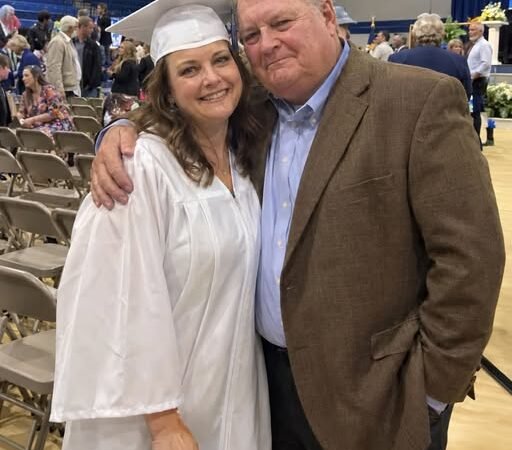
“At least that’s the end of the money we threw away on you,” my father whispered after pinning my nursing school pin to my collar.
He had never paid one dime of it. I smiled at him and said, “Yes, Daddy. It sure is.”
He looked at me as if he couldn’t tell whether I agreed. Then he went back to his seat. A few minutes later, the dean called my name for the night’s highest award, and my father turned around to see my grandmother crying in her wheelchair in the third row.
It took me six years to finish nursing school. I took night classes at the community college after full days at the county 911 center, working the dispatch console. By the time I came home, the headset had left a dent in my hair. I would smooth it down before starting on whatever Grandma Dessie needed that evening.
I’m forty-one. Dessie is eighty-eight, my father’s mother, and I live with her. I moved in after Grandpa died because nobody else would. I manage her pills, help with her bath, take her to doctor visits, and set her hair on Saturday nights. She taught me to make biscuits with lard and a cold hand. She also says, “Keep your chin up, baby girl, and your mouth shut till it counts.”
I knew what she meant. I had spent years learning when to answer my father and when to let him hear only what he wanted to hear.
That didn’t mean I was good at it. Sometimes I was just tired.
My father lives eleven miles away. He hadn’t set foot in Grandma’s house in four years, though he called her about twice a year, at Christmas and when he wanted something. The thing he wanted now was her house.
A real estate agent’s business card was on Grandma’s refrigerator. My father had mailed it to her with a note on the back: Think about it, Mama.
When he came by last fall, he talked as if the decision had already been made.
“She ought to be in a home,” he told me. “That house won’t sell itself.”
“It’s not your house to sell,” I said.
He glanced toward the living room, where Grandma was sitting. “It will be.”
“And then where will you live?” he asked me.
I didn’t have a good answer. I was afraid that if he got his way, I would lose Grandma and my bed in the same week. I hated that I had to think about the bed, too. It felt selfish, but it was true.
“I live here because she needs me,” I said.
“She needs more than you can give her.”
“Have you asked her what she wants?”
He didn’t answer that. He picked up the real estate card and put it back on the refrigerator.
Grandma had heard enough to understand. After he left, she said, “He talks like the house is already his.”
“It isn’t.”
“No,” she said. “It isn’t.”
She didn’t ask me to fight with him. I think she knew I was already doing that in my head.
My husband, Tim, wanted me to quit school two years before graduation. We sat looking at our bank app on his phone while he tried to explain what we could afford. He wasn’t wrong that money was tight. I had paid for every class myself, using overtime shifts and tax refunds. My father hadn’t given me a dollar for books, scrubs, or gas.
“We can’t afford it, Em,” Tim said.
“I know it’s a lot.”
“Your daddy’s right about one thing. It’s a lot of money.”
I looked at him. “He hasn’t paid any of it.”
“I know that.”
“Then don’t say ‘we threw away’ like it came out of his pocket.”
Tim rubbed at the edge of his phone case. “I’m saying the bills are real. I’m not saying he paid them.”
I knew the difference. I also knew what it sounded like when the person beside you was tired of the same financial strain you were. I didn’t quit. I picked up more overtime and kept going, but I couldn’t make myself forget that conversation.
My father had told people at the feed store that I was wasting money on a pipe dream. I heard about it from someone else, not from him. If I brought it up, he would say I had misunderstood or that people liked to repeat things. I stopped trying to correct every version of me he offered other people.
In October, my clinical instructor, Mrs. Nesbitt, came by the house to drop off a book. Grandma kept her on the porch with a glass of tea for two hours.
I went in and out while they talked, but I didn’t listen closely. They seemed to be getting along, and I had things to finish.
When Mrs. Nesbitt left, she said, “Your grandma is something else.”
“They get along with you,” I said.
“She has a lot to say about you.”
I laughed. “That sounds like her.”
Mrs. Nesbitt gave me a look, but she didn’t explain. I assumed they had talked about school. I didn’t know Grandma had written a letter to the college.
Graduation was in December, in the college gym. At a nursing pinning, someone from your family comes up on stage and pins you. My father called the week before and said he would do it.
“I’ll do the pinning,” he told me. “Folks expect it.”
I had not asked him. I paused before answering.
“Are you sure?”
“Why wouldn’t I be?”
“I didn’t say you couldn’t.”
“Then it’s settled.”
I could have said no. I could have asked Mrs. Nesbitt or someone else. But I could already hear my father telling people I had rejected him, and I didn’t want one more fight to become the story of my graduation.
Grandma wasn’t supposed to come. My father told everybody she was too frail, and Tim agreed with him.
“She’ll be exhausted,” Tim said. “It might be too much.”
“She wants to come.”
“Did she say that?”
“She doesn’t want to be trouble.”
“That’s not the same thing.”
I knew he was trying to be practical. I also knew we were both deciding for her without asking the right question.
I wanted my cousin Rianne to bring Grandma anyway, in late and quiet. At two in the morning, I lay awake thinking about what could go wrong. If my father made a scene and Tim took his side, I’d hear about it for weeks. Maybe it would be easier to let Grandma stay home.
I called Rianne anyway.
“Can you bring her?” I asked.
“If she still wants to go, yes.”
“She’ll say it’s too much trouble.”
“Then I’ll ask her, not you.”
I let out a breath. “All right.”
“She wants to see you graduate, Em.”
I didn’t know what to say to that. “Just come in quietly.”
“We’ll do our best.”
The program began with my father in the second row, wearing his brown sport coat. The dean gave her welcome speech. Then the graduates were called up one by one for their pins. My phone buzzed in my lap. It was Rianne: Running late. Save the end seat in row three.
I read the message twice and looked toward the side door. I didn’t see them yet.
When it was my turn, my father came up the steps behind me. He smelled like his truck. He pinned the little gold pin on my collar, then leaned in close, as if he were going to kiss my cheek.
“At least that’s the end of the money we threw away on you,” he whispered.
I wanted to stand up and tell the whole gym that he had paid for none of it. I didn’t. I smiled.
“Yes, Daddy. It sure is.”
He gave me a funny look. I couldn’t tell if he thought I was agreeing or trying to make him angry. He went back down to his seat, and I returned to mine with the other graduates.
That was when I saw Rianne at the side door, pushing Grandma’s wheelchair toward the end of row three. They were quiet as mice. Grandma wore her blue Sunday dress and the pearl earrings Grandpa had given her. My father was looking at his phone and didn’t see them.
Then the dean stepped back up to the microphone.
“We have one more award tonight,” she said. “Our highest honor, for service to patients.”
She said my name.
I didn’t move at first. I thought I had heard wrong. The girl beside me pushed me up from my chair, and I walked to the dean with my legs shaking.
“Her clinical instructor nominated her for her care of patients,” the dean said. “And the committee received one more letter we’d like to share.”
She unfolded a sheet of lined notebook paper. I knew the handwriting from across the stage: shaky blue ink, the same hand that had signed every permission slip I brought home.
I looked at row three. My father had turned around. He was staring at Grandma in her wheelchair. His face had gone white against the program in his hand. Grandma was crying and looking right at him.
The dean leaned toward the microphone and read the first line.
“I am writing as the mother of a man who has spent years telling people Emily’s education was money wasted. He did not pay for it. Emily paid for her classes herself, while working at the 911 center and caring for me.”
The dean paused. The gym was quiet.
“I am not writing because she is my granddaughter,” the letter continued. “I am writing because I have watched how she treats people who need help. She does not make them feel like a burden. She has done that for me at home, and I have watched her bring that same patience to her work. She has earned this honor.”
That was the answer. Grandma had written the letter because she wanted the committee to know who I was when nobody was handing me a pin. She also wanted the truth said in a room where my father couldn’t turn it into a story about himself.
The dean finished reading. I stood beside her, looking down at the page, trying not to cry. Grandma dabbed her face with a tissue. Rianne stood behind her wheelchair with one hand on the handle.
The audience applauded. My father didn’t. He kept looking at Grandma.
I took the award from the dean. When I turned toward the seats, Grandma was still crying, but she smiled at me. I smiled back. I didn’t look at my father again until the ceremony ended.
He came over in the lobby. Tim was there. Rianne had brought Grandma closer to the group, and a few relatives who had come to see the graduates were standing nearby. My father seemed to notice them only after he started speaking.
“What was that supposed to be?” he asked.
Grandma looked at him. “A letter.”
“You made me look like a fool.”
“You did that yourself,” Rianne said. She didn’t raise her voice.
My father turned to me. “You know I wasn’t talking about every single dollar.”
“You said we threw money away on me.”
“I meant the family. It takes a lot to put someone through school.”
“I put myself through school.”
He pressed his lips together. “You’re making it sound like I never did anything for you.”
“I said you didn’t pay for my classes.”
“I didn’t say I did.”
“You said ‘we.’”
He glanced at Tim, as if Tim might settle the argument for him. Tim looked uncomfortable, but he didn’t look away.
My father tried again. “I was proud to pin you. I showed up.”
“You showed up to pin me,” I said. “You didn’t pay for school.”
He gave a short laugh. “You always have to make everything a fight.”
I felt the old urge to smooth it over. I could have said the award was nice, the letter was sweet, everybody was tired. It would have been easier, at least for the next ten minutes.
Instead, I said, “You said it in front of me. I’m answering you in front of people.”
He looked past me at Grandma. “You had to put that in a letter?”
“I did,” Grandma said.
“You could have told me privately.”
“I have told you privately that Emily takes care of me. You weren’t interested.”
He shook his head. “I’m trying to make sure you’re safe. That house is too much.”
“It is my house.”
“Your house needs work.”
“It needs me living in it.”
He looked at me again. “You can’t do everything forever.”
“I’m not asking you to do everything. I’m asking you to stop talking about selling her house like it belongs to you.”
He didn’t answer. His eyes moved to the people standing nearby. Then he said, “I never said I was going to put her out.”
“You said she ought to be in a home,” I replied.
“I said she might need more care.”
“Then ask her what she wants.”
Grandma had been quiet while we went back and forth. Now she spoke.
“I want to stay in my house. I want Emily here. I don’t want you sending me real estate cards.”
My father frowned. “I was trying to help.”
“No,” she said. “You were trying to sell.”
He looked at her, then at the floor. “I thought you’d be better off.”
“You thought the house would be better off without me in it.”
“Mother.”
“Don’t call me that as if I’m confused.”
He had no answer ready. He started to say something about the house being a lot to manage, then stopped when Rianne spoke.
“She’s been managing it with Emily.”
My father turned to her. “This doesn’t concern you.”
“She’s my cousin,” Rianne said. “And I brought Grandma here because she wanted to come.”
He looked at the small group again. “I don’t need an audience.”
“Then don’t start this in front of one,” I said.
Tim had been standing beside me without speaking. My father turned to him.
“You know how much all this costs.”
“I do,” Tim said.
“Then tell her.”
Tim looked at me first. “Emily paid for her classes. I know that.”
My father’s mouth tightened. “You told me she was spending too much.”
“I said it was hard on our finances. I didn’t say you paid for it.”
That was not a dramatic speech. It was one sentence, and it left my father with no one else’s words to hide behind.
He turned back to me. “You didn’t have to let your grandmother write that.”
“I didn’t know she had.”
“You could have stopped it.”
“I didn’t know about it until the dean read it.”
Grandma lifted her chin. “It was my letter.”
He looked at her as if he expected me to make her take it back. I couldn’t. I didn’t want to. The truth in it belonged to both of us.
He left the lobby before the rest of us. Nobody stopped him. Nobody followed him out to tell him he had meant well.
We went home after the ceremony. Grandma was tired, but she kept her award-night program beside her and asked me to tell her what the dean had said after the letter. I told her about the applause and the award. She listened with her eyes half closed.
“You did good,” she said.
“I didn’t do anything.”
“You stayed there.”
I knew what she meant. Still, I didn’t know what would happen with my father or the house. We had not settled that just because she had spoken clearly in the gym.
A few days later, my father came to Grandma’s house. He didn’t call first. I opened the door, and he asked whether we could talk.
“Are you here about the house?” I asked.
“I want to talk to my mother.”
“She’s in the living room.”
He stepped inside. Grandma was sitting where she usually sat, and Rianne was visiting. Tim was there too. We had not arranged a meeting. We were simply all in the house when he arrived.
My father stood near the doorway.
“I don’t like how things went at graduation,” he said.
Grandma looked at him. “Neither did I.”
“I was trying to help.”
“You keep saying that.”
“Because it’s true.”
“What did you want, then?” she asked.
He rubbed his thumb along the edge of his belt. “I wanted you to think about your options.”
“I did think about them. I want to stay here.”
He glanced at me. “And what if she can’t keep doing all this?”
“I’ll tell her if I can’t,” I said.
“She shouldn’t have to wait until you’re burned out.”
“I don’t need you deciding for her.”
“I’m her son.”
“And I’m sitting right here,” Grandma said.
He looked back at her. “I know.”
“Then listen.”
For a moment, all he did was look at the floor. Then he said, “The house is a lot for you.”
“I know what my house is like.”
“I’m not trying to take it from you.”
“You sent me a real estate card.”
“I thought it might be useful.”
“You told Emily the house would be yours.”
“I didn’t mean it like that.”
“How did you mean it?”
He looked toward me. “I was talking about what would happen someday.”
Grandma didn’t let him move past it. “Someday is not today. You don’t get to sell my house while I’m living in it.”
“I wasn’t selling it.”
“You were asking me to consider it. You were telling Emily you knew what would happen.”
He had no easy way to answer. “I thought I was being practical.”
“That’s what you call it,” she said.
I had kept the tuition receipts and school account statements with my other records. I brought them out and laid them on the table. I wasn’t trying to prove that I had worked hard. I had done that for six years. I wanted to end the argument over what my father had paid.
“This is the school account history,” I said. “And these are the payment records I kept.”
He glanced down, then back at me. “I never said I paid all of it.”
“You said ‘we threw money away on you.’”
“I meant people were worried about you spending so much.”
“Who?”
He did not answer. The papers showed what I had paid. Grandma’s letter said what she had seen. Tim sat there and confirmed it. There was no family money hidden in the story, no contribution my father could point to.
“I didn’t have the money to pay for your schooling,” he said at last. “I’m not pretending I did.”
It was the first time he had said it plainly. I waited, but he did not add that he was sorry.
“You could have said that instead,” I told him.
He shifted his weight. “I thought you were making a mistake.”
“You could have let it be my mistake.”
He took a breath. “You always hear the worst in what I say.”
“I heard the words you used.”
Grandma picked up the real estate card from the table. “You can take this back with you.”
He stared at it. “That’s what we’re doing now?”
“I don’t want it on my refrigerator.”
He took the card. It was a small thing, but no one reached across the table to soften it for him.
“I want to visit,” he said.
“Then visit,” Grandma replied. “But you don’t come here to talk about selling my house. You don’t bring another card. And you don’t tell Emily what will happen to me as if I’m not here.”
He looked down at the card in his hand. “All right.”
“If you start again, I’ll ask you to leave.”
He looked at her, then nodded. “All right.”
That was the consequence. He did not get to direct her care or treat the house as a future possession. He was welcome to see his mother, but only on her terms. He couldn’t talk his way around the boundary because she had said it herself.
After he left, Grandma asked me to put the card away. I did. She didn’t ask me to reassure her that he would change. I didn’t offer.
I had spent a long time afraid that if my father pushed hard enough, I would lose the house and the person inside it. Grandma made clear that she could speak for herself. My part was to keep showing up, as I had before.
When I finished my last school shift, I still had the headset dent in my hair. The gold pin stayed on my collar through the ceremony, and the award came home with me. My father had paid for none of it. Grandma knew that, and so did everyone who had heard her letter.