The problem was my signature.
At 9:17 that morning, my bank manager, Richard Collins, called and asked whether I was sitting down.
I was standing beside the apartment window, watching a sanitation truck crawl through the snow-covered street. My coffee had gone cold.
“Thomas,” Richard said carefully, “did you authorize a second mortgage against your son’s property eighteen months ago?”
My fingers tightened around the phone.
“No.”
There was a pause.
“Did you sign a personal guarantee for a business credit facility totaling four hundred and eighty thousand dollars?”
I stared at the reflection of my face in the window.
“No, Richard.”
Another silence followed, longer this time.
“Then I need you to come to the bank. And bring your attorney.”
I called Evelyn immediately.
She arrived at my apartment forty minutes later, carrying a leather briefcase and wearing the expression I had seen only twice in twenty years of knowing her.
The first time was when my business partner tried to steal from our company.
The second was when my wife, Margaret, died, and Evelyn had to explain that grief did not excuse me from handling the estate.
“What happened?” she asked.
I repeated Richard’s questions.
Evelyn stopped taking off her coat.
“Don’t speak to Daniel or Vanessa until we’ve seen those documents.”
My phone vibrated on the kitchen counter.
Daniel.
Then Vanessa.
Then Daniel again.
Evelyn glanced at the screen.
“Especially now.”
At the bank, Richard led us into a private conference room. Two folders lay on the polished table.
He opened the first.
My name appeared on a guarantee agreement.
Thomas Edward Mercer.
Below it was a signature resembling mine closely enough to fool someone who had never watched me write.
But Margaret had always teased me about one peculiar habit.
I never connected the letters in my surname.
The signature on the document connected every letter.
“That isn’t mine,” I whispered.
Richard turned another page.
There was a photocopy of my driver’s license, an old bank statement, and an electronic authorization supposedly completed from my personal email account.
Evelyn leaned forward.
“Where did these documents originate?”
Richard consulted his notes.
“The application was submitted through Daniel Mercer’s business. The supporting documents came from an address associated with Vanessa Mercer.”
My stomach turned.
For years, Vanessa had helped me with online appointments, insurance renewals, and household paperwork after Margaret’s death.
I had trusted her with passwords.
I had trusted her with copies of my identification.
I had trusted her because she was family.
Richard slid the second folder toward me.
“The funds were transferred into three accounts. Two belonged to the business. The third was opened under a company called V.M. Holdings.”
“Vanessa,” I said.
Richard did not answer.
He didn’t need to.
Evelyn began photographing the documents.
“Preserve everything,” she told him. “Application records, authentication logs, correspondence, and recordings. We will formally dispute the guarantee and report the suspected forgery.”
Richard nodded.
“The fraud department has already restricted further advances pending investigation.”
I looked at the amount again.
Four hundred and eighty thousand dollars.
I had spent ten years helping my son build a life.
Someone had tried to turn my identity into collateral.
Then my phone rang again.
This time, I answered.
“Dad!” Daniel shouted. “What the hell are you doing?”
I closed my eyes.
“Good morning, Daniel.”
“Good morning? The cards aren’t working! The insurance company says the payment authorization has been withdrawn! Vanessa was embarrassed at the grocery store!”
Evelyn watched me without speaking.
“Daniel,” I said, “did you take out another loan using my name?”
Silence.
The sudden absence of his voice frightened me more than his shouting.
“What loan?” he finally asked.
“A business facility for four hundred and eighty thousand dollars.”
I heard movement, then a door closing.
“Dad, listen—”
“Did you sign my name?”
“No.”
“Did Vanessa?”
Another silence.
“Dad, I can explain.”
Evelyn held out her hand.
I put the call on speaker.
“Then explain.”
Daniel’s breathing became uneven.
“Vanessa handled the paperwork. She said you had already agreed.”
My throat tightened.
“And you believed her?”
“She said it was temporary. The business needed liquidity.”
“Did you ever ask me?”
He said nothing.
“Daniel.”
“No.”
I stared at the wooden table.
My son had been willing to risk my retirement, my credit, and everything Margaret and I had saved without giving me the dignity of a conversation.
“Come to Evelyn’s office at two,” I said. “Bring Vanessa.”
“Dad, please don’t make this legal.”
I looked at the forged signature.
“You made it legal when you put my name on that paper.”
Then I ended the call.
For several seconds, nobody spoke.
Richard quietly pushed a glass of water toward me.
I couldn’t lift it.
Evelyn placed her hand beside mine.
“Thomas, we can fight this.”
I nodded, but my eyes remained on the signature.
It wasn’t the money that hurt.
It was how confidently they had assumed I would never look.
At two o’clock, Daniel entered Evelyn’s office looking ten years older than he had at Christmas dinner.
His coat was unbuttoned. His hair was damp from melting snow. He avoided my eyes.
Vanessa followed him wearing a cream-colored designer coat and carrying a handbag that cost more than my first car.
She did not sit until Evelyn invited her.
Then she looked directly at me.
“This is completely unnecessary.”
I studied her face.
The same face that had laughed over her wineglass while my son humiliated me.
“Which part?” I asked. “The forged signature or the meeting?”
Her jaw tightened.
“Thomas, you’re being dramatic.”
Evelyn opened the folder.
“Mrs. Mercer, we have documentation indicating that a guarantee was submitted using my client’s identity without his authorization.”
Vanessa gave a small, dismissive laugh.
“Thomas forgets things.”
I felt Daniel shift beside her.
Evelyn remained perfectly still.
“Are you alleging that my client lacks the capacity to manage his financial affairs?”
Vanessa blinked.
“I didn’t say that.”
“Then please don’t imply it.”
For the first time, Vanessa looked uncertain.
Daniel leaned forward.
“Dad, the business was struggling. We were going to pay everything back.”
“With what?” I asked.
He rubbed his forehead.
“Contracts were coming.”
“Were they signed?”
“No.”
“Were there customers?”
“A few.”
“Were you making a profit?”
He looked down.
I remembered the nights Margaret and I spent at our kitchen table calculating expenses when we started our own company.
We had worked weekends, canceled vacations, and driven the same car for twelve years.
I had wanted Daniel to avoid that hardship.
Instead, I had accidentally taught him that hardship could always be passed to someone else.
Vanessa interrupted.
“We wouldn’t have needed the loan if you hadn’t kept interfering with Daniel’s business.”
I turned toward her.
“Interfering?”
“You always wanted control. Every payment came with an expectation.”
“Name one.”
She opened her mouth.
Nothing came out.
“Did I tell you what car to drive? Where to send the children? What furniture to buy?”
Her cheeks reddened.
“You made us feel dependent.”
“Then why didn’t you stop accepting the money?”
Daniel whispered, “Vanessa.”
She ignored him.
“Because you wanted us to need you.”
Something inside me became very quiet.
I thought about the first winter after Margaret died.
How I had sat alone at the kitchen table with two cups of tea before remembering there was nobody to drink the second.
How Daniel had appeared at my door and said, “Come live with us, Dad. We need you.”
I had mistaken those words for love.
“Perhaps,” I said softly, “I needed to feel useful.”
Vanessa folded her arms.
“But I never needed you to lie to me.”
Evelyn turned another page.
“We have also discovered transfers from the loan proceeds to V.M. Holdings. We are requesting complete records.”
Vanessa’s eyes flickered toward Daniel.
It lasted less than a second.
But I saw it.
Daniel saw it too.
“What is V.M. Holdings?” he asked.
Vanessa straightened.
“An investment account.”
“What investment?”
“Daniel, not now.”
He turned fully toward her.
“What investment, Vanessa?”
Evelyn placed three transaction summaries on the table.
The transfers totaled two hundred and sixteen thousand dollars.
Daniel stared at them.
His mouth moved, but no sound emerged.
“That’s business money,” he whispered.
Vanessa’s composure began to fracture.
“I was protecting our future.”
“By taking money out of the company?”
“Your company was failing!”
The words struck Daniel like a slap.
Vanessa immediately looked away.
He stared at her.
“You told me the accountant was wrong.”
“I told you we needed options.”
“You said Dad had agreed to help.”
She slammed her palm against the table.
“Because he always helps! That’s what he does!”
The room went silent.
Vanessa looked around, realizing what she had said.
I felt no satisfaction.
Only a terrible emptiness.
Evelyn closed the folder.
“This meeting is over. Any further communication about the disputed documents must go through counsel.”
Vanessa stood.
“You’re going to destroy your own family over paperwork?”
I looked at Daniel.
He was staring at his hands.
“No,” I said. “I’m trying to find out whether there’s still a family underneath it.”
That evening, my granddaughter Lily called.
She was sixteen, old enough to understand when adults were lying and young enough to believe they might eventually stop.
“Grandpa?”
Her voice was barely audible.
“Hello, sweetheart.”
“Are you really gone?”
I sat on the edge of the apartment sofa.
“Yes.”
“Because of Christmas?”
I swallowed.
“Partly.”
She hesitated.
“Dad said you were angry because he asked you to contribute.”
I closed my eyes.
“Lily, I contributed more than he understood. But that’s between adults.”
She was quiet.
Then she whispered, “I heard Mom tell Dad you wouldn’t survive without them.”
My hand tightened around the phone.
“I heard it too.”
“I wanted to say something.”
“You didn’t have to.”
“But I should have.”
I looked toward the little Christmas tree standing in the apartment corner. The landlord had left it there, decorated with silver ornaments.
“Lily, you are not responsible for what happened at that table.”
Her breathing trembled.
“Can I still see you?”
That question broke something in me.
“Of course.”
“Even if Mom gets mad?”
“Especially then.”
She began crying quietly.
I waited until she could breathe again.
Then I asked about her younger brother, Noah.
“He thinks you left because we were bad.”
My eyes burned.
“Tell him I love him. Tell him nothing he did caused this.”
“Will you tell him yourself?”
“Yes,” I whispered. “I promise.”
When the call ended, I sat without moving.
The apartment was warm.
The street outside was peaceful.
But for the first time since Margaret died, I understood how loneliness could exist even when people were reaching for you.
Three days later, Evelyn called with news that changed everything.
The bank had recovered the original electronic application records.
The documents had been submitted from an internet connection registered to Daniel and Vanessa’s home.
The identification files had been uploaded from Vanessa’s laptop.
But the most important discovery was an attached letter.
A letter supposedly written by me.
It stated that I was experiencing age-related memory problems and wished Vanessa to manage certain financial matters on my behalf.
My hands went cold.
“Evelyn,” I said, “Margaret’s father had dementia.”
“I know.”
“I watched what it did to him.”
“I remember.”
“And Vanessa knew.”
Evelyn paused.
“Yes.”
For several minutes, I could not speak.
Vanessa had not merely borrowed my identity.
She had prepared an explanation for why I might deny authorizing the loan.
She had turned one of my deepest fears into a weapon.
Evelyn’s voice softened.
“Thomas, there’s something else. The bank’s investigator found correspondence about a proposed guardianship petition.”
I gripped the counter.
“A what?”
“Nothing was filed. But someone consulted a legal document service about obtaining authority over your finances.”
The kitchen seemed to tilt.
I sat down.
My son had demanded rent from me at Christmas.
His wife had laughed.
And somewhere behind their polished walls and expensive furniture, they had apparently been considering whether I could be declared incapable of controlling my own life.
“Does Daniel know?” I asked.
“We don’t know yet.”
I stared at Margaret’s photograph on the counter.
She was laughing in our garden, sunlight caught in her hair.
“Then we find out.”
The confrontation happened the following Monday.
This time, it was not in Evelyn’s office.
It was at the family house.
Daniel had asked me to come because Lily and Noah were staying with his sister, Claire, and he wanted to speak without the children present.
Evelyn insisted on accompanying me.
Snow had collected along the driveway.
Vanessa’s SUV sat outside the garage, its windshield covered in frost.
I remembered paying the first lease installment.
I remembered Vanessa hugging me and saying, “You’re the best father-in-law anyone could ask for.”
Inside, the Christmas decorations were still hanging.
A wreath drooped over the fireplace.
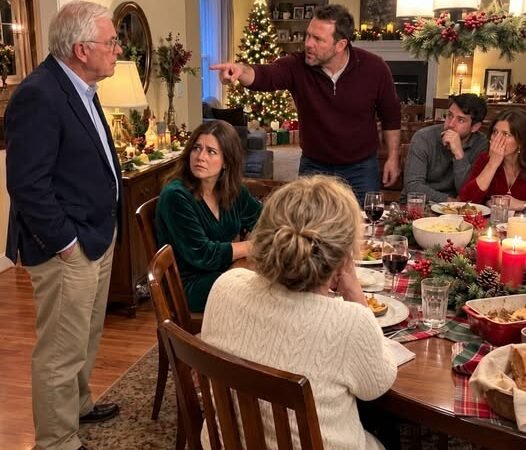
The dining table stood exactly where Daniel had pointed at me.
I stopped in the doorway.
Daniel noticed.
His face tightened.
“Dad, I’m sorry about Christmas.”
I looked at him.
“Are you sorry for what you said or because I stopped paying?”
He opened his mouth.
Then closed it.
“I don’t know,” he admitted.
It was the first truthful thing he had said to me in weeks.
Vanessa appeared from the kitchen.
“You brought your lawyer again.”
“Yes,” I said.
She rolled her eyes.
Evelyn placed a folder on the table.
“We need to discuss the letter submitted to the bank and the guardianship documents.”
Daniel frowned.
“What guardianship documents?”
Vanessa went completely still.
I watched my son turn toward her.
“What is she talking about?”
Vanessa’s lips parted.
“Daniel, don’t listen to them.”
Evelyn laid out the copies.
Daniel picked up the first page.
His eyes moved slowly across the text.
Then he read a sentence aloud.
“Thomas Mercer demonstrates increasing confusion regarding financial matters.”
He looked at me.
“Dad?”
I said nothing.
He turned another page.
“Vanessa, what is this?”
She crossed her arms.
“I was trying to protect everyone.”
“From what?”
“From losing everything!”
Daniel stared at her.
“You told someone my father couldn’t manage his own money?”
“He’s sixty-eight!”
“That’s not an answer.”
She pointed toward me.
“He forgets appointments. He repeats stories. He talks to Margaret’s photograph!”
The room went painfully silent.
I felt the blood drain from my face.
Daniel’s expression changed.
“Don’t,” he whispered.
Vanessa continued.
“He’s lonely, Daniel. He needs us. And if we had control of the assets, we could have stabilized the business and kept the house.”
I took one step toward her.
“Margaret was my wife for forty-one years.”
Vanessa looked away.
“Thomas—”
“I talk to her photograph because I miss her voice.”
My own voice shook.
“I remember the date she died. I remember the last thing she said to me. I remember every payment I made for this house.”
I pointed at the documents.
“And I remember never signing those.”
Daniel lowered the papers.
His face had turned gray.
“You knew,” he said to Vanessa. “You knew what happened to Grandpa.”
She said nothing.
“You watched Dad help him through it.”
“Daniel—”
“And you used that?”
Vanessa’s eyes filled, but her voice hardened.
“You don’t understand what I was carrying!”
Daniel stepped back.
“No. I understand exactly what you were carrying. Money you took, lies you told, and a plan to make my father look helpless.”
She turned toward me.
“You could stop this right now.”
I stared at her.
“Stop what?”
“The investigation. The bank. All of it. You have enough money.”
Evelyn quietly spoke.
“Mrs. Mercer, my client cannot simply erase the bank’s independent investigation.”
Vanessa ignored her.
“Thomas, if you loved your grandchildren, you wouldn’t do this.”
I felt something settle inside me.
Not anger.
Not revenge.
A boundary I should have drawn years earlier.
“Don’t use those children as a bargaining chip.”
Her expression twisted.
“You’re choosing money over family.”
“No,” I said. “I’m choosing not to teach my grandchildren that love means surrendering yourself to someone who hurts you.”
Daniel sat down heavily.
He covered his face.
For a long time, nobody moved.
Then he looked up.
“Dad, I knew about the loan.”
Vanessa turned sharply.
“Daniel!”
He ignored her.
“I knew your signature was on it. I knew you hadn’t mentioned it. I told myself you must have agreed because you always helped.”
His voice broke.
“I didn’t ask because I was afraid you’d say no.”
I looked at my son.
There he was.
Not the confident businessman who had humiliated me before twenty-two guests.
Just a frightened man who had made cowardice into a habit.
“And Christmas?” I asked.
He swallowed.
“Vanessa said we needed to establish boundaries before you started asking questions about the business.”
I felt the words land.
“So the rent demand was supposed to push me out.”
Daniel nodded.
“I thought you’d get angry and move somewhere else. I thought you’d keep helping with the bills anyway.”
My chest tightened.
He began crying.
“I didn’t think you’d actually leave.”
I looked at him for a long time.
“Neither did I.”
The investigation moved quickly after Daniel agreed to cooperate.
He provided business records, emails, and messages showing that Vanessa had arranged the false documents and directed the transfers.
The bank submitted its findings to investigators.
A forensic examination identified additional altered records, including a fabricated authorization bearing my name.
Vanessa hired an attorney.
Her attorney advised her not to contact me.
She contacted me anyway.
The message arrived at 11:42 one night.
You are going to regret destroying your son’s marriage.
I read it twice.
Then forwarded it to Evelyn.
I did not reply.
Over the following months, the financial consequences unfolded.
Daniel’s business entered restructuring and eventually closed. Its remaining assets were sold to satisfy legitimate debts.
The house went on the market.
Because I remained a guarantor on the original mortgage, Evelyn negotiated directly with the lender while keeping the disputed business guarantee separate.
I did not abandon obligations I had legally accepted.
But I refused to volunteer another dollar to maintain the illusion that Daniel and Vanessa could afford their old life.
The children transferred to a good public school.
The SUV was returned when the lease could no longer be maintained.
The household account was closed.
Daniel moved into a modest rental near Claire.
Vanessa moved out.
The marriage did not survive the disclosures.
Neither did Vanessa’s carefully constructed reputation.
Investigators traced the diverted loan funds through her company and established that she had used portions for personal expenses while concealing the transfers from Daniel.
She ultimately pleaded guilty to financial crimes arising from the fraudulent application and transfers.
The court ordered restitution and imposed a custodial sentence followed by supervision.
When the sentence was announced, Vanessa stood motionless.
Her attorney touched her elbow.
She looked across the courtroom at Daniel.
He did not look away.
But he did not move toward her.
I sat two rows behind him, holding my hat in both hands.
I had imagined that justice might feel like relief.
Instead, I felt the terrible weight of everything that had been destroyed.
Vanessa had made choices.
Those choices had consequences.
But Lily and Noah still had a mother.
Daniel still had years of rebuilding ahead.
And I still had a son whose face reminded me of the little boy Margaret used to lift onto the kitchen counter so he could help her make pancakes.
Outside the courthouse, Daniel approached me.
“Dad?”
I stopped.
His eyes were red.
“Do you hate me?”
I looked at the courthouse steps.
A cold wind moved between us.
“No.”
He swallowed.
“Do you forgive me?”
I took a long breath.
“Not yet.”
He nodded slowly.
I placed my hand on his shoulder.
“But I’m willing to see who you become when nobody is paying your bills.”
He began crying.
This time, I did not rescue him from the feeling.
I stood beside him until he could breathe.
Spring arrived quietly.
The snow disappeared from the sidewalks. Trees outside my apartment developed pale green buds.
I began walking every morning.
At first, I walked because I couldn’t sleep.
Then because I enjoyed the air.
Eventually, because I realized I had spent years arranging my life around other people’s emergencies.
One Saturday, Claire invited me to dinner.
She had been furious when she learned what happened at Christmas.
Not only with Daniel and Vanessa.
With herself.
“I was there,” she said as we washed dishes. “I heard him tell you to disappear.”
I handed her a plate.
“You weren’t responsible.”
“I didn’t say anything.”
“You were shocked.”
She shook her head.
“I was afraid of making things worse.”
I dried my hands.
“Claire, silence can hurt. But you came afterward. You helped the children. You told the truth when it mattered.”
Her eyes filled.
“I should have defended you.”
I smiled sadly.
“Then defend someone next time.”
She stepped forward and hugged me.
It was the kind of hug that didn’t try to fix anything.
It simply stayed.
That evening, Lily showed me a drawing Noah had made.
It showed a small house, a large tree, and four people holding hands.
One figure stood slightly apart.
“That’s you,” Noah explained.
I knelt beside him.
“Why am I so far away?”
He studied the picture.
“Because you have your own house now.”
My heart sank.
Then he pointed to the line connecting my hand to his.
“But you can still come over.”
I pulled him close.
“Yes,” I whispered. “I can.”
Daniel’s first real apology came in June.
Not in a courtroom.
Not during a crisis.
Not because he needed a payment.
He arrived at my apartment carrying a small cardboard box.
Inside were things I had left behind when I packed that single suitcase.
A wool scarf Margaret had knitted.
My old reading glasses.
A photograph from Daniel’s college graduation.
And a chipped blue coffee mug.
I lifted it carefully.
Margaret had bought it for me during a trip to Maine.
Daniel watched my hands.
“I found it in the back of the cabinet.”
I traced the chipped rim.
“Your mother hated this mug.”
He smiled faintly.
“She said it looked like something from a gas station.”
“She bought it at a gas station.”
For a moment, we laughed.
Then the laughter faded.
Daniel sat across from me.
“Dad, I’ve been going to counseling.”
I nodded.
“Claire told me.”
“I started because I wanted to prove I wasn’t like Vanessa.”
He stared at the floor.
“But I realized I didn’t need Vanessa to make me selfish.”
I waited.
“I let you pay for everything because it was easier than admitting I couldn’t afford my life. Every time you helped, I felt grateful for about five minutes. Then I felt ashamed.”
He rubbed his palms together.
“And instead of dealing with that shame, I got angry at you.”
I looked at him.
“Why?”
“Because you reminded me of what I hadn’t earned.”
His voice cracked.
“I thought if I could make you seem dependent on us, I wouldn’t have to feel dependent on you.”
The room became very still.
There it was.
The truth beneath Christmas.
Not merely greed.
A son who had mistaken his father’s generosity for an accusation against his own worth.
I leaned forward.
“Daniel, I made mistakes too.”
He shook his head.
“Dad—”
“Listen.”
He stopped.
“I helped you because I loved you. But sometimes I helped because I couldn’t bear watching you struggle. Your mother understood that better than I did.”
I looked at Margaret’s photograph.
“She used to tell me that children need roots and wings. I kept giving you roots and wondering why you never learned to fly.”
Daniel wiped his face.
“That doesn’t excuse what I did.”
“No.”
“I know.”
“But it explains why I need to do something differently now.”
He nodded.
“I don’t want your money anymore.”
I studied him.
“Then what do you want?”
He looked at me.
“My dad.”
The words nearly undid me.
I reached across the table.
He took my hand.
We sat that way for a long time.
There was no sudden restoration of trust.
No promise that everything would return to how it had been.
But for the first time in years, neither of us was pretending.
In August, Daniel started working as an operations supervisor for a small manufacturing company.
The salary was modest.
The hours were long.
He drove a used sedan and packed his lunch.
One evening, he called me from the parking lot after finishing a twelve-hour shift.
“Dad, can I tell you something ridiculous?”
“Of course.”
“I paid my electricity bill today.”
I smiled.
“Congratulations.”
“No, I mean I paid it myself. From my paycheck.”
I leaned against the kitchen counter.
“How did that feel?”
He considered.
“Terrifying.”
Then he laughed.
“And good.”
I looked out at the evening sky.
“That’s how independence usually starts.”
He was quiet.
“Dad?”
“Yes?”
“Thank you for not fixing everything.”
I closed my eyes.
“You’re welcome, son.”
The final surprise came in November.
Evelyn called and asked me to visit her office.
When I arrived, she had an envelope waiting.
It was addressed in Margaret’s handwriting.
My breath caught.
“Where did you get this?”
“Margaret left it with me several years before she died,” Evelyn said. “She instructed me to give it to you if you ever found yourself making a major decision about the family’s future without her.”
I stared at the envelope.
“Why didn’t you give it to me sooner?”
“Because until this year, you never stopped making decisions for everyone else.”
My hands trembled as I opened it.
Inside was a letter.
My dearest Thomas,
If Evelyn is giving you this, I suspect you’ve finally reached a moment when love and responsibility feel like opposite things.
You have always been a generous man. Sometimes wonderfully generous. Sometimes so generous that you forget other people must learn to carry their own weight.
I know you worry about Daniel. I worry about him too. He has a good heart, but he is frightened of failure. And you, my love, are frightened of watching him fail.
Those two fears can become a prison if neither of you is careful.
I stopped reading.
Tears blurred the page.
Evelyn quietly moved a box of tissues toward me.
I continued.
Please remember something. Our son does not need to inherit a life without difficulty. He needs to inherit the courage to face difficulty.
And you do not need to earn your place in this family by paying for it.
You earned your place the day you held Daniel for the first time and cried because his fingers were so small.
You earned it every night you came home exhausted and still read him a story.
You earned it every time you chose patience when anger would have been easier.
If one day you must say no to him, say it with love.
And if he becomes angry, let him.
He may need to lose the comfort of being rescued before he understands the comfort of being loved.
But Thomas, promise me one more thing.
Do not spend the rest of your life waiting to be needed.
Be happy.
Plant your garden. Take your walks. Buy the terrible coffee mugs you love. Let people visit you because they enjoy your company, not because you are solving their problems.
And when you think of me, don’t only remember the hospital.
Remember the kitchen. The music. The summer rain. Remember how much we laughed.
I loved you long before we had anything to give.
And I will love you long after everything else is gone.
Forever yours, Margaret.
I lowered the letter.
For a moment, I could hear her.
Not the weak voice from her final days.
Her real voice.
Warm.
Amused.
Certain.
I covered my mouth.
Then I cried in a way I had not allowed myself to cry since her funeral.
Evelyn stayed beside me.
She did not interrupt.
When I finally looked up, she was wiping her own eyes.
“She knew,” I whispered.
Evelyn smiled.
“She knew you.”
Christmas returned.
This time, there were no twenty-two guests.
No expensive centerpiece.
No elaborate dinner designed to impress people who barely spoke to one another.
I hosted eight people in my new home.
I had bought a small two-bedroom cottage in a quiet neighborhood, with a porch, a fireplace, and a garden Margaret would have loved.
Claire arrived with dessert.
Lily brought homemade cookies.
Noah carried a paper snowflake he had cut himself.
Daniel arrived last, holding a casserole dish.
“I made this,” he announced.
Claire raised an eyebrow.
“Should we be worried?”
Daniel grinned.
“Probably.”
The children laughed.
I stood in the doorway watching them.
For a moment, the sound of their voices filled the house so completely that I almost turned to tell Margaret we needed more chairs.
Then I remembered.
The ache came.
But it no longer swallowed everything around it.
Daniel noticed my expression.
“You okay, Dad?”
I nodded.
“Just remembering your mother.”
He stepped beside me.
“She would have liked this.”
“Yes,” I said. “She would.”
At dinner, nobody sat at the far end of the table.
Nobody was treated as an inconvenience.
We passed food, told stories, and laughed when Daniel’s casserole turned out to be surprisingly good.
After dessert, Lily stood.
My heart gave an involuntary jolt.
For one terrible second, I remembered another Christmas, another person standing after dessert, another room full of people waiting for words that would change everything.
Lily noticed my face.
“Grandpa?”
I smiled.
“Go ahead, sweetheart.”
She held up a small wrapped package.
“We all made you something.”
Inside was a wooden picture frame.
Noah had painted it blue.
Claire had helped attach a photograph.
Daniel had written something on the back.
The picture showed all of us standing outside my cottage in the autumn sunlight.
Margaret’s photograph was visible through the front window behind us.
I turned the frame over.
Daniel’s handwriting was uneven.
Home isn’t the place someone lets you stay.
It’s the place where nobody asks you to prove you belong.
I stared at the words.
Then I looked at my son.
He was crying quietly.
I stood and walked around the table.
He rose to meet me.
We embraced.
Not the careful hug of people trying to avoid old wounds.
A real embrace.
His arms tightened around me.
“I’m sorry, Dad,” he whispered.
“I know.”
“I love you.”
“I love you too.”
And this time, neither of us needed to add anything.
Later that evening, after everyone had gone home, I sat beside the fireplace with Margaret’s letter in my lap.
The house smelled of cinnamon, roasted vegetables, and the pine branches Lily had arranged above the mantel.
Outside, snow drifted softly past the windows.
My phone rested on the table.
No frantic calls.
No demands.
No threats.
Just a photograph Daniel had sent of Lily and Noah asleep in the back seat of his car.
Underneath it, he had written:
Best Christmas we’ve had in years. Thank you for having us.
I smiled and set the phone aside.
Then I looked at Margaret’s photograph.
“You were right,” I whispered.
The fire shifted.
A log cracked softly.
I imagined her smiling.
I thought about the man I had been one year earlier, sitting at the far end of a Christmas table, believing that if he gave enough, paid enough, endured enough, he would always have a place in his son’s life.
I wished I could tell him what I knew now.
That generosity without boundaries can become a chain.
That rescuing someone is not always the same as loving them.
That a parent can step away without abandoning a child.
And that sometimes the greatest gift a father can give his son is the chance to become a man who no longer needs saving.
I stood and carried Margaret’s letter to the small wooden desk near the window.
Beside it sat the chipped blue mug.
I filled it with tea.
Then I opened the front door.
Cold air touched my face.
The garden was covered in snow, but beneath the frozen soil, the bulbs I had planted in October were waiting for spring.
Margaret had always loved tulips.
I had planted fifty.
For the first time in years, I wasn’t waiting for someone to call and tell me what they needed.
I wasn’t calculating how much money I had to send.
I wasn’t wondering whether I was welcome.
I was simply standing on the porch of my own home, holding a warm cup in my hands, watching snow settle over a garden that would bloom when its time came.
Behind me, the house glowed with gentle light.
Ahead of me, the night was peaceful.
And somewhere in that stillness, I finally understood the difference between being needed and being loved.
One can make you feel important.
The other lets you be free.
I stepped back inside, closed the door, and turned off the porch light.
Tomorrow, Daniel would bring the children over for breakfast.
Noah wanted pancakes.
Lily wanted to help plant the remaining bulbs when the ground softened.
Claire had promised to come by with coffee.
There would be ordinary days ahead.
Imperfect days.
Days when old memories hurt and forgiveness required patience.
But there would also be laughter, birthdays, quiet Sunday afternoons, and new traditions that belonged to us rather than to the people we had once pretended to be.
I placed Margaret’s letter beside her photograph.
“Goodnight, my love.”
Then I went upstairs.
And for the first time since she died, the silence of my home did not feel empty.
It felt like peace.