PART 2
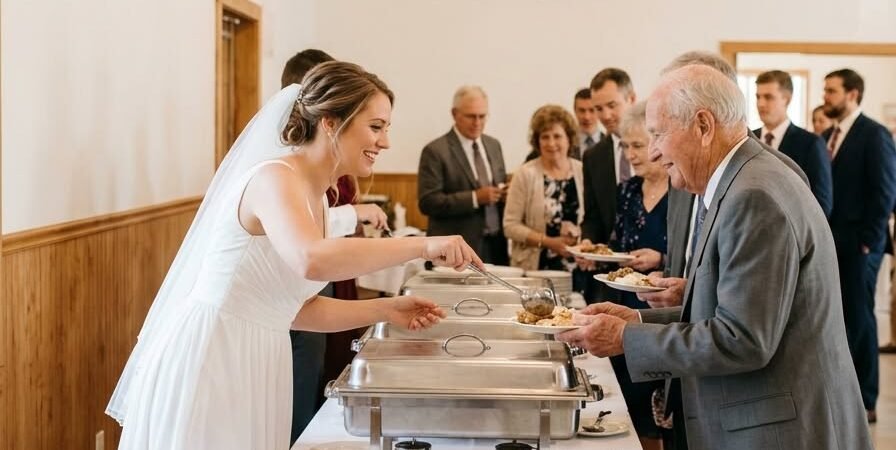
“Roast beef or chicken, Mrs. Whitcomb?”
Derrick’s mother stared at me as though I’d lost my mind.
“What?”
I held the clean plate across the steam table. “There’s roast beef, mashed potatoes, green beans, and rolls. Daddy paid for a hundred and forty dinners, and I’d hate to waste yours.”
Her mouth tightened. “Amy Jo, this is not the time to play games.”
“I’m not playing.”
She glanced toward the tables. My father’s relatives had stopped eating. Derrick’s aunt was watching us from beside the coffee urn. Even the band had grown quiet.
“I came for my mother’s ring,” Mrs. Whitcomb said. “And I expect an answer about the money.”
I set the plate down.
“You’ll have the ring, Mrs. Whitcomb. It belonged to your mother, and I wouldn’t dream of keeping something that means so much to your family.”
Her shoulders relaxed.
Then I continued.
“But as for that nine thousand dollars, you’ll need to discuss it with the people who made those arrangements. I didn’t book the rehearsal supper, and I didn’t book the honeymoon cruise. I certainly didn’t cancel a wedding.”
Her face reddened. “My son is devastated.”
I looked at her.
For one long moment, I couldn’t speak.
Then I asked quietly, “Is he?”
She opened her mouth, but I kept going.
“Because I’ve called him eleven times today. He’s answered none of them. He didn’t even have the decency to tell me himself that he wasn’t coming.”
A murmur moved through the room.
Mrs. Whitcomb glanced toward the head table, where Daddy sat with his hands folded beside his untouched dinner.
“You don’t understand what Derrick has been going through.”
“Then maybe Derrick should have told me.”
She gripped her purse.
I reached for the ring.
It had been beautiful when Derrick slipped it onto my finger beneath the oak tree behind his parents’ house. A small round diamond in an old-fashioned gold setting, with delicate engraving along the band.
I’d loved it because it had belonged to his grandmother.
I’d believed he was giving me something precious, something that meant I would become part of his family.
Now I slid it off.
For a moment, the pale indentation it left on my finger seemed more painful than the empty space around me.
I wrapped the ring in a clean napkin, set it on the plate, and held it out.
“There you go.”
Mrs. Whitcomb looked down.
She had clearly expected me to cry, refuse, or beg to keep it.
Instead, I gave it back before she’d even finished her argument.
She picked it up slowly.
Then looked at me.
“And the nine thousand?”
I took a breath.
“I’m not discussing a bill for somebody else’s decision in the middle of the dinner my father paid for.”
She stared at me.
“Now, would you like some supper?”
Her expression hardened.
“No, thank you.”
I nodded.
“Then at least stay for cake. It’s already been cut, and Grandma June says the lemon filling is the best she’s tasted in eighty-four years.”
A few people laughed softly.
Mrs. Whitcomb didn’t.
She turned sharply and walked toward the exit.
I watched her go.
Then I picked up my serving spoon.
“Harold, honey, you still want extra gravy?”
The old man held out his plate.
“You know I do.”
And just like that, the line began moving again.
I didn’t fall apart until somebody started playing our first-dance song.
The band hadn’t meant any harm. They were simply following the list Derrick and I had given them weeks earlier.
The opening notes floated across the VFW hall while I was standing beside the cake table.
It was an old country ballad about loving somebody for the rest of your life.
I recognized it immediately.
So did Daddy.
He looked toward the musicians, then toward me.
The bandleader caught his expression and reached for the microphone, apparently preparing to apologize.
But Grandma June was faster.
She pushed herself upright with her cane.
“Raymond!”
Daddy stood.
“Yes, Mama?”
“Come here and dance with me.”
He blinked.
“Mama, my knees aren’t what they used to be.”
“Neither are mine. That’s why I’m asking before one of us falls over.”
People laughed.
Daddy looked at me.
I smiled through the tears gathering in my eyes.
“Go on.”
He took Grandma’s hand and led her onto the floor.
She was tiny beside him, her silver hair arranged in the same careful curls she’d worn for decades.
Daddy put one hand at her waist.
Grandma rested hers on his shoulder.
Then they began moving.
Slowly.
Not particularly gracefully.
But with such obvious affection that everyone started clapping.
Someone called, “Go on, Miss June!”
Grandma lifted her cane like a trophy.
And the whole room erupted.
I laughed so hard I started crying.
Then the laughter stopped.
The tears didn’t.
I turned toward the kitchen, hoping nobody would notice.
But Daddy noticed.
He always did.
He found me near the back entrance, sitting on an overturned milk crate with my bouquet in my lap.
The late afternoon sun was spilling across the parking lot. Through the wall, I could hear the band beginning another song.
Daddy sat beside me.
For a while, neither of us spoke.
Then he asked, “Want me to take you home?”
I shook my head.
“Not yet.”
He nodded.
A minute passed.
Then another.
Finally, I whispered, “Did I do something wrong?”
Daddy turned toward me.
“Amy Jo.”
I kept staring at the flowers.
“We were together six years. We picked that church. We chose the music. He helped me taste the cakes. Last Sunday, he was arguing about whether we should get a dog.”
My voice cracked.
“How does somebody go from talking about a dog to leaving you standing in a wedding dress?”
Daddy didn’t answer immediately.
Then he said, “I don’t know why Derrick did what he did.”
I looked up.
“But I know a man who isn’t ready to marry ought to say so before a hundred and forty people put on their Sunday clothes.”
I tried to smile.
He continued.
“And he ought to say it to the woman he promised to marry. Not send six words through his brother.”
I began crying harder.
Daddy moved closer and put his arm around me.
I leaned against his shoulder.
The fabric of his new suit smelled faintly of aftershave and the peppermint candies he always kept in his pocket.
For a moment, I was eight years old again, crying because I’d fallen off my bicycle.
Only this time, Daddy couldn’t fix what hurt.
After a while, he reached into his coat pocket.
He pulled out the envelope Derrick’s sister had given me.
I stared at it.
“Daddy, please don’t.”
He turned it over.
On the back, the two expenses were still written in pencil.
Rehearsal supper: $2,100.
Honeymoon cruise: $6,900.
Total: $9,000.
Daddy studied it.
Then folded it once.
Carefully.
“I’m keeping this.”
“Why?”
“Because when somebody hands my daughter a bill on the day her wedding falls apart, I want to remember exactly who thought that was appropriate.”
I wiped my cheeks.
“Daddy, don’t start a fight.”
He shook his head.
“I’m not planning a fight.”
Then he looked at me.
“I’m just done pretending people can hurt you and then charge you for the inconvenience.”
By seven o’clock, the supper had become something none of us could have planned.
The bridesmaids had changed out of their matching shoes. My cousin Brenda was dancing with Harold, who’d taken off his jacket and folded it over a chair.
Grandma June had convinced the band to play an old waltz, then complained that the drummer was going too fast.
The children were running between tables with paper napkins tucked into their collars.
Someone had begun taking photographs.
Not wedding photographs.
Just pictures of people being together.
In one, my aunt was laughing so hard she couldn’t hold her cake plate straight.
In another, Daddy was dancing with Grandma.
And in a third, I was standing beside the buffet wearing my wedding gown and white sneakers, handing a slice of lemon cake to a little girl who had asked whether I was a princess.
I told her no.
She considered that.
Then asked, “Can you still be one if you don’t get married?”
I laughed.
“I suppose you can.”
She nodded as though that settled it and went running back to her table.
I watched her go.
For the first time all day, my chest didn’t feel quite so tight.
Then Derrick’s sister approached me.
Her name was Beth.
She was twenty-six, three years younger than Derrick, and usually so quiet at family gatherings that I’d sometimes wondered whether anybody ever asked what she thought.
Tonight, she looked miserable.
“Amy Jo?”
I turned.
“Hey, Beth.”
She glanced toward the tables.
“Can we talk somewhere private?”
I studied her face.
“Is Derrick okay?”
She nodded quickly.
“Yes. He’s fine.”
Then her eyes filled.
“But there’s something you need to know.”
We stepped into the small hallway beside the coatroom.
Beth closed the door behind us.
For a moment, she stared at her hands.
Then she whispered, “I’m sorry I brought you that envelope.”
I shrugged.
“You didn’t write it.”
“No. But I handed it to you.”
I looked at her.
She took a breath.
“Mom told me to make sure you saw it before you left the church.”
My stomach tightened.
“Before I left?”
Beth nodded.
“She wanted you to understand what the family had spent.”
I stared at her.
Then asked, “Beth, when did your mother write that list?”
She hesitated.
I waited.
Finally, she whispered, “Yesterday.”
For several seconds, I couldn’t speak.
Yesterday.
The day before our wedding.
I felt my heartbeat begin pounding in my ears.
“Why would she write me a bill yesterday?”
Beth looked down.
Then she said something that made the hallway seem to tilt.
“Because Derrick told her on Wednesday that he didn’t think he could marry you.”
I gripped the edge of a nearby table.
Wednesday.
Three days before the ceremony.
The day he’d called to tell me he loved me.
The day he’d reminded me to pack the little overnight bag for our hotel after the reception.
I stared at Beth.
“He knew?”
She began crying.
“He said he was having serious doubts. Mom told him everybody gets nervous before a wedding.”
I swallowed.
“Did he tell her he wanted to call it off?”
Beth nodded.
“Yes.”
I closed my eyes.
She continued.
“He said he didn’t know whether he wanted to be married at all. Mom got angry. She told him he’d embarrass the entire family if he backed out.”
I stared at her.
“And what did Derrick say?”
“He said he needed time.”
My hands were shaking.
Beth wiped her cheeks.
“Mom told him to stop being dramatic and get through the ceremony.”
I couldn’t speak.
Then Beth whispered, “Yesterday morning, she made that list because she was worried he’d still refuse. She kept saying somebody would have to pay for the embarrassment.”
I felt sick.
For three days, Derrick had known he might not walk down the aisle.
His mother had known.
Apparently, his sister had known enough to be frightened about what might happen.
And nobody had told me.
My father had paid the caterer.
I’d finalized the seating chart.
My bridesmaids had arrived.
The florist had delivered everything.
And I’d spent Friday evening carefully writing my vows because I believed I was marrying a man who wanted to be my husband.
I looked at Beth.
“Did Derrick know his mother planned to demand the money from me?”
She hesitated.
“I don’t know what he knew about the envelope. I do know she talked about getting the cruise money back.”
I closed my eyes.
Then asked quietly, “Beth, did you know he wasn’t coming today?”
She began crying harder.
“Not until this afternoon. I honestly thought he’d go through with it.”
I nodded.
I believed her.
But the truth still hurt.
Because the decision I’d thought had happened suddenly at three o’clock had been building for days.
And the family that knew had allowed me to walk into the church with flowers in my hands.
Beth reached toward me.
Then stopped.
“I’m sorry.”
I looked down at my dress.
The lace my aunt had helped sew.
The tiny pearl buttons down the back.
The hem I’d worried might drag on the church steps.
For weeks, I’d been so concerned about making everything perfect.
And all that time, the most important person had been wondering whether he wanted to be there.
I took a shaky breath.
“Beth, thank you for telling me.”
She nodded.
Then whispered, “I wish I’d told you sooner.”
I looked at her.
“So do I.”
When I returned to the hall, Grandma June was sitting beside the cake table with a plate balanced on her knees.
She took one look at my face.
“What’s happened now?”
I sat beside her.
“Derrick told his mother three days ago that he might not marry me.”
Grandma stopped chewing.
For a moment, she simply stared.
Then she put down her fork.
“Three days?”
I nodded.
“And nobody thought to mention it to the bride?”
I shook my head.
Grandma looked toward the ceiling.
“Well, Lord, I’ve seen some foolishness in my eighty-four years, but this family is trying to win a prize.”
Despite everything, I laughed.
Then I started crying again.
Grandma reached for my hand.
“Come here, child.”
I leaned toward her.
She patted my shoulder.
For a while, neither of us spoke.
Then she said, “You know what your grandfather told me before we married?”
I wiped my cheeks.
“What?”
“He said he couldn’t promise we’d never be poor, never argue, or never disappoint each other. But he promised he’d never make me face the hard things alone.”
My throat tightened.
Grandma looked at me.
“Your Derrick had three days to tell you he was scared.”
I nodded.
“Three days to sit down, look you in the eye, and tell you the truth.”
More tears.
“Instead, he let you put on that dress and walk into that church.”
She squeezed my hand.
“That’s not a man who was ready to keep a marriage promise.”
I stared at the cake.
Then whispered, “But I loved him.”
Grandma’s expression softened.
“I know you did.”
“And I thought he loved me.”
“He might have.”
I looked at her.
She continued.
“But loving somebody and being prepared to stand beside them when life gets difficult are two different things.”
For a moment, I couldn’t speak.
Then Grandma picked up her fork.
“Now, eat some cake.”
I laughed through my tears.
“Grandma!”
“What? Crying on an empty stomach won’t improve a thing.”
She cut me an enormous slice.
And I ate it.
By nine o’clock, the guests began leaving.
Some hugged me without saying anything.
Others told me they’d never forget the evening.
A few looked uncomfortable, unsure whether they should mention Derrick.
I appreciated the ones who didn’t try to explain what had happened.
They simply hugged me.
Derrick’s aunt kissed my cheek and whispered, “You deserved better today.”
My old high school teacher said she’d never seen a bride serve dinner in her wedding dress.
Harold asked whether I had any extra roast beef he could take home.
I filled a container for him.
When the last song ended, I helped Daddy gather the decorations.
He insisted the caterers could handle everything.
But I wanted something to do with my hands.
My bouquet sat on an empty chair.
I picked it up.
The flowers were already beginning to wilt.
For a moment, I stared at them.
Then Daddy came beside me.
“You ready?”
I nodded.
He looked toward the empty dance floor.
“Your mama would’ve been proud of you tonight.”
My throat tightened.
Mama had been gone for nearly six years.
She’d always said I worried too much about what other people thought.
Whenever something embarrassed me, she’d remind me that most people were too busy thinking about their own problems to spend much time judging mine.
I wished I could hear her voice.
I wished she could tell me what to do next.
Daddy must have seen something in my face.
He put an arm around me.
“Come on, sweetheart. Let’s go home.”
I looked around the hall one final time.
There were empty chairs, folded napkins, and a few forgotten programs.
The cake was nearly gone.
The band had packed up.
The evening was over.
But I hadn’t spent it alone.
And somehow, that mattered more than I could explain.
At 6:18 the following morning, Derrick finally called.
I was sitting at Daddy’s kitchen table wearing one of Mama’s old sweatshirts.
My wedding dress was hanging in the spare bedroom.
Grandma June was asleep down the hall.
Daddy had gone outside to feed the chickens.
I stared at Derrick’s name.
For a moment, I considered ignoring it.
Then I answered.
“Hello.”
He exhaled.
“Amy Jo.”
I said nothing.
His voice trembled.
“I’m so sorry.”
I stared at the kitchen window.
“Why didn’t you come?”
There was a pause.
Then he whispered, “I panicked.”
I closed my eyes.
“I know you panicked, Derrick. I want to know why you didn’t tell me.”
He hesitated.
Then began talking about pressure.
His mother’s expectations.
The money spent.
The wedding getting bigger than he’d wanted.
How overwhelmed he’d felt.
I listened.
For six years, I’d listened whenever Derrick needed to work through something.
When he hated his job.
When he argued with his brother.
When his mother criticized his decisions.
I’d sat beside him, heard him out, and tried to understand.
But this time, I wasn’t going to lose sight of the question.
“Derrick, did you know on Wednesday that you didn’t want to marry me?”
Silence.
Then he whispered, “I wasn’t sure.”
“Did you tell your mother?”
“Yes.”
“And you didn’t tell me?”
He began crying.
“I thought the feeling would pass.”
I looked down at my bare left hand.
“You let me spend Friday night writing my vows.”
“I know.”
“You let my father pay for a hundred and forty dinners.”
“I know.”
“You let me put on my mother’s pearl earrings and stand in that church waiting for you.”
His breathing became uneven.
“Amy Jo, please.”
My eyes filled.
Then I asked quietly, “Were you ever going to tell me yourself?”
He didn’t answer.
And somehow, his silence hurt more than anything he’d said.
Derrick asked whether we could meet.
I refused at first.
Then I decided there were a few practical things we needed to settle.
We had gifts to return.
A wedding website to update.
Shared arrangements to cancel.
And six years of belongings scattered between our two apartments.
But I wasn’t willing to meet alone in some romantic place where he’d ask me to remember how happy we’d once been.
We arranged to meet at a café on Monday afternoon.
He arrived ten minutes early.
When I walked inside, he stood.
His eyes were red.
He looked as though he hadn’t slept.
For a moment, I felt the familiar urge to hug him.
Instead, I sat down.
He reached across the table.
I kept my hands in my lap.
He slowly pulled his back.
“Amy Jo, I made the biggest mistake of my life.”
I looked at him.
“You made a decision.”
He shook his head.
“I didn’t want to hurt you.”
“But you knew you might not come.”
He looked down.
“Yes.”
“And you said nothing.”
Tears filled his eyes.
“I was scared.”
I took a breath.
“Derrick, do you know how scared I was standing in that church?”
He began crying.
“I know.”
“No. You don’t.”
My voice shook.
“I thought you’d been in an accident. For the first twenty minutes, I wasn’t embarrassed. I was terrified something had happened to you.”
He covered his face.
“I kept calling because I thought you were hurt.”
I swallowed.
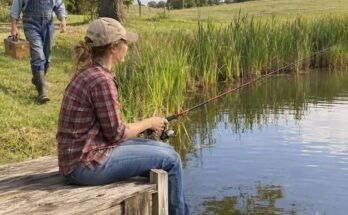
“And when your brother finally reached you, you were sitting by the lake.”
He looked up.
I continued.
“You were safe. You just didn’t want to come.”
Derrick began sobbing.
For a moment, I almost felt sorry for him.
Then I remembered my father standing in the bride’s room wearing his new suit.
Grandma June waiting with her cane.
A hundred and forty people wondering what had happened.
And me, clutching a bouquet while somebody handed me a bill.
I took a slow breath.
“Derrick, I could have survived you telling me on Wednesday that you weren’t ready.”
He looked at me.
“It would’ve hurt. I would’ve cried. We might have ended things.”
My voice broke.
“But I wouldn’t have spent Saturday waiting for a man who already knew he might not come.”
He sat quietly for a long time.
Then he asked, “Is there any chance we could try again?”
I looked at him.
The question hurt more than I expected.
Because a part of me still loved him.
I couldn’t turn six years of affection off in one weekend.
I remembered the good things.
The ordinary Sunday mornings.
The way he’d bring me coffee before I got out of bed.
The little notes he’d leave on my car windshield.
The evenings we spent talking about buying a house and starting a family.
Those memories were real.
But so was Saturday.
I looked at him.
“I don’t know how I could ever stand at an altar with you again.”
He began crying.
I continued.
“I would spend the entire morning wondering whether you were coming.”
He lowered his head.
For a while, neither of us spoke.
Then Derrick whispered, “I didn’t deserve how kind you were to my family.”
I looked up.
“What do you mean?”
“The dinner. Mom told me what happened.”
I sighed.
“She wanted the ring.”
He nodded.
“I know.”
“And nine thousand dollars.”
His expression changed.
For a moment, he looked genuinely confused.
“What?”
I studied him.
“She brought a list. Twenty-one hundred for the rehearsal supper. Sixty-nine hundred for the honeymoon cruise.”
He stared at me.
Then said something unexpected.
“Amy Jo, the cruise wasn’t canceled.”
I stopped breathing.
“What?”
He looked down.
“The reservation is still active.”
I stared at him.
“But your mother said the family was out sixty-nine hundred dollars.”
Derrick closed his eyes.
“Mom bought the trip as a wedding present. The travel agent told her there might be options for changing or canceling it, depending on the fees. I haven’t arranged anything yet.”
My hands began trembling.
“Then why is she demanding the entire amount from me?”
He looked miserable.
“I don’t know.”
I stared at him.
Then I asked, “And the rehearsal supper?”
He swallowed.
“Mom wanted to host it. She chose the restaurant.”
I nodded slowly.
“And she wants me to repay it?”
He looked down.
For the first time since we’d sat together, anger crossed his face.
“I’ll talk to her.”
I shook my head.
“No, Derrick. You’ll handle your family’s expenses because you’re the one who didn’t come to the wedding. Whatever arrangements they made with vendors are between them and those vendors.”
He nodded.
“I know.”
Then he whispered, “I’ll make sure she stops bothering you.”
I took a breath.
“Thank you.”
I stood.
He looked up, frightened.
“Amy Jo?”
I picked up my purse.
“Yes?”
He swallowed.
“I really did love you.”
My throat tightened.
I looked at him for a long moment.
Then answered honestly.
“I believe you. I just needed you to love me enough to tell me the truth.”
And I walked away.
Mrs. Whitcomb called twice that week.
I didn’t answer.
Then she sent a letter.
It was typed on cream-colored stationery with her name embossed across the top.
She thanked me for returning the ring.
Then she repeated her request for reimbursement.
Apparently, she still believed I should contribute toward the expenses because the wedding hadn’t taken place.
I showed the letter to Daddy.
He read it at the kitchen table.
Then he folded it.
Carefully.
Exactly as he’d folded the envelope on Saturday.
“Daddy, please don’t get upset.”
He looked at me.
“Amy Jo, do you feel you owe them this money?”
I shook my head.
“No.”
“Did you ask his mother to buy that cruise?”
“No.”
“Did you choose the rehearsal supper?”
“No.”
“Did you decide not to marry Derrick?”
I swallowed.
“No.”
Daddy nodded.
“Then we’ll have somebody qualified review any actual obligations before you agree to pay a cent.”
I smiled faintly.
He reached across the table.
“Your mother and I taught you to pay your debts, sweetheart. We never taught you to accept everybody else’s.”
We kept the letters and receipts, and I got advice about the expenses and canceled arrangements. I also made sure that any gifts we’d received as a couple were handled properly rather than simply keeping things that weren’t mine.
The written demand didn’t establish that I owed Derrick’s family nine thousand dollars. No agreement was produced showing I’d promised to reimburse his mother for those purchases.
Eventually, the demands stopped.
Not with a dramatic apology.
Not with a heartfelt admission that she’d behaved terribly.
They simply stopped.
And I discovered that silence could be a wonderful thing when it meant nobody was asking me to pay for being abandoned.
The photographs from the supper arrived three weeks later.
I almost didn’t open them.
The photographer had been kind enough to offer a selection of pictures without charging for an elaborate wedding album.
She said there were moments worth keeping.
I wasn’t sure I believed her.
Then I opened the folder.
The first photograph showed Daddy standing in the church, making his announcement.
His shoulders were straight.
His expression was serious.
Behind him, the organist sat with her hands folded.
The next showed Harold raising his hand from the fourth row.
Then came the VFW hall.
Grandma June dancing with Daddy.
My cousins laughing.
Children eating cake.
And me, standing beside the buffet in my wedding dress and sneakers.
I studied that picture for a long time.
I wasn’t smiling.
Not exactly.
But I wasn’t defeated either.
My eyes were tired.
My cheeks were flushed.
And I was handing somebody a plate of roast beef.
I looked like a woman who had been hurt terribly and was still trying to make sure nobody went hungry.
Then I found another photograph.
It showed Daddy and Grandma dancing.
Her cane was resting against a chair.
His head was bent toward hers.
She was laughing.
Really laughing.
I pressed the photograph against my chest.
Mama had died before I got engaged.
She never met the version of me who thought she’d found the man she’d marry.
But she’d have loved that photograph of her husband and his mother.
I knew she would.
And suddenly, for the first time since the wedding, I was grateful we’d kept the reception.
Because that picture wouldn’t have existed if we’d all gone home.
Two months later, Grandma June asked me to come over.
She was sitting at her kitchen table with an old shoebox.
“Sit down, honey.”
I pulled out a chair.
She pushed the box toward me.
Inside were photographs.
Grandma as a young woman.
Grandpa in his military uniform.
Their wedding day.
Their first house.
A black-and-white picture of Daddy as a little boy standing beside a bicycle.
I smiled.
“Grandma, I’ve never seen some of these.”
She nodded.
“Most people haven’t.”
Then she pulled out one more photograph.
It showed her standing beside Grandpa in a simple white dress.
There were perhaps twenty people gathered outside a little church.
No fancy decorations.
No elaborate cake.
No hired band.
Grandma studied it.
“We didn’t have much money.”
I smiled.
“I know.”
“Your grandfather borrowed a car to take me to the church.”
I laughed.
“He did?”
She nodded.
“And the flowers came from my mother’s garden.”
She looked down at the picture.
“We were married fifty-two years.”
My throat tightened.
Grandpa had died twelve years earlier.
Grandma touched his face in the photograph.
Then she looked at me.
“Amy Jo, I was proud to marry that man.”
I nodded.
“But I wasn’t proud because we had a wedding.”
I listened.
“I was proud because I knew he’d show up for me when things got hard.”
My eyes filled.
Grandma leaned closer.
“That’s what you want, honey. Somebody who’ll show up.”
For a moment, I couldn’t answer.
Then I whispered, “I thought Derrick was that person.”
She nodded.
“I know.”
She took my hand.
“And that makes what happened sad. But it doesn’t make your judgment worthless or your future ruined.”
I began crying.
Grandma reached for the shoebox.
Then handed me the photograph of our dance at the VFW.
“I want you to keep this one.”
I smiled through my tears.
“Grandma, that’s your picture.”
She shook her head.
“It’s yours.”
Then she added with a grin, “I look mighty good in it, though.”
I laughed.
And tucked the photograph carefully into my purse.
The months that followed weren’t easy.
People in town knew what had happened.
Some were kind.
Others were curious.
A few asked questions that made me wish I could disappear behind the canned goods at the grocery store.
“Have you heard from Derrick?”
“Do you think he’ll come back?”
“Did his mother really try to charge you for the honeymoon?”
I learned to answer briefly.
“Yes, I’ve heard from him.”
“No, we’re not getting married.”
“And I’d rather not discuss the rest.”
At first, I felt embarrassed.
I worried that people would see me as the woman whose fiancé had left her standing at the altar.
Then I realized something.
I hadn’t done anything shameful.
I’d kept my promises.
I’d arrived on time.
I’d stood ready to marry somebody I loved.
The person who failed to show up wasn’t me.
There was no reason for me to carry his embarrassment.
Eventually, I stopped avoiding the places where people might recognize me.
I went back to church.
I attended birthday parties.
I had dinner with friends.
And little by little, life became something other than the day Derrick didn’t show up.
One afternoon, Beth came to see me.
She brought a small paper bag from the bakery.
Inside were two lemon cupcakes.
I laughed when I opened it.
“Are you trying to make me hate lemon cake?”
She smiled sadly.
“I thought you might appreciate something that wasn’t served at a wedding.”
We sat on the porch.
For a while, we talked about ordinary things.
Her new job.
A neighbor’s dog.
The weather.
Then Beth became quiet.
“Amy Jo, I’ve wanted to apologize properly.”
I looked at her.
She continued.
“I knew Derrick was having doubts. I should have told you.”
I took a slow breath.
“Yes, Beth. You should have.”
She nodded.
“I kept telling myself it wasn’t my business. That he would figure it out.”
I looked down.
“I think everybody was hoping the problem would disappear if nobody said anything.”
She wiped her eyes.
“That’s exactly what happened.”
For a while, neither of us spoke.
Then she said something that surprised me.
“Derrick’s been seeing a counselor.”
I looked up.
“He has?”
She nodded.
“He’s trying to understand why he couldn’t tell you the truth.”
I stared toward the yard.
I still cared about Derrick.
A part of me probably always would.
But I was relieved that he was finally talking to someone who might help him make better decisions.
“I’m glad,” I said.
Beth looked at me.
“Are you?”
I nodded.
“Yes. I don’t want him to spend the rest of his life hurting people because he’s afraid of disappointing his mother.”
She became quiet.
Then smiled sadly.
“Neither do I.”
We finished our cupcakes.
And for the first time, talking about Derrick didn’t ruin my entire afternoon.
A year after the wedding, Daddy asked whether I’d like to go dancing.
I laughed.
“With you?”
He looked offended.
“I’ll have you know I was considered quite a dancer in my younger days.”
I smiled.
“By whom?”
“Your mother.”
I burst out laughing.
He grinned.
Then explained that the VFW was holding a fundraiser, and Grandma June wanted to go.
“She says you owe her another dance.”
I smiled.
“Then I suppose we better go.”
That Saturday, I wore a blue dress and comfortable shoes.
Not white sneakers this time.
When we arrived, several people recognized us from the previous year’s supper.
Harold was there.
He waved from beside the dessert table.
Grandma June immediately demanded that Daddy take her onto the floor.
He obeyed.
I sat watching them.
For a moment, I remembered the previous year.
The wedding gown.
The serving spoon.
The lemon cake.
The way I’d forced myself not to cry while Mrs. Whitcomb demanded her mother’s ring.
I thought the memory would hurt.
It did.
A little.
But something else came with it.
Gratitude.
For Daddy.
For Grandma.
For the guests who’d stayed.
For the people who had managed to turn a humiliating afternoon into an evening filled with kindness.
Then Harold appeared beside me.
He was wearing the same brown suit.
“Amy Jo, would you care to dance?”
I laughed.
“Harold, are you sure?”
He grinned.
“Girl, I survived seventy-eight years. I think I can survive one song.”
I took his hand.
And we danced.
Three years have passed since that Saturday.
Derrick and I never married.
We spoke occasionally during the months afterward to settle practical matters, but eventually those conversations ended too.
He moved to another town and later sent me a note apologizing again.
I didn’t respond.
Not because I hated him.
Because I no longer needed another apology to keep living my life.
Mrs. Whitcomb never became my mother-in-law.
I returned her ring, and that chapter of our relationship ended.
Daddy is doing well.
He still wears his new suit for special occasions, though the elbows have begun to shine from use.
Grandma June is eighty-seven now.
She complains about her knees but refuses to stop dancing.
Harold still comes to the VFW whenever there’s a good supper.
And I still have the photograph of Daddy dancing with Grandma on the night I was supposed to get married.
It’s framed in my living room.
People sometimes ask why I keep a picture from such a painful day.
I smile.
Then I tell them it’s not a photograph of a failed wedding.
It’s a photograph of the people who showed up.
Last Sunday, Grandma came over for lunch.
Afterward, we sat on the porch drinking sweet tea.
She studied the flowers in my yard.
Then asked, “You happy, honey?”
I thought about it.
Three years earlier, I might have given her the answer I thought she wanted.
I’d have said yes quickly.
Smiled.
Changed the subject.
But I’d learned to be more honest with myself.
“Most days,” I said.
Grandma nodded.
“That’s about as much as anybody gets.”
I laughed.
She smiled.
Then asked, “You ever think about marrying again?”
I looked toward the yard.
“Sometimes.”
She waited.
I continued.
“But I don’t feel like I’m waiting for somebody anymore.”
Grandma’s expression softened.
“Good.”
I smiled.
She took another sip of tea.
Then said, “You know what I liked best about that supper?”
I laughed.
“The cake?”
“Besides the cake.”
I thought for a moment.
“The dancing?”
She shook her head.
Then she looked directly at me.
“You didn’t let somebody else’s bad decision decide how you were going to treat everybody who came to love you.”
My throat tightened.
I looked down.
Grandma continued.
“You could have sent everybody home angry. Nobody would have blamed you.”
I nodded.
“But you fed them.”
She smiled.
“You gave them music. You danced. And you let people be kind to you when you needed it.”
For a moment, I couldn’t speak.
Then I whispered, “I nearly didn’t.”
Grandma nodded.
“I know.”
She leaned back in her chair.
“That’s what makes it worth remembering.”
Sometimes I still think about Mrs. Whitcomb standing across the steam table.
Her navy dress.
Her handbag.
The keys in her hand.
The way she demanded the ring as though she were collecting something from a failed business transaction.
I remember sliding the ring from my finger.
I remember setting it on a clean plate.
And I remember how much it hurt to let go of something that had once represented the future I wanted.
But I don’t regret giving it back.
The ring belonged to her family.
The promises attached to it had already been broken.
I didn’t need to keep a diamond to prove that six years had mattered.
And I didn’t need to accept a nine-thousand-dollar bill to prove I was a decent person.
I had loved Derrick.
That was true.
I’d trusted him.
That was true too.
He had failed to tell me something I deserved to know before the wedding.
And no amount of love could change the fact that he’d let me stand there waiting.
I spent a long time wondering whether I should have seen the signs.
Whether I had pushed too hard.
Whether I’d been too excited about the wedding.
Whether there was something I could have said to make him stay.
Eventually, I stopped.
Because marriage isn’t supposed to require one person to convince the other to show up.
That’s a decision two people are meant to make freely.
And if one person isn’t ready, the kindest thing they can do is tell the truth before everybody else has built their future around a promise they can’t keep.
I wish Derrick had done that.
But he didn’t.
And I couldn’t spend the rest of my life wishing a different man had stood at the altar.
A few weeks ago, I found my old wedding program while cleaning a drawer.
It was folded between two photographs.
Our names were printed across the front.
Below them was the date.
The day I’d spent nearly a year preparing for.
I held it for a long time.
Then I turned it over.
On the back, in Grandma June’s handwriting, were four words.
Eat. Dance. Keep living.
I began laughing.
Then crying.
She must have written them sometime during the supper.
I didn’t remember seeing them before.
I carried the program into the living room and placed it beside the photograph of Grandma dancing with Daddy.
For a moment, I looked at the two together.
The program showed the future I’d planned.
The photograph showed what actually happened.
And I realized that both belonged to my story.
One was the dream I lost.
The other was the love that remained.
I didn’t need to hide either.
That evening, Daddy called.
“What are you doing, sweetheart?”
I smiled.
“Looking at old pictures.”
“Good ones?”
I looked toward the framed photograph.
“The best.”
He laughed.
Then asked whether I wanted to come over for Sunday dinner.
I said yes.
And while we talked, I thought about the hundred and forty people who had come to my wedding.
Some had driven hours.
Some had bought new clothes.
Some had arranged babysitters.
All had expected to watch Derrick and me begin a marriage.
Instead, they’d watched something very different.
A father stand beside his daughter.
An eighty-four-year-old grandmother claim the dance she’d always wanted.
An old man accept a plate of roast beef in the suit he’d worn to his own wedding.
A room full of people choose kindness when an afternoon went terribly wrong.
And a woman in a wedding dress discover that losing one person’s promise didn’t mean losing everyone who loved her.
My groom didn’t show up for our wedding. His mother arrived demanding her family ring and nine thousand dollars.
I returned the ring, refused to accept responsibility for expenses I hadn’t agreed to repay, and invited her to stay for cake.
She didn’t stay.
But a hundred and forty other people did.
They ate the dinner my father bought.
They listened to the band.
They danced with my grandmother.
They helped turn the most humiliating day of my life into a memory that wasn’t entirely painful.
And when I look back now, I don’t remember only the empty place where Derrick should have been.
I remember Daddy standing beside me in his new suit.
Grandma June waving her cane.
Harold asking for extra gravy.
And the way everybody began clapping when my father took his mother onto the dance floor.
For a long time, I thought the most important part of a wedding was the person waiting at the altar.
Now I know there’s something important to be said for noticing everyone else who came.
Derrick didn’t show up to marry me.
But the people who truly loved me showed up to help me through it.
And three years later, those are still the people sitting at my table.
Those are the people whose photographs hang on my walls.
Those are the people I call when something wonderful happens—or when everything falls apart.
Because Grandma June was right about one thing.
You can’t always decide what other people will do.
You can’t make someone keep a promise.
And you can’t stop a person from disappointing you simply because you’ve loved them faithfully.
But you can decide what happens after they do.
That Saturday, I lost a wedding. I didn’t lose my dignity, my family, or my future.
And when the band played the song that was supposed to be my first dance, I learned something I’ll never forget.
The wrong person may leave you standing alone at the altar. But the right people will get up, take your hand, and remind you that the music hasn’t stopped.