PART 2
Eight minutes after I switched off the intercom, someone knocked on my office door.
It was Ben Torres, my workshop supervisor.
“Paige, we’ve got a problem.”
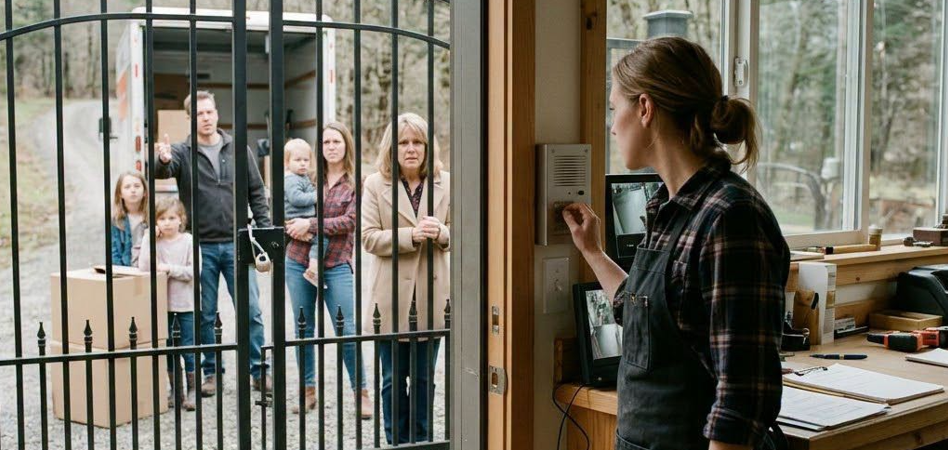
I glanced at the security monitor. My family was still outside the gate, and Grant was now arguing with someone on his phone while Mallory sat on the edge of the moving truck.
“I know,” I said.
Ben shook his head. “No, another problem. The truck’s blocking our delivery entrance. Carter’s Furniture is supposed to collect fourteen custom dining tables in twenty minutes.”
I closed my eyes. Those tables represented six weeks of work, a substantial client contract, and the next payroll cycle for twelve employees who depended on my business.
My mother’s little family reunion wasn’t just interfering with my peace anymore.
It was interfering with my livelihood.
I stood, picked up my phone, and called the local non-emergency police number. I explained that several people were refusing to leave my private entrance, that one had struck the gate, and that their vehicle was blocking a scheduled commercial delivery.
The dispatcher asked whether anyone had threatened me.
“Not directly,” I answered. “But they’re demanding access to my home and business after I’ve explicitly refused permission.”
She said an officer would be sent.
I thanked her and returned to the monitor.
Then I noticed something I hadn’t seen before.
My mother was holding a folder.
Not a purse.
Not a bag of travel documents.
A thick blue folder with several papers sticking out.
She opened it and handed something to Grant.
He studied the pages, pointed toward my house, and said something I couldn’t hear.
Then he approached the intercom again.
This time, he wasn’t shouting.
He was smiling.
I knew that smile.
It was the expression people in my family wore when they believed they’d found a way around my objections.
My phone rang.
Grant.
I answered.
“What?”
He chuckled.
“Paige, there’s no reason to involve the police. We’re family.”
I looked at his face on the monitor.
“Then move your truck.”
“We’re not going anywhere until you hear us out.”
“I heard you. You want to move into my house and run a business out of my workshop.”
He paused.
Then said something that made me sit down.
“Actually, your mother has paperwork showing this was already agreed to.”
For several seconds, I didn’t speak.
“What paperwork?”
Grant’s confidence returned.
“Maybe you should come outside and find out.”
I stared at the screen.
My mother looked up at the camera and smiled.
And suddenly, I understood that the moving truck might be only one part of what they’d prepared.
I called Ben back into my office.
“Keep everyone working inside until the entrance is clear. Don’t let the delivery driver confront anybody.”
He nodded.
“Understood.”
Then I called my attorney, Rebecca Shaw, who’d handled the property purchase and later helped me establish my business as a limited liability company.
I explained what was happening.
She listened carefully.
Then asked, “Have you signed any agreement giving your family permission to occupy the residence or use the workshop?”
“No.”
“Have you promised them access in writing?”
“No. I haven’t even spoken to them in months.”
“Then don’t sign anything they present. Preserve the camera recordings and any messages. We’ll review whatever documents they’re claiming to have.”
I agreed.
When I hung up, I looked at the screen again.
My niece was sitting on a suitcase.
The youngest child, a little girl, had fallen asleep against Mallory’s shoulder.
Her two older brothers stood near the truck, looking bored and embarrassed.
That sight hurt.
I hadn’t seen Mallory’s children in years. They were innocent in this, and I hated that they’d been brought three hours away only to sit beside a locked gate.
But letting them inside wouldn’t solve what their parents had done.
It would simply make removing them harder.
My phone buzzed.
A message from Mom.
You have a big house, Paige. We’re not asking you to sleep outside. We just need somewhere until Mallory and Grant recover financially.
I read it twice.
Then typed:
How long are you planning to stay?
Her answer came immediately.
As long as necessary. Family doesn’t put deadlines on helping family.
I stared at the screen.
As long as necessary.
No end date.
No discussion of expenses.
No acknowledgment that I had a life, employees, responsibilities, or plans of my own.
They hadn’t asked to borrow a bedroom.
They expected me to surrender control of my home indefinitely.
The police arrived eighteen minutes later.
Two officers stepped out of a patrol vehicle and approached the gate.
I watched through the security feed as my mother immediately began gesturing toward the house.
I knew what she was saying even without hearing the words.
She’s my daughter.
We’re family.
She has plenty of room.
We’re only trying to help.
One officer listened while the other spoke with Grant about moving the truck.
A few moments later, my intercom rang.
“Ms. Whitaker? Officer Reynolds with the county police. May I speak with you?”
I activated the speaker.
“Of course.”
He confirmed my identity and asked whether the people outside had permission to enter.
“No.”
“Have they ever resided at this address?”
“No.”
“Have you offered them a lease or permission to use the property?”
“Absolutely not.”
He paused.
“Your mother says she has a written family housing arrangement.”
“I haven’t signed any such agreement. My attorney is already aware.”
The officer nodded toward the camera.
“Understood. We’re documenting the circumstances. For now, we’re asking them to move their vehicles and leave the entrance clear.”
I thanked him.
Then I watched the conversation unfold.
Mom raised her voice.
Mallory began crying.
Grant pointed toward the workshop again.
But after several minutes, the officers directed them to remove their belongings from the driveway and move the truck.
They couldn’t force me to provide housing.
And my family couldn’t turn up at a private property, block a working business, and insist that the owner simply accept it.
Then something happened that I wasn’t expecting.
My oldest nephew, Caleb, approached the intercom.
He looked about eleven.
He waited until the adults were distracted.
Then pressed the button.
“Aunt Paige?”
I froze.
For a moment, I couldn’t answer.
The last time I’d seen him, he was a toddler.
Now he was standing at my gate, his hair falling over his forehead, looking frightened.
I pressed the speaker.
“Hi, Caleb.”
He looked up at the camera.
“Are you mad at us?”
My throat tightened.
“No, sweetheart.”
He shuffled his feet.
“Mom said we were coming to live with you.”
“I know.”
“Did we do something wrong?”
I closed my eyes.
There it was.
The question children always seemed to ask when adults made terrible decisions.
As though everything happening around them must somehow be their fault.
“No, Caleb. You and your brother and sister haven’t done anything wrong.”
He glanced toward the moving truck.
“Then why can’t we come inside?”
I took a breath.
“Because your mom and grandma made plans with my house without asking me. That’s something the adults need to sort out.”
He considered that.
Then asked, “Do you hate Grandma?”
The question caught me off guard.
I stared at the screen.
“No, sweetheart.”
“Mom said you don’t like our family.”
I felt something twist inside my chest.
I wanted to tell him everything.
About the night I left with two trash bags.
About sleeping in a tent.
About the grocery store parking lot where his grandmother had seen me and driven away.
But he was eleven.
He didn’t deserve to carry twelve years of adult bitterness.
So I answered carefully.
“Caleb, people can love their family and still disagree with them.”
He looked confused.
I continued.
“And saying no to something doesn’t mean you hate the person asking.”
He nodded slowly.
Then whispered, “Okay.”
Before I could say anything else, Mallory hurried over and pulled him away from the speaker.
She looked directly at the camera.
“Stop confusing my son!”
I didn’t respond.
I’d already said what mattered.
By late afternoon, the moving truck was gone.
The officers had documented the situation, and my attorney had copies of the messages and relevant security footage.
Ben called from the loading area.
“Carter’s delivery truck finally got through.”
I felt my shoulders relax.
“Everything loaded?”
“Almost. The crew stayed late, but we’ll make the deadline.”
I closed my eyes.
“Thank you, Ben.”
He hesitated.
“Paige, you okay?”
I looked toward the empty driveway on the monitor.
For twelve years, I’d worked to build a life where nobody could simply decide what happened to me.
Now my family had appeared and tried to take control of it within minutes.
“I’m getting there,” I said.
Ben paused.
Then replied, “For what it’s worth, you’ve got twelve people here who are grateful you built this place.”
My eyes filled.
“Thanks.”
After we hung up, I sat alone in my office.
The workshop outside hummed with familiar sounds.
Sanders.
Saw blades.
The occasional laughter of employees.
The smell of fresh-cut walnut drifting through the ventilation system.
I’d started with a borrowed workbench in a rented garage.
Now I had an established company, twelve employees, a production shop, restoration space, and a home I’d designed myself.
My family had looked at all of it and seen unused rooms and free workspace.
But my employees saw their jobs.
My customers saw the results of our work.
And I saw twelve years of refusing to give up.
Then my phone buzzed.
A message from Mallory.
I hope you’re proud of yourself. The kids are crying because their aunt doesn’t want them.
I stared at it.
And for the first time, I didn’t feel the familiar urge to apologize.
I simply replied:
Your children are upset because you promised them something you had no right to promise.
Then I put down the phone.
The next morning, Rebecca called.
“Paige, I’ve reviewed the photographs of the documents your mother showed the officers.”
I sat upright.
“And?”
Her tone was serious.
“They appear to be part of a proposed family occupancy agreement.”
My stomach tightened.
“What does that mean?”
“It says you agreed to provide your sister’s family with the downstairs suite of your home, and that Grant would be allowed to use your workshop for his furniture business.”
I stared at the wall.
Rebecca continued.
“It also says their stay would be rent-free for an initial eighteen-month period.”
I nearly dropped the phone.
“Eighteen months?”
“Yes.”
“That’s insane.”
“There’s more.”
I closed my eyes.
“Of course there is.”
“The agreement assigns you responsibility for household utilities, property maintenance, insurance, and several other expenses.”
I laughed.
Not because anything was funny.
Because the alternative was screaming.
“They expected me to pay for all of it?”
“That appears to be their proposal.”
I rubbed my forehead.
Then asked, “Did they forge my signature?”
“No signature purporting to be yours appears on the version we’ve seen. It looks like an unsigned draft, but your mother presented it as an arrangement that had already been agreed to.”
I took a breath.
“Then it means nothing without my agreement.”
“It doesn’t establish that you’ve consented,” Rebecca said. “But I want to address another concern.”
My stomach tightened.
“What concern?”
“Grant has apparently been contacting potential customers using your business address.”
I sat completely still.
“What?”
Rebecca continued.
“One of your suppliers forwarded an inquiry after receiving a message about a new furniture production partnership at your location.”
My chest went cold.
Grant hadn’t simply planned to move his family into my home. He’d already started advertising my workshop as though it belonged to him.
I asked Ben to come into my office.
He read the forwarded email and frowned.
The message had been sent from an account using the name Whitaker Family Furniture.
Beneath it was my workshop’s address.
The email described a new custom furniture operation with access to professional woodworking equipment, commercial finishing facilities, and an established production site.
It even mentioned capacity for large orders.
Ben stared at me.
“Paige, he’s describing our shop.”
“I know.”
He read the message again.
“He’s making it sound like he’s a partner.”
I nodded.
“And he doesn’t have a business here.”
“No.”
“He’s never rented space here.”
“No.”
“And he has no permission to use our equipment.”
Ben looked up.
“Then we need to get ahead of this before a client gets confused.”
He was right.
I contacted the suppliers involved and clarified that Grant had no association with my company.
Rebecca prepared a formal notice instructing him to stop representing that he had access to or authority over my facilities.
We also reviewed our public business information to make sure there was no confusion about ownership.
It was an aggravating interruption.
But it mattered.
Because unlike the family arguments I’d spent years avoiding, this situation involved employees and customers.
People who had nothing to do with my mother or Mallory.
People whose livelihoods and contracts depended on the company I’d built.
And I wasn’t going to let family drama threaten them.
That evening, I finally answered Mallory’s call.
She immediately began crying.
“Paige, you have no idea what we’re going through.”
I sat at my kitchen table.
“Then tell me.”
She hesitated.
“Grant’s business failed.”
I waited.
“He lost two contracts. We got behind on rent. Then Mom started helping us, but it wasn’t enough.”
I took a breath.
“How long have you known you needed somewhere to live?”
“Almost three months.”
Three months.
They’d had three months to look for housing.
Three months to contact me and explain the situation.
Instead, they’d spent that time preparing to move into my house without permission.
I asked, “Why didn’t you call me?”
Mallory sniffled.
“Because you never answer Mom’s messages.”
I stared at the wall.
“Mallory, I haven’t heard from you in years. You could’ve contacted me yourself.”
She became quiet.
Then whispered, “Mom said you’d probably say no.”
There it was.
They hadn’t forgotten to ask.
They’d avoided asking because they didn’t want to hear my answer.
I took a slow breath.
“So you decided to arrive with a moving truck?”
She began crying harder.
“We had nowhere else to go!”
“Where are you staying now?”
“At Mom’s friend’s house.”
“Are the children safe?”
“Yes.”
“Do they have somewhere to sleep?”
“Yes.”
I nodded.
“Then they’re not sleeping outside tonight.”
Mallory sounded offended.
“You make it sound so simple.”
“It isn’t simple. I understand you’re in trouble. But you don’t get to solve your problem by taking control of my home.”
She stopped crying.
Then her voice hardened.
“You’ve changed.”
I looked toward the workshop through my window.
“Yes.”
She laughed bitterly.
“You think you’re better than us because you have money.”
I swallowed.
“Mallory, I don’t think I’m better than you.”
“Then why won’t you help?”
I sat quietly for a moment.
Then asked something I’d wanted to ask for twelve years.
“Where were you when I needed help?”
Silence.
I continued.
“When Mom told me to leave, you stood behind her and said it should be easy because I was independent.”
Mallory didn’t answer.
“I slept on friends’ floors. Then in a tent behind a flea market. I washed in gas-station bathrooms before work.”
Her breathing changed.
I swallowed.
“And when Mom saw me pushing carts outside the grocery store, she drove away.”
A long silence followed.
Then Mallory whispered, “I didn’t know you were sleeping in a tent.”
My throat tightened.
“No. You didn’t.”
She sniffled.
“I thought you had somewhere to stay.”
I closed my eyes.
“You never asked.”
For several seconds, neither of us spoke.
Then I said quietly, “That’s the difference, Mallory. When I had nowhere to live, you didn’t ask whether I was okay. When you needed somewhere to live, you didn’t ask whether you could move in.”
She began crying again.
But this time, I didn’t rush to make it better.
Two days later, my mother came back.
Alone.
No truck.
No boxes.
No grandchildren.
She parked outside the gate and pressed the intercom.
“Paige?”
I was in my office reviewing a client order.
“What do you need, Diane?”
She stiffened.
“I am your mother.”
“I know.”
Her expression changed.
For a moment, I saw the same woman who’d stood in our old duplex doorway twelve years earlier, explaining why my bedroom was more valuable to Mallory.
She looked older now.
Her hair was nearly white.
The deep lines around her mouth made her constant frown seem permanent.
But her voice was exactly the same.
“I came to talk.”
I looked at the monitor.
“About what?”
She glanced toward the house.
“Would you at least let me inside?”
I hesitated.
Then replied, “We can talk at the gate.”
Her expression hardened.
“Are you really going to treat your own mother like a stranger?”
I took a breath.
“I’m willing to talk. I’m not willing to give you access to the property.”
She looked away.
Then, unexpectedly, she began crying.
“Paige, I don’t know what to do anymore.”
I sat still.
She continued.
“Mallory’s marriage is falling apart. Grant’s business debts are overwhelming. The children need somewhere stable.”
I felt the familiar pull of guilt.
But I waited.
Mom wiped her cheeks.
“I thought if we could all live here together, things would finally settle down.”
I looked at her.
“And what would happen to my life?”
She frowned.
“What do you mean?”
“My business. My home. My expenses. My privacy.”
She sighed.
“You’ve always been good at managing things.”
I almost laughed.
There it was again.
You’re independent.
At nineteen, it had meant I didn’t deserve a bedroom.
At thirty-one, it apparently meant I was responsible for providing everybody else’s.
I took a slow breath.
“Mom, do you remember what you told me the night I left?”
She looked down.
“Paige, that was a long time ago.”
“Do you remember?”
She hesitated.
Then whispered, “I told you that you were old enough to be on your own.”
I nodded.
“And you told me to say I chose to move out.”
Her face tightened.
“I didn’t want people judging us.”
I stared at her.
For twelve years, I’d carried that memory.
The two trash bags.
The canned soup.
The crackers.
My mother’s concern about appearances while her daughter walked away without a place to sleep.
Now she was standing outside my gate, crying because I wouldn’t allow her to move somebody else into my home.
I looked directly into the camera.
“Mom, were you ever sorry?”
She stopped moving.
“What?”
“After I left. Did you ever regret what you did?”
Her eyes filled.
She opened her mouth.
Then closed it.
I waited.
Finally, she whispered, “I thought you were okay.”
I swallowed.
“You saw me pushing carts at the grocery store.”
She looked away.
“I remember.”
“You looked right at me.”
More tears.
“And you drove away.”
Mom covered her mouth.
I felt my voice beginning to tremble.
“Did you ever wonder where I slept that night?”
For a long time, she said nothing.
Then she whispered, “I was afraid you’d ask to come home.”
I froze.
There it was.
The truth I’d spent twelve years trying not to believe.
She hadn’t failed to recognize me.
She hadn’t assumed I was doing well.
She’d seen her daughter struggling and driven away because she didn’t want me to ask for help.
I sat back.
For a moment, I couldn’t breathe.
Then I whispered, “Thank you for finally telling me.”
Mom began crying harder.
“Paige, I didn’t mean—”
“I know what you meant.”
She pressed one hand against the gate.
“Can we please start over?”
I looked at her.
“Starting over doesn’t begin with moving into my house.”
She lowered her head.
I continued.
“It begins with acknowledging what happened.”
Mom left twenty minutes later.
Before driving away, she asked whether I could at least help the children.
I told her I would consider practical assistance that didn’t involve anyone occupying my property.
I meant it.
I wasn’t interested in punishing three children for decisions made by adults.
But I needed to know what help would actually be useful.
Not what would allow their parents to avoid responsibility.
Over the next week, Rebecca helped me identify local housing resources and explained how Mallory and Grant could seek advice about their rental situation and debts.
I forwarded the information.
I also offered to cover a consultation with a qualified housing counselor, directly through the organization, so the family could understand its options.
Mallory initially refused.
She called it insulting.
Then, three days later, she accepted.
I didn’t ask for praise.
I didn’t expect gratitude.
I simply wanted the children to have stability without my home becoming a substitute for every adult obligation their parents had avoided.
Grant, however, remained furious.
He sent messages accusing me of ruining his business opportunity.
He claimed I was selfish for refusing him access to equipment he could never afford himself.
Finally, he wrote:
You have a whole workshop sitting there, and you won’t let family use it. Grandma Elaine would be ashamed.
I stared at that message.
Then I walked into the workshop.
At the far end, beside the finishing room, stood an old wooden workbench.
The surface was scarred.
One corner had been repaired.
And beneath the drawer, burned into the wood, were two words:
ELAINE’S BENCH.
I’d built it during my second year in business, using salvaged lumber and the techniques Grandma had taught me.
It wasn’t expensive.
It wasn’t elegant.
But it was one of my favorite pieces in the entire building.
I ran my fingers over the repaired corner.
Then remembered something Grandma used to say while teaching me how to restore damaged furniture.
Never be ashamed of a crack. Just pay attention to what caused it.
For years, I’d thought she was talking about wood.
Now I understood she’d been teaching me something else.
Damage didn’t always mean something was beyond repair.
But repairing it required honesty about what had caused the damage in the first place.
My family had never wanted to discuss that.
They wanted me to pretend the cracks weren’t there.
And then surrender whatever I’d built because they needed it.
I took out my phone and sent Grant one message.
My grandmother taught me to repair things with care. She never taught me to hand over my work to someone who hasn’t asked permission.
Then I blocked his number.
Two months passed.
Mallory and Grant found a rental townhouse near the children’s school. It was smaller than their previous place, and money remained tight, but they had a stable address.
Grant took a job with a local cabinet installation company.
It wasn’t the business he’d imagined running from my workshop.
But it was work.
Mallory found additional hours at the medical office where she’d been employed part-time.
My mother continued living with a friend while arranging her own housing.
I didn’t solve all their problems.
They had to apply for rentals.
Review their finances.
Handle the consequences of their debts.
And make decisions they could sustain.
For the first time, my sister couldn’t simply announce that she needed something and expect me to give it to her.
That didn’t make her life easier.
But it forced her to start managing it.
One evening, she called from an unfamiliar number.
I almost didn’t answer.
Then I did.
“Hello?”
“Paige?”
I sighed.
“Mallory.”
She was quiet.
Then said, “I wanted you to know we moved into the townhouse.”
“I heard.”
“The kids like it.”
“Good.”
She hesitated.
“Caleb has his own little room.”
I smiled faintly.
“He must be happy.”
“He is.”
For a while, neither of us spoke.
Then she said something unexpected.
“I think Mom was wrong about you.”
I sat very still.
“What?”
Mallory swallowed.
“She always said you didn’t need anyone.”
My throat tightened.
She continued.
“She said you were born independent. That you didn’t care about family the way I did.”
I stared out the window.
“Mallory, I was nineteen when I left.”
“I know.”
“I needed people.”
Her voice broke.
“I know that now.”
I closed my eyes.
She continued.
“When you wouldn’t open the gate, I thought you were trying to hurt us.”
I said nothing.
“But after we moved into the townhouse, I kept thinking about what you said.”
She paused.
“You were nineteen. You didn’t have a job that paid enough for an apartment. You didn’t have a house or a husband or children. And Mom sent you away because I wanted your bedroom.”
I swallowed.
Mallory began crying.
“I’ve spent years telling myself you chose to leave because that was easier than admitting I let it happen.”
For a moment, I couldn’t speak.
Then I whispered, “Yes.”
She sniffled.
“I’m sorry.”
I looked down.
Those were words I’d wanted to hear for twelve years.
But now that they’d finally arrived, I realized they didn’t erase everything.
I still remembered the tent.
The cold mornings.
The endless shifts.
The times I’d wondered whether my family even cared if I was alive.
I took a breath.
“Thank you.”
Mallory waited.
Then asked, “Do you think we could ever be sisters again?”
My throat tightened.
“We never stopped being sisters.”
She began crying harder.
I continued.
“But we haven’t been close in a long time. And I don’t know what rebuilding that would look like.”
She nodded, though I couldn’t see her.
“I understand.”
I looked toward the workshop.
Then said quietly, “If we try, it has to be different.”
“I know.”
“No more decisions about my life made without me.”
“Okay.”
“No more assuming that because I have something, you can take it.”
“I understand.”
“And no more using the children to make me feel guilty.”
She began crying again.
“I won’t.”
I wanted to believe her.
But I also knew that trust wasn’t repaired by a single telephone call.
It was repaired by what happened afterward.
That autumn, I received an unexpected invitation.
Mallory wanted to meet for coffee.
Just the two of us.
No Mom.
No Grant.
No children.
At first, I declined.
Then I changed my mind.
We met at a small café halfway between our homes.
For several minutes, the conversation was awkward.
We talked about the weather.
Work.
The children’s school.
Then Mallory reached into her handbag.
She took out a small wooden box.
I stared at it.
“What’s that?”
She pushed it across the table.
“I found this when Mom was moving her things out of storage.”
I opened it.
Inside was a little brass drawer pull, worn smooth from years of use.
And a folded piece of paper.
My throat tightened.
I recognized the drawer pull immediately.
It had come from Grandma Elaine’s kitchen cabinet.
The drawer where she kept her measuring tape, pencils, and the small tools she used for delicate furniture repairs.
I looked at Mallory.
“Where did you get this?”
She swallowed.
“Mom kept it after Grandma died.”
I lifted the paper.
It was a handwritten note in Grandma’s familiar script.
For Paige.
My hands began trembling.
I unfolded it.
I found the missing brass pull from the kitchen drawer you always loved. I thought you might want it for a project someday.
Keep making things, sweetheart. You have good hands and a patient heart.
Love, Grandma.
For a moment, I couldn’t breathe.
Grandma had died when I was seventeen.
I’d never seen this note.
I stared at Mallory.
“Why didn’t Mom give this to me?”
She looked embarrassed.
“I don’t know. She had a box of Grandma’s things and probably never sorted all of it.”
I looked back at the paper.
It wasn’t money.
It wasn’t property.
It wasn’t a secret inheritance.
Just a tiny brass handle and a few lines written by the one person who’d always made me feel seen.
I began crying.
Mallory watched me quietly.
Then she said, “I thought you should have it.”
I looked up.
“Thank you.”
She nodded.
For a while, we sat without speaking.
Then I folded the note carefully and placed it back in the box.
It was a small gesture from my sister.
But it was the first time in years she’d given me something without expecting anything in return.
Winter came.
The business continued growing.
We completed a large restoration contract for a historic hotel and began taking on more custom furniture commissions.
I hired two additional employees.
Ben became operations manager.
And I began developing a training program for young people interested in woodworking and furniture restoration.
I wanted it to be practical.
Real skills.
Safe instruction.
Paid opportunities where possible.
A chance for people who hadn’t followed a traditional path to discover that they could still build something worthwhile.
I remembered being nineteen.
Sleeping behind a flea market.
Working whatever jobs I could find.
Learning how to turn a damaged chair into something somebody wanted to buy.
I hadn’t needed someone to rescue me forever.
I’d needed someone to give me a fair chance.
Grandma had given me the knowledge.
A few kind strangers had given me temporary places to sleep.
And eventually, customers had trusted me with their furniture.
Those small chances had become the foundation of everything I owned.
Now I wanted to create some of those chances for other people.
Not because my family had failed me.
But because I knew what it felt like to need help and have nowhere to turn.
In December, Caleb sent me a letter.
He’d written it himself.
The handwriting was uneven, and several words were crossed out.
Dear Aunt Paige,
Mom told me you make furniture. I didn’t know that was your job.
I like building things too. In school I made a wooden birdhouse.
Mom says you used to build things with Great-Grandma Elaine.
I’m sorry we came to your house without asking.
I didn’t know you didn’t want us to live there.
I hope you have a good Christmas.
Love, Caleb.
I read it twice.
Then I smiled.
A week later, I mailed him a small beginner’s woodworking kit with age-appropriate tools and a note reminding him to work under an adult’s supervision.
I also included a photograph of Grandma Elaine’s old kitchen worktable.
On the back, I wrote:
Great-Grandma Elaine taught me that making something takes patience. I think you might enjoy that too.
He called me on Christmas morning.
“Aunt Paige!”
I laughed.
“Hey, buddy.”
“I got your present!”
“I hope you like it.”
“It’s awesome!”
I smiled.
Then he asked, “Can I show you what I build?”
My throat tightened.
“Of course.”
He hesitated.
“Maybe someday I could see your workshop?”
I thought about it.
Then smiled.
“Maybe. When we plan a visit and everyone understands the safety rules.”
He sounded delighted.
“Really?”
“Really.”
And for the first time, the thought of seeing Mallory’s children didn’t feel like a threat to my home.
It felt like the beginning of a relationship we might actually have a chance to build.
The following spring, Mallory brought Caleb to the workshop for a supervised visit.
No moving truck.
No suitcases.
No assumption that anyone could come inside whenever they pleased.
She’d called two weeks earlier and asked whether a visit would be possible.
I had checked my schedule.
Then said yes.
When they arrived, Ben greeted them at the office entrance.
I showed Caleb the design room, the finishing area from a safe viewing position, and the workstations where our employees restored damaged furniture.
He was fascinated.
He asked a thousand questions.
Why did walnut wood look different from oak?
How did we fix broken chair legs?
Could a badly damaged table ever look new again?
I answered patiently.
Then I showed him Grandma Elaine’s bench.
He ran his fingers over the repaired corner.
“Did you make this?”
I nodded.
“Yes.”
“By yourself?”
“Mostly.”
He smiled.
“It’s really cool.”
My throat tightened.
I looked at the old bench.
At the scratches.
The repaired wood.
The little brass drawer pull I’d finally installed after Mallory gave it back to me.
And I felt something I hadn’t expected.
Peace.
Not because everything had been forgiven.
Not because my childhood suddenly seemed less painful.
But because something Grandma had taught me was now being passed to another generation.
When the visit ended, Mallory stood beside the office door.
“Thank you for letting him come.”
I nodded.
“He was a good visitor.”
She smiled.
“He talks about you all the time.”
I looked toward Caleb, who was showing Ben his notebook of furniture sketches.
Then Mallory said quietly, “I know this doesn’t fix anything.”
I turned toward her.
“But I’m glad you’re letting him know you.”
My eyes filled.
“So am I.”
For a moment, we stood together without speaking.
Then she asked, “Would you ever consider having coffee again?”
I thought about it.
Then smiled faintly.
“Yes.”
She looked relieved.
“We can do that.”
It wasn’t a dramatic reunion.
We didn’t hug and pretend twelve years had disappeared.
But we made a plan.
And both of us understood that a plan wasn’t a promise made on somebody else’s behalf.
Mom’s relationship with me remained more difficult.
She apologized eventually.
But even her apology came with explanations about how frightened she’d been when Mallory lost her housing.
How worried she was about the grandchildren.
How she hadn’t intended to hurt me.
I listened.
Then told her what I’d told Mallory.
The problem wasn’t that she’d worried about someone she loved.
It was that she’d repeatedly decided my needs mattered less.
At nineteen, she’d believed Mallory needed my bedroom more than I did.
At thirty-one, she’d believed Mallory needed my home more than I did.
Twelve years had passed.
The circumstances had changed.
But her assumption hadn’t.
When I finally said that aloud, Mom went quiet.
She looked down at her hands.
Then whispered, “I suppose I always thought you could manage on your own.”
I swallowed.
“I did manage.”
She nodded.
“But that doesn’t mean I didn’t need you.”
Her eyes filled.
For a long time, she said nothing.
Then she whispered, “I’m sorry, Paige.”
I nodded.
“Thank you.”
She looked up.
“Can you forgive me?”
I thought about the question.
Then answered honestly.
“I don’t know yet.”
Her face fell.
But I continued.
“I want us to have a better relationship. I just can’t promise that one apology will make me feel safe trusting you again.”
She wiped her cheeks.
Then nodded.
“I understand.”
I hoped she did.
And this time, I was willing to let her actions answer that question.
Nearly two years have passed since the day my family arrived at my gate.
The property is still mine.
The workshop is busier than ever.
The house is still the quiet place I worked so hard to create.
And nobody has moved in.
Grant eventually stopped trying to associate himself with my business. He continued working in cabinet installation, and the formal concerns about his unauthorized representations were resolved without involving my customers further.
Mallory and I speak occasionally.
Sometimes we meet for coffee.
Sometimes she brings the children for an arranged visit.
She’s still rebuilding her finances and making choices I don’t always agree with.
But she asks before expecting anything from me.
And when I say no, she accepts it.
That matters.
Mom and I are still finding our way.
I don’t see her every week.
I don’t feel guilty about that anymore.
Our relationship may never resemble what she has with Mallory.
But it can become something more honest than it was before.
And I’ve stopped believing that being a good daughter requires pretending the past never happened.
Last Sunday, I was working alone in the workshop when I came across a damaged oak chair.
One of the back supports had split.
The finish was worn.
Someone had attempted a repair years earlier, but the joint had loosened again.
I carried it to Grandma Elaine’s bench.
For a while, I studied the damage.
Then I thought about the lesson she’d taught me.
Never be ashamed of a crack. Just pay attention to what caused it.
I smiled.
That advice had helped me build a business.
But it had also helped me understand my family.
The damage between us hadn’t appeared overnight.
It had started when I was a child.
One daughter always needing more.
The other always being expected to accept less.
Years of silence.
Years of pretending that unfairness was simply the natural order of things.
Then the night Mom sent me away.
And twelve years later, the morning she arrived demanding that I open my gate.
I couldn’t repair those memories by pretending they hadn’t happened.
And I couldn’t rebuild trust by giving everyone whatever they wanted.
Some things needed time.
Some needed accountability.
And some needed distance.
I began working on the chair.
Slowly.
Carefully.
Cleaning the old joint before preparing the repair.
There was something comforting about knowing that the wood didn’t need to become perfect to be useful again.
It simply needed to be repaired properly.
Later that afternoon, I walked back toward the house.
The gravel driveway was quiet.
The gardens were blooming.
Sunlight reflected off the iron gate.
I stopped beside it.
For a moment, I remembered the first time I’d seen my mother’s face on the security camera.
The beige coat.
The impatient expression.
The moving truck.
Mallory announcing which bedrooms her family would take.
Grant examining my workshop as though it were an empty building waiting for him.
And my mother’s demand:
Open the gate, Paige.
I remembered how frightened I used to be of disappointing her.
How desperately I’d wanted her approval.
How easily I’d once believed that being the quiet daughter meant accepting whatever everybody else decided.
Then I looked toward my workshop.
Twelve employees.
A growing company.
A home I loved.
A life I’d built from a place where I had once had almost nothing.
I thought about nineteen-year-old me.
Standing outside a rented duplex with two trash bags.
Holding canned soup and crackers.
Wondering where I was going to sleep.
If I could speak to that girl now, I wouldn’t tell her everything would be easy.
It wasn’t.
There would be cold nights.
Long shifts.
Failed orders.
Unpaid invoices.
Equipment breakdowns.
And mornings when she’d feel too exhausted to continue.
But I’d tell her something she needed to hear.
Being unwanted in one house doesn’t mean you don’t deserve a home.
I’d tell her that her mother’s decision didn’t define her worth.
That her sister’s needs weren’t automatically more important than hers.
And that learning to survive alone didn’t mean she had to spend the rest of her life without love.
She would find people who respected her.
People who paid her fairly for her work.
People who celebrated her success without demanding a piece of it.
And eventually, she’d build a life she could share on her own terms.
I walked toward the gate.
There was a small keypad beside the pedestrian entrance.
I entered my code.
The lock clicked.
I opened it, stepped outside, and looked down the road.
The same road where the moving truck had disappeared almost two years earlier.
For a moment, I thought about how differently that day might have ended if I’d allowed guilt to make my decision.
My sister’s family would have moved in.
Grant would have taken over my workshop.
Mom would have treated my home as a place she’d arranged for everyone.
And eventually, I would have become the problem whenever I wanted my own space back.
Instead, I had said no.
The children found a home.
Mallory began taking responsibility for her life.
Grant found work elsewhere.
Mom was forced to confront an old pattern she’d never wanted to acknowledge.
And I kept what I’d built.
Not because I hated them.
Because I finally understood that love didn’t require surrender.
I stepped back inside and closed the gate.
Then I returned to the house.
That evening, Caleb sent me a photograph.
He’d built a little wooden bookshelf with help from his school workshop instructor.
It was uneven.
The shelves weren’t perfectly aligned.
And one corner had clearly required some extra sanding.
But it was his.
Beneath the photograph, he’d written:
Look, Aunt Paige! I made this myself.
I smiled.
Then replied:
You should be proud. You worked for it.
A moment later, another message appeared.
I am.
I sat quietly, staring at those two words.
For most of my childhood, I’d been taught that Mallory’s needs came before mine.
When I finally built something of my own, my family expected me to give it away because they believed having more meant owing more.
But here was my nephew, proud of a little bookshelf he’d built with his own hands.
And I hoped he’d grow up understanding something that had taken me years to learn.
The value of what we build isn’t determined by whether someone else wants to take it.
It’s determined by the care, effort, and meaning we put into it.
I placed my phone on the table.
Outside, the evening light moved slowly across the driveway.
The iron gate stood closed.
Beyond it was the road.
Behind it were my home, my workshop, and the life I’d spent twelve years building.
At nineteen, my mother made me leave because my twin sister needed more space.
At thirty-one, they arrived with a moving truck because my sister wanted mine.
They expected the same quiet girl who had packed two trash bags without arguing.
But that girl had grown up.
She had learned to make furniture from broken pieces.
To turn hard work into a business.
And to build a home where nobody could decide she didn’t belong.
The gate didn’t mean my heart was closed.
It meant the people who entered my life needed to respect the person living inside it.
Because Grandma Elaine had taught me how to repair damaged things.
But life taught me something just as important.
Not every broken relationship can be fixed by giving away another piece of yourself.
And for the first time, I finally understood the difference between shutting people out and protecting what belongs to you.
My mother once decided there wasn’t room for me in her home.
Twelve years later, I decided there would always be room for me in mine.