The police lights turned onto our street while Dana was still crossing the road toward me.
She came at a run, black medical bag swinging from one hand, her sensible nurse shoes slapping the wet pavement. Her coat hung open over her scrubs. Rain beaded in her hair.
“Nora. Oh my God. Nora.”
She knelt on the porch and took my arm. Her hands were cold.
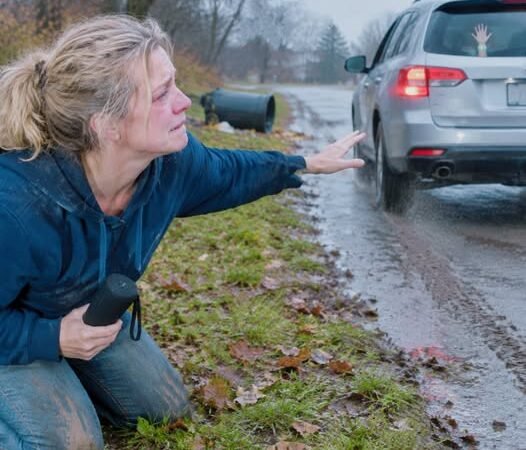
I pointed at her bumper. “Your car.”
“What?”
“There’s a white scrape.”
Dana looked over her shoulder. For half a second, her face did something I didn’t understand. Then she shook her head, fast.
“I hit the mailbox last week. You know that. Nora, where’s Miles?”
“Gone. A silver SUV. I saw his hand.”
Officer Reyes came up the walk with a flashlight. Older guy, tired-looking, rain jacket too big at the wrists. He crouched down beside me.
“Ma’am. Start from the beginning.”
“My front door was open. Miles’s shoes were inside. His blue insulin pack is gone. The spare-key box was open. The speaker was in the backyard, playing his scream. A woman’s voice said, ‘You should have chosen me.’ Then a silver SUV came out from behind the garage. I saw a child’s hand in the back. His green medical bracelet.”
Reyes wrote fast.
Dana’s hand tightened on my arm.
“Where’s his emergency phone?” she asked. “The blue one in his backpack?”
Reyes looked at her. “Emergency phone?”
“He carries a little phone,” Dana said. “Because of his blood sugar. In case he feels low at school.”
I stared at her.
Reyes went inside. He came back three minutes later with a small blue phone in a clear bag. The screen was cracked at the top corner.
“Found it under the patio chair,” he said. “It was on vibrate.”
The phone lit up through the plastic.
Reyes read it out loud.
“Don’t show the police. Take the blue envelope in the freezer to the I-70 exit 118 rest stop. 8:30. Come alone. If I hear sirens, he loses a shot. You should have chosen me.”
The porch tilted.
Dana pressed a hand to her mouth. “Oh my God.”
I grabbed the bag out of Reyes’s hand. The words swam. “He loses a shot.” Insulin. Not a threat that sounded like drama. A threat with a clock in it.
“Mrs. Hayes,” Reyes said, “what’s in the blue envelope?”
“Emergency money. Seven hundred dollars. A copy of Miles’s new prescription. Nothing that makes sense for a kidnapper.”
“Who knows about it?”
“Nobody.” I looked at Dana before I could stop myself. “Nobody.”
Dana was looking at the phone, not at me. Then, soft: “Did they take the envelope too? The one in the freezer?”
My mouth went dry.
“What?”
“The blue envelope,” she said. “You told me you kept one.”
“No. I didn’t.”
Dana blinked. “Maybe I saw it when I helped you organize the freezer.”
Reyes’s pen stopped. “You were in the house?”
“She has a key,” I said. It came out flat. “For Miles. For emergencies.”
Dana’s eyes filled. “I’m his godmother. You asked me to be on the list.”
Headlights swept across the lawn. Paul’s work truck jerked to the curb. He got out without shutting off the engine and left the driver’s door hanging open.
“Where’s my son?”
I stood up too fast. My ankle gave and Dana caught me.
Paul came up the steps. Still in his work boots, dust on his jeans. He looked at the police, at Dana holding my arm, at the black speaker on the porch.
“What the hell happened?”
Reyes stepped between us. “When did you last see Miles?”
“This afternoon. I dropped off a birthday card. It was yesterday, but I missed it. Left it at the door.”
“You went inside?”
“No. I knocked. Nobody answered. I left the card and went back to work.”
“What time?”
“Around three-thirty.”
“Can anyone confirm that?”
Paul’s jaw tightened. “My truck has GPS for work. Check it. I was gone by three thirty-five.”
Dana made a soft sound. “Paul, they have to ask.”
“Don’t.” He swung toward her. “Don’t do that sweet voice with me. You’re the one who kept telling her she couldn’t handle him alone.”
“Paul.” My voice cracked. “Not now.”
Too late. Reyes’s eyes went from Paul to Dana and back again.
“I need both of you to stay available,” Reyes said.
Dana helped me across the street to her house while another officer taped off my porch. Her living room smelled like cinnamon and hospital soap. She sat me on the couch and wrapped my ankle with an elastic bandage from her bag.
“You should put ice on it,” she said.
“I should be looking for Miles.”
“The police are doing that.”
“You know what I keep thinking?” I said. “Whoever took him knew about the blue pack. Knew where it was in my fridge. Knew about the freezer.”
Dana’s hands stopped on the bandage. “I didn’t know it was gone.”
“I didn’t say it was gone. I said the freezer.”
The room went very still.
Dana’s eyes slid toward the kitchen. “I helped you organize that freezer last month. Remember? After his endocrinologist appointment.”
I didn’t remember.
“You did all the labels,” she said. “I asked because I know you keep emergency stuff in blue. That’s all.”
She tied off the bandage and stood. Her hands were steady. Mine weren’t.
The question sat in my mouth, fully formed. Did you take him?
But Miles needed a shot. If Dana was involved, if Miles was somewhere with her people, one careless word could turn her from helpful friend into a woman with everything to lose.
I swallowed it.
“Can I use your bathroom?” I asked.
In the hallway, through the kitchen doorway, I could see the back end of Dana’s SUV through her side window. The white scrape on the bumper looked bright as a knife cut.
I took three pictures with the prepaid phone Reyes had pressed into my hand before I left my porch.
Then I texted Reyes the photos, the message from Miles’s emergency phone, and our location.
Another message: Do not pull me over. Do not block the rest stop. If sirens show up too soon, he’ll hurt Miles. Wait until I’m inside, then move.
I added one more line.
Dana may be involved. I don’t know how much.
Reyes called back thirty seconds later. I whispered in the bathroom with the faucet running.
“You can’t do this alone, Nora.”
“I’m not. I’m telling you. But I need to keep Miles alive.”
“We’ll set up a perimeter.”
“Not close. Please.”
A pause. “All right. But you keep that phone on. If I don’t hear from you every ten minutes, I move in.”
“I have to go.”
When I came back into the living room, Dana was putting her coat on.
“I’m driving you,” she said.
“No.”
“You can’t drive on that ankle. And I know what to do if Miles is low. You need me.”
A week ago, I would have said yes. A week ago, I would have cried in her car and let her fix everything.
“I have to run to CVS first,” I said. “Glucose tablets. I’ll call you after.”
Dana’s eyes narrowed. “You’re lying.”
“I’m not.”
“Nora.”
“I need you to stay here,” I said. “Please.”
She stared at me. Then she picked up her keys. “You’re one person against a man with nothing to lose. You think I’m letting you go alone?”
I didn’t answer. I walked out to my car with the blue envelope tucked inside my coat.
The freezer door had been open an inch. The envelope was still there because whoever wrecked my kitchen hadn’t come for money. They came for Miles.
Reyes had photographed the message on the emergency phone, then handed the phone back to me in a plastic bag.
“The kidnapper is texting that number,” he said. “We need the next one. You read it, you tell me.”
By 8:12 I was on I-70. Rain hammered the windshield. I kept checking the mirror.
At first there was nothing but headlights.
Then a silver SUV came up two cars behind me, headlights off, moving at exactly my speed.
I gripped the wheel until my fingers ached.
Miles’s emergency phone, sealed in its bag on the passenger seat, lit up.
The text read: You brought her. Good. Now make her stay back.
In the mirror, Dana’s SUV slowed and dropped back, like it had been told where to go.
The I-70 exit 118 rest stop looked like a place people only stopped at because they had to.
A brick restroom building. Eighteen-wheelers idling in a blue haze of diesel. A row of picnic tables under a metal shelter. Rain poured off the roof in sheets and turned the whole lot black.
At 8:35 I parked at the far edge, away from the trucks. Dana’s silver SUV was already in the truck lot. Engine off now. She hadn’t followed me into the car row.
Good. Maybe.
Reyes’s unmarked car was somewhere past the exit ramp. I couldn’t see it. That was the point.
I took the blue envelope out of my coat. My hands left sweat on the paper. Seven hundred dollars. A prescription with Miles’s name on it. Nothing that could buy a child’s life. It was bait. Whoever was texting me wanted me alone, moving, answering.
The text had said: Put it under the third picnic table. Then step back ten steps.
I did.
A truck door opened somewhere behind me. Boots hit wet gravel.
A figure in a gray hoodie came out between the trailers. Not tall. Not small. A rain jacket over broad shoulders. Hood up. The face was a blur of shadow and beard.
I made myself look at the shape. Dana was five-six. This person looked wider. But rain gear does that.
“Let me hear Miles,” I said. “One word from him, and the envelope’s yours.”
The figure stopped six feet away.
The voice came out low. Not natural.
“You could’ve moved away. Just you. He would’ve settled.”
“You’re not answering me.”
“Where is he?”
A hand came out. Not toward the envelope. Toward me.
I stepped back. My ankle screamed.
“Who are you?”
“You always have to be the one who knows.”
I turned my head for half a second to check the trucks. That was the mistake.
Something hit me in the back of the head.
White. Then black at the edges. I went down in the wet grass next to the picnic table. Gravel bit into my cheek. Hands rolled me onto my stomach. A plastic zip tie bit into my wrists and pulled tight.
I kicked. My shoe caught a leg. The figure grunted and dropped to one knee.
I twisted and caught a flash under the hood. A woman’s mouth. A sliver of pale cheek. Hair tucked under a black cap.
The hood fell back for one second, and I saw a blue bead of nail polish on a thumbnail.
Then a hand slammed into my ribs.
“Not yet,” the voice said.
A boot kicked my phone out of my pocket. It skidded across the pavement and dropped into the drain.
The figure grabbed the envelope and dragged me by the zip tie toward the back of the rest stop. My knees tore through wet leaves. The diesel smell faded. Rain got louder.
Behind the restroom building, a concrete drainage culvert opened into a ditch. A metal grate covered the mouth. Somebody had pulled it loose and propped it with a wet wooden wedge. Water was already running into the black pipe.
“Please,” I said.
The figure shoved me through the gap.
My shoulder hit concrete. Water rushed around my calves. The wedge jammed back into place. The grate rang.
Then footsteps moved away.
For a few seconds I just lay there listening to the rain. My hands were tied behind my back. My feet were still in the open. I could’ve crawled back to the grate if I’d had time.
The water came faster.
It climbed from my knees to my thighs while I fought the zip tie. The plastic cut deep. I couldn’t see. The culvert narrowed as it went back into the dark. Rainwater poured in behind me, cold and heavy. It smelled like asphalt.
I heard my phone ring, outside the grate.
The drain. The edge of the lot. Three feet away, maybe. I saw the phone light through the grate for one second — a blue square in the dark. Then water sloshed over my waist and the light was gone.
I jerked my wrists apart. The tie held.
Think.
No knife. No phone. My ankle was swelling inside my shoe. The culvert was maybe twelve feet long. If the water kept coming, I’d drown in a concrete pipe behind a rest stop while the cops waited outside for a ransom drop that had never been real.
I braced my feet against the pipe walls and pushed backward. My shoes slipped. I fell hard on my side. Water hit my chin.
The grate. The wedge. If I could get my tied hands in front of me, I could kick.
I bent double. Pulled one leg through my arms. Pain tore through my shoulder. The zip tie didn’t give, but my wrists came around in front.
Now.
I got my knees under me and kicked at the grate. Once. Twice. The metal rattled. The wedge held.
I turned around. There was a jagged strip of metal on the pipe wall — part of an old sign, half buried in the concrete. Under the waterline now. I pressed my wrists against it and sawed.
The plastic scraped and slipped. My skin tore open. I kept sawing.
The water reached my chest.
The tie snapped.
I grabbed the grate with both hands and kicked. Fourth kick, the wooden wedge popped free. The grate swung out two inches. I clawed it open and crawled into the ditch on my hands and knees.
Rain hit my face. I threw up in the grass.
Behind me the culvert gulped. Water rose over the metal lip where I’d been lying.
I lay there for one breath. Two. Then I remembered the phone.
Gone. The drain. My backup phone — the old prepaid I kept in the glove box after Paul and I split — was still in my car. But my keys had been in my coat pocket. I felt for them. Gone. The figure took them.
So. No car. No phone. A rest stop full of trucks and a woman who had followed me here.
I crawled up the bank and stopped at the chain-link fence.
A key ring hung off a broken hook. It must’ve caught there when the figure dragged me past. Cheap metal, shaped like a boat wheel. The words were stamped in silver: Buckeye Lake Marina.
I turned it over.
A tiny blue dot of nail polish on the back.
Dana had key rings like this. She had one on her SUV key. I’d watched her twist that blue dot while she talked about Miles’s bolus numbers.
My hands went cold.
Dana.
It wasn’t proof of a kidnapping. It wasn’t a confession. But it wasn’t nothing. It was a thing that should not be here.
I shoved it into my bra strap and crept around the side of the restroom building. The lot was a mess of rain and diesel. A truck driver was climbing back into his cab. Dana’s silver SUV rolled slowly along the edge of the car row, wipers slapping.
She leaned out the window.
“Nora? Oh my God, Nora!”
I ducked behind the front of a Peterbilt.
Dana stopped the SUV. The door opened. Her shoes hit the pavement.
“Nora, please! I followed you because I was scared. I saw you leave. I know you’re trying to protect Miles. Let me help!”
I backed along the truck’s fuel tank. My ankle rolled and I grabbed the side of the cab.
The driver leaned out. “Ma’am?”
“Please,” I whispered. “Phone. Call nine-one-one.”
He looked at my face. Then my hands. Then at the woman out in the rain. He opened his door and pulled me up onto the step.
Dana’s SUV reversed hard, swung across the exit lane and stopped, blocking the way out. Then she got out again and started walking toward the trucks.
“Nora! I know you’re here!”
The truck driver handed me his phone. I dialed with a shaking finger.
“I’m at the exit 118 rest stop. A woman is after me. I have a child-abduction report at six-oh-four-two Ashbury Lane. Get me Officer Reyes. Tell him she’s here.”
The dispatcher started talking. The truck driver pointed at the low cinder-block building next to the dumpster. A door marked Supplies/Staff Only stood open.
I jumped down. Pain shot up my leg, but I could move.
The cleaning closet smelled like bleach and mops. I pulled the door almost shut and wedged a mop handle through the inside latch.
The borrowed phone blinked. Low battery.
Then it died.
Dana’s heels came across the wet pavement outside. Tap. Tap. Tap.
They stopped on the other side of the door.
Rain dripped off the roof.
Through the crack, I saw one eye. Pale. Wide.
Dana’s voice was soft.
“Nora, I know you’re in there.”
Reyes pulled in with the patrol car, lights on, no siren.
Two officers had Dana outside the cleaning closet, her hand still on the door. She didn’t run. The second they touched her arm, she started crying.
“I was looking for Nora! She’s hurt. I followed her because I was afraid she’d do something crazy.”
Reyes pulled the door open. I almost fell into him.
“Miles?” I said. “Do you have Miles?”
Dana was already shaking her head. “No. God, no. I don’t know where he is.”
They searched her SUV. I stood in the rain with a blanket around my shoulders and watched them open the back.
No car seat. No dinosaur blanket.
No Miles.
Dana looked at me through the wet window of the cruiser.
“Nora, tell them. Tell them I’m not the person who took him.”
I couldn’t speak.
Reyes asked if I wanted to go to the hospital first. My ankle was purple and swollen fat over my shoe. My wrists were bleeding. Water was still running out of my sleeve.
“No,” I said. “Buckeye Lake Marina.”
I put the key ring in his hand. “It was on the fence by the culvert. There’s nail polish on the back. I’ve seen that blue dot on her key ring before.”
Reyes looked at Dana. She looked back.
“I lost that key ring,” she whispered. “Two weeks ago.”
“Where?”
“I don’t remember.”
Reyes told a patrol officer to hold her. “We need her medical logs,” he said. “Her rental paperwork. Anything.”
“You can’t go into my house.” Dana’s voice pitched up. “That’s my house.”
“Call your lawyer,” Reyes said. “We’re not looking for a confession. We’re looking for a child.”
They put her in the back of the patrol car. No cuffs. Reyes said she wasn’t under arrest yet, just detained. He needed the house, the logs, the rental records.
The law moved slower than my fear.
Then a pickup slid into the ditch at the exit ramp. The patrol officer stepped six feet away to wave traffic around.
I didn’t see the rest.
I heard the radio. I heard Reyes swear. By the time the officer looked back, the rear door of the cruiser was open.
Dana was gone. Her silver SUV was two taillights running dark toward the highway.
“She can’t get far,” Reyes said. “We’ve got her plate.”
But I knew her plate. I knew her car. I knew the color of the dot on her key ring.
None of it had stopped her.
At 10:05 we walked into Dana’s house.
Her front door was standing open.
It had always been the most orderly house on the street. Now it looked staged.
The guest room was made up for a boy. Dinosaur blanket. Little stacks of T-shirts in Miles’s size. A kid’s insulin cooling bag on the nightstand, still zipped. On the dresser, a printed reservation confirmation.
Buckeye Lake Marina. Cabin 4. Check-in tonight.
Reyes put on gloves and picked it up.
“They have a marina office. I’ll call the lake police.”
In the kitchen, I opened the drawer beside the stove and found a notebook. Sticker on the front: MILES CARE.
My hands didn’t feel like mine when I opened it.
Dates. Times. Pump settings. Numbers. Miles’s insulin doses, in Dana’s round handwriting.
But it wasn’t just a log. It was a script.
“Fri—Nora closing shift. Lower basal 8 p.m. Low at 1:40. Call Nora. She stays home Saturday.”
“Sat—skip bedtime snack. Pump alarm 2:10. Nora sleeps on couch.”
“Sun—Nora exhausted. She will ask me to stay.”
I turned the pages. Three weekends matched the three nights he’d gone low. I found the date of his last ER visit. Next to it, Dana had written: “Nora cried. Said she couldn’t do it alone. Good.”
The room tilted.
“She’s a nurse,” I said. “She knows how to adjust the pump.”
Reyes spoke from behind me. “Clinic records say she’s a pediatric care coordinator. She can talk to families about supplies. She can’t independently change pump settings.”
The floor felt soft under my good foot.
Dana had told me for years that doctors were too busy to explain anything. She told me she’d come with me to appointments. She told me I was lucky she worked in pediatrics.
I sat down hard on a kitchen chair.
“The nights he almost died,” I said. “I thought he was brittle. I thought I couldn’t keep him safe.”
“We need to know what she was planning,” Reyes said. “But we already have the marina.”
The landline rang.
Nobody moves fast in a house that isn’t theirs. Reyes looked at the phone on the wall. Then he nodded at me.
I picked up.
“Nora.”
Dana’s voice was calm. That was worse than the yelling.
“Where is he?”
“He’s safe. He had a little low. I corrected it.”
“Dana.”
“I made your house look like somebody broke in,” she said. “I used the video from the pool party. You remember? The time Miles got stung by the wasp. I cut the scream. I made the low voice with the fish tank filter in my garage. Paul’s temper made the whole thing easy to sell. The police never even looked at me.”
My hand shook around the receiver.
“You took him from after-school.”
“He was waiting for me,” she said. “I’m on the list. The girl at the desk knows me.”
“His blue pack.”
“I took it. I know what he needs.”
Reyes was writing on a pad, pointing at the phone, mouthing keep her talking.
“Let me hear him,” I said.
A pause. Water slapped against wood. A rope clinked.
“Mom?”
Miles’s voice came through small and far away. “Mom, I want to go home.”
“Miles, baby.” I gripped the counter. “Mommy’s coming. Are you hurt?”
“Aunt Dana says we’re going to see the boats.”
“Put his pump on the phone,” I said. “Dana, listen to me. Do it now.”
Rain filled the silence. Then a soft beep.
Then another.
The alarm on his pump, steady and quick.
Dana said, “He was high. I gave him a correction.”
The beeping kept going. It wasn’t a high alarm. It was the low warning.
“Dana, what number is on the screen?”
“He was nine.”
“What number now?”
“Don’t do that.”
“You know what it means. You know what a low alarm sounds like. Say the number.”
“I’m handling it.”
“He’s six. You’ve been doing this to him for months. You did it so I’d need you. Now he needs glucose. Not a correction. Do you hear me?”
Her breath came through the phone.
“I just wanted you to see,” she said. “I lost my baby. My marriage died. You were leaving for Arizona. You were going to take him from me.”
“So you made him dependent on you.”
“You made him mine,” she screamed. Then quiet. “At the lake, he’ll only remember who took care of him.”
The phone clicked dead.
Reyes was already on his radio. “Buckeye Lake Marina, Cabin four. Female suspect with a six-year-old diabetic boy. Possible insulin emergency. She may be heading for the water.”
I grabbed the painkillers he’d left on the counter and swallowed two dry. Then I took Miles’s spare glucose gel from the cooler in Dana’s guest room — the one she’d packed for him — and put it in my coat.
“You’re not going,” Reyes said.
“Try and stop me.”
At 11:45, Reyes’s car turned onto the marina road. The rain had stopped, but the lake was black and wide. Docks creaked. A string of low lamps along the pier made yellow circles on the wet boards.
Cabin 4 was dark. The office light was on. A small motorboat idled at the end of the dock.
I got out before the car stopped.
Dana was on the pier, one hand on Miles’s shoulder. He was pale like skim milk. His T-shirt was wet. The green medical band was gone from his wrist.
The boat rocked against the bumpers. The engine coughed.
Dana turned and saw me.
She reached under the boat seat and pulled out a flare gun. Red plastic, wide barrel. She raised it at my chest.
“You came just in time,” she said. “Let him choose who he goes with.”
I stood at the end of the dock with my hands up.
Reyes was somewhere behind me on the bank. I could hear his shoes on gravel, then his radio. A lake police boat was out there in the dark, not close enough. Water slapped the pilings.
Miles sat in the small boat, slumped against the seat. His pump alarm was still beeping, thin and fast.
Dana held the flare gun with both hands.
“Dana,” I said. “Look at him.”
“He’s fine.”
“He is not fine. You know that sound. You know it better than I do.”
Her eyes flicked to Miles.
That was it. One second.
“Miles, baby,” I said. “Can you look at Mommy?”
He turned his head slowly. His lips were pale.
“Mom.”
Dana jerked. “Don’t.”
“I’m glad you took care of him when I needed help,” I said. “I should’ve said that more. But you have to let him get treated. He needs glucose now.”
“I’m his nurse.”
“You’re not his mother.”
The flare gun shook.
I took one step onto the dock boards. “Remember the logs, Dana. Friday night. You lowered his basal to eight. He was 3.1 at two in the morning. Saturday, you skipped his snack. He was 2.7. You wrote that in your own book, in your own kitchen. You made him sick so I would call you.”
Her mouth twisted. “I made him need someone who would stay.”
“You made a six-year-old fight for his life.”
“You were leaving!”
“Yes,” I said. “I was. And you could’ve asked me to stay your friend. You could’ve come to Arizona. You chose this.”
Tears ran down her face. Her finger went white on the trigger.
“He should be mine.”
“He’s not a thing you get to pick,” I said. “He’s a child. Put the flare down.”
I saw her finger move.
I threw myself sideways.
The flare went up, not at me. Red light burst over the water and turned the whole marina blood red. The pop echoed off the cabins.
Dana stumbled back.
I stepped onto the boat. I didn’t reach for her. I went straight for Miles.
“Mommy—”
“I’ve got you.”
I grabbed the emergency kill switch cord at the console and pulled. The engine coughed and died. The boat rocked hard.
Dana swung around with the flare gun, but the plastic was wet and her hands were shaky. I tore the glucose gel out of my pocket, squeezed some onto my fingers, and wiped it inside Miles’s cheek.
“Swallow, baby. Slowly.”
He coughed. Swallowed.
Dana raised the flare gun again. “Put him down.”
I lifted Miles against my chest. He was lighter than he should’ve been. His arm hung around my neck.
“You want to shoot me in front of him?” I said. “He’ll remember that. That’s what you’ll be to him.”
Her face cracked.
A paddle swung in from the dock edge. Reyes’s flashlight hit her eyes.
“Drop it!”
Dana turned and jumped from the boat onto the breakwater. She ran along the wet rocks.
Reyes and a lake officer caught her thirty feet down the shore. She went down on her knees in shallow water, still screaming.
“He should be mine! I was supposed to have a son!”
I didn’t listen. I couldn’t. Miles was limp in my arms.
At the marina office, I found the blue insulin cooling pack in the office freezer where Dana had tucked it. The zip kit held insulin, a glucagon pen, and glucose tablets. The 911 dispatcher stayed on speaker while I checked his pump and, when he wouldn’t swallow enough, used the glucagon pen the way the label showed and the paramedic on the phone told me.
“Hold on,” I said. “Miles, stay with me.”
His eyes fluttered open. “Am I bad?”
“No. No, baby. You did nothing wrong.”
“Aunt Dana said I made you tired.”
“She lied.”
I held him until the ambulance came. Until the color started coming back into his lips. Until he squeezed my hand and said he wanted his dinosaur blanket.
Paul got to the emergency room at 1:10 a.m. His work boots were still dusty. He stood outside the nurse station with his hands in his pockets. He didn’t try to push past anybody. He asked if Miles was alive. Then he sat down and put his head in his hands.
A detective confirmed Paul’s truck GPS and the birthday card. He’d been on the other side of Reynoldsburg by 3:35. He had not taken Miles. He was easy for Dana to use — he was loud and angry, and everyone, me included, expected the worst from him.
I didn’t tell him it was okay. It wasn’t. But I told the nurse to let him know when Miles woke up.
Dana was charged with kidnapping, child endangerment, assault, and attempted murder. The marina rental confirmation, her cabin key, the blue cooler, the cut-up pool party video on her laptop, the Bluetooth speaker, her burner phone, her own care log — all of it collected. My photographs of the white scrape on her bumper matched the paint from my trash can. The blue envelope and the seven hundred dollars were recovered from her SUV.
Her own file came out in pieces. A stillbirth three years earlier. A divorce. A job where she was a coordinator, not the nurse she’d let people believe. And a text exchange with a Buckeye Lake Marina agent: “Cabin four. One adult, one child. Late check-in.”
Reyes let me talk until my voice was gone. I told him about the speaker, the voice, the blue pack, the missing key, Dana asking about the freezer, the scratch, the hoodie, the culvert, the key ring. I didn’t make it clean or brave. I told him where I’d been stupid. I told him where I’d been scared. I told him about every night I let Dana sit in my kitchen and talk about Miles’s pump, because I wanted so badly to believe somebody else could carry part of the weight.
Miles’s blood sugar stabilized. The doctor said he’d be all right. No permanent damage. He slept with his hand in mine and woke up asking for a blue Gatorade.
That afternoon, I called a locksmith before we left the hospital. I changed the front door lock, the garage keypad, the spare-key box. I filed for a restraining order. I called Miles’s school and made a new pickup list. Then I called his endocrinologist and signed a new medical authorization that named nobody but me and the clinic’s on-call physician.
I did not visit Dana.
I did not answer her lawyer.
At home, the police tape was gone. There was a faint mud stain on the driveway. The trash can had been replaced. My ankle was in a walking boot. My wrists had white bandages under my sleeves.
The black Bluetooth speaker had been tagged and photographed. After the detective released it, he let me throw it in the trash myself. I didn’t listen to it. I didn’t need to.
Inside, the kitchen smelled like lemon soap. Miles was still tired, but he was in there with a box of crackers, sitting on the floor because he said the chairs were too high.
“Mom?”
“Yeah, baby?”
He said something I didn’t catch.
I turned.
“What?”
Miles looked up and laughed. A real laugh, his own, the one that came up from his belly when he was about to say something silly.
“I said the cracker looks like your boot.”
I looked down at the ugly blue boot. Then at him. Alive. Pale but alive. Laughing with his whole face.
Outside, the late October light was thin and clean. The new lock clicked against the frame when I leaned on the door. The school list was on the counter. The restraining order was on the fridge under a magnet. Paul was not inside. Dana was not coming inside.
For the first time since I heard that scream, I let myself breathe.
Then I went to sit on the floor with my son and eat a cracker shaped like a boot.