Part 3
I sat in that attorney’s office for a long time after I finished reading, the letter shaking slightly in my hands even though the room was completely still.
Fifteen years of assuming I understood my grandmother’s life. Months of accusing a grieving twenty-nine-year-old man of scheming for a house he’d never once mentioned, never once asked about, never once seemed to care whether he’d inherit.
I found Jason two days later, sitting alone on Grandma’s porch swing, the one she used to say Grandpa built with his own hands the summer before he proposed. Jason looked smaller than I remembered him — not physically, just somehow diminished, like grief had taken up the space confidence used to occupy. He’d stopped by, he told me later, just to sit somewhere that still smelled like her.
“I know about Ruth,” I said.
He looked up at me, and something in his face braced for impact, the way you brace when you think someone’s about to take something else away from you.
“She told you,” he said. It wasn’t a question.
“In a letter. After the funeral.”
He nodded slowly, looking back out at the yard. “I didn’t know how much your grandmother had done for me until I was already an adult. Tuition I thought was a scholarship. A landlord who mysteriously never raised my rent. I found out most of it piecing together old bank statements after my mom died, and by then I didn’t know how to say thank you for something that big.”
“So you married her instead.”
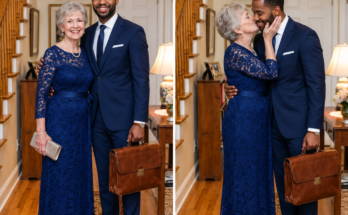
“I married her because she asked me to be her family,” he said. “Because she said I’d spent enough of my life being nobody’s son, and she wasn’t going to let that be true anymore. The romance people assumed — I never corrected it, because it was easier than explaining what we actually were to each other, and easier than watching people decide it was still somehow inappropriate.”
I sat down next to him on the swing, the wood creaking under both our weights the way it must have creaked under my grandparents’, decades ago.
“I accused you of being a gold digger for six months,” I said. “I threatened you. I told my friends you were probably counting down the days.”
“You loved her,” Jason said simply. “You were trying to protect her. I understood that better than you think — I’d have done the same for my own mother, if anyone had ever tried to take advantage of her.”
We sat there while the evening came in, and I found myself, for the first time since I’d seen him with his arm around my grandmother, not looking for the angle. Not waiting for the catch.
There wasn’t one. There never had been.
A month later, I asked Jason if he wanted to keep his old room in the house — my house now, officially, though it had never really stopped feeling like ours. He cried the first time I called it that out loud, standing in the doorway with a box of Grandma’s old hospice paperwork he’d finally worked up the courage to sort through.
He still tends Grandma’s garden every Sunday, the same roses she used to fuss over, the same stubborn tomato plants that never quite got enough sun. Sometimes I sit out there with him, and we talk about Ruth, and about Grandpa, and about a debt of kindness that somehow, impossibly, found its way all the way around to becoming a family neither of us expected but both of us needed.
Grandma’s plan worked exactly the way she wanted it to. It just took me longer than her to understand what she’d actually built.
I have a brother now. I almost didn’t let myself find out.