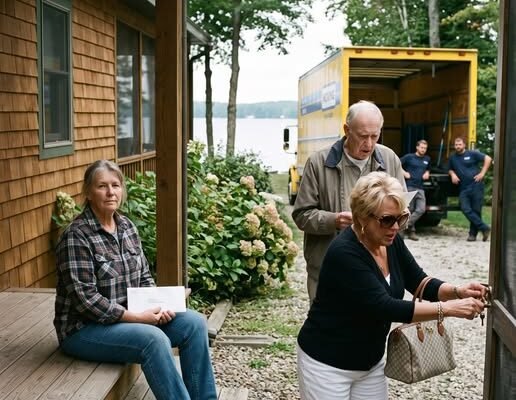
At 9 A.M., My Daughter’s Mother-In-Law Arrived With A Moving Truck And Said, “Why Are You Still Here? We’re Moving In Today.” I Didn’t Argue. I Just Held A White Envelope. She Tried My Old Key Twice. Then Her Husband Read One Page—And His Face Went Pale…
Part 1
At exactly nine on Saturday morning, a yellow moving truck rolled through the trees at the end of my driveway and stopped beside the gate. I was sitting on the porch with a mug of coffee cooling beside me and a plain white envelope resting across my knees, watching sunlight scatter across Torch Lake as if this were any other quiet September morning. The first person out of the cab was Marla Callahan, my daughter’s mother-in-law, wearing white capri pants, oversized sunglasses, and the expression of a woman arriving at a property she had already mentally redecorated. In her right hand was the spare key I had given my daughter four years earlier.
Marla saw me and stopped for half a second. Then she walked straight toward the porch and said, “Ruth, why are you still sitting out here? We need the driveway clear so the movers can get closer.” I looked at the boxes visible inside the truck, then at Dean Callahan climbing down from the passenger side, and asked what she meant by “still.” Marla gave me an irritated little smile and said, “You know what I mean. Megan said you’d start moving your things above the garage before today.”
I was sixty-seven years old, and I had spent almost four decades welding steel at a shipyard in Bay City, Michigan. People imagine welding as sparks and brute strength, but most of the job is patience: cleaning the joint, checking the angle, watching the heat, knowing that a seam can look smooth while a crack is spreading underneath it. Standing on that porch, looking at my daughter’s in-laws preparing to move into my house, I realized families could fail the same way. The break rarely started on the day everything finally split apart.
“This is my home,” I said. “I’m not moving above the garage.”
Marla stared at me as if I had changed the terms of an agreement we had negotiated together. Behind her, two movers opened the truck, and Dean began directing them toward boxes marked MASTER BEDROOM and SEWING ROOM in thick black marker. Marla turned away from me and told them to start unloading anyway. The first boxes landed beside the flower bed my late husband, Caleb, had once sketched on the back of a grocery receipt while we sat in an oncology waiting room.
Caleb and I had been married forty-one years when pancreatic cancer took him. For the last twenty years of our marriage, he talked about retiring near water, somewhere with a porch wide enough for two chairs and a kitchen window facing the lake. He wanted hydrangeas along the front walk because his grandmother had grown them, and he used to joke that after thirty years of waking up before dawn, he wanted to waste entire mornings drinking coffee and watching boats go by. He never got that retirement.
Two years after he died, I bought the house anyway.
It wasn’t grand. The cedar siding needed work, the dock leaned slightly to the left, and the kitchen had cabinets that belonged in 1998, but it had the porch, the lake view, and enough room beside the front steps for the hydrangeas Caleb wanted. I used my savings and part of the life insurance, and on the day I closed, I sat alone on the porch until after dark. I cried harder that evening than I had at the funeral because grief is strange that way; sometimes the life you almost had hurts more than the life you lost.
There was one detail about the purchase my daughter, Megan, barely noticed. During Caleb’s final year, after one of my coworkers suffered a stroke and his adult children began fighting over his property while he was still in rehabilitation, Caleb insisted we meet with an estate attorney. We created a family trust for our major assets, and after Caleb died, I became the sole trustee. When I bought the lake house, I bought it with trust funds and placed the property directly into the trust.
Megan was thirty-four and had been married to Derek Callahan for seven years. She managed the front office of a dental clinic outside Lansing, and when she was little, she used to sit on the kitchen floor near the back door whenever I worked late because she wanted to hear my truck pull into the driveway before she went to bed. After Caleb died, she became the only immediate family I had left, which was probably why I ignored more than I should have when our relationship started thinning around the edges. She spent more holidays with Derek’s family, canceled weekends with me at the last minute, and gradually treated every invitation from me as something that could be moved if Marla wanted the same date.
Still, when I bought the lake house, I gave Megan a spare key.
“You never need an invitation,” I told her.
Four years later, that key ended up in Marla’s hand.
The trouble had started one month before the moving truck arrived. I was repainting the porch railing on a Tuesday afternoon when Megan called, made small talk about work, then became quiet in the particular way she did when she had rehearsed something unpleasant. “Mom,” she finally said, “I wanted to give you enough notice. Derek’s parents are moving into the lake house next month.” →
“I beg your pardon?” I said, holding the wet paintbrush suspended over the cedar rail.
“Derek’s dad lost his consulting contract, and their subdivision in Grand Rapids has been pricing them out with property taxes,” Megan continued, her voice rattling off practicalities as if she were scheduling a patient’s six-month cleaning. “They sold their place. They need somewhere stable, and you’re rattling around in three bedrooms all alone. We figured the apartment over your detached garage is plenty of space for one person. It’s got that little kitchenette. You always said you liked cozy spaces anyway.”
We figured.
Not a question. Not a request. A logistical update, delivered between billing insurance claims and running errands on her lunch hour.
“Megan,” I said slowly, keeping my tone as level as an iron girder, “I am not moving into an unfinished attic space above a workshop so your husband’s parents can live on my lakefront.”
“Mom, don’t be selfish,” she snapped, that familiar, defensive edge creeping in—the voice she always used whenever Derek convinced her that his family’s comfort took priority over everything else. “Derek already promised them. They’ve got nowhere else to go that fits their lifestyle. They’re family too. Just think about it.”
She hung up before I could reply.
I didn’t argue further on the phone. In forty years at the shipyard, I had learned that when men start shouting, you don’t shout back; you check your gauges, tighten the clamps, and let reality do the heavy lifting. The next morning, I drove into Traverse City to see Donald Vance, the estate attorney who had set up Caleb’s and my trust nearly a decade before. When I walked out of his office two hours later, the deadbolts on my front door, back door, and garage had been scheduled for replacement, and I carried a single, sealed manila folder in my bag.
Now, thirty days later, Marla marched up my front porch steps, the gold-tone key held between two manicured fingers like a championship trophy.
“You’ve had plenty of time to come to terms with this, Ruth,” Marla said, bypassing where I sat and stepping directly up to the front door. “We aren’t unreasonable people. Derek said we’d even help carry your boxes out to the garage once the men get our heavy armoire inside.”
She jammed the key into the brass deadbolt.
It slipped in half an inch and stopped dead.
She wiggled it. Nothing. She pulled it back, checked the teeth, aligned it again, and pushed harder, twisting with both hands. The lock didn’t budge. A tiny scratch appeared on the polished brass plate around the keyway.
“What is wrong with this lock?” Marla muttered, irritation pinching the corners of her mouth. She rattled the doorknob violently. “Ruth, did you let the salt air seize the tumblers? It won’t turn.”
“The lock hasn’t seized,” I said quietly, not moving from my wicker chair.
Marla huffed, turning around with her hands on her hips, her face turning blotchy pink beneath her foundation. “Dean! Come up here and force this door! Your son said this was the right key.”
Dean climbed the steps, wiping sweat from his forehead with a handkerchief. He was a tall, stooped man who had spent thirty years letting his wife organize the universe while he nodded along from the passenger seat. “Let me try, Marla. Don’t break the key off in the cylinder.”
He took the key, tried to guide it into the keyhole, and met the exact same resistance. A new Schlage commercial cylinder, pinned to a key that had never left my pocket.
“It’s not turning because the tumblers were replaced on the twelfth,” I said.
Dean paused, looking down at me. “Ruth? What are you talking about? Megan told us the house was clear. Derek had the paperwork drawn up for our residential transfer. We closed on our house in Grand Rapids yesterday—the buyers took possession at eight this morning. Our furniture is in that truck.”
“I know,” I said.
I picked up the plain white envelope resting across my knees. I held it out toward Dean.
Dean looked at Marla, hesitated, and then took it. He tore open the top edge and pulled out a single sheet of watermarked bond paper bearing the letterhead of Vance, Higgins & Keller, Attorneys at Law.
Marla rolled her eyes and crossed her arms. “What is that, a bill? An estimate for the garage stairs? Because Derek already agreed to pay for half of the renovation once we’re settled.”
Dean didn’t answer. His eyes scanned the first paragraph, and the color began draining out of his face, starting at his cheekbones and sinking right down to his collar.
“Dean?” Marla said, her tone sharpening. “What does it say?”
Dean’s hands began to tremble, just a slight flutter against the crisp edges of the paper. “It’s… it’s a formal notice of non-party tenancy and intent to trespass.”
“What?” Marla snatched the corner of the paper, trying to read over his forearm. “Megan owns half this property as the surviving heir! Derek looked up the county tax records. It’s an inherited asset. She signed an occupancy grant to us as a leasehold!”
“No, Marla,” Dean whispered, his voice cracking like dry kindling. “Read the third paragraph. Read who owns the deed.”
Marla glared at the paper. Her eyes darted back and forth across the legal phrasing:
…hereby certified that the real property commonly known as 4140 Shoreline Drive is held in perpetuity under the Caleb & Ruth Miller Irrevocable Trust. Ruth Miller serves as the sole surviving Trustee, with full, exclusive discretionary authority over occupancy, encumbrance, and alienation. Megan Callahan holds a contingent remainder interest that vests only upon the death of the surviving Trustee, conferring zero current possessory rights, zero authority to execute lease agreements, and zero power of entry to third parties. Any unauthorized attempt to breach the premises or deposit chattels on the parcel constitutes civil trespass under Michigan Compiled Laws § 600.2919.
The silence that followed was broken only by the diesel engine of the moving truck idling out by the hydrangeas and the distant cry of a gull circling Torch Lake.
“This… this isn’t possible,” Marla stammered, dropping the edge of the paper as if it had burned her fingertips. “Derek checked. He said she was an only child. He said she owned it.”
“Derek made assumptions based on a piece of mail,” I said, resting both hands on the arms of my chair. “Caleb and I worked our entire lives for what we had. When Caleb got sick, we made sure this land would never be carved up, traded away, or leveraged by anyone until both of us were buried in the cemetery behind Bay City. Megan has no authority here. She never did. And neither do you.”
“We sold our house!” Marla’s voice broke into an octave that sent a flock of sparrows scattering from the birch trees. “Dean! Call Derek right now! Call Megan!”
Dean didn’t reach for his phone. He just stared at the sheet of paper, his mouth slightly open, looking like a man who had suddenly realized the lifeboat he jumped into was made of wet cardboard. “Our closing check cleared this morning, Marla. We wired the balance into the high-yield fund. The new owners have the keys. We don’t have a house.”
Down in the driveway, the two movers leaned against the bumper of the truck, checking their watches. “Hey, folks,” the taller one called out, squinting up at the porch. “Clock is running on the offload rate. Where do these bedroom sets go?”
“Nowhere,” I called back, my voice carrying clearly through the crisp autumn air. “They stay on the truck.”
Marla lunged toward me, her fingernails digging into the strap of her designer handbag, her face contorted with pure fury. “You vindictive old woman! Where are we supposed to sleep tonight? What are we supposed to do with two tons of furniture?”
“I imagine there’s an extended-stay motel out near the highway interchange,” I said. “Or perhaps you can call Derek and Megan. I understand they have a lovely guest bedroom in Lansing. It doesn’t have a lake view, but it has four walls and a roof.”
Dean took his wife by the elbow. He didn’t say another word to me. He didn’t apologize, and he didn’t argue, because forty years of running an honest trade teaches you when you’ve been entirely out-positioned. He steered Marla, who was sobbing in furious, breathless gasps, back down the front walkway, right past Caleb’s hydrangeas.
I watched them reach the driveway. Dean spoke to the driver, who nodded, climbed back into the cab, and fired the engine. With a hiss of air brakes, the yellow truck backed slowly out between the trees, tires crunching along the gravel until the noise faded onto the main road and vanished completely.
My phone began vibrating in my pocket five minutes later.
I pulled it out and saw Megan’s name flashing on the screen. It rang until it stopped, then started again immediately—three, four, five times.
I didn’t answer.
Instead, I set the phone face down on the wicker table, picked up my coffee, and looked out across the blue water of Torch Lake. The seam had cracked, just as I knew it would, but for the first time in four years, the house felt entirely, unmistakably my own.