The carving was simple.
No decoration.
No fancy border.
Just six words cut carefully into the wood.
FOR MARY, IF I GO FIRST.
I looked at Mom.
Her hand was still resting on the lid.
“He made this for you?”
She shook her head.
“That’s what I thought at first.”
Then she reached beneath the edge and lifted the lid.
Inside, carved into the underside, were more words.
IF MARY GOES FIRST, THIS IS HERS.
IF I GO FIRST, PUT ME HERE.
EITHER WAY, I BUILT US ONE GOOD LAST BED.
I laughed.
Then I cried.
It sounded exactly like Dad.
Practical.
Awkward.
Tender in a way he would have denied if anyone accused him of it.
Mom smiled for the first time since Thursday.
“He was never much for poetry.”
“No.”
“He was proud of that line, though.”
“You knew about this?”
“Since the night he finished it.”
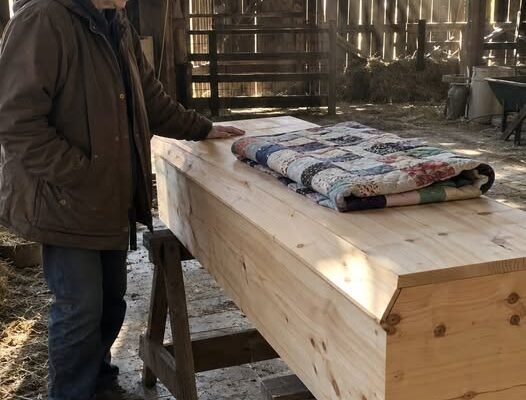
She ran her fingers along the smooth walnut.
That was when I really looked at the thing.
This was no rough wooden box.
Dad had built hundreds of cabinets, staircases, doors, mantels, porches, bookshelves, dining tables, and rocking chairs in his lifetime.
But I had never seen him build anything like this.
The sides were solid walnut.
The corners were joined by hand.
No metal brackets.
No visible screws.
The lid had a gentle curve.
Tiny maple inlays ran along the edges.
At the head was a carved oak leaf.
At the foot was a small cardinal.
Mom touched it.
“Your sister was born in February,” she said. “There were cardinals outside the hospital window.”
My sister, Ellen, had died as an infant before Kevin or I were born.
Dad almost never talked about her.
I swallowed.
“He remembered that?”
Mom looked at me.
“Your father remembered everything.”
She opened a shallow compartment beneath the lid.
Inside was an envelope yellowed with age.
On the front, in Dad’s handwriting, was written:
FOR WHICHEVER ONE OF US IS LEFT STANDING.
Mom didn’t open it.
“Not yet,” she said.
Twenty minutes later, a black funeral-home van pulled into the driveway.
Mr. Harris, the funeral director, got out with four employees.
He walked into the barn.
Then stopped.
“Oh my.”
Mom stood beside the casket.
“My husband built it.”
Mr. Harris walked around it slowly without touching.
“How long ago?”
“Thirty-seven years.”
He looked at the joints.
Then the wood.
Then the lid.
“Mrs. Bennett, this may be one of the finest handmade caskets I’ve ever seen.”
Mom nodded as if he had just confirmed something obvious.
“He was a good carpenter.”
Mr. Harris smiled.
“Yes, ma’am. I can see that.”
The men brought in padded straps.
They lifted Dad’s casket as carefully as if they were carrying something from a museum.
When they reached the barn door, another car came up the driveway.
Kevin.
He got out quickly.
“What’s going on?”
Nobody answered him.
He looked toward the men carrying the walnut casket.
Then at Mom.
“Where did that come from?”
“The barn,” I said.
Kevin frowned.
“We had something like that in the barn?”
Mom looked at him.
“For almost forty years.”
He walked closer.
When he saw the carving on the lid, his face changed.
“Dad made this?”
“Yes.”
“For himself?”
“For us,” Mom said.
Kevin stood there staring.
Nobody mentioned the ninety-five-dollar container.
Nobody had to.
His words were hanging in the air between all of us.
Cheapest box they’ve got.
He won’t know the difference.
Kevin stepped toward the casket.
He put one hand on the walnut.
Then immediately pulled it away.
“I didn’t know.”
Mom looked at him.
“No.”
There was no anger in her voice.
That made it worse.
Kevin swallowed.
“I was trying to keep the cost down.”
“I know.”
“I thought you were worried about money.”
“I am.”
“Then why didn’t you tell me this was here?”
Mom looked toward the barn.
“Because I thought my sons knew their father better than that.”
Kevin flinched.
I almost interrupted.
Mom raised one hand.
She wasn’t finished.
“Your father spent fifty-four years building things for other people.”
Her voice remained calm.
“Porches where people drank coffee.”
“Tables where families ate Thanksgiving dinner.”
“Cribs babies slept in.”
“Wheelchair ramps old people needed.”
“Steps.”
“Doors.”
“Church pews.”
“Kitchen cabinets.”
“Half the houses around here have something your father touched.”
Kevin stared at the ground.
Mom continued.
“And when he had no work in the winter of 1988, he didn’t sit around feeling sorry for himself.”
“He used scraps he’d been saving.”
“He built this.”
She touched the casket.
“Not because he was obsessed with dying.”
“Because your father hated wasting good lumber.”
Mr. Harris smiled despite himself.
Mom did too.
“He said if death was one bill neither of us could avoid, he might as well save us the markup.”
That was Dad.
Even Kevin laughed.
Barely.
Then his face crumpled.
“I screwed up.”
Mom didn’t answer immediately.
Kevin looked at her.
“I shouldn’t have said what I said.”
“No.”
“I shouldn’t have made the decision without you.”
“No.”
“I thought I was helping.”
Mom nodded.
“I know.”
He looked at the casket again.
Then said quietly,
“He would’ve hated that cardboard thing.”
Mom raised an eyebrow.
“Your father refused to buy particleboard furniture.”
I laughed.
Kevin covered his face.
“God.”
Mom finally stepped toward him.
She touched his arm.
“He would’ve forgiven you too.”
Kevin’s eyes filled.
“How do you know?”
“Because you once backed his truck through the garage door and he eventually forgave that.”
I laughed so suddenly I had to turn away.
Kevin started laughing too.
Even Mr. Harris did.
Dad had talked about that garage door for twenty-three years.
The story changed slightly every time.
By the end, Kevin had apparently been driving seventy miles an hour in reverse.
Mom looked at Mr. Harris.
“Can we use it?”
“Absolutely.”
“For the viewing too?”
“If you’d like.”
“I would.”
Then she looked at Kevin.
“And we’re having a proper service.”
Kevin nodded immediately.
“Whatever you want.”
“No.”
Mom shook her head.
“Not whatever I want.”
She pointed toward the barn.
“Whatever he wanted.”
That sent us looking.
Dad kept everything.
Instruction manuals for tools he no longer owned.
Receipts from 1976.
Coffee cans filled with bolts.
Coffee cans filled with washers.
Coffee cans containing things no human being could identify.
If Dad had planned his own casket, chances were he had planned more.
It took nearly an hour.
Kevin finally found a small metal toolbox tucked beneath Dad’s workbench.
Inside was a notebook.
The first page read:
WHEN I CROAK.
Below that:
MARY KNOWS ABOUT THE BOX.
DON’T BUY FLOWERS THAT COST MORE THAN GROCERIES.
NO OPEN BAR FOR PEOPLE I DIDN’T LIKE WHEN I WAS ALIVE.
Kevin looked at me.
“He planned his funeral like a construction job.”
Mom nodded.
“Keep reading.”
Dad had written everything down.
He wanted the service at Grace Methodist.
He wanted Psalm 23 because his mother loved it.
He wanted Hank Williams played afterward.
He wanted his old carpenter friends invited.
And he wanted the funeral procession to drive once past Bennett Woodworks.
At the bottom of the page, he had written:
IF ANYBODY WEARS A TIE TOO TIGHT, THAT’S THEIR OWN FAULT.
The final note said:
PUT MY HAMMER IN WITH ME.
NOT THE GOOD ESTWING.
THAT ONE COST TOO MUCH.
THE OLD WOOD-HANDLE ONE.
Kevin sat down on Dad’s work stool and started crying.
Not quietly.
I had never seen my brother cry like that.
He picked up Dad’s old wooden-handled hammer from the bench.
The handle was dark from decades of use.
Dad had reshaped it twice.
Kevin held it in both hands.
“He taught me with this.”
“I know.”
“I forgot.”
Mom sat beside him.
“What?”
Kevin looked around the workshop.
“How much of him was in here.”
Mom didn’t say anything.
Kevin stared at the hammer.
“I moved ten minutes away and somehow stopped coming out here.”
His voice cracked.
“I kept thinking there’d be time.”
That sentence silenced all of us.
Because that was the truth none of us wanted to say.
There is always supposed to be more time.
One more Sunday dinner.
One more Christmas.
One more phone call.
One more chance to ask your father why he saved thirty-seven bent screwdrivers.
Then Thursday comes.
And suddenly there isn’t.
The viewing was Monday evening.
Mr. Harris placed Dad in the casket he had built with his own hands.
They didn’t cover much of the wood with flowers.
Mom wouldn’t allow it.
“I want people to see his work.”
They did.
People came from everywhere.
Men I hadn’t seen since childhood.
Women Dad had built kitchens for twenty years earlier.
Families whose porches he had repaired.
A retired schoolteacher brought a photograph of a bookcase Dad built in 1981.
A young man came carrying a wooden toy truck.
“Mr. Bennett made this for me when I was six.”
Another man said Dad had built a wheelchair ramp for his mother and refused payment.
Someone else brought a picture of a gazebo.
Then an elderly woman approached Mom.
“Your husband rebuilt my front steps after my Harold died.”
Mom nodded.
“I remember.”
“He came every morning for four days.”
She smiled.
“He knew I was lonely.”
That was when I realized we were not looking at the record of Dad’s work.
We were looking at the record of his life.
Wood had simply been the way he entered people’s stories.
Kevin stood beside the casket most of the evening.
Whenever someone admired it, he said the same thing.
“Dad built it in 1988.”
At one point, I heard him add,
“And I almost put him in a cardboard box.”
The man beside him didn’t know what to say.
Kevin smiled sadly.
“That’s all right. I’m telling people because I don’t want to forget what an idiot I was.”
Later, Mom found him alone.
“You don’t have to punish yourself forever.”
“I disrespected him.”
“You made a bad decision.”
“There’s a difference?”
“Yes.”
She took his hand.
“A bad decision is something you did.”
She touched his chest.
“It isn’t who you are.”
Kevin looked at her.
Mom smiled.
“If your father were here, he’d tell you to quit standing around and find something useful to do.”
Kevin laughed through his tears.
So he did.
The next morning, before the funeral, Kevin drove to Dad’s workshop.
He found a piece of walnut left from the original casket.
Then he did something I hadn’t seen him do since we were teenagers.
He picked up Dad’s tools.
Kevin isn’t a carpenter.
His first cut was crooked.
His second wasn’t much better.
But after three hours, he had made a small wooden box.
The corners weren’t perfect.
The lid didn’t sit quite straight.
Dad would have noticed immediately.
Kevin placed Dad’s old hammer inside.
Then he carved two words into the lid.
THANKS, DAD.
We put the little box inside the casket.
Mom cried when she saw it.
Then she kissed Kevin.
“He’d complain about those joints.”
“I know.”
“He’d say you used too much glue.”
“I know.”
“He’d probably pull it apart and redo it.”
“I know, Mom.”
She smiled.
“He’d keep it, though.”
The church was full.
More people stood along the walls.
After the service, six men who had worked with Dad carried the casket outside.
All of them were over sixty.
All of them insisted.
As they brought him down the church steps, people placed their hands against the walnut as he passed.
Not because the casket was valuable.
Because Dad had made it.
There was something extraordinary about that.
A carpenter carried through town inside his final piece of work.
The procession passed Bennett Woodworks.
Kevin had opened the big shop doors that morning.
Dad’s tools were visible inside.
His workbench remained exactly where he’d left it.
Mom asked the hearse to stop.
Just for a moment.
Nobody spoke.
Then she whispered,
“Okay, Raymond.”
Her voice trembled.
“Time to go.”
We continued to the crematory.
Dad had always wanted to be cremated.
The casket went with him.
That surprised Kevin.
“All that work?”
Mom looked at him.
“That was the point.”
“But it took him months.”
“Probably.”
“And now it’s going to be burned?”
“Yes.”
Kevin struggled with that.
Mom didn’t.
She placed her palm against the wood one last time.
“Your father never built things because he thought they’d last forever.”
She looked at us.
“He built them because they were needed while they were here.”
I have thought about that sentence ever since.
Afterward, we returned home.
The house was packed.
People brought casseroles.
Pies.
Potato salad.
Someone brought enough fried chicken to feed the entire county.
Grandma Ruth from church brought a cake with Dad’s name misspelled.
Mom laughed harder than she had all week.
Late that evening, after everyone left, the three of us went back to the barn.
Dad’s workbench looked enormous without him standing behind it.
Mom finally opened the yellow envelope from the casket.
Inside was one sheet of paper.
Dad’s handwriting was shaky in places.
Apparently, he had updated it only a year earlier.
Mary—
If you’re reading this, one of us got unlucky first.
If it was me, don’t spend too much money burying a man who spent his whole life complaining about prices.
You gave me more than I ever deserved.
Fifty-seven years.
Two boys.
One little girl we didn’t get to keep long enough.
A house.
A good life.
And enough arguments to keep it interesting.
Tell the boys I loved them.
Tell Kevin I always knew he’d eventually learn to measure twice.
Tell Daniel he still owes me twenty dollars from 1996.
I stopped reading.
“What?”
Mom was laughing.
“I paid him that twenty dollars.”
Kevin shook his head.
“No chance.”
I kept reading.
The last paragraph was for Mom.
If you’re the one left behind, Mary, don’t turn this house into a museum.
Use my tools.
Give things away.
Let the grandchildren scratch the table.
Paint the kitchen if you want.
And don’t sit around talking to my chair like some sad old woman.
You always talked enough for both of us anyway.
Mom hit the page with her hand.
“That old fool.”
But she was crying.
At the bottom, Dad had written:
P.S. If Kevin puts me in some cheap cardboard box after I spent all winter of 1988 building that walnut one, I will haunt him personally.
For three full seconds, nobody moved.
Then I looked at Kevin.
Mom looked at Kevin.
Kevin stared at the page.
“Oh, come on.”
Mom started laughing.
I laughed.
Kevin tried not to.
Then all three of us were laughing so hard we couldn’t breathe.
Mom finally wiped her eyes.
“Well.”
Kevin pointed toward the ceiling.
“He knew?”
“Apparently.”
Kevin looked upward.
“I changed it, Dad!”
That made us laugh again.
It was the first time since Thursday that grief didn’t feel like something sitting on my chest.
It felt like Dad was still somehow in the room.
Not as a ghost.
Not literally.
Just in the jokes.
The wood shavings.
The old tools.
The ridiculous note.
The way Mom laughed.
The way Kevin looked embarrassed.
The way families carry people forward without realizing they’re doing it.
Over the following months, Kevin started visiting Mom every Saturday.
At first, I assumed he was checking on her.
Then one afternoon Mom sent me a photograph.
Kevin was standing in Dad’s workshop wearing Dad’s old canvas apron.
He was building a small bench.
The legs were uneven.
I called him immediately.
“That thing looks dangerous.”
“Shut up.”
“Dad would burn it.”
“Dad burned his own casket, so that’s not much of an insult.”
He kept building.
By Christmas, the bench was finished.
Mom put it beside the barn door.
The next spring, Kevin built a birdhouse.
Then a planter.
Then a small bookshelf for his granddaughter.
He never became the carpenter Dad was.
That wasn’t the point.
He just stopped treating the barn like a place belonging to someone who was gone.
One Saturday, nearly a year after Dad died, Mom called both of us over.
She was standing beside the workbench.
On top was another blue tarp.
Kevin looked horrified.
“Please don’t tell me Dad built you another coffin.”
Mom laughed.
“No.”
She pulled away the tarp.
Underneath was a stack of walnut boards.
Enough for another casket.
Dad had labeled them years earlier.
MARY’S, IF SHE WANTS IT.
Mom stared at the lumber.
Then shook her head.
“No.”
Kevin blinked.
“What do you mean, no?”
“I don’t want one.”
“But Dad saved this for you.”
“He also wrote not to turn the house into a museum.”
She smiled.
“I have another idea.”
That walnut became twelve small pieces of furniture.
Kevin built most of them.
I helped badly.
Mom supervised aggressively.
We made rocking horses for Dad’s great-grandchildren.
Two small tables.
A bookshelf.
A bench for the church.
And one sturdy porch swing.
We hung the swing on Mom’s front porch.
The same porch Dad had built forty-three years earlier.
Sometimes when I visit, Mom is sitting there.
She’ll run one hand along the walnut armrest.
Then she’ll say something like,
“Your father would’ve made this joint tighter.”
Kevin always answers,
“Then he should’ve stuck around and done it himself.”
Mom laughs every time.
Dad died on a Thursday.
For a few terrible days, I thought the last decision our family would make for him was whether a ninety-five-dollar container was good enough.
Instead, Dad had made his own final choice thirty-seven years earlier.
He left us a casket built with patience.
A letter filled with jokes.
A workshop full of tools.
And one final lesson none of us understood until he was gone.
The value of something isn’t determined by how long it survives.
A porch eventually rots.
A table gets scratched.
A house changes owners.
A handmade casket becomes ashes.
Even the strongest carpenter eventually puts down his hammer.
What lasts is what happened around those things.
The meals at the table.
The conversations on the porch.
The children rocked to sleep.
The neighbors who remember who showed up when they needed help.
The son who finally returned to his father’s workshop.
The widow who can still laugh at a note written decades earlier.
Dad spent fifty-four years building with wood.
But standing in that barn after his funeral, I finally understood what he had really been building all along.
A life people would remember.
And that turned out to be something no cheap box could ever contain.