Part One — The Number That Didn’t Add Up
I’ve done taxes for half of Stillwater for twenty years, out of my dining room.
I can spot a number that doesn’t add up from across the room.
Vernon and I have been married thirty-nine years.
We never had children. It just never happened for us.
We had Duke instead.
A big, dumb, sweet yellow Lab, fourteen years old.
Vernon found him in a ditch as a puppy and carried him home in his coat.
Every other weekend for seven years, Vernon has gone fishing at a lake an hour east.
He comes home with no fish.
“They weren’t biting,” he says, every time.
I used to tease him about it.
I don’t anymore.
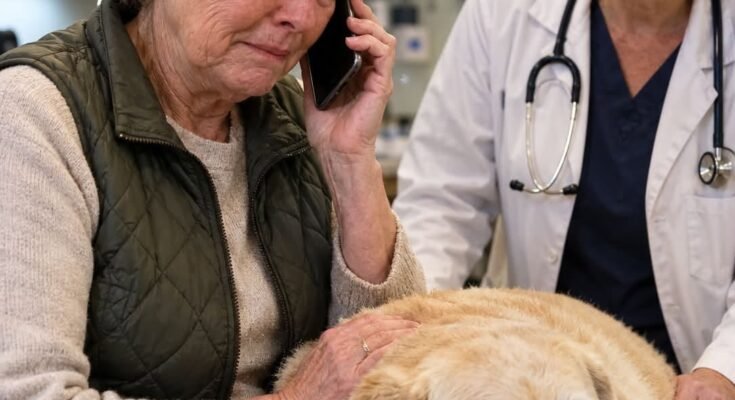
Last Saturday morning, Duke couldn’t get up.
I’m proud. I don’t ask for help. Not from my sister, not from the neighbors.
I got that dog into the back of my car myself, and it about broke my back.
At the vet, the young doctor shook her head.
“Mrs. Petrie, his kidneys are failing, and it’s time.”
I called Vernon. No answer.
I called again. And again.
Nine times.
On the tenth call, somebody picked up.
“Hello?”
It was a little girl. Maybe six.
“Who’s this?” I said.
“Hadley,” she said. “Who’s this?”
Then I heard a woman in the background.
“Baby, give me Daddy’s phone!”
And the little girl said, “Daddy’s in the shower.”
The line went dead.
I sat in that little vet room with my hand on Duke’s head.
“Mrs. Petrie?” the doctor said. “Do you need a minute?”
I needed about thirty-nine years.
I held Duke while he went.
He was looking at me the whole time.
I kissed his old gray head goodbye.
Then I paid the bill, wiped my face, and called the number back.
Nobody answered.
So I looked up Vernon’s phone on our account on my computer, the way I’d set it up for us years ago.
It still shares his location with me.
He never knew how to turn it off.
It showed a motel two towns over.
No lake anywhere near it.
I sat in my car in the vet’s parking lot, holding Duke’s empty collar.
It was two in the morning that night before I made up my mind.
Lying there, all I could think was, he puts his paycheck in our joint account.
I’ve never once checked where it goes after that.
If I go after him, I could lose the house we’ve paid on for thirty years.
I got up and pulled the bank statements anyway.
Seven years of them.
Seventeen hundred dollars a month, every month, to a rental company two towns over.
I’d seen that line a hundred times. He’d told me it was his truck payment.
Sunday morning, I drove there.
The Lamplighter Motel. Long-term rooms by the week.
Vernon’s truck was parked right in front of room 14.
There was a pink bicycle with training wheels leaning on the rail.
I parked across the lot and sat there with Duke’s collar in my lap.
At nine o’clock the door to room 14 opened.
A woman came out with a laundry basket on her hip.
She was maybe forty, tired, in a Walmart vest.
━━━━━━━━━━━━━━━━━━━━
Part Two — Room 14
Then Vernon came out behind her.
He was carrying a little girl’s backpack.
Hadley followed him.
She saw me before he did.
“Daddy!”
Vernon turned.
The backpack slipped from his hand.
For thirty-nine years, I’d wondered what my husband would look like if I ever caught him in a lie too big to explain.
Now I knew.
Old.
He walked toward me slowly.
“Marjorie.”
I got out of the car.
Duke’s collar was still wrapped around my hand.
Vernon saw it.
His face changed.
“Where’s Duke?”
“Dead.”
One word.
He actually staggered.
“What?”
“He died yesterday while you were fishing.”
Vernon closed his eyes.
The woman had stopped on the walkway.
Hadley was holding her hand.
“Vernon,” she said carefully, “who is that?”
He didn’t answer.
So I did.
“I’m his wife.”
The woman’s laundry basket hit the concrete.
Hadley jumped.
Her mother stared at Vernon.
“Your what?”
That was the first thing that didn’t fit the story I’d already built in my head.
She hadn’t known either.
Her name was Rachel.
Hadley was six.
And Vernon was her father.
He hadn’t been living with them.
He’d been visiting every other weekend, paying their rent and telling Rachel that he was a widower who lived alone outside Stillwater.
Rachel had known him for seven years.
The arithmetic landed before the emotion did.
Seven years.
Six-year-old daughter.
Seventeen hundred dollars a month.
Every fishing trip.
I looked at Vernon.
“You have a child.”
He nodded.
“Say it.”
“I have a daughter.”
“And you let me spend thirty-nine years believing we never got to have one.”
He started crying.
I didn’t.
Not yet.
Rachel told Hadley to go inside and watch television.
Then the three of us stood outside room 14 while Vernon finally stopped trying to protect himself with half-sentences.
He had met Rachel when she was working at a convenience store.
He’d told himself it would happen once.
Then twice.
Then Rachel became pregnant.
And instead of telling me, he built another life around the lie.
Not a second marriage.
Not another grand house.
Just room 14, grocery money, school shoes, birthday presents and every other weekend that I’d believed belonged to a lake.
“Why the motel?” I asked.
Rachel answered.
“It’s not really a motel anymore. Half these units are monthly rentals.”
She looked sick.
“He told me the seventeen hundred came from a rental property.”
I almost laughed.
Of course he had.
A lie for each woman.
Balanced neatly enough that neither of us would examine the ledger.
Vernon stepped toward me.
“Marjorie, please.”
I held up Duke’s collar.
“You weren’t there.”
His face collapsed.
That was the part that finally made me cry.
Not Rachel.
Not even Hadley.
Duke.
That stupid old dog had waited beside the front window every other Friday for Vernon to come home from work.
And on the last morning of his life, I had called Vernon ten times.
Vernon had chosen not to answer because answering risked exposing his secret.
“I didn’t know Duke was dying.”
“No. You only knew your wife called nine times.”
He had nothing to say to that.
I drove home alone.
This time I didn’t wonder whether I might lose the house.
I called an attorney Monday morning.
━━━━━━━━━━━━━━━━━━━━
Part Three — What the Statements Couldn’t Tell Me
Thirty-nine years of marriage doesn’t disappear because somebody confesses in a motel parking lot.
It has to be untangled.
Slowly.
Bank accounts.
Retirement.
Property.
Insurance.
Tax returns.
Debts.
The house.
And seven years of money I’d believed was paying for a truck.
My attorney explained something important before I let anger make decisions for me.
Hadley was a child.
Whatever Vernon had done to me, supporting his daughter was not the wrongdoing.
The deception was.
Using marital money secretly was something the lawyers could examine.
But I wasn’t going to turn a six-year-old girl’s groceries and rent into evidence that she shouldn’t have existed.
That distinction saved me from becoming someone I wouldn’t have recognized.
Rachel called me once.
I almost didn’t answer.
“I’m sorry,” she said.
“For what?”
“For your marriage.”
“You didn’t know.”
“I should’ve asked more questions.”
“So should I.”
There was a long silence.
Then she said:
“Hadley keeps asking about Duke.”
That surprised me.
Apparently Vernon had shown her hundreds of pictures.
Hadley knew Duke’s name.
She knew he hated thunderstorms.
She knew he slept with one paw stretched under Vernon’s side of the bed.
She knew everything about my dog.
She just hadn’t known I existed.
That hurt in a strange new place.
“Tell her Duke was a good boy,” I said.
Rachel’s voice broke.
“I will.”
Vernon moved out.
The divorce took more than a year.
There was no dramatic moment when a judge handed me everything and left him with nothing.
We divided what had to be divided.
Records were reviewed.
The house had equity.
So did retirement accounts.
There were difficult negotiations over money Vernon had concealed, but there was also the reality that some of what he’d paid had supported his child.
Life was messier than revenge.
The hardest part came four months after I found them.
Vernon asked if he could come to the house.
I said no.
So we met at my attorney’s office.
He looked thinner.
He placed something on the table.
Duke’s old red leash.
I’d forgotten Vernon kept it in his truck.
“I found this under the back seat.”
I stared at it.
“I loved him too,” Vernon said.
I believed him.
That’s the terrible thing about betrayal.
People can love you and still lie to you.
People can love a dog and still miss his death because they’re protecting a secret.
People aren’t divided neatly into people who care and people who don’t.
Sometimes they care deeply and still make selfish choices for years.
“Why didn’t you tell me about Hadley?” I asked.
Vernon looked down.
“At first because I was afraid you’d leave.”
“And later?”
He took a long time.
“Because every year I waited made the truth uglier.”
That was probably the most honest thing he’d ever told me.
“I kept thinking I’d find the right time.”
“There wasn’t one.”
“I know.”
“No, Vernon. There was a right time.”
He looked up.
“The day you found out Rachel was pregnant.”
He nodded.
I asked the question I’d carried since the motel.
“Did you stay married to me because you loved me, or because divorce was inconvenient?”
His eyes filled.
“I loved you.”
I surprised both of us by saying:
“I believe you.”
Then I added:
“It just wasn’t enough to make you honest.”
We divorced.
Vernon remained Hadley’s father.
I never asked him to choose between us.
That would’ve been another kind of cruelty, and the only person punished by it would’ve been a little girl who hadn’t created any of this.
For a long time, I wanted nothing to do with Hadley.
Not because I blamed her.
Because hearing her name made my stomach hurt.
Then, almost two years later, a small envelope arrived.
The return address was Rachel’s.
Inside was a drawing.
A yellow dog with enormous ears standing beside a blue lake.
Across the top, in purple crayon, Hadley had written:
FOR DUKE. DADDY SAYS HE WAS THE BEST DOG.
I sat at my dining-room table and cried harder than I had at the veterinarian.
I put the picture in a drawer.
Then I took it back out.
It wasn’t the child’s fault that her father had built her life inside a lie.
So I put it on the refrigerator.
I’m sixty-seven now.
I still prepare taxes at that same dining-room table.
People bring me shoeboxes full of receipts and apologize for the mess.
I tell them I’ve seen worse.
Sometimes I think about those seventeen-hundred-dollar payments.
They had been right there for seven years.
A number I saw over and over without ever questioning it because I trusted the explanation attached to it.
For a while, I hated myself for that.
I’m supposed to notice numbers that don’t add up.
Eventually, I understood something.
Trust isn’t stupidity.
A marriage shouldn’t require forensic accounting to remain honest.
The person deceived is not responsible for becoming suspicious enough to prevent the deception.
Last spring, I finally cleaned the drawer beside Vernon’s old chair.
At the very back was Duke’s collar.
I’d kept it exactly as it was after the veterinarian handed it to me.
His little metal tag still said:
DUKE PETRIE
I carried it outside and sat on the back steps.
Thirty-nine years with Vernon had been real.
So was the betrayal.
Duke’s fourteen years with us were real.
So was Hadley.
One truth didn’t have to erase another.
I hung Duke’s collar from the hook beside the back door where his leash used to be.
It doesn’t hurt quite as much there.
And whenever I see it, I remember the last day of his life.
I wish Vernon had been beside us.
I always will.
But Duke wasn’t alone.
I was there.
My hand was on his head.
He was looking at me.
And after thirty-nine years spent believing love meant trusting someone without question, that old dog left me with one final truth no bank statement could have shown me:
Love can be real.
And the lie can be real too.
You don’t have to deny one to finally walk away from the other.