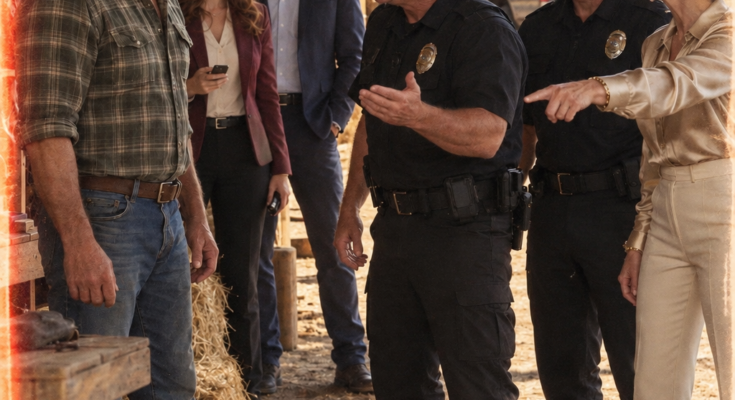
Part One — The Badge That Wasn’t Real
The first man who called me homeless was wearing a fake police badge.
The second was my own son.
And neither of them noticed the tiny red light glowing behind the rusted horseshoe above my barn door.
“Mrs. Mercer, you have ten minutes to collect whatever personal property the association has agreed to release,” the man in the navy tactical shirt said. He rested one hand on the pistol at his hip and used the other to point toward the gravel road behind me. “After that, you leave Cedar Hollow Ranch and do not return.”
I looked at the badge clipped to his belt.
SILVER RIDGE COMMUNITY POLICE.
There was no Silver Ridge Community Police.
There was a Silver Ridge Homeowners Association.
There was a private security contractor the HOA had fired three months earlier.
There was a county sheriff’s department twenty-two miles away.
But there was no police department owned by the collection of stucco houses glittering beyond my eastern pasture.
I knew that.
The two federal agents sitting silently inside the hayloft knew it.
The four microphones hidden in the barn knew it.
And somewhere in Richmond, an FBI evidence server was preserving every word the man said.
My son Eric stood twenty feet behind him beside a pearl-white Range Rover, arms folded across his chest.
He wouldn’t look at me.
That hurt more than the badge.
I had changed Eric’s diapers in this house.
I had worked double shifts when his father, Samuel, broke his back in a tractor accident.
I had sold my mother’s jewelry to keep Eric in college after his scholarship disappeared.
I had paid the down payment on the first home he shared with his wife.
I had watched his children every summer without asking for gas money, grocery money, or gratitude.
Now my sixty-four years of life had apparently been reduced to ten minutes and whatever property a homeowners association had “agreed to release.”
Eric finally glanced at me.
“Mom,” he said, low enough that the fake officers probably thought he was being compassionate, “please don’t make this uglier.”
I said nothing.
His jaw tightened.
My silence always bothered Eric more than anger.
When he was a teenager, he knew yelling meant I was scared.
Silence meant I had decided something.
Behind him stood Vanessa Whitfield, the president of the Silver Ridge HOA, dressed like she was attending a country-club luncheon instead of an eviction she had manufactured.
Cream blazer.
Gold bracelets.
Auburn hair arranged in smooth, expensive waves.
Vanessa smiled.
Not kindly.
Victoriously.
The smile of someone standing in another person’s front yard while already choosing where the hydrangeas would go.
“You should listen to your son, Evelyn,” she said. “We’ve been more patient than most boards would have been.”
I turned my eyes toward her.
That was all.
The smile flickered.
People like Vanessa needed resistance.
They fed on it.
A shouted accusation gave them something to call unstable.
Tears gave them something to call pathetic.
Pleading gave them proof they held the power.
So I gave her nothing.
No tears.
No shouting.
No begging.
No explanation.
No warning.
Five days earlier, Eric had arrived at my farmhouse carrying Chinese takeout and a bottle of the California cabernet Samuel and I used to buy on anniversaries.
I should have known something was wrong the moment Eric remembered the wine.
For the previous three years, my son had barely remembered my birthday.
He arrived alone, hugged me longer than usual, and asked whether we could eat at the old oak table in the kitchen.
He talked about his children.
He talked about work.
He talked about how exhausted he was.
Then, just before dessert, he put a blue folder beside my plate.
Inside were twenty-seven pages of legal language.
He told me the documents were part of a “family estate restructuring.”
I read three pages before I understood what they actually were.
The papers transferred management control of Cedar Hollow Ranch, including 1,840 acres, three houses, six barns, timber rights, mineral rights, two reservoir easements, and forty-seven acres bordering Silver Ridge, into a holding company called Mercer Family Land LLC.
Eric controlled the company.
Not me.
I looked at him across the same table where I had once helped him glue together a fifth-grade solar system.
“Why?”
He rubbed both palms over his face.
“Because you’re sixty-four, Mom.”
I waited.
“That’s your reason?”
“It’s part of it.”
“You think sixty-four is dead?”
“Don’t do that.”
“Do what?”
“Turn everything into an insult.”
I almost laughed.
Then he told me Silver Ridge had made an offer.
Thirty-two million dollars.
The HOA’s development partners wanted my eastern fields for a second gated phase, a private golf practice facility, and a commercial access road connecting the neighborhood to Route 17.
They had already spent millions preparing.
Architects.
Lobbyists.
Engineering studies.
Deposits.
Promotional material.
They were so confident the deal would close that Vanessa Whitfield had shown prospective investors digital renderings of luxury homes sitting on land I had never agreed to sell.
Eric said thirty-two million dollars was “life-changing money.”
I told him my life did not require changing.
He said I was being emotional.
I closed the folder.
“No.”
His face hardened.
“Mom, at least think about it.”
“I just did.”
“You can’t maintain eighteen hundred acres forever.”
“I don’t need forever.”
“You’re being stubborn.”
“And you’re asking me to sign away control of my land.”
“Our land.”
That stopped me.
I looked directly at him.
“No, Eric.”
His cheeks reddened.
“Eventually it’ll be mine.”
“Eventually isn’t today.”
He left angry.
The next morning, my attorney called.
Not because I’d contacted her.
Because someone had already filed paperwork involving Mercer Family Land LLC.
And my signature appeared on it.
There was only one problem.
I had never signed it.
By that afternoon, what I thought was a family betrayal had become something larger.
My attorney contacted the appropriate authorities after discovering additional irregularities connected to the proposed land transaction.
I was told very little at first.
Only this:
Do not confront Eric.
Do not confront Vanessa.
Do not sign anything.
Preserve every communication.
And if either of them contacted me about the sale, notify my attorney immediately.
Two days later, Vanessa called.
She said there had been a “misunderstanding.”
She wanted to meet privately.
At my barn.
She wanted to bring Eric and two men who would “explain the transition.”
My attorney told me not to agree until law enforcement had been consulted.
Then the strangest instruction of my life came back.
Agree.
So I did.
Which was how I ended up standing in my own barn while a man with a fake badge informed me that I was trespassing.
He pointed toward the farmhouse.
“Your son is the authorized property representative now.”
Eric finally spoke.
“Mom, just take what you need.”
I looked at him.
“You believe that?”
He swallowed.
Vanessa stepped between us.
“Evelyn, you’re no longer in a position to interfere with the transaction.”
“What transaction?”
“The eastern parcel.”
“I never agreed to sell it.”
She smiled.
“We have documents saying otherwise.”
“Signed by me?”
Another pause.
“Yes.”
“Then show me.”
That was when the second fake officer opened a leather case.
He removed a contract.
A deed-related instrument.
And a notarized acknowledgment bearing my name.
He placed them on Samuel’s old workbench.
Then Vanessa said the sentence the people hidden above us had been waiting to hear.
“Once you confirm today that you won’t challenge the signatures, Eric receives his distribution and we close Friday.”
Eric looked at her sharply.
“Vanessa.”
“What?”
“You said we weren’t discussing that here.”
The first fake officer stepped toward me.
“Mrs. Mercer, you’re homeless at this point. I’d strongly recommend taking the deal.”
Then a voice came from above us.
“No one move.”
Eric looked toward the hayloft.
Vanessa went completely white.
The barn door behind us opened.
And for the first time all afternoon, the men wearing badges were looking at people whose badges were real.
━━━━━━━━━━━━━━━━━━━━
Part Two — What They Thought I Had Signed
What happened next wasn’t the dramatic ending Vanessa probably imagined.
Nobody declared me the winner of Cedar Hollow Ranch on the spot.
Property records don’t work that way.
Neither do federal investigations.
The armed men were separated and disarmed while their identities and authority were checked.
Documents were preserved.
Phones and other evidence were handled through the legal process that followed.
And the land dispute went to lawyers and the appropriate court.
What mattered was that the meeting in my barn had documented something far more useful than an argument.
It documented what they believed.
That my signature could be used without my consent.
That intimidation could keep me from challenging it.
And that Eric was supposed to receive money if the transaction closed.
My attorney later showed me the signature that had supposedly transferred control.
It looked like mine.
Almost.
Whoever produced it knew how I looped the E in Evelyn.
They didn’t know that after arthritis stiffened my right thumb three years earlier, I’d stopped signing my last name with the same long upward stroke.
Old examples and recent examples looked different.
But handwriting wasn’t the only issue.
Electronic records, document histories, financial communications and witness statements all became part of determining who had done what.
Eric hired his own lawyer.
For nearly three weeks, he didn’t contact me.
Then one afternoon my attorney asked whether I would accept a letter from him.
I did.
It contained one sentence that mattered:
Mom, I knew you hadn’t agreed to the sale. I told myself you’d thank me once you saw the money.
I put the letter down.
That was worse than any excuse he could have made.
My son hadn’t mistaken my wishes.
He had simply decided they mattered less than his plan.
━━━━━━━━━━━━━━━━━━━━
Part Three — Eventually Isn’t Today
The investigation took months.
So did the civil fight over the land documents.
There were no overnight miracles.
No judge handed me thirty-two million dollars because I’d been mistreated.
No federal agent walked into my kitchen and announced that everyone who had crossed me was going to prison forever.
Reality was slower.
And, in some ways, more satisfying.
The disputed transfer documents were challenged through the proper process.
The attempted sale did not close.
The development company backed away from the eastern parcel while ownership and authorization were contested.
Silver Ridge’s board faced questions of its own about what Vanessa had represented as official HOA action and what she had undertaken with others.
The two men who had presented themselves as police officers faced scrutiny over their conduct, their badges, their weapons and the authority they had claimed.
Vanessa resigned from the HOA board before everything was finished.
Her resignation didn’t erase anything.
Neither did Eric being my son.
His involvement was evaluated separately based on evidence, not on whether I wanted to protect him.
That was one of the hardest decisions of my life.
People assume a mother stops loving a child when she finally stops rescuing him.
She doesn’t.
Sometimes she loves him while allowing the consequences to reach him.
Eric eventually admitted that he had convinced himself I was wasting an asset.
Thirty-two million dollars had stopped looking like an offer to him.
It had started looking like money I was stealing from the family by refusing it.
He had debts I hadn’t known about.
Investments that had gone badly.
Promises he’d made to his wife about what their life would look like once “the ranch deal” closed.
Vanessa knew he was desperate.
He knew she needed my land.
They each mistook the other’s desperation for leverage.
And somewhere between those two things, I became an obstacle instead of a person.
Nearly a year after the barn meeting, Eric asked to see me.
My attorney told me I didn’t have to.
I knew that.
I agreed anyway.
We met at a small diner.
He looked older.
So did I.
For a while, neither of us touched our coffee.
Finally he said:
“I kept thinking about what you said.”
“What did I say?”
“Eventually isn’t today.”
I remembered.
He stared at his hands.
“I thought because I’d inherit some of it someday, taking control early wasn’t really stealing anything from you.”
I didn’t rescue him from the ugliness of that sentence.
He continued.
“I told myself Dad would’ve sold.”
“Your father had opportunities to sell.”
Eric looked up.
“He did?”
“Three that I know of.”
“Why didn’t he?”
“Because we didn’t want to.”
Eric’s eyes dropped.
I said:
“You didn’t betray me because you wanted money. People want money every day.”
He waited.
“You betrayed me when you decided wanting it gave you authority over my answer.”
He nodded.
There were tears in his eyes.
But I had learned something during that year.
Tears are information.
They are not restitution.
“I am sorry, Mom.”
“I believe you.”
His face changed, hopeful for half a second.
Then I finished.
“That doesn’t mean things go back.”
They didn’t.
Eric never regained control over my finances.
He never received authority over Cedar Hollow Ranch.
I revised my estate plan with independent counsel.
Not to punish him.
To make sure nobody could again confuse a future inheritance with present ownership.
Our relationship became smaller.
For a while, that was all it could safely be.
Birthday calls.
Occasional lunches.
Visits with the grandchildren arranged without discussions about property.
Over time, Eric stopped asking when I would trust him again.
That was when I began to think perhaps he finally understood trust.
It isn’t something the injured person owes you on a timetable.
You behave differently.
Then you wait.
Cedar Hollow remained mine.
I didn’t keep all 1,840 acres simply to spite Silver Ridge.
Eventually I placed conservation protections on part of the woods and leased additional pasture to a neighboring family.
Years later, I sold a small parcel on the opposite side of the property.
My choice.
My signature.
My price.
The first thing I bought afterward wasn’t a Range Rover.
It was a new roof for the west barn.
The old horseshoe still hangs above the door.
The recording equipment disappeared long ago.
But sometimes when I walk underneath it, I remember that tiny red light.
I remember Vanessa’s cream blazer.
The fake badge.
The pistol.
My own son standing beside strangers while they told me I was homeless on land I’d spent decades working.
And I remember something else.
When Eric was nine, Samuel once caught him trying to pry open a locked toolbox.
Eric said:
“But someday it’ll be mine.”
Samuel took the screwdriver from his hand.
Then he told him:
“Someday is not the same thing as yours.”
I’d forgotten that story until everything happened.
Eric had too.
Maybe that was our family’s mistake.
We talked so much about what children would inherit that we forgot to teach clearly enough what inheritance means.
It is not ownership in advance.
It is not permission.
It is not a vote over someone else’s life.
And it certainly isn’t a key you get to use before the person holding it is gone.
I’m seventy now.
Eric and I are better than we were.
Not what we were.
Maybe we never will be.
I’ve made peace with that.
Last summer, he brought his oldest daughter to the ranch.
She stood inside the west barn and pointed toward the rusted horseshoe.
“Grandma, why do you keep that ugly thing?”
Eric and I looked at each other.
He knew.
I smiled.
“Because it reminds me of something.”
“What?”
I looked around the barn Samuel and I had repaired with our own hands.
Then out toward the fields someone once spent millions assuming they could buy without my yes.
“That nobody gets to decide something is theirs just because they expect to have it someday.”
My granddaughter considered that.
Then nodded.
Eric said nothing.
He didn’t need to.
Above us hung an old horseshoe that had once hidden a tiny red light.
The fake officers thought that light was recording the deal that would take my ranch.
Instead, it recorded the moment they finally said out loud what they believed gave them the right to take it.
And after all the lawyers, investigations, documents and consequences, the truth turned out to be much simpler than any of them wanted it to be.
Eventually isn’t today.