Part One — The Sound Behind the Locked Door
My daughter, Clara, called a little after eight on Thursday morning.
I was standing on a ladder clearing wet leaves from the gutter when my phone buzzed in my pocket.
“Morning, Dad.”
“You sound exhausted.”
She gave a tired little laugh.
“It’s been a long week.”
Behind her voice, I heard an airport announcement and suitcase wheels rolling across tile.
“I’m at the airport,” she said. “They started boarding earlier than expected.”
“You still get to every flight two hours early.”
“It makes me feel better.”
Then she went quiet.
“I wanted to thank you again for watching the house while I’m gone.”
“Of course.”
“And for finding someone to cut the grass.”
“He’ll be there around one.”
“Perfect.”
Another pause.
Careful this time.
“If you go by today, don’t be surprised if the house looks a little empty. I packed some things away.”
I frowned.
“You’re not moving without telling me, are you?”
She laughed, but there was no ease in it.
“No. Just organizing.”
Clara had been different for six months.
Ever since the divorce from Evan, everything had become a rule.
Check the locks twice.
Close the curtains before dark.
Save screenshots.
Never walk to the car without looking around first.
She never said she was frightened.
But fathers notice the things their children believe they’re hiding.
“You’ll call when you land?”
“I promise.”
“I love you.”
“Love you too, Dad.”
At the time, I had no idea it would be the last normal conversation we had that day.
Around noon, I drove to Clara’s house outside town to water her flowers.
Everything looked ordinary.
Shutters closed.
Porch swept.
No packages.
As I pulled away, I noticed a dark pickup turning out of the neighborhood.
I couldn’t see the driver.
I barely thought about it.
Later, I would remember every inch of that truck.
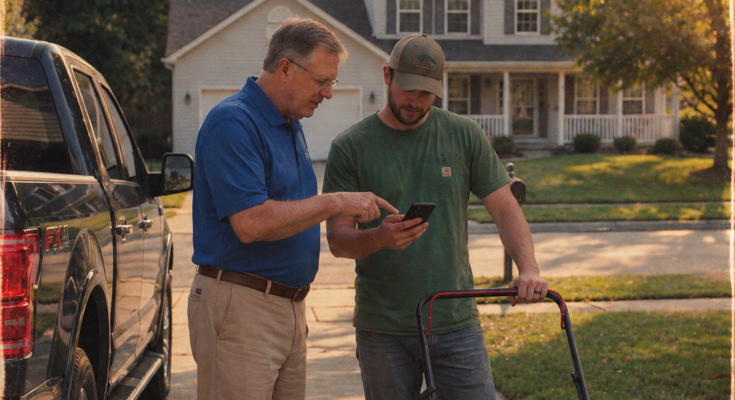
At 1:15, Jesse texted me a photograph of the front lawn.
Looking good. Starting the backyard.
Jesse Morales was twenty-one, polite, hardworking, saving money for community college.
I’d hired him several times.
At 1:56, he called.
The second I heard his voice, my stomach tightened.
“Mr. Whitmore?”
“What happened?”
“I’m not sure.”
I put down the broom.
“What do you mean?”
“I keep hearing something.”
“What?”
He hesitated.
“Somebody crying.”
My hand tightened around the phone.
“Where?”
“Inside your daughter’s house.”
For several seconds, I couldn’t speak.
“The house is empty.”
“I thought it was coming from next door. But whenever I turn the mower off…”
The mower stopped.
Silence.
Then I heard it through Jesse’s phone.
Faint.
Broken.
Barely more than a whimper.
Then a little voice.
“Help…”
Jesse whispered:
“That’s what I’ve been hearing.”
I was already grabbing my keys.
“Do not go inside.”
“Yes, sir.”
“Stay where you can see the house, but don’t approach anybody.”
I called 911 before I called Clara.
The dispatcher asked whether anyone was supposed to be inside.
“No.”
“Do you have a key?”
“Yes.”
“Do not enter until responders arrive unless circumstances clearly become life-threatening.”
I drove.
Then I called Clara.
Straight to voicemail.
“Clara, call me immediately.”
I tried Evan.
No answer.
Their divorce had been final almost a year, but the custody dispute over their six-year-old son, Liam, had continued.
That was when a memory punched through me.
Three weeks earlier, Clara had sat across from me at dinner and said:
“Dad?”
“Yeah?”
“If someone kept driving past your house… slowing down, then leaving… what would you do?”
I lowered my fork.
“How many times?”
“A few.”
“Is Evan doing that?”
She looked down.
“I don’t know.”
“Clara.”
“It could be nothing.”
I had told her to document it.
To tell her lawyer.
I had offered to install another camera.
Then the conversation moved on.
Now, driving toward her house, I hated myself for allowing it to.
A sheriff’s cruiser arrived almost simultaneously with me.
Jesse stood beside the mower.
His face was pale.
“It happened again.”
The deputy, a woman named Erin Walsh, held up one hand.
“Everybody stays outside while we clear the house.”
I handed her Clara’s spare key.
The front door was locked.
No visible damage.
Deputy Walsh and another officer entered.
I stood with Jesse near the driveway.
Thirty seconds.
A minute.
Then someone’s radio crackled.
“Child located.”
My heart stopped.
I ran toward the porch.
Deputy Walsh appeared in the doorway.
“Sir, wait.”
“Who is it?”
Her face told me before she answered.
“His name is Liam.”
The ground seemed to move.
“My grandson?”
“You need to stay here while EMS comes inside.”
“He’s supposed to be with—”
I stopped.
I didn’t actually know where Liam was supposed to be that afternoon.
Clara had told me he was staying with his father while she traveled.
An ambulance arrived.
A few minutes later, a paramedic carried Liam through the doorway.
He was wrapped in a blanket.
His cheeks were streaked with tears.
One shoe was missing.
“Grandpa?”
I went toward him.
The paramedic stopped only long enough to ask:
“You family?”
“Yes.”
Liam reached for me.
I took his hand.
“You’re okay. I’m here.”
He began crying.
I wanted to ask what happened.
Who brought you here?
Where is your father?
Did he hurt you?
But Deputy Walsh quietly shook her head.
“Don’t question him right now.”
So I didn’t.
I simply walked beside the stretcher.
At the hospital, we learned Liam was dehydrated, frightened, and had been shut inside Clara’s downstairs laundry room for several hours.
He had no serious physical injuries.
That should have made me feel better.
It didn’t.
Because while the nurse checked him, Liam suddenly whispered:
“Grandpa?”
“Yes?”
“Daddy said Mommy would come home if I cried loud enough.”
And everything in the room went still.
━━━━━━━━━━━━━━━━━━━━
Part Two — The Trip Clara Never Finished
A hospital social worker named Denise came in.
She heard what Liam said.
Then she gently stopped the conversation.
“We’re not going to ask him more questions about Daddy right now.”
I understood.
Liam had offered something spontaneously.
That was enough.
The adults could investigate.
He did not need to keep performing the worst afternoon of his life for every new person who walked through the door.
Then my phone rang.
Clara.
I answered immediately.
“Dad?”
“Where are you?”
“At the airport in Chicago. We just landed. Why?”
I closed my eyes.
“Liam is with me.”
Silence.
“What?”
“At the hospital.”
Her breathing changed.
“Dad, Liam is with Evan.”
“No.”
I heard something hit the floor on her end.
“What happened?”
“We found him inside your house.”
Clara made a sound I’ve never forgotten.
Not a scream.
The sound a mother makes when terror empties all the air from her body.
“I didn’t put him there.”
“I know.”
“Where’s Evan?”
“Nobody knows yet.”
Clara was on the first flight back.
Meanwhile, investigators began reconstructing the day.
Liam had been attending a half-day summer program.
Evan was authorized to pick him up during his parenting time.
He collected him shortly before noon.
That part was lawful.
What happened afterward wasn’t.
A neighbor’s doorbell camera showed Evan’s truck entering Clara’s neighborhood.
The same unfamiliar pickup I had noticed.
Another camera showed him carrying Liam toward the side door.
Clara later discovered a spare key missing from a place Evan had known about during the marriage.
The cameras did not show everything that occurred inside.
But they showed Evan leaving alone.
Liam remained inside.
The laundry-room door had an exterior latch Clara used only to keep cleaning supplies inaccessible when Liam was younger.
Someone had closed it.
There was water in a utility sink, but Liam was too short to reach the faucet easily.
His father’s phone was turned off.
Police eventually located Evan that evening at a motel almost ninety miles away.
I wasn’t there.
I didn’t confront him.
Nobody needed me playing vigilante.
He was taken into custody while investigators sorted through what could actually be proved.
Clara arrived shortly after midnight.
The second Liam saw her, he burst into tears.
“Mommy!”
She ran to him.
Then stopped just before grabbing him.
“Can I hug you?”
He nodded hard.
She held him against her.
For several minutes, neither said anything.
Finally Liam whispered:
“I cried like Daddy said.”
Clara’s face changed.
She looked at Denise.
Denise crouched beside them.
“You don’t have to tell us anything else tonight, sweetheart.”
Liam nodded.
Clara kissed his hair.
“You never have to cry to make Mommy come home.”
That sentence broke me.
Later, after Liam was asleep, Clara told me the part she had kept hidden.
Evan had become increasingly controlling after the separation.
Repeated calls.
Showing up unexpectedly.
Driving past the house.
Accusing her of keeping Liam from him even when she followed the custody schedule.
When Clara mentioned an upcoming work trip, Evan had asked three times whether she’d cancel if Liam “needed her.”
She thought he was trying to guilt her.
Now investigators had to determine whether locking Liam in the house had been an attempt to frighten Clara, force her return, punish her, or something else.
We did not invent an answer before the evidence gave us one.
But one fact was enough.
A six-year-old had been deliberately left alone behind a latched door.
━━━━━━━━━━━━━━━━━━━━
Part Three — The Day Someone Turned Off the Mower
The weeks afterward were not dramatic.
They were exhausting.
Protective orders.
Attorneys.
Custody hearings.
A formal child interview conducted by trained professionals.
Counseling for Liam.
Counseling for Clara.
The criminal case took months.
The family court did not simply erase Evan from Liam’s life because everyone was angry.
Safety evaluations were done.
Evidence was reviewed.
Contact was restricted and later handled according to professional recommendations and court orders.
Clara hated the slowness.
So did I.
But I learned that careful is not the same thing as indifferent.
Eventually, Evan admitted much of what had happened.
He said he was angry Clara had gone on the trip.
He felt she was “choosing work over family.”
He claimed he intended to return quickly.
He told himself Liam would be safe inside the house.
But the detail that stayed with me was what he’d told his son:
Mommy will come home if you cry loud enough.
He had turned a child’s fear into leverage against the child’s mother.
No explanation made that smaller.
Clara blamed herself for months.
“If I hadn’t gone.”
“If I’d told you more.”
“If I had changed that lock.”
I finally stopped her one evening.
“You’re doing what I did.”
She looked at me.
“What?”
“Going backward until you find a moment where you can make his choice belong to you.”
She started crying.
I understood because I had done the same thing.
If I had pressed harder at dinner.
If I’d recognized the truck.
If I’d checked the house more carefully at noon.
But responsibility isn’t the same as omniscience.
We can learn from warning signs without pretending we controlled another person’s decisions.
Liam struggled in unexpected ways.
He wasn’t afraid of the laundry room.
He was afraid of silence.
If a vacuum shut off suddenly, he’d look around.
If the television muted, he’d call for Clara.
For a while, he refused to close any bedroom door completely.
His therapist helped us understand that the goal wasn’t to convince him nothing bad could ever happen again.
That would be another lie.
The goal was to help him know what happened wasn’t his responsibility and that adults would respond if he needed help.
Jesse visited once.
He stood awkwardly on Clara’s porch holding a small toy lawn mower he’d bought for Liam.
I laughed.
“Subtle.”
He looked embarrassed.
“I didn’t know what kids like.”
Liam loved it.
Then he asked:
“Are you the mower guy?”
Jesse smiled.
“I guess I am.”
Liam looked at him seriously.
“You heard me?”
Jesse nodded.
“Yeah.”
“Even when I was quiet?”
“Yeah.”
Liam seemed to think about that.
Then he said:
“Good.”
And went back to playing.
Jesse never called himself a hero.
He hated when other people did.
He told me:
“I just turned off the mower because something sounded wrong.”
Exactly.
That was what mattered.
He noticed.
Then he listened.
A year later, Clara sold the house.
Not because Evan had permanently ruined it.
She simply wanted a place that didn’t carry so much history.
Her new home was smaller.
Closer to me.
The first thing she installed wasn’t an expensive alarm system.
It was a little bell beside Liam’s bedroom door.
He had picked it himself.
“If I ring it, Mom can hear me.”
Clara smiled.
“Yes.”
He tested it approximately forty-three times the first evening.
By bedtime, we all regretted agreeing.
That felt wonderfully normal.
Eventually, Liam stopped needing it.
The bell remained beside the door.
Unused.
Years passed.
Jesse finished community college and started his own landscaping company.
Clara became one of his first regular customers.
Whenever someone asked how they knew each other, she simply said:
“He helped us once.”
That was enough.
I still think about that Thursday afternoon more than I admit.
For years, I remembered the frightening parts.
The faint crying.
The locked room.
The ambulance.
Clara running through the hospital hallway.
But age changes what details your mind chooses to keep.
Now I think about a twenty-one-year-old standing behind a lawn mower.
He could have decided the noise was a television.
A neighbor’s child.
A cat.
Anything that allowed him to keep working.
Instead, he shut off the engine.
He listened again.
Then he called.
There was nothing heroic-looking about it.
No dramatic rescue through a window.
No fight.
No speech.
Just a young man noticing that something didn’t sound right and refusing to ignore it.
When Liam was twelve, he asked me about that day.
He remembered almost none of it clearly.
“Was Jesse the one who found me?”
I thought about the question.
“Sort of.”
“What do you mean?”
“He didn’t find you.”
I smiled.
“He heard you.”
Liam nodded slowly.
Then he said:
“That’s probably better.”
I knew exactly what he meant.
Sometimes people in trouble don’t need someone who already understands everything happening behind a closed door.
Sometimes they just need one person willing to stop what they’re doing long enough to notice the sound coming from the other side.
That afternoon, Jesse turned off a lawn mower.
The yard went quiet.
And because it did, my grandson was finally heard.