Part One — The Sound They Turned Into a Joke
The crack of plastic against wood echoed across my parents’ backyard.
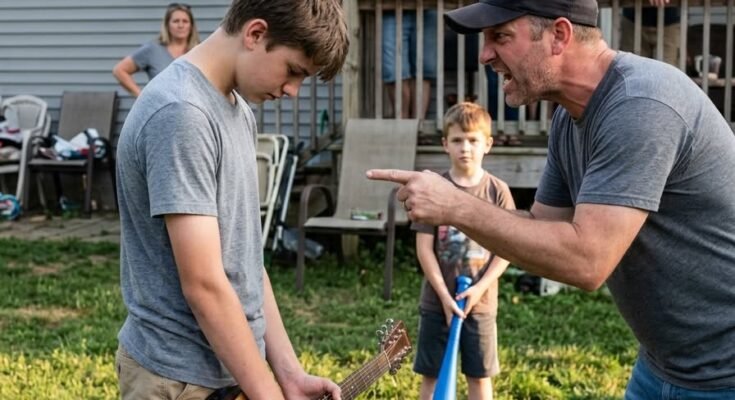
My twelve-year-old son, Mason, froze with both hands around the neck of his guitar.
One of my brother Derek’s nine-year-old twins had just swung a plastic baseball bat straight into the body of the $2,000 acoustic guitar I had worked three months of overtime to buy.
A long dent cut through the finish.
My father was filming.
My mother laughed.
Derek doubled over on the porch with a beer in his hand.
“Oh, man. You should’ve seen your face.”
Mason’s eyes filled instantly.
Then my sister came outside, looked at the guitar, and smirked.
“Guess he’ll learn about real life now.”
Something inside me went very still.
I crouched beside Mason and took the guitar carefully.
The top was cracked near the lower bout.
The damage was deeper than a cosmetic scratch.
“All right,” I said. “We’re done here.”
Derek stepped in front of me.
“Whoa. Don’t be such a buzzkill. It’s just a guitar.”
“It’s Mason’s guitar.”
“Accidents happen.”
“That wasn’t an accident.”
His grin widened.
“Maybe if you didn’t baby him so much, he’d toughen up.”
Mason had talked about learning guitar for almost a year.
I worked extra shifts at the repair shop, skipped buying lunches, postponed work on my truck, and saved until I could finally bring home the instrument he had spent months admiring through a music-store window.
The night I opened the case, Mason stared at it for almost a full minute.
Then he touched one string.
Played a terrible chord.
And looked at me as though I had given him the world.
So when he asked whether he could play for Grandma and Grandpa, I ignored the knot in my stomach and said yes.
I knew my family.
My parents dismissed almost everything I did.
Derek treated his twins like every room belonged to them.
And whenever Mason received attention, someone found a way to turn it into a joke.
The first time he played there, my mother interrupted halfway through.
“Cute. But don’t get him too excited, Cory. Kids quit hobbies all the time.”
When Derek learned what the guitar cost, he laughed.
“You can get one at Walmart for eighty bucks.”
Then he glanced toward his sons.
“If they don’t get to it first.”
I should have listened to that sentence.
A week later, Derek invited us back.
“Bring Mason and his precious baby guitar. Maybe we’ll finally teach him to loosen up.”
When we arrived, the twins were already near the shed with their plastic bats.
My father already had his phone out.
Then came the swing.
Now Mason stood beside me trying not to cry while adults he was supposed to trust treated his humiliation like entertainment.
I lifted the guitar case.
“We’re leaving.”
Derek grabbed it.
“Fine. Take your kid home. Guitar stays.”
I stared at him.
“What did you just say?”
“The twins want to mess around with it.”
“You’re not touching it again.”
His hand tightened.
“You think you’re better than everybody because you bought your kid some fancy guitar.”
“Let go.”
“Or what?”
Then I noticed Dad’s phone.
The camera was no longer pointed toward the children.
It was pointed at us.
“You’re recording this?”
Dad shrugged.
“This is good stuff. Maybe we’ll send it to one of those funny-video shows.”
Mason whispered:
“Dad, can we please go?”
That ended everything.
I pulled the case free.
We left.
That night, Mason barely spoke.
Hours later he came into the kitchen and asked:
“Did I do something wrong?”
I knelt in front of him.
“No.”
“Then why were they laughing?”
That question hurt more than the damaged guitar.
“Because sometimes adults decide being funny matters more than being kind.”
He looked down.
“Was I being spoiled?”
“No.”
“Uncle Derek said—”
“I know what he said.”
I put both hands on Mason’s shoulders.
“Being upset because someone deliberately damages something you care about isn’t being spoiled.”
The next morning, Derek sent me a link.
Dad’s video was online.
The bat hitting the guitar.
Mason flinching.
Everyone laughing.
Derek had added a cartoon crashing sound at the moment of impact.
The caption said:
WHEN YOUR BROTHER THINKS HIS KID IS A ROCK STAR.
People were laughing in the comments.
Some were strangers.
Derek had tagged me.
He wanted to make sure I saw it.
Then, two nights later, Mason sat at the kitchen table and said:
“Dad, can we sell the guitar?”
“Why?”
He stared at the cracked wood.
“Because every time I look at it, I hear them laughing.”
That was when I stopped treating the situation like a bad family joke.
I saved every post.
Every comment from Derek.
Every text.
The original video.
I asked the music shop for a written repair estimate.
I spoke with a lawyer I knew through work.
And I reported the videos through the platforms’ harassment and minor-safety channels.
Then Derek uploaded a second video.
Old clips of Mason singing.
Practicing.
Missing chords.
Clips I didn’t even know Derek had recorded.
Now I understood.
This hadn’t been one impulsive prank.
My son had been entertainment to them for months.
So I stopped arguing.
I started documenting.
Derek exploded when the first video disappeared.
WHAT DID YOU DO?
Do you know how many views that had?
You’re pathetic. Can’t take a joke.
I saved those too.
Meanwhile, I did one thing Mason didn’t expect.
I signed him up for private lessons.
Not to prove anything to my family.
Because I didn’t want their laughter to decide whether he kept something he loved.
Then Derek’s birthday barbecue invitation appeared in the family chat.
Mom wrote:
Sunday at 3. Everyone’s coming. Bring Mason.
Derek replied:
Better tell Cory to leave the baby guitar home this time.
I stared at the message.
Then typed:
We’ll be there.
By then I had the screenshots.
The repair estimate.
A lawyer’s letter.
And something Derek didn’t yet know about the company that had just hired him.
When Mason and I walked into that backyard Sunday afternoon, phones were already raised.
The twins were holding bats.
Derek had the same grin.
He thought another joke was beginning.
I smiled back.
This time, I had come prepared.
━━━━━━━━━━━━━━━━━━━━
Part Two — The Joke Ended at 3:17
I didn’t bring the guitar.
That disappointed Derek immediately.
“Where’s the rock star equipment?”
“Being repaired.”
His smile widened.
“So you actually paid to fix it?”
“No.”
That stopped him.
Mom came over.
“Cory, don’t start something at Derek’s birthday.”
“I haven’t started anything.”
I handed Derek an envelope.
“What’s this?”
“A letter from my attorney.”
His smile weakened.
Dad lowered his phone.
Derek opened it.
The letter was simple.
Preserve the videos and original recordings.
Do not publish additional recordings of Mason.
Remove any remaining posts.
The damage to the guitar had been documented at $1,180 for professional repair and restoration.
The footage itself showed the act that caused the damage.
The text messages showed Derek’s knowledge afterward.
I wasn’t threatening him with prison.
I wasn’t claiming a plastic bat had created some enormous criminal case.
I was telling him that if he refused to pay for the documented damage, I was prepared to pursue the ordinary civil remedies available to me.
Derek laughed, but it sounded different now.
“You’re suing your own brother over a guitar?”
“No.”
I looked at him.
“I’m giving my brother the opportunity to take responsibility before I decide whether I need a court to make him.”
Mom stepped forward.
“This is ridiculous.”
I turned toward her.
“You were there.”
“So?”
“You laughed.”
“It was a joke.”
“Mason didn’t laugh.”
“He’s sensitive.”
Behind me, Mason was silent.
I looked at him.
Then back at her.
“That’s the last time you use his feelings as evidence that your behavior was acceptable.”
Nobody spoke.
Then one of the twins quietly said:
“Dad told us to do it.”
Derek spun around.
“Go play.”
The boy didn’t move.
“He said hit it when Grandpa started recording.”
The other twin nodded.
“Dad said Mason would freak out.”
The entire yard went silent.
I looked at the boys.
“You two aren’t in trouble with me.”
Derek scoffed.
“Come on, Cory.”
“No.”
I pointed toward the children.
“They’re nine. You’re the adult who turned another kid’s belongings into a setup.”
That mattered.
I had been angry at the twins at first.
But they were children performing for adults who rewarded cruelty with laughter.
I wasn’t going to make them carry what their father had handed them.
Derek folded the attorney’s letter.
“You’re trying to ruin my birthday.”
I almost smiled.
“No. I’m explaining what happens after yours ruined my son’s week.”
Then his phone rang.
He glanced at the screen.
And his face changed.
He walked several feet away to answer.
“What?”
We could still hear him.
“No, I didn’t—”
Pause.
“It’s just some family thing.”
Another pause.
His face went pale.
“Monday?”
Then:
“Yeah. I’ll be there.”
He hung up.
Mom immediately asked:
“Who was that?”
Derek stared at me.
“My supervisor.”
I said nothing.
“What did you do?”
“Nothing.”
“Bull.”
Then I told him the part he didn’t know.
His new employer, a regional equipment company, sponsored the youth arts center where Mason had started lessons.
One of the center’s board members worked in Derek’s corporate office.
The second mocking video had circulated through a local parent group after Derek posted it publicly from an account that listed his employer.
I had not contacted his boss.
I hadn’t needed to.
Someone else had recognized his name.
The company wasn’t firing him on my command.
They had simply scheduled a meeting to review the public posts under their own workplace conduct and social-media policies.
Derek stared at me.
“You did this.”
“No.”
I shook my head.
“You posted it.”
That distinction was important.
For years, my family had treated consequences as something another person did to them.
Someone complained.
Someone was too sensitive.
Someone couldn’t take a joke.
Never:
I chose something, and then something followed.
Dad finally lowered his phone completely.
“Cory, can’t we just wipe the slate clean?”
I looked at him.
“That depends.”
“On what?”
“Whether anybody here can say what happened without using the word joke.”
Silence.
My sister looked at Mason.
For the first time, she didn’t smirk.
“The guitar was damaged.”
“Deliberately.”
She swallowed.
“Deliberately.”
“And?”
Her eyes dropped.
“And we laughed.”
Mason looked away.
Dad sat down.
Mom crossed her arms.
Derek didn’t apologize.
Not that day.
Instead he muttered something about everybody becoming soft and walked inside.
That told me everything I needed to know.
I turned to Mason.
“You ready?”
He nodded.
We left after twelve minutes.
On the drive home, he asked:
“Did Uncle Derek lose his job?”
“I don’t know.”
“Because of me?”
“No.”
I answered quickly.
“Whatever happens at his job is about choices he made publicly. You are not responsible for protecting adults from consequences.”
He stared out the window.
Then:
“Are the twins in trouble?”
“I don’t know.”
“They’re kind of annoying.”
I laughed.
“Yes.”
“But Uncle Derek told them to hit it.”
“Yes.”
Mason was quiet for a while.
Then he said:
“I don’t want them to think I hate them.”
That was my son.
Twelve years old.
His guitar had been smashed.
He’d been mocked online.
And somehow he was still worrying about two nine-year-olds who had been taught the wrong lesson.
I reached over and squeezed his shoulder.
“Then don’t.”
━━━━━━━━━━━━━━━━━━━━
Part Three — The Scar We Left in the Wood
Derek did not lose his job that Monday.
That surprised several relatives.
His employer documented the issue, reminded him that publicly identifying himself with the company while posting content involving humiliation of a child could reflect on them, and required him to remove references linking his personal account to the company.
He remained employed.
Real consequences are often less theatrical than internet stories.
Sometimes they are simply embarrassing conversations you never wanted to have.
The larger consequence came at home.
My parents expected me to get over everything by Thanksgiving.
I didn’t.
Mason and I stopped visiting for several months.
Not because I wanted to punish anyone.
Because every gathering had become a place where Mason watched the room for the next joke.
That wasn’t family time.
That was vigilance.
Derek initially refused to pay for the guitar.
Then his attorney, after reviewing Dad’s original video and Derek’s messages, apparently gave him more practical advice.
Three weeks later, a check arrived for the repair cost.
No apology.
Just the check.
I deposited it.
Accountability does not have to wait for sincerity.
The luthier who repaired Mason’s guitar called me before beginning the cosmetic work.
“I can make the crack much less noticeable.”
I looked at Mason.
“What do you want?”
He studied the damage.
Then said:
“Can you make it safe but leave a little of the mark?”
The repairman looked surprised.
“Sure.”
“Why?” I asked later.
Mason shrugged.
“I don’t want it pretending nothing happened.”
That sounded wiser than anything I’d said during the whole mess.
So the guitar came home repaired.
Strong again.
Playable.
Beautiful.
But when light hit the wood at the right angle, you could still see a faint line.
Mason started lessons.
At first, he wouldn’t play if anyone besides his teacher could hear him.
Then he played while I sat in the hallway.
Later with the door open.
Six months after the barbecue, his teacher asked whether he wanted to perform at a small student recital.
Mason said no.
Then changed his mind.
The recital was held in a community arts center.
Maybe seventy folding chairs.
No stage lights.
No record contract waiting backstage.
Just children playing songs they’d practiced.
Mason invited me.
His teacher.
One friend from school.
And, unexpectedly, Derek’s twins.
Not Derek.
The twins.
I asked:
“Are you sure?”
“They apologized.”
I hadn’t known.
Apparently they had sent Mason a handwritten note.
We’re sorry we hit your guitar. Dad told us it would be funny but it wasn’t funny when you cried.
They had each signed their names.
Mason kept the note inside his guitar case.
The boys came with my sister, who had become noticeably quieter around us.
My parents weren’t invited.
Neither was Derek.
That bothered them.
I didn’t negotiate.
Mason played one song.
He missed one chord.
Paused.
Started the measure again.
Nobody laughed.
When he finished, the twins clapped harder than anyone.
On the drive home, Mason said:
“I messed up.”
“You recovered.”
“Did you hear it?”
“Every note.”
He grinned.
That was the first time I knew the guitar belonged to him again instead of belonging to that afternoon in my parents’ backyard.
Derek’s apology took almost a year.
He came to my repair shop near closing.
No audience.
No phone.
No beer.
He stood beside my toolbox and said:
“I thought you were making Mason soft.”
I kept working.
“And?”
“I think I was trying to make my boys like me.”
That made me stop.
Derek stared at the concrete floor.
“My whole thing is making everything a joke before anybody else can.”
I understood that better than he probably expected.
We grew up in the same house.
Dad had always filmed embarrassment.
Mom always called hurt feelings weakness.
Derek had simply become better at performing the family language.
He continued.
“I told the twins to hit the guitar because I wanted a funny video.”
“Yes.”
“I knew it would upset him.”
“Yes.”
“I didn’t think about what that meant.”
I waited.
Then he finally said:
“I was cruel to your kid.”
That was the apology.
Not:
Sorry everybody got upset.
Not:
Sorry the joke went too far.
He named it.
I nodded.
“Yeah.”
“Do you forgive me?”
“I’m working on it.”
He looked disappointed.
But he accepted it.
That mattered too.
My parents took longer.
Dad’s first apology was mostly about the video going public.
Mom’s was about “family division.”
Neither understood at first.
Eventually Dad deleted hundreds of old clips he’d collected of relatives being embarrassed without their permission.
One afternoon he told me:
“I thought filming everything meant I was preserving memories.”
I answered:
“Sometimes you were preserving humiliation.”
He nodded.
Mom eventually apologized directly to Mason.
No excuses.
“I laughed when you were hurt because everybody else was laughing. I should have been the grandmother who stopped it.”
Mason said:
“Okay.”
He didn’t hug her.
Nobody forced him.
Trust does not return on command just because an adult finally finds the right sentence.
Three years have passed.
Mason is fifteen now.
He still plays.
Not because he’s destined to become famous.
Maybe he’ll quit someday.
That would be fine too.
The point was never making sure the $2,000 purchase produced a musician.
The point was that something mattered to my son, and therefore it deserved basic respect.
The guitar hangs on his bedroom wall.
That faint repaired line is still visible.
Sometimes I catch him running his thumb across it.
One night I asked:
“Still bother you?”
He shook his head.
“No.”
“What does it make you think about?”
He thought for a second.
“Probably that broken doesn’t always mean ruined.”
I smiled.
“That’s annoyingly profound.”
“I know.”
Then he played the first song he’d tried to play for my parents all those years ago.
He was much better now.
But that’s not the part that mattered.
I used to think the jaw-dropping thing I did after my family smashed that guitar would be some perfect act of revenge.
Making Derek lose his job.
Humiliating him in front of everybody.
Breaking something he loved.
I did none of those things.
I documented what happened.
Made the responsible adult pay for the damage.
Protected my son’s privacy.
Stopped showing up where cruelty was treated as entertainment.
And refused to make two nine-year-old boys responsible for behavior the adults around them had encouraged.
That turned out to be harder than revenge.
And much more useful.
The crack in Mason’s guitar is still there.
We chose not to erase it completely.
Not because pain should be displayed forever.
But because some scars become proof of something worth remembering.
They laughed because they thought hurting something Mason loved would teach him about “real life.”
Maybe it did.
Just not the lesson they intended.
Real life taught him that people can be careless with what matters to you.
That family doesn’t automatically make someone safe.
That being hurt doesn’t make you weak.
And that when somebody tries to turn your pain into entertainment, you are allowed to pick up what matters to you—
and leave.