Part 2
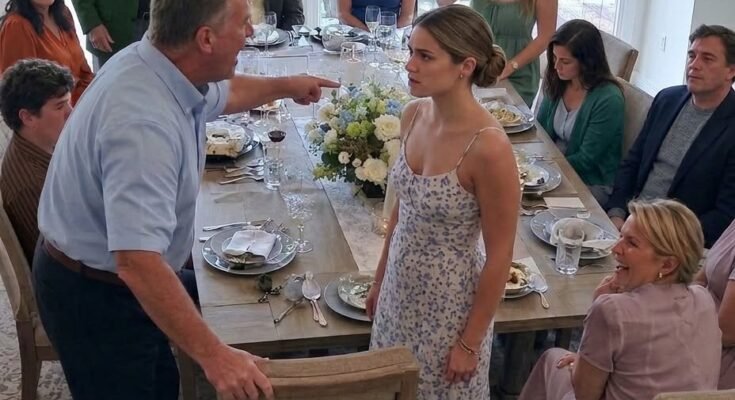
Dad’s face had gone through three colors in under a minute — red with irritation, white with shock, and now a kind of gray that made him look, for the first time in my life, old.
“Caroline, sit down,” he said. Not a command this time. Almost a request.
“I was told to go sit at the bar,” I said. “That’s for people who haven’t accomplished anything, remember?”
My uncle, who’d been quiet the whole time, cleared his throat. “Robert, what is she talking about? What foreclosure?”
Dad didn’t answer him. He was still staring at the document like it might rearrange itself into something less true.
“The apartment project on Larkspur,” I said, since he wasn’t going to explain it. “You leveraged the warehouse and equipment yard against it eighteen months ago. When the project stalled, you missed three consecutive payments. The bank sold the note rather than carry the risk. My partnership acquired it.” I paused. “We’ve been more than patient. We offered two extension proposals through your attorney. Both were declined because your attorney told us you refused to discuss terms with, and I’m quoting his email, ‘whoever this consulting group is.'”
“That was you,” Dad said slowly. “The whole time, that was you.”
“Yes.”
My mother spoke for the first time, her voice thin. “Robert, is this true? The business is in trouble?”
Dad didn’t answer her either. He was looking at me the way you look at someone you suddenly realize you’ve never actually seen before.
“I could have called your office directly weeks ago,” I said. “I chose not to, because some part of me still hoped you’d never have to know it was me — that we could just quietly restructure the debt and you’d keep your company without ever finding out your ‘poor, useless’ daughter was the one who saved it. That folder was never supposed to be a weapon, Dad. It was supposed to be a gift I never had to explain.”
The dining room was dead silent except for the low hum of the restaurant beyond the closed doors.
“But you just pushed my chair away from your table,” I continued, “in front of people who’ve spent years repeating whatever you told them about me. So now they get to hear the rest of it too. The foreclosure notice is real. It goes into effect in eleven days unless new terms are signed. I’m still willing to restructure — better terms, honestly, than any bank would offer you at this point. But that offer doesn’t come with a seat I have to fight for at a table I don’t need.”
I turned to Madison, who still hadn’t put her phone down, her eyes wide. “You can stop recording. I think everyone got what they needed.”
She lowered it slowly, and for the first time all evening, she looked at me — not with pity, not with the vague embarrassment she usually reserved for my “failed” life, but with something that looked almost like awe.
I picked up my bag, left the folder on the table beside my father’s untouched birthday cake, and walked out of the private dining room without looking back.
He called four times before I reached my car. I let it go to voicemail.
Eleven days later, I sat across from him in a real conference room — not a restaurant, not a family gathering, just the two of us and my attorney — and we restructured the loan on terms that gave him eighteen more months and gave me something he’d never once offered me at any table in his house: a signature that said, on paper and for the first time, that he needed me.
I didn’t gloat. I didn’t need to. The folder had already said everything I never could.