Part 2
Dad didn’t slam the door. He didn’t yell. He just stepped out onto the porch, phone pressed to his ear, and I heard him say, “Marissa, it’s Tom. I need you to pull up the account records for me — everything from the last six months.” Marissa was his accountant, the same steady woman who’d helped him rebuild his contracting business after the recession nearly buried it. If Dad was calling her on a Friday evening, this wasn’t a bluff.
My husband’s smirk faded a little. “What is he even doing?”
I didn’t answer. I was watching my son instead, who had wandered to the doorway and wrapped both arms around my father’s leg like he already understood, in the way children sometimes do, that the person holding him was the safe one.
Ten minutes later, Dad came back inside, set his phone on the counter, and looked at my husband with a stillness that was somehow louder than any argument we’d ever had.
“Here’s what’s going to happen,” he said. “You’re going to give me the login to that joint account tonight. Not tomorrow. Tonight. And you’re going to call your mother and tell her the transfers stop, effective immediately.”
“You don’t get to walk into my house and make demands,” my husband snapped, some of his earlier bravado creeping back.
“I don’t have to make demands,” Dad said evenly. “I already spoke to my daughter’s employer’s HR department two years ago when she first told me you two were combining finances — I made sure her paycheck could be redirected to a protected account if it ever needed to be. I never told her because I hoped I’d never have to use it. But I updated it twenty minutes ago, sitting right there on your porch. Starting next pay period, her income goes where she decides it goes. Not you. Not your mother. Her.”
The silence that followed wasn’t heavy this time. It was final.
My husband’s face went through something complicated — anger, then disbelief, then something smaller and more frightened underneath it. “You can’t just—”
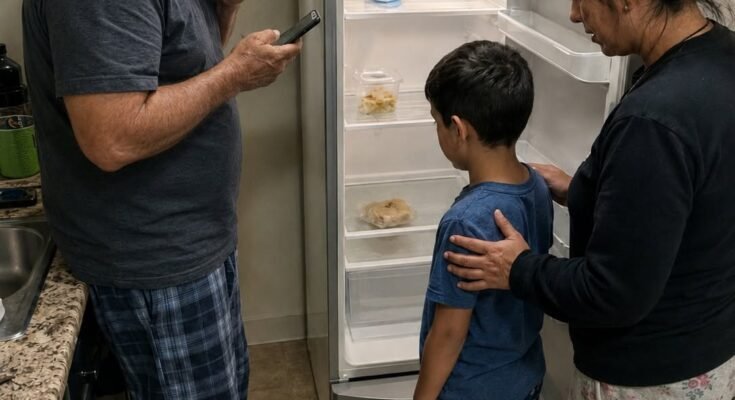
“I can, and I did,” Dad said. “Because right now, my grandson has a bottle of ketchup for dinner, and you’re standing here defending yourself instead of driving to the store.”
Nobody said anything for a long moment. Then my son tugged my father’s sleeve and asked, in the small, matter-of-fact voice only a six-year-old can manage, “Grandpa, can we get chicken nuggets?”
Something in that question broke whatever tension was left in the room. My father knelt down, brushed the hair off my son’s forehead, and said, “We’re getting chicken nuggets, buddy. And ice cream. And anything else you want.”
He looked up at me before standing. “Pack a bag for the weekend. Both of you.”
I didn’t argue. For the first time in months, I didn’t feel like I had to.
As we walked out, my husband stood frozen in the kitchen, staring at the open fridge like it might somehow refill itself if he waited long enough. It didn’t. And neither did the version of our marriage I’d been quietly trying to hold together.
That weekend, sitting at my father’s kitchen table watching my son eat a real dinner and laugh with his mouth full, I finally understood something I’d been too afraid to admit: love isn’t measured by sacrifice for the loudest voice in the room. It’s measured by who shows up when the refrigerator is empty.
My father didn’t just pick up his grandson that Friday. He picked up the pieces of a life I hadn’t realized I’d been living on empty — and he did it without raising his voice once.