Part One: Three Dollars
A little boy stood on my porch with three dollars and asked to buy the only thing keeping me alive.
That was exactly how he said it.
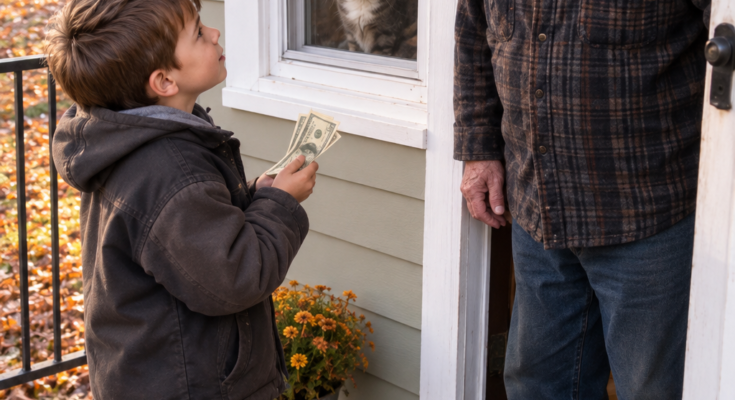
“Mister, can I buy your cat?”
He couldn’t have been more than eight. Maybe nine if life had been hard on him, and it looked like it had. His coat was too thin for November. One sleeve hung lower than the other. His sneakers were clean but worn down at the toes.
In his hand were three one-dollar bills, folded so many times they looked soft as cloth.
Behind me, my old cat, Biscuit Lantern, sat on the windowsill like a fat gray judge.
“No,” I said.
The boy blinked.
“She’s not for sale.”
He looked past my hip at Biscuit Lantern. “Is she nice?”
“When she wants to be.”
“She looks warm.”
That stopped me a little.
Kids usually say cute. Pretty. Funny. They don’t usually look at an old cat with one cloudy eye and a crooked tail and say warm.
“What’s your name?” I asked.
“Tuck.”
“You live around here?”
He pointed toward the row of small duplexes at the end of the block. The ones with patched screens, plastic porch chairs, and porch lights that flickered when the wind got mean.
I had seen him before. Walking home from the bus stop. Head down. Backpack too big. Always alone.
“Tuck,” I said, “why do you want to buy my cat?”
He looked at the money in his palm. “I can bring more later.”
“That’s not what I asked.”
His face turned red, not the angry kind. The ashamed kind.
“I had a cat once,” he said. “Before we moved.”
I waited.
“He slept by my feet. I used to know where I was in the dark because I could feel him there.”
Biscuit Lantern jumped down from the windowsill. She was sixteen years old and moved like every bone had a complaint. Still, she walked straight to the screen door and pushed her nose against it.
Tuck smiled like somebody had just handed him Christmas in a paper bag.
I should have closed the door. That would have been easier.
Biscuit Lantern was not just a cat to me. My wife found her behind a laundromat years ago, skinny and mean, hissing at the whole world. My wife said, “That one’s coming home. She has opinions.”
After my wife passed, that cat became the sound of another living thing in the house.
Her paws in the hallway.
Her purr beside my chair.
Her little grunt when she jumped onto the bed at night.
Some people have family dinners. I had a gray cat who stole toast crumbs.
“No,” I said again, softer this time. “I can’t sell her.”
Tuck nodded fast. Too fast.
“Yes, sir. I understand.”
He started to back down the steps.
Then Biscuit Lantern made a noise.
Not a meow. Not really. More like a rusty door opening in a tiny church.
Tuck froze.
The cat looked at me. Then at him.
I sighed.
“You can sit on the porch for a minute,” I said. “But she stays here.”
He sat on the top step like he was afraid to take up space.
I opened the screen door.
Biscuit Lantern stepped out, sniffed his shoes, then climbed into his lap like she had been waiting for him all week.
Tuck did not move.
Not even a finger.
His mouth pressed tight. His eyes filled up.
“She’s heavy,” he whispered.
“She knows.”
He gave a small laugh, but it broke in the middle.
For a few minutes, neither of us said anything. Cars passed. A dog barked somewhere down the street. A leaf skittered across the sidewalk.
Then Tuck bent his head and said, “Tomorrow’s my birthday.”
I looked at him.
“My grown-up works late,” he said. “I’m not supposed to bother anybody. I just thought maybe, if I paid, it wouldn’t be bothering.”
That hit me harder than I expected.
And suddenly I understood: he wasn’t trying to buy my cat at all. He was trying to buy one night where he wouldn’t have to be alone.
—
Part Two: The Birthday
I didn’t invite him in that night. I should have. But I was still learning how to be a person who noticed things, and noticing takes practice.
What I did was ask where he lived. He pointed again at the duplexes. Number 14, he said. The one with the blue door.
I told him Biscuit Lantern needed her rest, but she could visit tomorrow. He nodded and walked home, looking back twice.
That night I couldn’t sleep. I kept thinking about three dollars folded soft as cloth. I kept thinking about a boy who thought he had to pay to not be alone.
The next morning I went to the grocery store. I bought a small cake. Chocolate. I bought a card with a dog on it because they didn’t have cats. I bought a bag of cat treats.
At 5 o’clock I walked to number 14 and knocked.
Tuck opened the door. He was wearing the same thin coat. Inside, the apartment was clean but nearly empty. A folding chair. A small television. A mattress on the floor in the corner.
“You said tomorrow,” he said.
“I did.”
I held up the cake.
He stared at it like I had brought him the moon.
“Is that for me?”
“It’s your birthday, isn’t it?”
He didn’t answer. He just stepped back and let me in.
We sat on the floor because there was no table. I cut the cake with a plastic knife I had brought from home. We ate off paper plates. Biscuit Lantern sat in my lap and watched him with her one good eye.
“Where’s your grown-up?” I asked.
“Working,” he said. “She works a lot.”
“Your mom?”
He shook his head. “My aunt. My mom’s in a place that helps her get better.”
I didn’t ask more. He didn’t offer.
After cake, I gave him the card. He read it three times. Then he put it on the mattress, propped against the wall like a picture.
“Thank you,” he said.
“You’re welcome.”
“Can Biscuit Lantern come back tomorrow?”
I looked at the cat. She was already asleep in his lap.
“She might not want to leave,” I said.
He smiled. A real smile. The first one I had seen.
“Good,” he said.
—
Part Three: The Open Door
That was two years ago.
Tuck still comes over. Most days after school. His aunt works doubles, and he doesn’t like being alone in that apartment. I don’t blame him.
Biscuit Lantern died last spring. She was eighteen. She went peacefully, in her sleep, curled on the windowsill where she always sat.
Tuck cried. I cried. We buried her in the backyard under the maple tree. He made a little marker with her name on it. *Biscuit Lantern. Good cat. Warm.*
He asked if he could still come over. I told him he didn’t need to ask.
Now he comes every day. We do homework at the kitchen table. I taught him how to make spaghetti. He taught me how to play a video game on his phone. I’m terrible at it. He laughs at me. I don’t mind.
Last week he asked if he could call me Grandpa.
I told him he could call me whatever he wanted.
He thought about it.
“I’ll call you Mister,” he said. “Like before. But not because I’m being polite. Because it’s yours.”
I don’t know what that means exactly. But it felt right.
Sometimes I think about that first night. Three dollars. A cat. A boy who thought he had to buy his way into not being lonely.
I didn’t sell him the cat.
But I gave him something better.
I gave him a door that stays open.
And he gave me something too.
He gave me a reason to keep it that way.
Some people have family dinners. I have a boy who shows up after school and a cat buried under a maple tree.
That’s enough.
That’s more than enough.
—