
Part 1: The Party
“Can I play it for my mom?”
The room went quiet for half a breath. Then somebody laughed. It was not a big laugh. It was worse than that. It was small, sharp, and careless, the kind of laugh people make when they think someone beneath them has forgotten their place.
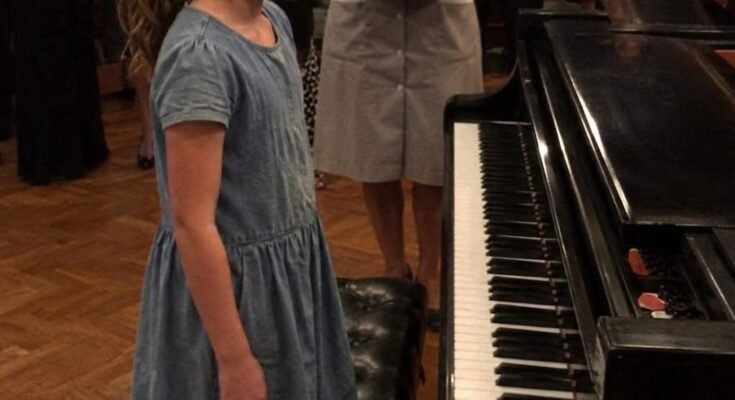
Maddie Parker stood beside the black grand piano with both hands pressed flat against her faded blue dress. Her sneakers were old. Her ponytail had come loose. Her cheeks were pink with fear.
Across the room, her mother froze with a silver tray in her hands. “Maddie,” her mother whispered. It was not a scolding. It was a warning. Please don’t. Please come back. Please don’t make them notice us.
But Maddie had already stepped out from behind the thick curtain near the service hallway. She had already crossed the marble floor. She had already asked the question. And now every polished face in that downtown Chicago penthouse was turned toward her.
A ten-year-old girl who was not supposed to be there. A housekeeper’s daughter. A child in a room full of people who wore more money on their wrists than her mother made in six months.
The party had been going on for two hours. Glasses chimed. Low voices floated through the air. Waiters moved like shadows. The windows looked out over the city from so high up that the cars below seemed like little beads of light sliding through the streets.
To the guests, it was a fundraiser. A winter benefit for music education, printed on thick cream invitations with gold lettering. To Maddie, it was the night her mother turned thirty-six. And nobody knew. Nobody cared.
Not the women in shining earrings. Not the men with soft hands and hard smiles. Not Harrison Whitmore, the owner of the penthouse, who stood near the fireplace like the whole city belonged to him. Especially not him.
Maddie had watched him all night. She had watched him snap his fingers when he wanted his glass refilled. She had watched him talk over her mother like she was furniture. She had watched him smile warmly at donors, then turn cold the second he faced staff.
Her mother, Ellen Parker, had said before they arrived, “Stay tucked away by the service hall. Read your book. Don’t make a sound. I’ll get us home as soon as I can.”
Maddie had nodded. She was good at being quiet. She had been quiet in apartment hallways when neighbors argued. Quiet at the kitchen table when bills were spread out like bad news. Quiet in the back pew at funerals and school concerts and church suppers. Quiet in all the places where grown-ups looked tired.
But tonight was different. Tonight there was supposed to be a cupcake waiting at home. A small chocolate one from the discount shelf at the grocery store. Maddie had hidden it in the refrigerator behind a jar of pickles. She had stuck one bent candle into it before they left. She had planned to sing to her mom at the kitchen table after work. Just the two of them.
Part 2: The Request
But at 9:45, Maddie heard Mr. Whitmore stop her mother near the study door. “Ellen,” he said. Her mother turned fast. “Yes, Mr. Whitmore?” “There is a spill on the rug in the library.” “I’ll take care of it right away.” “And after that, the kitchen needs a full clean-down. The caterers left a mess.”
Her mother’s face changed. Only a little. Most people would not have noticed. Maddie did.
“Mr. Whitmore,” Ellen said carefully, “I was told I could leave at ten. My daughter—” “Will still be your daughter at midnight,” he said, not even looking at her. “You’ll be paid for the extra hours.”
Ellen lowered her eyes. “Yes, sir.” He walked away. Just like that. As if a birthday could be pushed aside like a chair. As if a promise to a child could be erased because a rich man wanted a cleaner kitchen.
Maddie felt something swell inside her chest. Hot. Sharp. Bigger than fear. Then she looked from her mother’s bent shoulders to the grand piano by the windows—and made a decision that would leave the entire room speechless.
She stepped out from behind the curtain, walked across the marble floor, and asked the question that made everyone laugh. But she didn’t back down.
“My mom’s birthday is today,” Maddie said, her voice trembling but clear. “I’ve been learning a song. It’s not very long. I just want to play it for her.”
Harrison Whitmore’s eyes narrowed. “There are professional musicians here tonight,” he said. “This isn’t a playground.”
Maddie held her ground. “Please.”
Ellen had started moving toward her daughter when a guest near the piano suddenly gasped. “That girl,” the woman said, pointing at Maddie. “I recognize her.” She reached into her purse and pulled out a business card. “I was at the South Side Community Center last month. She performed there. The director said she was the most talented young pianist he’d seen in a decade.”
Another guest stepped forward. “I’ve heard about her. She’s been offered scholarships. She turned them down because she wouldn’t leave her mother.”
The room began to shift. People were whispering now, but the whispers were different. They weren’t mocking. They were curious.
Harrison Whitmore’s face was unreadable. He looked at Maddie, then at the piano, then at the guests who were watching him. “Fine,” he said flatly. “One song. Make it fast.”
Maddie walked to the piano. She sat down, adjusted the bench, and placed her small hands on the keys. Then she began to play.
Part 3: The Revelation
The music that filled the penthouse was not what anyone expected. It was not a child’s simple melody. It was something deeper—rich, complex, and haunting. The notes flowed from her fingers like she had been playing for decades, not years.
The room fell silent. Even the waiters stopped moving. Harrison Whitmore’s jaw tightened. A woman near the fireplace wiped her eyes. Ellen stood frozen, her hand over her mouth.
When Maddie finished, the silence stretched for three full seconds. Then someone began to clap. Then another. Then the entire room rose to its feet, applauding.
Harrison Whitmore stepped forward. His expression had changed. It was no longer cold. It was something else—recognition, perhaps. Or regret.
“Where did you learn to play like that?” he asked.
Maddie stood up from the bench. She looked at her mother, then back at Whitmore. “My father taught me. He was a musician. He died when I was three. My mom works two jobs so I can still take lessons. She never complains. She never asks for anything. She just keeps going.”
Ellen was crying now. She walked across the room and wrapped her arms around her daughter.
Whitmore stood there for a long moment. Then he reached into his jacket and pulled out his wallet. He removed a thick stack of bills and placed them on the piano. “This is for your lessons,” he said. “And for your mother’s birthday.”
Maddie shook her head. “I don’t want your money. I just wanted to play for my mom.”
Whitmore’s face softened. “I know. But I want to give it anyway.”
Then he turned to the guests. “This girl just taught me something important,” he said. “I’ve been so focused on money that I forgot what it was supposed to buy. Not power. Not control. Decency.”
He looked back at Maddie. “Your mother has worked for me for six years. I never asked her about her life. I never asked if she had a birthday. I never asked if she had a daughter who could play like that. I’m sorry.”
Ellen was speechless. Maddie took her mother’s hand. “It’s okay,” she said. “We don’t need anything else. We have each other.”
But the guests didn’t let them leave empty-handed. By the end of the night, a scholarship fund had been started for Maddie’s education. A music teacher offered to mentor her. A guest handed Ellen an envelope with enough cash to cover a year’s rent.
Harrison Whitmore made one more promise. He pulled out a business card with his personal number on it and handed it to Maddie. “When you’re ready for the next step,” he said, “call me. I’ll make sure you have everything you need.”
Maddie looked at the card. Then she smiled. “Thank you, Mr. Whitmore. But my mom taught me that the best things in life are free.”
She slipped the card into her pocket. Then she and her mother walked out of the penthouse together—a housekeeper and her daughter, carrying nothing but each other and the sound of a song that had changed everything.
Years later, Maddie became a concert pianist. She performed in halls all over the world. But she never forgot that night in the penthouse. She never forgot the woman who cleaned other people’s homes so she could practice.
And every year on her mother’s birthday, she played that same song—the one her father had taught her, the one she had played for her mother in a room full of strangers who had become witnesses to something extraordinary.
Sometimes the people who have the least give the most. And sometimes the smallest voice carries the greatest melody. ❤️