
Part 1: The Drawer
“Just write your name down.”
That was what Troy Maddox told the young mother standing at the counter with tears in her eyes and two crumpled dollar bills in her hand. Outside, rain streaked the windows of the little gas station off a two-lane highway in rural Missouri. Her old sedan sat beside Pump 4, a toddler asleep in the back seat and another child pressing his face against the glass.
“I’m seven dollars short,” she whispered.
Troy glanced toward the manager’s office, then opened the bottom drawer beneath the register. Inside were dozens of index cards. Some were yellowed. Some were bent. Some had coffee stains. Troy slid a fresh card across the counter. “Name and what you owe. That’s it.” She stared at him. “When do I have to pay it back?” Troy shrugged. “When you can.” “What if I can’t?” He looked through the window at her children. “Then get those babies home safe.”
The woman covered her mouth with one hand. Troy added seven dollars of gas to the pump. He never saw her again. At least, not for a long time.
Troy was 57 and knew more than most people about what it felt like to need mercy. Three years earlier, a tornado had torn through the edge of his county. His house had been small, old, and completely paid for. It had also been the house where he raised his daughter. The house where his wife used to plant tomatoes every spring before she passed away. The house with pencil marks inside the pantry door showing how tall his little girl had been at six, nine, twelve, and fifteen.
The tornado left almost nothing standing. Troy salvaged a cast-iron skillet, one family photograph, and his father’s toolbox. After insurance problems, bills, and bad luck piled up, he ended up living in a used camper behind his sister’s property. It wasn’t much. But it was dry. And every morning before sunrise, Troy drove eight miles to the gas station, put on his faded work shirt, brewed the first pot of coffee, and unlocked the doors.
He knew the regulars. Farmhands heading out before daylight. Retired couples buying lottery tickets. Teenagers buying sodas after football practice. Truck drivers stretching their backs in the parking lot. And every now and then, someone came through the door carrying that particular look Troy recognized immediately. The look of a person doing math in their head and realizing the numbers wouldn’t work.
Part 2: The Discovery
A construction worker once came in with $4.13. His truck was nearly empty. Payday was the next morning. Troy gave him twenty dollars in gas. “Write it down.” An elderly man driving his wife to a medical appointment was eleven dollars short. “Write it down.” A college kid headed home for Thanksgiving realized her debit card had been frozen. “Write it down.” A father with two children in an old pickup had spent the last of his cash on a motel room after his transmission started slipping. “Write it down.”
Troy never asked for identification. Never took a phone number. Never threatened anyone. He kept the cards in the bottom drawer beneath the register. His private little system. Some people returned the next day. Some returned months later. Some never came back at all.
His coworker once asked why he kept doing it. “You know some of those folks are taking advantage of you.” Troy nodded. “Probably.” “Doesn’t that bother you?” Troy thought for a moment. “Not as much as accidentally turning away somebody who really needs help.”
That was Troy. He wasn’t wealthy. He wasn’t important. He didn’t own the station. He didn’t even own a house anymore. But he still had something to give. Trust.
Then, one Tuesday morning, everything changed. The station’s owner was going through paperwork when he noticed the fuel numbers weren’t matching what he expected. By lunchtime, he was standing behind the counter holding a stack of Troy’s index cards. “What is this?” Troy’s stomach dropped.
The owner began reading. “Twenty-two dollars. Fourteen dollars. Thirty-one dollars. Nine dollars.” He opened the drawer wider. There were cards going back almost four years. Hundreds of dollars in fuel. Maybe more. “You’ve been giving away gas?” “I’ve been helping people who were stuck.” “With my gas.”
Troy didn’t argue. The owner wasn’t a cruel man. But he had bills too. Payroll. Taxes. Repairs. Insurance. A small business does not survive on good intentions. “You had no authority to do this,” he told Troy. “I know.” “You could be fired.” Troy lowered his eyes. “I know that too.”
By that afternoon, word had spread around town. Nobody knew exactly how. Small towns are like that. By dinner, people were talking about the drawer at the diner. By the next morning, someone had posted online that the gas station attendant who had quietly helped stranded people for years might lose his job.
Part 3: The Return
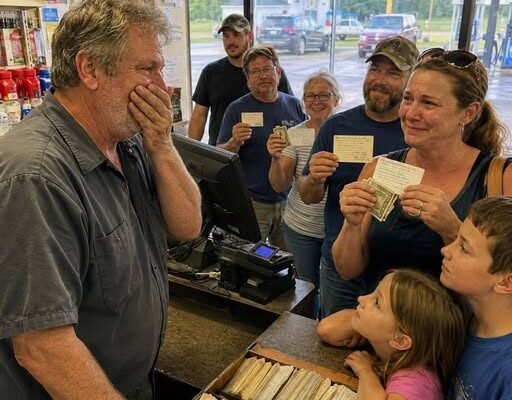
The first person arrived just after 7 a.m. A woman in a blue minivan. She walked inside holding an index card. The handwriting was faded. Troy recognized her face before he recognized the card. The young mother from that rainy night. Only now her children were older. She placed the card on the counter. “You gave me seven dollars.” Troy smiled. “I remember.” She put a fifty-dollar bill beside it. Troy pushed most of it back. “You only owed seven.” She shook her head. “No. I owed seven dollars for gas.” Then she pointed at the card. “This is for the night you reminded me I wasn’t alone.”
Before Troy could answer, another vehicle pulled in. Then another. A plumber drove nearly forty miles. He had owed Troy sixteen dollars. He brought one hundred. A retired teacher arrived with an index card from two years earlier. A delivery driver brought his card and a bag of breakfast sandwiches for the staff. A young man walked in wearing work boots and carrying a baby. Years earlier, Troy had given him twenty dollars in gas so he could make it to a job interview. “I got the job,” the man said. Then he looked down at his child. “Changed everything.”
By noon, cars were lined along the shoulder. People came from neighboring towns. Some still had their original cards. Others had taken pictures of them. One woman admitted she’d lost hers but had never forgotten the handwriting Troy added at the bottom: “Drive safe.”
People brought ten dollars. Twenty dollars. Fifty. One farmer dropped an envelope on the counter and refused to say how much was inside. Someone brought a homemade pie. Someone brought groceries for Troy’s camper. Someone else quietly handed his sister an envelope to help with repairs.
The station owner stood near the coffee machine watching all of it. Finally, he opened the drawer again. Those cards looked different now. Yesterday, they had looked like unpaid debts. Today, they looked like evidence. Evidence that people remember how you treat them when they are embarrassed. Evidence that dignity can be given away without costing much. Evidence that sometimes the smallest kindness follows a person home and stays there for years.
Near closing time, the owner called Troy into the office. Troy assumed he was about to be fired. Instead, the owner placed the drawer on the desk. “I was wrong about one thing,” he said. Troy waited. “I thought this drawer was full of money we lost.” He looked toward the front windows, where several former customers were still talking beside their cars. “It wasn’t.” The owner paused. “It was full of people who remembered.”
Troy stayed. The unofficial gas loans stopped being secret after that. The owner created a small emergency fund beside the register, supported entirely by customers who wanted to contribute. No speeches. No big sign. Just a little wooden box with a handwritten note: “FOR SOMEONE HAVING A HARD DAY.”
Troy still lives in the camper behind his sister’s place. He still works early mornings. He still drinks his coffee too strong. And he still keeps the old index cards. Not because anyone owes him money. Because some promises are worth more after they’ve already been paid.
I think about Troy whenever people say the world has become selfish. Maybe they’re looking in the wrong places. Sometimes goodness isn’t standing on a stage. Sometimes it’s behind a scratched gas station counter at six in the morning, quietly trusting a stranger with seven dollars and their dignity.
Because the truth is, people may forget what they borrowed. They may forget the date. They may even lose the little card you handed them. But they rarely forget the person who helped them when being broke made them feel invisible. Some drawers hold debts. The important ones hold proof that kindness is never truly given away—it keeps traveling until it finds its way home.
Troy never asked for recognition. He never expected repayment. He just kept showing up, kept trusting, kept believing that people were better than their circumstances. And in the end, the town showed him that he was right.
The drawer is still there. The cards are still there. And every time a new person comes in short on cash, someone reaches into that drawer and says, “Just write your name down.”
Because that’s what Troy taught them. Kindness doesn’t need to be announced. It just needs to be passed on. And when it is, it never stops growing. ❤️