Part 1: The Charge
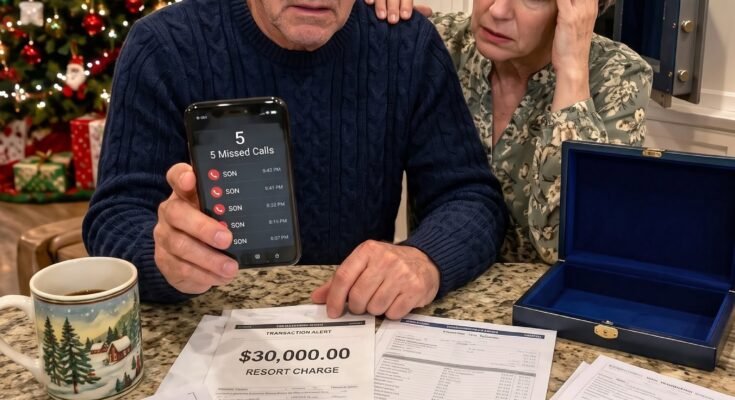
It began nine days before Christmas with a white bank envelope sitting on my kitchen island. I was sixty-nine, retired after thirty years at an auto plant outside Cleveland, and living alone in the four-bedroom colonial where my wife, Eleanor, and I had raised our son, Preston. Eleanor had been gone for three years, but every morning I still drank coffee from her blue ceramic mug, and every December I arranged her little Christmas village across the mantel.
I opened the statement expecting nothing unusual. Then I saw the charge. $30,000. A luxury ski resort in Telluride, Colorado. I checked the account number twice. Preston was still listed as an authorized user on one of my cards. Years earlier, I had added him for emergencies and work travel. Somewhere along the way, “emergency” had come to mean anything he assumed his father would eventually pay for.
I called him. “Why is there a thirty-thousand-dollar resort charge on my account?” He sighed. “Dad, it’s Christmas.” “That doesn’t answer my question.” “You do this every year. Everyone wants to enjoy the holiday, and you always turn it into some conversation about money.”
I looked toward Eleanor’s empty chair. Then Preston used the one argument he knew could still make me hesitate. “Mom always wanted us to enjoy life. This trip is exactly the kind of thing she would’ve wanted.”
“Don’t use your mother to justify a charge I never approved.” “You’ll understand once you see the itinerary.”
Fifteen minutes later, his email arrived. That was his mistake. Instead of sending only the flight information, Preston forwarded the entire email chain between himself and his wife, Marissa. I scrolled through airline confirmations, private transportation details, ski rentals, and the reservation for a six-bedroom lodge. Then I found my name. Not inside the lodge. At a roadside motel three miles away.
At first, I thought there had to be some mistake. Then I reached Marissa’s message. “Raymond cannot stay in the main house.” Preston had responded: “Already handled.”
Then I read the sentence that made my hands completely still. Marissa complained that my old flannel shirts and “gloomy look” would ruin the family photographs she intended to post. She wanted me brought over for dinner and sent back to the motel afterward. But my credit card? That was welcome to stay.
Part 2: The Plan
Another message read: “Make sure he brings the card. Raymond can cover dinners and incidentals.”
I sat staring at the glowing screen while the Christmas lights blinked behind me. Eleven people would be staying in the luxury lodge I had paid for. Marissa’s parents. Her sisters. Their husbands. Preston. Everyone except the father whose account had funded the reservation.
For thirty years, I had stood on concrete factory floors through Ohio winters so Preston could graduate without student debt. I wore work boots until the soles were nearly gone. I drove the same truck for seventeen years. Eleanor and I skipped vacations whenever tuition was due. Those choices had once been called sacrifice. Now my family seemed to consider them proof that I did not belong in their polished holiday pictures.
I almost closed the email. Then I noticed older messages beneath the vacation planning. One was dated three weeks earlier. Marissa had written: “We need him out of that house before spring. The property value is being wasted on one person.” Preston replied: “January is better. After the trip he’ll be tired and easier to talk into simplifying.”
I leaned closer to the screen. They already had a plan. Convince me the house was too large. Make selling it sound like something that would make my life “safer” and “easier.” Use the equity to cover debts they had never mentioned to me. The same Cleveland home Eleanor and I had spent thirty years paying off had somehow become part of their financial strategy without anyone asking whether I wanted to leave.
I printed every page. The printer continued feeding sheets into the tray while I sat there listening to the mechanical hum. Then my banking app flashed another alert. A new transaction. $5,000 had been withdrawn that morning from a joint savings account I had opened for Preston decades earlier as an emergency fund.
I called the bank. The representative confirmed the withdrawal. “Would you like to discuss restricting future access?” she asked. I looked at the pages spread across my desk. “Yes.”
Before doing anything else, I went upstairs. Behind a landscape painting in my bedroom was a wall safe. Inside were the deed to the house, old insurance papers, our marriage certificate, and a dark blue velvet box containing Eleanor’s anniversary jewelry. At least, that was where the box should have been. The deed was there. The documents were there. The velvet box was gone.
Part 3: The Reckoning
I stood staring into the empty space. The jewelry had never mattered because of its monetary value. I had bought it for Eleanor on our twentieth anniversary after selling the old pickup truck I had restored myself. After she died, I saved it for our granddaughter, Emma. I intended to give it to her when she turned eighteen. Only two people had ever known where the spare key to the safe was hidden. Eleanor. And Preston.
That was the moment I stopped describing what was happening as “family tension.” I photographed the safe, gathered the bank statements, printed the email chain, located my old power-of-attorney documents, and placed everything inside a manila folder. The following morning, I carried that folder into the downtown Cleveland office of my attorney, Julian Vance.
He read for almost fifteen minutes without speaking. Then he looked at me. “Raymond, what do you want?” No one had asked me that in years. Not what Preston needed. Not what would keep Christmas peaceful. Not what would make life easier for everyone else. What did I want? “I want my decisions to belong to me again.”
By noon, Preston’s financial authority had been revoked. My accounts were being separated from his access. My estate documents were being revised. The house had been placed inside a trust that required my approval for any major decision. I also closed the old joint savings account and removed Preston from every card connected to mine.
The strangest part was how little drama any of it required. Sign here. Initial there. Confirm your identity. Transfer the balance. Cancel access. For years, I had imagined that reclaiming my boundaries would require some enormous confrontation with my family. Instead, it sounded like sheets of paper sliding across a desk.
That evening, I went home, switched on the Christmas tree, and looked at the Telluride itinerary again. Eleven people in a luxury lodge. Me in a motel. My card paying for everything. I picked up a pen and wrote two short sentences across the top: “Not attending. Not paying.”
On the morning of December twenty-third, Preston started sending instructions. Don’t miss the airport shuttle. Pack warm clothes. The motel shuttle runs every hour. Marissa wants everyone ready for pictures by five. Call me when you land.
I responded once. “Have a wonderful Christmas.”
At four in the afternoon, my phone started ringing. And then it didn’t stop. Preston called. Marissa called. Marissa’s mother called. Then came the texts. Angry ones. Confused ones. Desperate ones. They had arrived at the resort only to find that the reservations were frozen. The card had been declined. There was no backup payment. Eleven people stood in a luxury lodge with no way to pay for it.
“What did you do?” Preston screamed when I finally answered. I told him the truth. “I did what you wanted. I simplified.” He didn’t understand. So I explained. “You wanted me out of the house. You wanted my money. You wanted me in a motel while you played family in the lodge I paid for. Now you have exactly what you planned—a Christmas without me.”
“But the lodge—” “Is not mine to pay for.” “We can’t afford it.” “Then you should have thought about that before you spent thirty thousand dollars I never approved.” “Dad, please—” “No, Preston. This is what you wanted. This is what you planned. And I finally decided to give you exactly that.”
I hung up and blocked his number. Then I turned off my phone, poured a cup of coffee into Eleanor’s blue mug, and watched the lights on the tree blink through the evening.
The calls lasted through Christmas. Marissa’s mother left a voicemail telling me I was “ruining everything.” Preston sent emails, texts, and even a photograph of the children standing in the snow, hoping I would change my mind. I didn’t.
The family eventually scraped together enough to cover the first few nights. They cut the trip short. They returned home angry, resentful, and broke. Preston never apologized. He didn’t know how. But he also never tried to take anything from me again.
I kept the house. I kept my peace. And when Emma turned eighteen, I gave her Eleanor’s jewelry myself. She cried. She hugged me. She told me her mother had always said I was the best man she ever knew.
Preston was never part of that moment. That was fine. I had finally learned that family is not the people who share your blood. It is the people who share your life without wanting to take it over.
I still drink coffee from Eleanor’s mug. I still arrange the Christmas village. And every December, I sit in my quiet house and remember what I learned that year: boundaries are not walls. They are doors. And sometimes, you have to close one to keep what matters safe. ❤️