PART 1 — THE PHONE CALL
The first sound I heard after the crash was metal screaming.
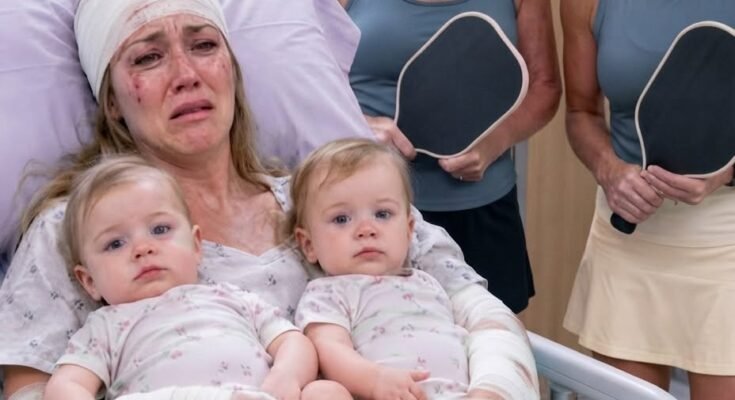
The second was my mother saying, “I can’t take the twins. I have a pickleball tournament.”
I was lying in a hospital bed with a fractured pelvis and two broken ribs.
My eighteen-month-old twins, Noah and Lily, had survived with minor injuries, but I could not lift them, bathe them or even stand beside their cribs.
“Mom, I almost died,” I whispered. “I only need help for a few days.”
“You have nurses,” she replied. “Your sister never bothers us the way you do.”
Then she ended the call.
For eight years, I had paid my parents’ mortgage, medical bills, country-club fees and car payments.
I also sent my younger sister, Claire, twelve thousand dollars every month to support her failing boutique.
But the first time I truly needed them, they were busy.
A nurse named Elena found me crying.
She stayed after her shift until my company attorney, Daniel, arranged an emergency nanny and a rehabilitation suite where the twins could remain with me.
Three days later, my parents finally visited.
They did not bring food.
They did not ask about my injuries.
My father placed a folder on my hospital table.
“We need you to sign this.”
It was a guarantee for a four-million-dollar business loan.
The borrower was Claire.
The collateral was my company.
“You want me to risk everything I built for Claire’s boutique?”
“It is a family expansion,” my father said.
Claire folded her arms.
“You can afford it.”
My mother picked up Lily for the first time since the crash.
“If you sign,” she said, “we can take the babies home while you recover.”
I stared at her.
“You refused them until you had something to trade.”
“Do not be dramatic,” she replied. “Families help each other.”
I took Lily from her arms despite the pain tearing through my pelvis.
“No,” I said.
My father’s expression hardened.
“Then do not expect us to rearrange our lives for you.”
They left.
That night, I stopped every payment.
The mortgage.
The club membership.
Claire’s allowance.
My father’s company card.
Everything.
By morning, my phone was filled with angry messages.
None mentioned my health.
They only asked when the money would return.
Two weeks later, Daniel entered my hospital room carrying a laptop.
“Someone submitted the loan application anyway,” he said.
The guarantee carried my electronic signature.
But I had never signed it.
PART 2 — THE PRICE OF HELP
Daniel traced the application to Claire’s laptop.
Attached was a letter claiming I had approved the loan before the accident.
The letter used my company logo and contained a copy of my signature taken from an old insurance form.
The lender had paused the application because my compliance team detected inconsistencies.
I wanted to believe Claire had acted alone.
Then Daniel recovered a family group chat.
My parents were in it.
One message from Claire read:
Keep refusing the babies until she becomes desperate.
My mother replied:
She will sign once the pain becomes too much.
My father added:
After the loan closes, we replace her as chief executive.
The accident had not created their cruelty.
It had merely revealed it.
I invited all three of them to my parents’ house after I was discharged.
They believed I wanted to negotiate.
I arrived in a wheelchair with Noah and Lily beside me.
Daniel connected his laptop to the television.
Their messages appeared on the screen.
My mother turned pale.
“That was taken out of context.”
“What context makes refusing injured grandchildren acceptable?” I asked.
“You had hospital staff.”
“My children needed family.”
“You had money.”
Her answer came too quickly.
That was what I had always been to her.
Not a daughter.
A bank account capable of purchasing whatever care she refused to give.
My father pointed at the screen.
“This is why Claire never asks you for anything. You turn everything into a trial.”
“Claire asks me for twelve thousand dollars every month.”
“She needs support.”
“So did I.”
He looked away.
Then Daniel opened a second file.
For four years, Claire’s boutique had received consulting payments from my company for work she never performed.
My father had approved the invoices.
My mother had submitted false expense reports.
Together, they had quietly transferred nearly six hundred thousand dollars.
My compliance system had been designed to catch strangers.
It had never occurred to me that the threat would share my last name.
Claire moved toward the door.
It opened before she reached it.
Two investigators entered.
One requested her laptop and phone.
The other handed my parents notices concerning fraudulent borrowing and misuse of company funds.
My mother began crying.
“You are destroying us because I refused to babysit.”
“No,” I said. “I am ending the arrangement that allowed you to call dependence love.”
“This is our home,” my father snapped.
“No. It is a house I purchased and allowed you to occupy.”
Their faces changed.
The mortgage, taxes and utilities had always been paid through one of my holding companies.
They had lived there for six years without contributing a dollar.
Daniel placed the final notice on the table.
They had sixty days to leave.
My mother stared at me.
“We would have taken the twins after you signed.”
“That sentence is why you will never be alone with them.”
PART 3 — WHAT THE PAYMENTS HID
Their united family collapsed within days.
Claire blamed my father for promising her control of my company.
My father blamed my mother for providing the photograph of my signature.
My mother turned over their messages to protect herself.
The people who had coordinated against me began trading evidence against one another.
Claire admitted submitting the forged documents.
My father admitted approving false invoices.
My mother avoided the most serious charge by cooperating and repaying money linked to her accounts.
They received probation, restitution orders and permanent financial consequences.
Claire closed her boutique.
My father lost access to every company account.
My mother’s club membership ended when the next payment failed.
They sold their SUV and moved into a modest rental outside the city.
They survived.
Their panic had always depended on the lie that they could not live without my money.
They could.
They simply preferred not to.
My parents requested mediation.
I agreed to one meeting.
My mother arrived without her expensive clothes or carefully polished smile.
“We made mistakes,” my father said.
“You made choices.”
“We were afraid of losing stability.”
“You mean losing my money.”
My mother began crying.
“I loved those babies before they were born.”
“Then why did you refuse them?”
“I wasn’t refusing forever.”
“You refused until I signed.”
“It was Claire’s idea.”
“You wrote the message.”
She covered her face.
For years, her tears had ended every difficult conversation.
They did not end this one.
My father leaned forward.
“We can help now.”
“No.”
“We are still their grandparents.”
“That is a biological fact. It does not guarantee access.”
“You would erase your family over one phone call?”
“The call did not destroy this family,” I said. “It revealed what eight years of payments had hidden.”
Recovery took eleven months.
I moved from bed to wheelchair.
Then from wheelchair to walker.
The twins learned to walk before I did.
Noah took his first steps across the rehabilitation room while Elena stood nearby.
Lily followed two weeks later.
I cried both times.
Not because my parents missed it.
Because I was there.
When I returned to work, I created an emergency-care program for employees recovering from accidents, illness or family crises.
No one in my company would ever have to beg relatives for help while lying in a hospital bed.
One year after the crash, I returned to the hospital with Noah and Lily.
They ran ahead of me toward Elena.
I followed them without a cane.
Slowly.
Carefully.
But on my own.
That evening, Daniel sent me the final restitution notice.
The last recovered payment had entered the company account.
I deleted the notification without checking the total.
For years, every transfer to my family had been labeled support.
Mortgage support.
Medical support.
Business support.
I had mistaken repeated payments for love.
But when money could not lift my children, strangers stayed.
A nurse held my hand.
An attorney protected my company.
A nanny cared for my babies.
The people my father dismissed as outsiders gave freely.
My family demanded collateral.
The first sound I heard after the crash was metal screaming.
The second was my mother choosing pickleball.
But the sound that mattered most came months later:
Two small pairs of feet crossing the rehabilitation floor toward me.
That was when I finally understood who truly needed me.
And who had never deserved to.
MY MOTHER CHOSE PICKLEBALL OVER MY CHILDREN—THEN ASKED ME TO SIGN AWAY MY COMPANY