
Europe is often described as the world’s great drinking continent.
But Europeans do not all drink the same thing.
Travel from Portugal to Poland, from Sweden to Ukraine, or from France to the Baltic states, and the type of alcohol that dominates recorded consumption can change dramatically.
In much of central and northern Europe, beer takes the largest share.
Across Europe’s Mediterranean and traditional wine-producing regions, wine often dominates.
Farther east, particularly in several Baltic and eastern European countries, spirits become much more important.
The result is a surprisingly clear cultural geography—one shaped by agriculture, climate, history, trade and centuries-old drinking traditions.
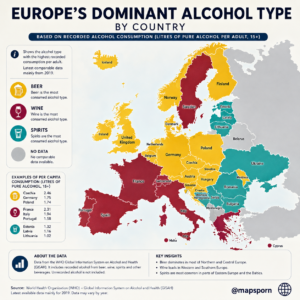
First: What Does “Dominant Alcohol Type” Mean?
The map does not show which drink people order most often.
It shows which category accounts for the largest amount of recorded pure alcohol consumed.
That distinction matters.
A liter of beer is not equivalent to a liter of whisky.
Typical beer may contain around 5% alcohol.
Wine around 12%.
Spirits often around 40%.
WHO therefore converts consumption into litres of pure alcohol before comparing beverages. (World Health Organization)
For example, drinking:
100 liters of 5% beer
contains roughly the same amount of ethanol as:
about 12.5 liters of a 40% spirit.
So this map is really asking:
Which beverage supplies the largest amount of recorded ethanol consumed by adults in each country?
That is much more meaningful than simply counting bottles or liters.
Europe Drinks More Alcohol Than Any Other WHO Region
The broader context is striking.
WHO reports that adults in its European Region consumed an average of about 9.2 liters of pure alcohol per person in 2019, the highest level of any WHO region.
Approximately two-thirds of adults consumed alcohol, and consumption among men was substantially higher than among women. (World Health Organization)
That does not mean every European country drinks heavily.
Consumption varies enormously.
But Europe overall remains exceptional both for the amount consumed and for the variety of drinking traditions packed into a relatively small geographic area.
The Beer Belt of Central Europe
One of the clearest patterns on the map is the broad beer-dominant zone running through much of central and northern Europe.
Countries strongly associated with beer include:
Czechia
Germany
Poland
Austria
and several neighboring states.
This is hardly surprising.
Some of the world’s most influential brewing traditions developed here.
Czechia: A Global Beer Powerhouse
Czechia’s connection with beer is especially strong.
Modern WHO-derived data put Czech beer consumption at roughly 6.83 liters of pure alcohol per adult in 2022, the highest figure in the latest dataset shown by Our World in Data. (Our World in Data)
Remember that this is not 6.83 liters of actual beer.
It is 6.83 liters of pure ethanol contained in beer.
Using a rough 5% alcohol content, that would correspond to well over 100 liters of beer.
Beer is deeply embedded in Czech history, hospitality and local identity.
The famous brewing city of Plzeň—Pilsen in German—gave the world the name “Pilsner.”
What began as a regional brewing style eventually became one of the world’s dominant beer categories.
Germany: Beer Culture Is Regional, Not Uniform
Germany also appears firmly in the beer category.
But speaking of one “German beer culture” oversimplifies the country.
Bavaria is famous for:
lager,
wheat beer,
beer halls
and Oktoberfest.
Cologne has Kölsch.
Düsseldorf has Altbier.
Northern and eastern Germany developed their own brewing traditions.
Germany’s Reinheitsgebot—often translated as the German beer purity law—also became internationally associated with the country’s brewing identity.
Today WHO-derived data still show beer accounting for a major part of Germany’s recorded alcohol consumption. Beer consumption amounted to around 4.85 liters of pure alcohol per adult in 2022. (Our World in Data)
Poland: Beer Became Increasingly Important
Poland may culturally evoke vodka for many outsiders.
Yet modern drinking patterns are more complicated.
Beer has become enormously important.
Recent WHO data put recorded beer consumption at around:
5.47 liters of pure alcohol per adult in 2022. (Our World in Data)
Spirits remain significant, but the stereotype of Poland as simply a vodka-drinking country no longer captures the full picture.
That illustrates one of the most interesting things about this map:
Historical reputation and current consumption are not always the same.
Wine Dominates the Mediterranean West
Southern and western Europe contain a very different pattern.
France, Italy and Portugal are among the clearest wine-dominant countries in the WHO’s 2019 beverage-share data.
Wine accounted for:
63.7% of recorded alcohol consumption in Italy
57.7% in Portugal
and
56.8% in France. (Our World in Data)
Those are exceptionally high shares.
The reasons go far beyond consumer preference.
Wine is rooted in the landscape itself.
Italy: Nearly Two-Thirds From Wine
Italy had the highest wine share among the major European countries shown in the WHO-derived 2019 dataset:
63.7%
of recorded alcohol consumption came from wine. (Our World in Data)
Italy’s wine traditions stretch back thousands of years.
Ancient Greeks cultivated grapes in parts of southern Italy.
The Romans expanded viticulture across their empire.
Today wine remains part of regional agricultural identity from:
Tuscany,
Piedmont,
Veneto,
Sicily
and dozens of other areas.
The important point is not simply that Italians drink wine.
Italy is also one of the world’s major wine-producing countries.
Production and consumption developed together over centuries.
Portugal: Wine Still Leads
Portugal shows a similar pattern.
WHO data indicate wine supplied about:
57.7% of recorded alcohol consumption in 2019. (Our World in Data)
Portuguese wine culture includes famous products such as:
Port,
Madeira,
Vinho Verde,
Douro reds
and Alentejo wines.
Geography played a crucial role.
Portugal’s climate and soils made grape cultivation practical over large parts of the country, while centuries of Atlantic trade created international markets for Portuguese wines.
France: Still Very Much a Wine Country
France follows at:
56.8% wine in the 2019 WHO beverage-share data. (Our World in Data)
France’s association with wine is perhaps stronger internationally than that of any other country.
Bordeaux.
Burgundy.
Champagne.
The Rhône.
Loire.
Alsace.
Each became both a geographical region and a globally recognized wine identity.
Yet French drinking habits have changed greatly.
Historical alcohol consumption was far higher than it is today.
Our World in Data notes that France consumed extraordinarily large quantities of alcohol during the early 20th century compared with current levels. (Our World in Data)
So while wine still dominates, modern France is not simply continuing the drinking patterns of previous generations unchanged.
Spain Is More Complicated Than the Stereotype
Spain is colored as wine-dominant on the infographic.
Wine is unquestionably important culturally, but WHO’s 2019 data show wine at about:
33.5% of recorded alcohol consumption. (Our World in Data)
That means Spain’s beverage mix is less overwhelmingly wine-centered than Italy, Portugal or France.
Beer has become extremely important in modern Spain.
This is a good reminder that:
wine-producing country does not automatically mean wine overwhelmingly dominates consumption.
Production, exports and domestic drinking habits are separate things.
Greece: Wine Leads, but Not by an Italian Margin
Greece had wine accounting for approximately:
44% of recorded alcohol consumption in 2019. (Our World in Data)
That places it solidly within the Mediterranean wine tradition.
Greece has one of Europe’s oldest histories of viticulture.
Wine was central to ancient Greek agriculture, religion, trade and social life.
Modern Greek wine culture remains extensive, although beer and spirits—including ouzo and tsipouro—are also important.
Sweden Is One of the Map’s Most Interesting Surprises
Sweden appears wine-dominant.
That may surprise people who associate Scandinavia with beer or strong spirits.
But WHO’s 2019 data support it:
47.2% of Sweden’s recorded alcohol consumption was wine. (Our World in Data)
That is higher than:
France? No—France was 56.8%.
But it is higher than wine’s share in many other European countries.
Sweden therefore illustrates how drinking cultures can change.
Wine was historically much less central to Scandinavia than it was to Mediterranean Europe.
Modern trade, rising incomes and changing tastes reshaped consumption patterns.
Switzerland: Wine Has a Narrow but Important Lead
Switzerland is another country where wine accounted for a large share:
46.2% in 2019. (Our World in Data)
Switzerland is often overlooked as a wine country because much of its production is consumed domestically rather than exported.
Important vineyards exist around:
Lake Geneva,
Valais,
Ticino,
Neuchâtel
and other favorable valleys and lake regions.
The country’s extreme topography limits agricultural land, but sunny slopes can create excellent grape-growing conditions.
Eastern Europe and the Spirits Belt
Move eastward and another pattern appears.
Distilled spirits occupy a much larger share of alcohol consumption.
In the WHO’s 2019 figures, spirits made up:
47.6% in Ukraine
45.2% in Lithuania
40.6% in Latvia
38.2% in Estonia
and
43.1% in Russia. (Our World in Data)
This is the historical world of:
vodka,
brandy,
rakia,
and other distilled drinks.
But again, stereotypes can exaggerate the pattern.
Beer has become extremely important in several countries that historically had strong spirits traditions.
Ukraine: Spirits Were Nearly Half the Recorded Mix
Ukraine’s 2019 share from spirits was approximately:
47.6%. (Our World in Data)
That gives spirits a clear leading position in the WHO dataset.
Vodka and related distilled beverages have long cultural histories throughout much of eastern Europe.
But the figures represent the period before Russia’s full-scale invasion of Ukraine in 2022.
War, displacement, changing economic conditions and disrupted markets mean a 2019 snapshot should not automatically be assumed to describe the country today.
That is why the infographic’s date matters.
The Baltic States: Spirits Remain Important
Lithuania:
45.2% spirits
Latvia:
40.6%
Estonia:
38.2%. (Our World in Data)
These percentages show why the Baltics appear in the spirits category.
Yet recent beverage-specific data also show substantial beer consumption in all three countries.
In 2022, recorded beer consumption in pure-alcohol terms was approximately:
Estonia — 4.41 L
Latvia — 4.36 L
Lithuania — 4.20 L. (Our World in Data)
So saying “Estonia is a spirits country” should not imply beer is marginal.
The map only indicates which category is largest.
Romania May Need Rechecking on the Map
Romania deserves caution.
The infographic colors it as spirits-dominant.
However, WHO-derived 2019 data put spirits at only about 19.6% of recorded alcohol consumption, while wine was around 30.6%. (Our World in Data)
More recent WHO data also show very substantial beer consumption: approximately 4.95 liters of pure alcohol per adult in 2022. (Our World in Data)
So I would recheck Romania before publishing. The spirits classification appears questionable against the WHO dataset.
“Recorded Consumption” Is a Crucial Limitation
This map does not necessarily capture every drink consumed.
WHO’s recorded alcohol statistics are derived from sources such as:
government tax data,
production,
imports,
exports,
sales,
industry statistics
and other national records. (World Health Organization)
But alcohol can also come from:
home production,
informal markets,
unregistered sales,
cross-border purchases
or illicit production.
That is called unrecorded alcohol consumption.
In countries where homemade spirits or informal alcohol markets are significant, official recorded figures can understate actual drinking.
The distinction is especially important when comparing countries with very different alcohol-tax and reporting systems.
Why Does Europe Have Such Clear Alcohol Regions?
The answer begins with agriculture.
Grapes favor particular climates
Wine production developed most strongly where grapes could grow reliably.
Mediterranean and temperate regions such as:
Italy,
France,
Portugal,
Spain
and parts of Switzerland
were naturally suited to viticulture.
Grain supports brewing and distilling
Farther north, grain crops were often more practical than vineyards.
Barley became an important brewing crop.
Other grains and potatoes could also be fermented and distilled.
This helped reinforce beer and spirits traditions.
Climate did not determine everything.
But before modern transportation, people generally drank beverages that could be produced from what grew locally.
Religion Also Shaped Drinking Traditions
Christianity played an important historical role in European wine culture.
Wine had religious significance in Christian worship.
Monasteries became important centers of:
viticulture,
brewing
and agricultural knowledge.
Monastic brewing traditions remain famous in Belgium and central Europe today.
Trade, taxation and political regulation later transformed these industries further.
So Europe’s drinking map is not simply an agricultural map.
It reflects centuries of interaction among:
geography,
religion,
commerce,
law
and social tradition.
Modern Europe Is Blurring the Old Boundaries
Historical drinking belts remain visible—but they are weakening.
A Swedish consumer can buy Italian wine.
A Spanish bar can specialize in craft beer.
A Czech supermarket stocks French wine and Scottish whisky.
International trade has removed many of the geographic constraints that originally shaped Europe’s drinking cultures.
Consumer tastes change too.
Wine has become more common in northern Europe.
Beer has become more prominent in parts of southern Europe.
Craft beer has expanded.
Low- and no-alcohol products are growing in many markets.
So this map should be thought of as:
a snapshot of the largest beverage category
rather than an unchanging cultural rule.
Europe’s Alcohol Consumption Is a Public-Health Issue Too
The map is fun from a cultural-geography perspective, but alcohol consumption also has serious health consequences.
WHO reports that the European Region has both the world’s highest alcohol consumption and major alcohol-related health burdens. (World Health Organization)
Alcohol consumption is associated with increased risk of:
liver disease,
several cancers,
cardiovascular conditions,
injuries,
alcohol-use disorders
and other harms.
WHO’s current position is that health risk generally increases with alcohol consumption; the beverage category does not eliminate risks associated with ethanol itself.
From a health perspective, therefore, whether the ethanol comes from beer, wine or vodka matters less than the amount consumed.
What the Map Really Shows
At first glance, this looks like a map of favorite drinks.
It is more interesting than that.
The wine zone reflects ancient viticulture.
The beer belt reflects northern and central European grain agriculture and brewing traditions.
The eastern spirits pattern reflects another long history of distillation and drinking culture.
And Sweden demonstrates how those historical boundaries can shift dramatically over time.
The map is therefore partly about alcohol.
But it is also about:
climate
farming
trade
history
and
culture.
A bottle on a supermarket shelf can contain centuries of geography.
Accuracy Note for Your Infographic
The underlying WHO source and the overall concept are solid. WHO defines recorded beverage-specific alcohol consumption as liters of pure alcohol consumed per person aged 15+, using government statistics and other production/sales sources. (World Health Organization)
However, I would revise two things before publishing:
- Remove or recalculate the “Examples of per capita consumption” box. Values such as Czechia beer 2.46 L, France wine 2.31 L, and Estonia spirits 1.32 L do not match the WHO beverage-specific series if they are intended to represent annual liters of pure alcohol per adult. For comparison, the latest WHO-derived figures available through Our World in Data show Czech beer at 6.83 L and Estonian spirits at 5.85 L in 2022. (Our World in Data)
- Recheck Romania’s spirits classification. WHO’s 2019 data put spirits at about 19.6% and wine at 30.6%, while beer is also substantial, so Romania does not appear to fit the turquoise spirits category shown. (Our World in Data)
The source date of 2019 should remain prominent. WHO still identifies 2019 as the key comparable year in its latest major European alcohol assessment. (World Health Organization)