Switzerland is small enough to drive across in a few hours.
Yet depending on which direction you travel, road signs, newspapers, school lessons, conversations and even the name of your destination can change language completely.
Drive east from Geneva and French gradually gives way to German.
Head south across the Alps and Italian becomes dominant.
Travel deep into parts of Graubünden and you may encounter Romansh, a language spoken by only a tiny fraction of the Swiss population.
All of this happens inside one country.
Switzerland recognizes four national languages: German, French, Italian and Romansh, making it one of Europe’s clearest examples of a multilingual state. (About Switzerland)
But Switzerland does not simply declare all four languages equally official everywhere.
Instead, its linguistic system follows one of the country’s most important political principles:
local control.
Each canton determines its official language or languages largely according to the historic language of its population.
That is why the map of Switzerland looks almost like several linguistic countries fitted together.
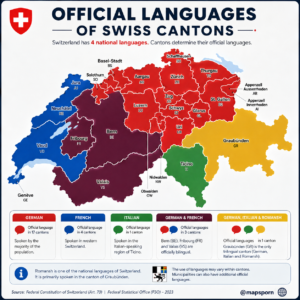
Switzerland Has 26 Cantons—and They Don’t All Speak the Same Language
Switzerland consists of 26 cantons.
These cantons have unusually strong political authority compared with regions in many other countries.
Language policy is part of that autonomy.
The broad pattern is:
- 17 German-speaking cantons
- 4 French-speaking cantons
- 1 Italian-speaking canton
- 3 bilingual German-French cantons
- 1 trilingual German-Italian-Romansh canton
Together they create Switzerland’s four major language regions.
The borders are not perfectly rigid. Municipalities and individual districts can have different linguistic profiles within the same canton.
But the cantonal pattern shown on the map provides a remarkably good introduction to the country’s linguistic geography.
German Switzerland: The Largest Language Region
German dominates most of northern, central and eastern Switzerland.
German-speaking cantons include Zurich, Lucerne, Uri, Schwyz, Obwalden, Nidwalden, Glarus, Zug, Solothurn, Basel-Stadt, Basel-Landschaft, Schaffhausen, Appenzell Ausserrhoden, Appenzell Innerrhoden, St. Gallen, Aargau and Thurgau.
Nationally, around 61% of the Swiss population primarily speaks German or Swiss German, according to the Swiss government’s 2026 national guide. (Federal Chancellery)
But there is an important catch:
What you hear on the street is often not the same German you hear in Berlin or Hamburg.
Swiss German Is Not One Dialect
In everyday conversation, most German-speaking Swiss use varieties collectively known as Swiss German, or Schweizerdeutsch.
These are Alemannic dialects.
And they can differ dramatically.
A person from Basel may sound noticeably different from someone from Bern.
Zurich has its own dialect.
Mountain communities can have even stronger regional forms.
The Swiss government notes that dialect differences between regions such as Basel, Zurich and Bern can be substantial, even though Swiss German speakers generally understand one another. (About Switzerland)
Standard German is still extremely important.
It is normally used for:
formal writing, legislation, newspapers, school materials and much official communication.
So many German-speaking Swiss effectively move between two linguistic registers every day:
Swiss German for conversation
and
Standard German for formal writing.
That alone makes Switzerland’s language situation more complicated than a simple red-colored map suggests.
French Switzerland: Romandie
Western Switzerland is predominantly French-speaking.
The four officially French-speaking cantons are:
Geneva, Vaud, Neuchâtel and Jura.
This region is commonly known as Romandie.
French is the main language of roughly 23% of Switzerland’s population. (Federal Chancellery)
Unlike Swiss German, modern Swiss French is generally quite close to the standard French spoken in France.
There are accents, expressions and vocabulary differences, of course.
But a French speaker from Paris usually has little difficulty understanding someone from Lausanne or Geneva.
Historically, however, western Switzerland contained many regional Franco-Provençal dialects.
Those traditional dialects have largely disappeared from daily use, though traces survive in some parts of Valais, Jura and Fribourg. (About Switzerland)
Ticino: Switzerland’s Italian South
Cross the Alps into Ticino and Switzerland suddenly feels much more Italian.
Italian is Ticino’s official language.
Around 8% of Switzerland’s population primarily speaks Italian nationally. (Federal Chancellery)
Cities such as:
Lugano,
Bellinzona
and Locarno
form the cultural heart of Italian-speaking Switzerland.
Architecture, food and everyday life often show obvious connections with neighboring northern Italy.
Yet Ticino is unmistakably Swiss politically and institutionally.
This creates one of Switzerland’s most fascinating regional identities:
Italian-speaking culture inside the Swiss federation.
Italian is also spoken in several southern valleys of Graubünden, so Ticino is not the only place in Switzerland where Italian has official status. (About Switzerland)
Bern, Fribourg and Valais: The Bilingual Cantons
Three cantons officially bridge the German-French linguistic divide:
Bern
Fribourg
and
Valais.
All recognize both German and French.
But this does not mean everyone in those cantons is bilingual.
Instead, different areas traditionally belong to different language regions.
Bern
Most of Canton Bern is German-speaking.
But the western part contains French-speaking areas.
Its most famous bilingual city is:
Biel/Bienne.
Even the city’s official name appears in both languages.
German speakers call it Biel.
French speakers call it Bienne.
The Swiss government specifically identifies Biel/Bienne as officially bilingual. (About Switzerland)
It may be one of the best places to physically see Switzerland’s multilingualism.
Street signs, government services and everyday communication can appear in both German and French.
Fribourg
Fribourg is another linguistic meeting point.
French dominates much of the canton, while German-speaking communities are concentrated especially toward the east and northeast.
The cantonal capital itself is often called:
Fribourg in French
and
Freiburg in German.
Again, the geography of language is built directly into place names.
Valais
Valais is split dramatically by language.
The western portion is predominantly French-speaking.
The eastern Upper Valais is German-speaking.
The linguistic transition follows geography and settlement patterns through the Rhône valley.
Swiss government language guidance even notes that Upper Valais Swiss German has especially distinctive regional features. (About Switzerland)
Graubünden: Switzerland’s Remarkable Three-Language Canton
Then there is Graubünden.
No other Swiss canton has quite the same linguistic landscape.
Its official languages are:
German
Italian
and
Romansh.
The Swiss government identifies Graubünden as Switzerland’s only trilingual canton. (About Switzerland)
Much of the canton is German-speaking.
Italian dominates several valleys south of the Alps.
Romansh survives in scattered areas across central and eastern parts of the canton.
The result is a patchwork created largely by mountains.
Why the Mountains Matter
Graubünden is filled with valleys separated by high Alpine terrain.
Before modern tunnels, roads and railways, neighboring communities could remain surprisingly isolated.
That helped different languages and dialects survive.
One valley could develop strong German-speaking connections.
Another could maintain Italian.
Another could preserve Romansh for centuries.
Political maps make Graubünden look like one canton.
Linguistically, it is far more complicated.
Romansh: Switzerland’s Smallest National Language
Romansh is easily the most unusual language on the map.
Only around 0.5% of Switzerland’s population primarily speaks it today. (Federal Chancellery)
Yet Switzerland recognizes it as one of its four national languages.
Romansh developed from the Latin spoken after the Roman conquest of the Alpine region.
Over centuries, isolated valleys developed their own forms of the language.
Modern Romansh contains five major traditional varieties:
Sursilvan, Sutsilvan, Surmiran, Puter and Vallader. (About Switzerland)
For a language spoken by only tens of thousands of people, that is extraordinary internal diversity.
Is Romansh an Official Language of Switzerland?
Yes—but with a qualification.
The Federal Constitution distinguishes between national languages and federal official languages.
German, French and Italian are the Confederation’s general official languages.
Romansh is also used officially by the federal government when communicating with Romansh-speaking people. (Federal Chancellery)
That distinction is worth explaining because infographics often simply call all four “official languages.”
For everyday purposes, describing Switzerland as a four-language country is fine.
Legally, however, the status is slightly more nuanced.
Why Isn’t English an Official Language?
This often surprises international visitors.
English is extremely common in Switzerland.
It is widely used in:
business,
finance,
universities,
tourism,
science
and international organizations.
Switzerland’s government says English has become increasingly important as a means of communication across all language regions. (About Switzerland)
But English is not one of Switzerland’s national languages.
The four national languages reflect historically rooted communities within Swiss territory.
English’s importance is comparatively recent and largely international.
Interestingly, non-national languages have collectively become a significant part of Swiss society because of immigration. English, Portuguese and Albanian are among the country’s most commonly mentioned non-national languages. (About Switzerland)
Switzerland Is More Multilingual Than the Map Shows
A map requires neat colors.
Real people do not.
Many Swiss residents speak multiple languages.
The government’s latest national guide says around 61% primarily speak German, 23% French, 8% Italian and 0.5% Romansh, while about 24% report a mother tongue that is not one of the national languages. (Federal Chancellery)
More than two-thirds of people aged 15 and older regularly use more than one language, according to Swiss government summaries. (About Switzerland)
That multilingualism can involve combinations such as:
German and French.
Italian and German.
Romansh and German.
A national language plus English.
Or immigrant languages combined with one or several Swiss languages.
So Switzerland’s linguistic reality is not four isolated blocks.
It is overlapping layers.
Why Switzerland Never Chose One National Language
Many European states historically attempted to build national unity around one dominant language.
Switzerland developed differently.
The Swiss Confederation grew through alliances among territories that already possessed different languages, cultures and religious traditions.
Instead of forcing everyone to become linguistically identical, the political system gradually accommodated regional differences.
Federalism made that easier.
Cantons retained strong powers.
Local populations could preserve their language.
And national identity developed around political institutions rather than one shared mother tongue.
This is one reason Switzerland offers an interesting answer to a difficult political question:
Can people who speak different languages still see themselves as one nation?
Switzerland’s answer has been yes.
Language Borders Do Not Match International Borders
Switzerland’s linguistic geography also demonstrates that languages rarely stop neatly at state boundaries.
German connects Switzerland culturally to:
Germany,
Austria
and Liechtenstein.
French connects western Switzerland with France.
Italian connects southern Switzerland with Italy.
Romansh belongs to the broader family of Rhaeto-Romance languages found around parts of the Alps.
Switzerland therefore lies at the meeting point of several major European cultural zones.
Instead of one language expanding over the others, Switzerland preserved that meeting point inside its political borders.
Why Cantonal Control Matters
The sentence near the top of the infographic—“Cantons determine their official languages”—is one of its most important facts.
Switzerland’s federal system deliberately gives local communities enormous influence.
Language is tied to:
schools,
courts,
government documents,
municipal administration
and public services.
That is why the linguistic boundary is not merely cultural.
It has practical consequences.
Children attend school in the language of their region.
Government offices operate in appropriate official languages.
Multilingual cantons must accommodate more than one linguistic community.
This transforms language from something people simply speak into an important part of Switzerland’s constitutional structure.
The Bigger Story Behind the Map
Look at Switzerland from far away and it seems small and remarkably unified.
Zoom in and another picture appears.
Western Switzerland speaks French.
Northern and central Switzerland speak German—mostly in dialect.
Ticino speaks Italian.
Graubünden contains German, Italian and Romansh.
Bern, Fribourg and Valais straddle language borders.
Biel/Bienne operates officially in two languages.
And millions of residents regularly use additional languages as part of everyday life.
Yet all of these regions share:
one federal state,
one currency,
one flag,
one national political system
and a strong Swiss identity.
That is what makes the language map interesting.
It is not really a map showing where people speak German, French or Italian.
It is a map showing how Switzerland built national unity without demanding linguistic uniformity.
For a country with four national languages, that may be its most impressive linguistic achievement.
Accuracy Note
The infographic’s canton categories are broadly correct. Swiss government sources identify Bern, Fribourg and Valais as officially German-French bilingual and Graubünden as German-Italian-Romansh trilingual; the remaining cantons fall into German-, French- or Italian-speaking categories. Municipal language arrangements can still vary within cantons. (About Switzerland)
For maximum legal accuracy, I would change the subtitle from “Switzerland has 4 national languages. Cantons determine their official languages.” to:
“Switzerland has four national languages: German, French, Italian and Romansh. German, French and Italian are the Confederation’s general official languages; Romansh is official in federal communication with Romansh speakers. Cantons determine their own official languages.” (Federal Chancellery)