
You might assume that a bottle of Fanta Orange is basically the same drink everywhere.
Same orange color.
Same logo.
Same familiar fizzy taste.
But cross a European border and something surprising can happen:
The recipe can change.
In some European countries, Fanta Orange contains a little over 4 grams of sugar per 100 ml.
In others, the label shows more than 11 grams.
That means two cans carrying almost identical branding can have dramatically different nutritional profiles.
And this isn’t an accident.
Coca-Cola openly acknowledges that Fanta Orange recipes vary across Europe. (Coca-Cola)
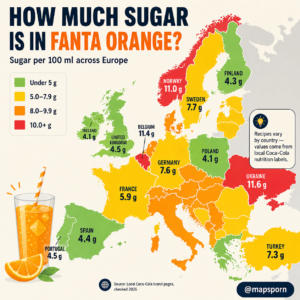
Belgium: One of the Highest-Sugar Versions
Belgium provides one of the clearest examples.
The official Belgian Coca-Cola page currently lists Fanta Orange at:
11.4 g of sugar per 100 ml
and about:
46 kcal per 100 ml. (Coca-Cola)
That is dramatically different from the version sold just across the English Channel.
United Kingdom: 4.5 g per 100 ml
The British Fanta Orange recipe currently contains:
4.5 g of sugar per 100 ml
with only about:
19 kcal per 100 ml. (Coca-Cola)
Why is it so much lower?
One major difference is that British Fanta combines sugar with low-calorie sweeteners, including acesulfame K and sucralose.
This allows the drink to remain sweet while containing considerably less sugar.
The UK has also experienced extensive soft-drink reformulation following policies designed to encourage manufacturers to reduce sugar levels.
Ireland: Even Slightly Lower
Ireland’s official Coca-Cola nutrition information lists:
4.1 g of sugar per 100 ml.
The Irish recipe includes sugar as well as sweeteners such as acesulfame K and aspartame. (Coca-Cola)
So despite Ireland and Belgium both being relatively close geographically, their versions of Fanta Orange have very different sugar concentrations.
Poland: 4.1 g
Polish Fanta Orange is also listed at:
4.1 g of sugar per 100 ml.
Its ingredient list contains sugar along with sweeteners, including sodium cyclamate and saccharin. (Coca-Cola)
This demonstrates one of the major ways beverage companies reduce sugar without making the drink taste dramatically less sweet.
They replace part of the sugar with high-intensity sweeteners.
Finland: 4.3 g
Finland’s version is similar.
The official Finnish page gives:
4.3 g of sugars per 100 ml
and approximately:
19 kcal.
The recipe combines sugar with acesulfame K and aspartame. (Coca-Cola)
Interestingly, Coca-Cola Finland explicitly explains why European recipes differ.
The company says it adjusts recipes in response to local ingredients, local regulations, consumer preferences, and efforts to reduce sugar. (Coca-Cola)
That statement essentially explains the whole map.
Why Isn’t Fanta Standardized Across Europe?
It might seem easier for Coca-Cola to manufacture exactly the same Fanta everywhere.
But soft drinks are surprisingly local products.
Several factors influence the recipe.
1. Sugar Taxes and Government Policy
European governments have increasingly tried to reduce sugar consumption.
One strategy has been taxing beverages according to their sugar content.
That gives manufacturers a powerful financial reason to reformulate drinks below certain thresholds.
Rather than dramatically reducing sweetness, companies can replace some sugar with low-calorie sweeteners.
This is one reason some markets now have regular—not merely “Zero”—soft drinks containing both sugar and sweeteners.
2. Local Consumer Taste
People do not necessarily prefer exactly the same sweetness everywhere.
Someone accustomed to a sweeter soft drink may dislike a rapidly reformulated lower-sugar version.
Companies therefore adjust gradually and conduct extensive taste testing.
Coca-Cola explicitly says local preferences are one factor influencing its European formulations. (Coca-Cola)
3. Different Amounts of Orange Juice
Even the juice percentage varies.
For example, official pages currently list approximately:
Belgium — 4% orange juice
Norway — 4.5%
Finland — around 5% in the ingredient listing
Ireland — 5%. (Coca-Cola)
So European Fanta is not merely the same concentrate diluted differently.
There can be real formulation differences.
4. Different Sweeteners
Lower-sugar versions can use different combinations of sweeteners.
Depending on the country, you may find ingredients such as:
- Aspartame
- Acesulfame K
- Sucralose
- Cyclamates
- Saccharin
For example, Poland’s current recipe uses a different sweetener combination from Great Britain’s. (Coca-Cola)
Even when two countries have similar sugar levels, their recipes may therefore not be identical.
“Sugar” on the Label Does Not Always Mean Added Table Sugar
There is another important detail.
European nutrition labels usually report “of which sugars.”
That means all sugars present in the finished drink.
Some may come from added sugar.
Some may also occur naturally in the fruit juice used in the product.
So a label stating:
4.3 g sugars per 100 ml
does not necessarily mean exactly 4.3 grams of granulated sugar were poured into every 100 ml.
It is the beverage’s total sugar content.
This distinction becomes especially important when comparing standard Fanta with Fanta Zero products that may still contain a very small quantity of naturally occurring sugars from fruit juice.
Why Belgium Stands Out
Belgium is particularly interesting because its current Fanta Orange recipe looks much closer to a traditional full-sugar soft drink.
At 11.4 g per 100 ml, it contains more than twice the sugar concentration of the current versions sold in Britain, Ireland, Poland and Finland. (Coca-Cola)
Visually the products may appear almost identical.
Nutritionally, they are not.
That is probably the strongest takeaway from the entire map.
The brand name alone does not tell you the recipe.
The Same Thing Happens Outside Europe
Fanta’s recipe differences become even larger when the comparison goes worldwide.
An official Coca-Cola page covering several Caribbean markets, for example, lists one Fanta Orange formulation at 9 g sugar per 100 ml, while the version listed for the Bahamas and Belize reaches 13 g per 100 ml. (Coca-Cola)
Another Coca-Cola market page lists Fanta Orange at 14.5 g per 100 ml. (Coca-Cola)
So Europe is only one part of a much larger global pattern.
“Fanta Orange” is really a family of locally adapted recipes.
Does Lower Sugar Automatically Mean Healthier?
A lower-sugar soft drink contains fewer calories from sugar.
That is straightforward.
But nutrition is more complicated than ranking beverages based on one ingredient.
Lower-sugar versions often replace part of the sugar with intense sweeteners.
Consumers may have different preferences about those ingredients.
And regardless of formulation, soft drinks generally should not be treated as substitutes for water or nutritionally important foods.
The useful point of this map is not declaring one country the “winner.”
It is showing how dramatically the same global product can change when it crosses a border.
Always Read the Local Label
The most practical lesson is simple.
If sugar content matters to you, don’t assume you know the nutritional information because you have consumed the same brand in another country.
Check the label.
A Fanta Orange bought in:
Belgium
may be very different from one bought in:
Britain, Ireland, Poland or Finland.
Recipes can also change over time as manufacturers reformulate products.
Coca-Cola Poland, for example, has previously reported significant reductions in sugar across its European Fanta portfolio as part of its reformulation efforts. (Coca-Cola)
That means today’s map could eventually become outdated even if every number is correct right now.
The Bigger Story Behind a Bottle of Fanta
At first glance, this is just a map about soda.
But it actually shows something interesting about globalization.
We often assume global brands have conquered local differences.
In reality, global companies frequently adapt themselves to those differences.
The logo stays the same.
The orange color stays familiar.
But behind the label, the recipe reflects:
local regulations, local tastes, taxation, ingredient choices and public-health policies.
So the next time you drink Fanta while traveling in Europe, look at the nutrition label.
You may be drinking a noticeably different beverage from the one sold back home.
Same Fanta. Different formula.
Source & Accuracy Note
Current official Coca-Cola pages confirm substantial differences in European Fanta Orange sugar content, including Belgium 11.4 g/100 ml, Great Britain 4.5 g, Ireland 4.1 g, Poland 4.1 g and Finland 4.3 g. Coca-Cola also explicitly states that recipes can vary between European markets. (Coca-Cola)
I would independently recheck the map’s Norway 11.0 g figure before publication. Coca-Cola Norway’s current page does display 11 g of sugars, but the same nutrition table lists only 7.2 g total carbohydrate, an internal inconsistency that suggests the webpage may contain an error. (Coca-Cola)