
Every sentence you are reading right now depends on one of humanity’s most transformative inventions:
writing.
Before writing, information survived primarily through speech, memory and oral tradition.
Writing changed that.
It allowed governments to record laws, merchants to track goods, scholars to preserve knowledge and ordinary people to communicate across enormous distances and generations.
But humanity did not invent just one way to write language.
Across thousands of years, different societies developed remarkably different solutions to the same problem:
How do you turn spoken language into visible symbols?
Some systems give separate letters to consonants and vowels.
Others focus primarily on consonants.
Some build characters around consonant-vowel combinations.
Some assign one symbol to an entire syllable.
And some use characters connected with words or meaningful units rather than individual speech sounds.
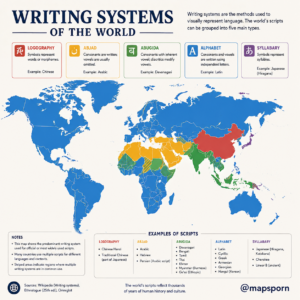
The map above groups the world’s major scripts into five broad categories:
logographic or logosyllabic systems, abjads, abugidas, alphabets and syllabaries.
The real world is even more complicated.
And that complexity is exactly what makes the geography of writing so fascinating.
First: A Language and a Script Are Not the Same Thing
This distinction is essential.
English is a language.
Latin is the script used to write it.
The same Latin script is also used for French, Spanish, Vietnamese, Turkish, Indonesian, Swahili and hundreds of other languages.
Likewise, the Arabic script is used not only for Arabic but also, in adapted forms, for Persian, Urdu and several other languages.
Unicode emphasizes that scripts and languages are separate concepts: one script can serve many languages, while one language can sometimes be written using several different scripts. (Unicode)
That is why a map of writing systems is not the same thing as a language map.
Alphabet: The Most Widespread Type Today
The largest blue area on the map represents alphabetic writing systems.
In an alphabet, consonants and vowels generally receive independent letters.
The most familiar example is the Latin alphabet:
A, B, C, D…
But Latin is only one alphabet.
Other alphabetic scripts include:
Greek, Cyrillic, Armenian and Georgian.
Unicode defines an alphabet as a system in which consonants and vowels have broadly equal status as letters. (Unicode)
Why Latin Covers So Much of the World
If this map had been drawn two thousand years ago, the Latin script would occupy only a small fraction of its modern territory.
Its extraordinary spread reflects history.
Latin writing expanded first with Rome.
After the Roman Empire, the script continued through Christianity and medieval European institutions.
Then European colonial expansion carried Latin letters around the world.
English, Spanish, Portuguese, French and Dutch colonial networks helped establish Latin-based writing across:
North America, South America, Australia, much of Africa, Southeast Asia and islands throughout the Pacific.
Later, some countries voluntarily adopted Latin-based alphabets as part of modernization or language reform.
Turkey provides one of the best-known examples.
In 1928, the Turkish Republic replaced the Arabic-derived Ottoman script with a modified Latin alphabet.
Today Latin is probably the most geographically widespread script family on Earth.
Cyrillic: Another Alphabet With a Huge Territory
The blue coloring across Russia and parts of Eastern Europe and Central Asia represents another alphabetic tradition:
Cyrillic.
Cyrillic developed in the medieval Slavic world and became strongly connected with Eastern Orthodox Christianity.
Modern languages written in Cyrillic include Russian, Bulgarian, Serbian in one of its official scripts, Macedonian, Ukrainian, Belarusian and several languages of Eurasia.
Its visual similarity to Greek is not accidental.
Cyrillic developed within a cultural world strongly influenced by Greek writing and Byzantine Christianity.
Some letters look familiar to Latin-script readers.
Others are deceptive.
For example, Cyrillic Р represents an “r” sound rather than English “p.”
Greece Preserves Its Own Alphabet
Greek occupies a relatively tiny region on a modern world map.
Historically, however, the Greek alphabet has had enormous influence.
It developed from the Phoenician writing tradition more than 2,500 years ago and became particularly important because it systematically represented vowels with independent letters.
The Greek alphabet later influenced both:
Latin
and
Cyrillic.
So three enormous writing traditions visible on today’s map are historically connected.
Even someone who cannot read Greek encounters its influence constantly through mathematics and science:
alpha, beta, gamma, delta, pi, sigma and omega.
Armenian and Georgian Stand Apart
The Caucasus contains two particularly distinctive alphabetic traditions.
Armenian uses its own alphabet, traditionally associated with Mesrop Mashtots in the early fifth century.
Neighboring Georgia uses the Georgian script, whose modern form, Mkhedruli, looks completely unlike Latin or Cyrillic.
This provides a perfect example of why geographic proximity does not necessarily produce similar writing.
Armenia and Georgia share a border.
Their languages belong to different families.
Their alphabets also developed as distinct traditions.
Abjad: Writing Built Around Consonants
Move across North Africa and the Middle East and another writing-system type becomes dominant:
the abjad.
An abjad primarily represents consonants.
Vowels may be omitted, inferred from context, represented partly with certain letters or added through optional marks.
The two most familiar examples are:
Arabic
and
Hebrew.
Unicode classifies both as abjads and notes that they are normally written without full vowel marking, although optional marks can indicate vowels when needed. (Unicode)
How Can You Read Without All the Vowels?
To an English speaker, this may seem impossible.
Imagine writing:
TH CT ST N TH MT
and expecting someone to understand:
The cat sat on the mat.
But languages such as Arabic and Hebrew have grammatical structures in which consonantal patterns carry enormous information.
Experienced readers use:
context, grammar and familiar word patterns
to identify words even without every vowel being explicitly written.
Vowel marks are still useful in certain circumstances, particularly:
religious texts, language instruction and material for children.
Arabic Script Traveled Far Beyond Arabia
The Arabic script spread alongside Islam and Islamic civilization.
But it is not restricted to the Arabic language.
Persian uses an adapted Arabic script.
So does Urdu.
Historically, Arabic-derived writing was also used for languages from Ottoman Turkish to Malay and numerous African languages.
This demonstrates another recurring pattern:
religion can spread a writing system far beyond the language that originally used it.
Arabic became important to Muslim communities partly because it is the language of the Quran.
Hebrew: Ancient Script, Modern National Use
Hebrew presents a remarkable historical story.
The Hebrew writing tradition is ancient.
For centuries, Hebrew survived especially as a religious, literary and scholarly language while Jewish communities spoke many different everyday languages.
Modern Hebrew was later revived as a spoken national language and today uses the Hebrew script in Israel.
So an ancient writing tradition became central to a modern technological society using smartphones, road signs, programming environments and digital media.
Abugida: The Great Writing Tradition of South and Southeast Asia
The green zones across India and parts of South and Southeast Asia represent abugidas.
An abugida combines properties of alphabets and syllabaries.
Typically, a consonant carries an inherent vowel.
Instead of writing a completely independent vowel letter every time, marks attached to the consonant can change the vowel.
Unicode describes Devanagari as one of the best-known examples and places many Brahmi-derived scripts—including Bengali, Tamil, Telugu, Khmer, Myanmar and Thai—within the broad abugida category. (Unicode)
Devanagari
One of the most recognizable abugidas is Devanagari.
It is used for languages including:
Hindi, Marathi and Nepali,
and historically for Sanskrit.
Its letters are visually distinctive because characters often appear suspended from a horizontal headline.
A consonant symbol normally includes an inherent vowel unless another mark modifies or suppresses it.
That structural principle differs fundamentally from English spelling.
India Is Far More Diverse Than One Green Color Suggests
India should never be thought of as having one national writing system.
The country contains numerous major scripts, including:
Devanagari, Bengali-Assamese, Gujarati, Gurmukhi, Tamil, Telugu, Kannada, Malayalam and Odia.
Many ultimately descend from ancient Brahmi, but they developed distinctive forms over centuries.
So the green region on a simplified map actually contains multiple separate script traditions.
India is one of the best places in the world to see how writing systems can diversify while retaining deeper structural relationships.
Southeast Asian Scripts
Brahmi-derived writing also spread into Southeast Asia.
Scripts such as:
Khmer, Thai, Lao and Myanmar
belong to this broader historical world.
Their shapes look dramatically different from Indian scripts today because they evolved independently over long periods.
Still, underlying structural principles preserve traces of their common ancestry.
Trade, Buddhism, Hinduism and royal culture all played roles in spreading writing across the region.
Logographic—or More Precisely, Logosyllabic—Writing
China is colored red as logographic.
That is understandable for a general audience, but linguists often use the more precise term logosyllabary for Han characters.
Unicode’s script typology places Han in its logosyllabary category. (Unicode)
Why?
Because Chinese characters do not simply represent pictures or entire ideas.
Characters generally correspond to meaningful units—often morphemes—and typically also have a conventional pronunciation.
So describing Chinese as a system where each symbol merely represents an “idea” can be misleading.
Chinese Characters Are Not Pictures
Some of the earliest Chinese characters originated pictographically.
For instance, historical forms representing things such as mountains, trees or the sun sometimes visually resembled what they described.
But modern Chinese writing is not primarily a collection of pictures.
Many characters combine components providing clues to:
meaning
and
pronunciation.
This is one reason thousands of characters can represent a complex modern language capable of expressing everything from poetry to quantum physics.
Simplified and Traditional Chinese
Modern Chinese writing also exists in different character standards.
Simplified Chinese characters are dominant in mainland China and Singapore.
Traditional characters remain standard in Taiwan, Hong Kong and Macau.
The distinction affects the forms of many characters, not the fundamental writing-system type.
Both belong to the Han-character tradition.
Japan: The Map’s Biggest Simplification
Japan is where the five-color model begins to break down most obviously.
The map colors Japan as a syllabary.
But modern Japanese is not written with a single syllabary.
It combines several scripts simultaneously:
Kanji, which are Han characters;
Hiragana, a syllabary;
Katakana, another syllabary;
and frequently Latin letters, or rōmaji.
Unicode explicitly describes modern Japanese as a mixed system using Han, Hiragana, Katakana and Latin. (Unicode)
A normal Japanese sentence may contain several of them at once.
Why Japanese Uses Multiple Scripts
Kanji commonly carry lexical information—the core meaning of many nouns, verbs and adjectives.
Hiragana frequently handles grammatical endings and native words where kanji are unnecessary or unavailable.
Katakana is widely used for foreign loanwords, emphasis and certain names or technical vocabulary.
Latin letters appear in company names, technology, abbreviations and other modern contexts.
Rather than being inefficient, this mixture can actually make Japanese text easier to visually parse because different script types help identify different functions.
Kanji Are Not Simply “Traditional Chinese”
This is an important correction to the graphic.
Japanese kanji were historically borrowed from Chinese writing.
But modern Japanese kanji usage developed independently.
Japan also introduced its own simplified character forms known as shinjitai.
Characters may have Japanese pronunciations and usage patterns different from Mandarin Chinese.
So the correct wording is:
Kanji — Han characters used in Japanese
rather than:
Traditional Chinese — part of Japanese.
Syllabaries: One Symbol for a Syllable
In a syllabary, a symbol usually represents a complete syllable rather than an individual consonant or vowel.
Unicode gives Japanese Hiragana and Katakana as classic examples. (Unicode)
For instance, Japanese has separate kana for sound units corresponding approximately to:
ka, ki, ku, ke and ko.
English would write each of those using two letters.
A syllabary can represent each with one basic sign.
Cherokee
One of the world’s best-known syllabaries outside Asia is Cherokee.
Sequoyah developed the Cherokee syllabary in the early 19th century.
Its creation allowed Cherokee speakers to become literate in their own language with extraordinary speed.
This demonstrates that successful writing systems did not only originate in the ancient world.
Entirely new scripts have been deliberately designed in recent centuries.
Linear B
The map also lists Linear B, an ancient script used for Mycenaean Greek.
It is historically important because deciphering it revealed that the Mycenaean palace records were written in an early form of Greek.
Linear B disappeared more than three thousand years ago.
It shows that writing systems themselves can die even when the language family survives.
Korean Hangul Is in a Category of Its Own
The infographic puts Hangul under alphabets.
That is defensible at one level because Hangul’s basic units, called jamo, represent consonants and vowels.
But Hangul is unusual enough to deserve its own explanation.
Instead of writing letters in a simple horizontal sequence like:
C-A-T,
Hangul combines individual consonant and vowel letters into visually compact syllable blocks.
Unicode describes Hangul as a featural syllabary whose syllable blocks are built systematically from alphabetic components. (Unicode)
That means Hangul can reasonably be described as alphabetic in its basic components while syllabic in its visible organization.
Why Hangul Is So Famous Among Linguists
Hangul was deliberately designed during the reign of King Sejong in the 15th century.
Some consonant letter shapes were created to reflect aspects of how speech sounds are articulated.
That makes Hangul unusually systematic.
Instead of simply inheriting an older alphabet through thousands of years of gradual change, Korea acquired a script whose structure was consciously engineered.
Few major writing systems have such well-documented origins.
Ethiopia and the Ge’ez Tradition
The Ethiopian and Eritrean region adds another interesting classification issue.
The Ge’ez/Ethiopic script is used for languages including Amharic and Tigrinya, while Ge’ez itself remains important liturgically.
It is commonly discussed as an abugida because consonant forms change according to the associated vowel.
However, script classification is not always universally rigid; Unicode’s typological discussion itself illustrates how some systems can be analyzed in more than one way. (Unicode)
This is a useful reminder:
The five categories on the map are analytical tools, not laws of nature.
Africa Is Far More Script-Diverse Than the Map Suggests
Much of Africa appears blue because many official languages use the Latin alphabet.
That is historically understandable.
European colonial administrations strongly promoted Latin writing.
Today languages such as:
Swahili, Zulu, Hausa in one common orthography, Yoruba and many others
are regularly written in Latin-derived systems.
But Africa also contains indigenous and regionally important scripts such as:
Ethiopic, Tifinagh, N’Ko, Vai and Adlam,
alongside Arabic writing traditions and other systems.
A country-level map can therefore dramatically understate African script diversity.
Countries Often Use More Than One Script
Serbia is a well-known European example.
Serbian can be written using both:
Cyrillic
and
Latin.
In India, dozens of languages use different scripts.
Pakistan predominantly uses an Arabic-derived script for Urdu while English and regional languages may use other writing traditions.
China uses Han characters nationally while numerous minority languages employ Tibetan, Arabic-derived, Mongolian and alphabetic scripts.
Japan mixes four script traditions inside ordinary sentences.
The Unicode Standard specifically notes that languages and scripts do not have a one-to-one relationship. (Unicode)
This is why striped regions on the infographic are important—but even stripes cannot capture the full complexity.
Writing Direction Adds Another Dimension
Writing systems also differ in which direction text flows.
Latin, Cyrillic, Greek and most South and Southeast Asian scripts generally run:
left to right.
Arabic and Hebrew primarily run:
right to left.
Historically, some scripts could even change direction.
Modern computer systems must therefore know much more than which characters to display.
They must understand how different directional systems interact, especially when Arabic or Hebrew text contains Latin words or numbers. Unicode maintains detailed bidirectional-text rules for precisely this reason. (Unicode)
Why Did Humans Invent So Many Systems?
There was no worldwide committee designing writing.
Systems emerged at different times for different languages.
Then they traveled through:
empire, migration, religion, commerce, conquest, education and technology.
Latin spread through Rome, Christianity and European expansion.
Arabic spread strongly through Islamic civilization.
Brahmi-derived scripts traveled through South and Southeast Asia.
Chinese characters influenced Korea, Japan and Vietnam historically.
Cyrillic expanded alongside Slavic states and Orthodox Christianity.
Scripts survive because communities keep using them.
They disappear when political, technological or cultural conditions change.
Scripts Can Change Without Languages Disappearing
Turkey is one dramatic example.
Turkish did not disappear in 1928.
Its script changed.
Vietnam provides another.
Vietnamese was historically written using Chinese characters and a locally developed character system called Chữ Nôm.
Today Vietnamese overwhelmingly uses a Latin-based alphabet called Quốc Ngữ.
Several Central Asian languages have also moved between Arabic, Latin and Cyrillic scripts during the past century.
Kazakhstan has pursued a long-term transition toward a Latin-based alphabet while Cyrillic remains widely used.
So a script is not permanently attached to a language.
Governments and communities can deliberately change writing systems.
Computers Created a New Challenge
For much of early computing history, computers were designed primarily around Latin characters.
That created serious problems for other writing systems.
How do you store Chinese characters?
How do you display Arabic correctly from right to left?
How do you combine Devanagari vowel marks?
How do you represent Hangul syllables?
The development of Unicode was one of the most important solutions.
Instead of requiring incompatible encoding systems for different languages, Unicode assigns standardized digital representations across the world’s scripts.
It now supports Latin, Cyrillic, Arabic, Devanagari, Han, Hangul, Cherokee, Ethiopic and a huge range of modern and historical writing systems. (Unicode)
That is one reason you can receive:
English,
Arabic,
Hindi,
Chinese,
Japanese,
Korean
and many other scripts on the same smartphone.
One Planet, Thousands of Ways to Preserve Language
Look again at the map.
The giant blue regions might make alphabetic writing appear inevitable.
It isn’t.
Its global dominance is largely the result of historical expansion.
The Arabic-speaking world developed another structure.
South Asia built extraordinary abugida traditions.
China preserved a logosyllabic system.
Japan combined several systems together.
Korea deliberately engineered one of history’s most distinctive scripts.
And smaller communities created writing systems uniquely adapted to their own languages.
There is no single “best” form of writing.
Different scripts encode different aspects of language in different ways.
What they share is far more important:
They allow human speech to survive after the speaker is gone.
A voice lasts seconds.
Writing can last thousands of years.
That may be why the world’s scripts are more than collections of symbols.
They are records of migrations, religions, empires, inventions and cultural identities—drawn directly onto the page.
Accuracy and Source Note
The infographic’s five categories are a useful introduction but should be treated as simplified typology. Unicode distinguishes alphabets, abjads, abugidas, logosyllabaries, simple syllabaries and featural syllabaries, and some real-world writing systems combine more than one script type. Han characters are more precisely described as logosyllabic; Japanese mixes kanji, hiragana, katakana and Latin; and Korean Hangul combines alphabetic jamo into syllable blocks and can be classified as a featural syllabary. (Unicode)