
Put three completely different cultural topics on the same world map—
Bible. Quran. Manga.
—and an unexpectedly clear geographic pattern appears.
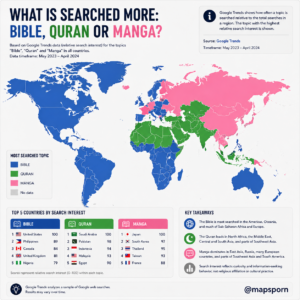
According to the Google Trends comparison represented in this infographic, the Bible leads relative search interest across much of the Americas, Oceania, Sub-Saharan Africa and parts of Europe.
The Quran leads through much of North Africa, the Middle East, Central Asia, South Asia and parts of Southeast Asia.
And manga emerges as the leading topic across Japan, parts of East and Southeast Asia, Russia and a surprising collection of European countries.
At first glance, the map may look like a comparison between Christianity, Islam and Japanese popular culture.
But that interpretation would be too simple.
What this map actually shows is something more interesting:
the geography of online curiosity.
It reveals how history, language, religion, entertainment and internet culture influence what people choose to search for.
What Exactly Does Google Trends Measure?
Google Trends does not tell us that 10 million people in one country searched for the Bible while five million searched for manga.
Instead, Google uses a sample of searches and calculates a topic’s popularity relative to all Google searches occurring in that location during the selected period.
The numbers are then normalized.
A value of 100 represents the highest relative interest within the relevant comparison—not 100% of the population and not 100 searches. (Google Help)
That distinction matters enormously.
A smaller country can rank higher than a larger country if the topic represents a larger share of its Google activity.
Likewise, two countries with the same Trends score can have very different numbers of actual searches.
Why Using “Topics” Matters
The infographic says it compares Google Trends topics rather than merely the English search terms “Bible,” “Quran,” and “Manga.”
That is the better approach for an international map.
Google explains that a topic groups searches representing the same concept across languages.
For example, a topic can include different translations and linguistic variations rather than requiring everyone to type the same English word. (Google Help)
Without that feature, an English-language query would produce a badly biased world map.
Someone in Japan might search using Japanese characters.
Someone in Egypt might use Arabic.
Someone in Brazil might search in Portuguese.
Topics make international comparison more meaningful.
The Bible Leads Across Much of the Americas
The blue region dominates most of North and South America on the map.
That is not particularly surprising given the enormous historical influence of Christianity throughout the Western Hemisphere.
European colonization brought Catholic and Protestant traditions across the Atlantic.
Today Christianity remains culturally important throughout much of:
- North America
- Central America
- the Caribbean
- South America
But again, the map is not measuring how many Christians live in each country.
Someone might search the Bible because they are:
- Reading scripture
- Preparing a sermon
- Studying history
- Looking up a quotation
- Completing schoolwork
- Debating religion
- Comparing translations
Search behavior has many motivations.
The United States
The infographic lists the United States at the top of its Bible-interest ranking.
The Bible occupies an unusual position in American culture.
It is obviously a sacred text for millions of Christians.
But it is also deeply connected with:
- Literature
- Politics
- History
- Music
- Popular expressions
Biblical phrases appear throughout English-language culture.
People therefore search Bible-related topics for reasons extending well beyond formal worship.
The Philippines
The Philippines also appears near the top.
This is particularly interesting because the country sits geographically in Southeast Asia, surrounded by regions where the Quran or manga may attract stronger relative interest.
Centuries of Spanish colonial rule made Christianity—especially Catholicism—deeply influential in Filipino culture.
That historical difference helps distinguish the Philippines from many neighboring Southeast Asian countries.
Sub-Saharan Africa
Large parts of Sub-Saharan Africa appear blue as well.
Christianity expanded dramatically across Africa during the 19th and 20th centuries and today plays an important role across many countries in central, eastern and southern Africa.
But Africa’s religious geography is highly diverse.
Christian and Muslim communities often exist within the same countries, alongside traditional religious practices and secular populations.
A single color necessarily simplifies all of that complexity.
The Quran Forms a Huge Belt Across North Africa and Asia
The green zone on the map stretches from parts of West and North Africa through the Middle East and into Central and South Asia.
Countries shown with particularly strong Quran interest include places such as:
- Saudi Arabia
- Pakistan
- Indonesia
- Malaysia
- Egypt
This pattern broadly overlaps with regions where Islam has been historically influential for centuries.
The Middle East
The Quran originated in the Arabian Peninsula during the 7th century.
Arabic remains the language of the Quran itself, regardless of the native language spoken by individual Muslims.
This gives Quran-related searching a special linguistic dimension.
A Turkish, Indonesian, Pakistani or Nigerian Muslim may speak completely different everyday languages, while still encountering the Quran in Arabic.
That helps make the text a remarkably international cultural object.
Saudi Arabia
Saudi Arabia appears at the top of the infographic’s Quran ranking.
That is understandable given the country’s position in Islamic history.
Mecca and Medina—Islam’s two holiest cities—are both located in modern Saudi Arabia.
The Quran therefore has religious, historical and cultural importance there that is difficult to separate.
Pakistan
Pakistan’s strong search interest also fits its religious and cultural landscape.
The country was created in 1947 in the context of the partition of British India and has a predominantly Muslim population.
Religious study, education and public discussion all contribute to Quran-related interest.
But even there, Google searches should not be mistaken for direct measurements of religious observance.
Indonesia: A Crucial Reminder About Islam’s Geography
Indonesia is especially interesting.
It lies thousands of kilometers away from the Arabian Peninsula.
Yet it has the world’s largest Muslim population by national total.
Islam spread into the Indonesian archipelago largely through trade, local conversion and political networks rather than through a single military conquest.
This is why a Quran-interest map stretches so far into Southeast Asia.
The Islamic world has never been confined to the Middle East.
Manga Creates an Entirely Different Kind of Geography
Then comes the pink category.
Unlike the Bible and Quran, manga is not a religious text.
It refers broadly to Japanese comics and graphic storytelling.
Yet in several countries, manga reportedly generates stronger relative Google search interest than either religious topic in this comparison.
That alone shows how powerful Japanese popular culture has become internationally.
Japan
Japan naturally leads the manga category.
Manga is not a niche hobby there.
It encompasses enormous numbers of genres and audiences.
There is manga aimed at:
- Children
- Teenagers
- Adults
- Sports fans
- Romance readers
- History enthusiasts
- Business readers
- Fantasy and science-fiction audiences
Manga has also provided source material for countless anime television series and films.
The relationship between anime and manga has helped Japanese entertainment spread worldwide.
South Korea
South Korea also appears very strongly in the infographic’s manga category.
But this deserves a little nuance.
South Korea has its own enormous comics culture known as manhwa, and digital webtoons have become globally influential.
So strong manga search interest in South Korea should not be interpreted as Japanese comics replacing Korean popular culture.
Instead, East Asia has developed a highly interconnected comics, animation and digital-entertainment market.
France: Europe’s Manga Powerhouse
One of the most fascinating countries in the infographic’s manga ranking is France.
France already had a strong domestic comics tradition through bandes dessinées long before Japanese manga became internationally mainstream.
That established readership helped manga find a receptive audience.
Today France is widely regarded as one of the world’s most significant manga markets outside Japan.
So seeing France appear strongly pink is not as strange as it might initially look.
Russia and Parts of Europe
The pink coloring across Russia and parts of Europe highlights the enormous globalization of Japanese entertainment.
Anime streaming, social media, cosplay, gaming and online fandom all reinforce manga interest.
A teenager in Warsaw, Moscow or Paris can now encounter Japanese entertainment almost immediately after its release.
This type of cultural transmission would have been unimaginable only a few generations ago.
Why Comparing These Three Topics Is So Fascinating
On the surface, the three categories have almost nothing in common.
The Bible is a collection of religious texts central to Christianity and Judaism.
The Quran is Islam’s sacred scripture.
Manga is a medium of illustrated storytelling originating in Japan.
Yet all three are powerful forms of written cultural content.
They are:
translated,
discussed,
shared,
interpreted,
studied,
and searched online.
The map therefore compares three very different kinds of cultural influence.
Two are ancient religious traditions.
One is a modern entertainment phenomenon.
And all three can generate intense curiosity across international borders.
What the Map Does NOT Tell Us
This section is important if the article is intended to accompany the infographic.
The map cannot tell us:
Which religion is largest in a country.
Search activity is not religious affiliation.
It cannot tell us:
Which text is read most often.
People can read books without searching Google.
It cannot tell us:
Which subject has more followers globally.
Google Trends measures relative search interest.
It cannot tell us:
Why someone searched.
Someone searching “Quran” could be Muslim, Christian, atheist, a student or simply curious.
The same applies to “Bible.”
And a manga search could be for entertainment, academic research or shopping.
Google explicitly cautions that Trends is not a scientific poll and that high search interest should not automatically be interpreted as popularity, support or opinion. (Google Help)
Why Internet Access Matters
Another limitation is internet geography.
Google is not equally dominant everywhere.
Search-engine market share varies by country.
Internet penetration varies.
Some countries have restricted access to Google products.
Languages and spelling can also affect results when search terms rather than properly categorized topics are used.
This means a Google Trends world map is really showing:
behavior among Google searches available in the dataset
rather than the behavior of every human being.
That is still valuable—but it is not the same thing.
The 0–100 Scores Can Be Misunderstood
The infographic’s bottom section gives numbers such as:
United States — Bible: 100
Saudi Arabia — Quran: 100
Japan — Manga: 100
Those numbers do not mean the topics are equally popular in absolute terms.
Nor do they mean every three countries produced an identical level of searches.
Google’s 0–100 system is normalized.
A score of 100 means the highest point of relative interest within the relevant data comparison.
Google specifically notes that regions displaying identical interest scores can still have very different total search volumes. (Google Help)
So the ranking should always be labeled relative search interest.
Ancient Texts Meet the Internet Age
Perhaps the most interesting contrast on this map is historical.
The Bible contains texts written over many centuries in the ancient world.
The Quran dates to the 7th century.
Modern manga culture largely developed in its recognizable form during the 20th century.
Yet on Google, they all compete inside exactly the same search box.
A person can move in seconds from:
Bible verse
to Quran translation
to manga chapter.
That technological flattening of cultural distance is historically extraordinary.
Knowledge that once required specialized libraries, religious institutions or imported books can now be accessed almost instantly.
Search Maps Also Reveal Globalization
Manga is perhaps the clearest example.
Japanese comics were once overwhelmingly a domestic cultural product.
Today manga and anime influence entertainment around the planet.
At the same time, Bible-related searching extends far beyond Europe, where Christianity originated as a major institutional force.
Quran-related interest stretches from West Africa to Indonesia.
None of these cultural traditions stays inside one geographic origin.
They travel.
They are translated.
They adapt to local languages.
And the internet accelerates the process enormously.
A Better Way to Read the Map
Rather than asking:
“Which one is most popular?”
a more interesting question is:
“Which of these three topics occupies the largest share of Google search interest in each country?”
That wording captures what Google Trends can actually tell us.
And it turns the map into a fascinating portrait of global cultural geography.
Across much of the Americas and Sub-Saharan Africa, Bible-related interest leads.
Across a huge belt from North Africa through South and Central Asia, Quran-related interest leads.
Across Japan and several parts of Eurasia, manga takes the lead.
Three subjects.
Three entirely different histories.
One search engine.
The Bigger Lesson
Search maps reveal something traditional atlases cannot.
A political map tells us where countries begin and end.
A religious map tells us which faiths have the most adherents.
A language map tells us what people speak.
But a search map shows something much more temporary and dynamic:
what people are curious about right now—or were curious about during a particular period.
That interest can change after a film release.
A news event can reshape it overnight.
A viral anime can increase manga searches.
A religious holiday can boost scripture searches.
And a major public debate can suddenly make ancient texts trend again.
So this map should never be treated as a permanent description of the world.
It is a snapshot of digital curiosity between May 2023 and April 2024.
And perhaps that is what makes it so interesting.
Accuracy & Method Note
Google Trends uses a sample of anonymized and aggregated Google searches. Data is normalized by location and time, then scaled from 0 to 100; it does not represent raw search counts. When topics are compared, Google’s regional map can identify which compared topic has the highest relative search share in each region. Topics are preferable to literal English-language terms for a global comparison because Google Topics can group related searches across languages. Trends data should not be interpreted as polling, religious affiliation or actual reading/consumption behavior. (Google Help)