
Few foods divide people quite like chili peppers.
For some, a meal does not feel complete without heat.
For others, a tiny piece of chili can turn dinner into an emergency search for milk.
Yet spicy food is deeply embedded in cuisines across enormous portions of the world—from India and Thailand to Mexico, Ethiopia, Indonesia, Korea and parts of West Africa.
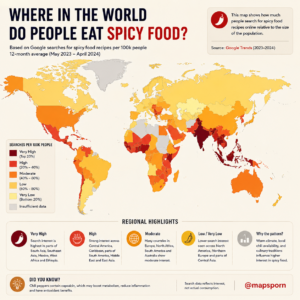
The map above attempts to show that global pattern using Google search interest for spicy-food recipes.
And while search behavior is not the same thing as actual consumption, the geographical pattern raises a fascinating question:
Why did some regions develop cuisines famous for intense heat while others traditionally use much less chili?
The answer combines history, climate, agriculture, trade and changing food culture.
First: What Does This Map Actually Measure?
This distinction matters.
Google Trends does not report the literal number of people searching for something in each country.
Instead, Google normalizes searches according to all Google search activity within a particular place and time.
The results are then expressed as a relative index.
A country with a score of 100 is therefore the place where the search topic represents the highest proportion of search activity among the places being compared—not necessarily the country with the largest absolute number of searches. (Google Help)
That means a smaller country could rank higher than a much larger one even if the larger country generated more total searches.
So the safest interpretation is:
Darker countries show stronger relative online interest in spicy-food recipes during the selected period.
They do not necessarily eat more chilies per person.
The Broad Pattern Is Still Fascinating
The infographic shows especially strong interest across parts of:
- South Asia
- Southeast Asia
- Mexico and Central America
- West and East Africa
- Indonesia and the Philippines
- portions of the Caribbean
More moderate interest appears across countries including the United States, Australia and parts of Europe.
This broadly overlaps with several regions famous for chili-heavy food traditions.
But the reasons behind those traditions differ enormously.
South Asia: A Global Center of Spicy Cuisine
India immediately stands out on almost any discussion of spicy food.
But “Indian food” is itself far too broad a category.
India contains dozens of regional cuisines with very different heat levels.
Chili is especially important in dishes from areas such as:
- Andhra Pradesh
- Telangana
- Rajasthan
- Maharashtra
- parts of southern India
- northeastern India
Other regions may rely more heavily on aromatic spices than pure chili heat.
That distinction is important.
Spiced food and spicy-hot food are not the same thing.
Cumin, coriander, turmeric, cardamom and cinnamon can create intense flavor without large amounts of capsaicin.
The Strange Part: Chilies Aren’t Originally Indian
This surprises many people.
Chili peppers did not originate in India.
Capsicum peppers are native to the Americas.
They were brought across the world following European contact with the Americas beginning in the late 15th century.
Portuguese trading networks helped introduce chilies into South and Southeast Asia.
Yet the plants adapted so successfully that within only a few centuries they became inseparable from cuisines that had existed for thousands of years before their arrival.
Today it is difficult to imagine many Indian dishes without them.
That is one of the great examples of how global trade completely transformed regional food.
Southeast Asia: Heat, Aromatics and Fresh Chilies
Move east and chili becomes equally important.
Thailand is famous for dishes combining heat with:
- Lime
- Fish sauce
- Herbs
- Garlic
- Sugar
- Fermented ingredients
Thai cuisine often uses fresh bird’s-eye chilies, dried chilies and chili pastes.
The heat is only one component.
It is balanced against sweetness, acidity, saltiness and aroma.
Vietnam
Vietnamese cuisine varies enormously by region.
Fresh chilies and chili sauces accompany many dishes, but heat levels can be considerably milder than stereotypical Thai cooking.
Central Vietnamese cuisine, particularly around Huế, is often associated with stronger chili use.
Indonesia
Indonesia possesses an enormous range of chili-based condiments known broadly as sambal.
Some are relatively mild.
Others can be intensely hot.
Sambal may combine chilies with:
- Shrimp paste
- Garlic
- Shallots
- Lime
- Tomato
- Sugar
There are dozens of regional versions.
For many diners, sambal is not simply a sauce added occasionally—it is part of the structure of the meal.
Korea: Chili Became Part of a National Food Identity
Korean cuisine provides another fascinating historical case.
Modern Korean food is strongly associated with gochugaru, Korean red chili flakes, and gochujang, fermented chili paste.
They appear in foods such as:
- Kimchi
- Tteokbokki
- Spicy stews
- Marinated meats
- Noodles
Again, however, chilies entered Korea only after the Columbian Exchange.
Yet they became so deeply integrated into cooking that today Korean food without red chili can seem almost historically unimaginable.
Food traditions can become “traditional” surprisingly quickly when measured against the full span of human history.
Mexico: The Original Homeland of Chili Culture
If Asia demonstrates how dramatically chilies traveled, Mexico reminds us where much of the story began.
Capsicum peppers were domesticated in the Americas long before Europeans arrived.
Mexico developed an extraordinary diversity of chili varieties.
They include:
- Jalapeño
- Poblano
- Serrano
- Habanero
- Ancho
- Guajillo
- Pasilla
- Chipotle
And Mexican cooking demonstrates something often missed when people talk about spicy food:
Chilies are not used merely to make food painful.
Different peppers provide entirely different flavors.
Some are:
- Smoky
- Fruity
- Earthy
- Sweet
- Bright
- Bitter
A dried ancho pepper tastes radically different from a fresh serrano.
The goal is often flavor complexity rather than simply maximum heat.
Central America and the Caribbean
The map also suggests strong interest through parts of Central America and the Caribbean.
Again, regional differences are huge.
Hot sauces may use peppers alongside:
- Vinegar
- Citrus
- Tropical fruit
- Garlic
- Herbs
The Caribbean is particularly famous for very hot Capsicum chinense varieties such as Scotch bonnet peppers.
Scotch bonnets contribute not only intense heat but a distinctive fruity aroma.
They are important in several Jamaican and broader Caribbean dishes.
West Africa: A Major Chili Belt
West African cuisines frequently make heavy use of hot peppers.
Countries such as:
- Ghana
- Nigeria
- Senegal
- Sierra Leone
- Liberia
have food traditions where peppers may appear in stews, sauces, rice dishes and condiments.
Pepper sauces can be fundamental accompaniments rather than optional extras.
As in Asia, chili peppers were introduced after contact with the Americas.
Yet African farmers adopted them rapidly.
The warm climate suited pepper cultivation, and chilies became integrated into local cuisines over generations.
Ethiopia and the Horn of Africa
Ethiopia also has a strong tradition of highly seasoned food.
One of its most famous spice mixtures is berbere.
Recipes vary, but mixtures often include chili alongside spices such as:
- Coriander
- Fenugreek
- Ginger
- Cardamom-like spices
- Cloves
- Garlic
Berbere is fundamental to dishes including several types of Ethiopian stews.
Again, the flavor is much more complicated than simple heat.
Chili becomes part of a broader aromatic system.
China: One Country, Very Different Chili Cultures
China demonstrates why country-level maps can be misleading.
Chinese cuisine differs enormously from province to province.
Some regions are famous for strong chili traditions.
Others are not.
Sichuan
Sichuan cooking is famous worldwide for heat.
But one of its defining sensations does not actually come from chili.
It comes from Sichuan pepper, which creates a tingling, numbing sensation.
The combination of chili heat and Sichuan pepper produces the famous málà profile:
má = numbing
là = spicy-hot
Hunan
Hunan cuisine is also famous for chili but generally uses peppers differently.
Fresh and pickled chilies feature heavily, and the heat can be intense.
That means a national Chinese average hides major differences between Hunan, Sichuan, Guangdong, Jiangsu and countless other regional traditions.
Japan: Less Chili-Dominated, But Not Heat-Free
Japan generally appears less associated with chili-heavy cuisine than Korea, Thailand or parts of China.
But Japanese food absolutely contains pungent elements.
Examples include:
- Wasabi
- Karashi mustard
- Shichimi tōgarashi
- Chili oil
Wasabi demonstrates another important distinction:
Not every food we call “spicy” produces the same physiological sensation.
Chili heat comes mainly from capsaicin.
Wasabi and mustard contain different compounds that create a sharp sensation concentrated more strongly in the nose and sinuses.
So even defining “spicy food” scientifically is more complicated than it looks.
The United States: Increasingly Spicy, but Highly Diverse
The United States appears around the moderate-to-high range on the infographic.
That makes sense as a cultural mixture.
Traditional American cooking varies enormously, while immigration has introduced and expanded cuisines from:
- Mexico
- India
- Korea
- China
- Thailand
- Vietnam
- Caribbean countries
- West Africa
Hot sauce has also developed into a major consumer category.
American supermarkets now sell everything from mild jalapeño sauces to products marketed around extremely hot peppers.
Regional America Matters Too
The Southwest and California have long histories of Mexican and Mexican-American food.
Louisiana has its own hot-sauce traditions.
Major metropolitan areas contain enormous immigrant communities whose cuisines have become mainstream.
So the idea of a single national American tolerance for chili is not particularly meaningful.
Why Is Northern Europe Often Milder?
Traditional northern European cuisines historically relied less on chilies for a simple reason:
Chilies arrived relatively late and were not native to the region.
The climate also did not naturally favor widespread outdoor chili cultivation in the same way tropical and subtropical regions did.
Northern European food traditions instead developed around ingredients such as:
- Root vegetables
- Cabbage
- Fish
- Meat
- Dairy
- Grain
- Herbs
- Mustard
- Horseradish
That doesn’t mean modern northern Europeans dislike hot food.
Globalization has changed eating habits dramatically.
Indian, Thai, Mexican and Korean restaurants are now commonplace across European cities.
Search interest can therefore measure curiosity and changing tastes as much as longstanding tradition.
Does Hot Climate Really Cause People to Eat Spicy Food?
The infographic suggests warm climate as one explanation.
There may be associations, but it should not be presented as a simple rule.
Hot countries are not universally chili-loving.
And many chili-loving populations experience cold winters.
Food culture develops through a complicated combination of:
- Which ingredients were historically available
- Trade routes
- Agricultural conditions
- Preservation methods
- Religion
- Migration
- Local taste
- Economic history
Climate may contribute, but it does not determine cuisine by itself.
India and Mexico developed strong chili traditions.
Many equally warm places did not develop identical ones.
Why Does Chili Feel Hot When It Isn’t Actually Hot?
The burning sensation comes mainly from capsaicin.
Capsaicin binds to the TRPV1 receptor, which is involved in detecting heat and potentially harmful stimuli.
Your mouth therefore sends a signal similar to:
“This is hot.”
But the chili itself does not have to be physically hot.
That is why room-temperature salsa can make you sweat.
Your nervous system interprets capsaicin as a heat-related stimulus.
Why Do Some People Love the Burn?
Tolerance can increase with repeated exposure.
Someone who rarely eats chili may find a dish overwhelmingly hot.
Someone who has eaten spicy food since childhood may barely notice the same concentration.
Cultural familiarity matters enormously.
There is also a psychological component.
Some people enjoy the intense sensation precisely because they know it is safe.
Spicy food can create:
- Excitement
- Sweating
- Tingling
- Endorphin-related responses
For chili enthusiasts, that sensation becomes part of the pleasure of eating.
Can Capsaicin Boost Metabolism?
The infographic mentions possible metabolic benefits.
There is some scientific support for a small thermogenic effect.
A meta-analysis of human studies found that capsaicin and related compounds can modestly increase energy expenditure and fat oxidation. But the magnitude was small—not a dramatic metabolism “boost.” (PubMed)
So chili peppers should not be promoted as a magical weight-loss food.
They are food, not a substitute for overall diet and health habits.
What About Inflammation?
Capsaicin interacts with biological pathways involved in inflammation and metabolism, and researchers continue investigating potential benefits. (PubMed)
But the evidence is not as simple as:
“spicy food reduces inflammation.”
Effects can depend on dose, individual tolerance and context. Recent research has even examined circumstances in which long-term high capsaicin exposure may adversely affect gut inflammation. (PubMed)
So the safest wording for an infographic is:
Capsaicin has been studied for metabolic and inflammatory effects, but health outcomes depend on dose and individual factors.
Search Interest Does Not Equal Consumption
This is the biggest limitation of the map.
Suppose Country A frequently searches:
“spicy chicken recipe”
while Country B eats chili every day but rarely searches for recipes because people already know how to prepare traditional dishes.
Google Trends could make Country A look more interested.
But Country B might consume considerably more chili.
Likewise, search activity is influenced by:
- Internet access
- Google market share
- Language
- Recipe-search habits
- Tourism
- Food trends
- Media
- Viral dishes
Google itself stresses that Trends measures search interest, not a scientific sample of attitudes or behavior. (Google Help)
That means this map is better described as a map of online spicy-food curiosity.
Why the Map Is Still Interesting
Even with that limitation, search data can reveal something valuable.
Food culture is increasingly global.
A Korean dish can go viral in Brazil.
A Mexican hot sauce can become popular in Britain.
Thai recipes can trend in Australia.
Indian dishes can become household staples in Canada.
Search data captures some of that cultural movement.
It shows not just where spicy food has deep historical roots, but where people are actively looking for it online.
And those two maps—the map of traditional cuisine and the map of current curiosity—do not necessarily have to match.
The Bigger Story: Chilies Conquered the Planet in Only 500 Years
Perhaps the most fascinating part of all is how recently this global food map emerged.
Before roughly 1500, there were no chili peppers in traditional cuisines of:
India.
Thailand.
China.
Korea.
Indonesia.
West Africa.
Europe.
The peppers were American plants.
Then global maritime trade carried them across oceans.
Farmers planted them.
Cooks experimented with them.
Communities incorporated them into traditional dishes.
Within several centuries, the chili became so deeply embedded in Asian and African cooking that many people assume it had always been there.
Few ingredients demonstrate globalization more clearly.
Today a single plant family connects cuisines from Mexico to Sichuan, Kerala, Bangkok, Seoul, Lagos and Jakarta.
And judging from online search behavior, the world’s appetite for heat is still spreading.
Final Thought
So where does the world eat the spiciest food?
This particular map cannot give us a definitive answer.
What it can show is where interest in spicy-food recipes appears especially strong relative to other Google searches.
And that pattern overlaps with many of the world’s great chili-food regions.
South and Southeast Asia.
Mexico and Central America.
Parts of Africa.
The Caribbean.
East Asia.
But the real story is larger than a ranking.
A fruit domesticated in the Americas crossed the oceans, transformed cuisines on several continents and became an essential ingredient for billions of people.
Today, when someone in India, Thailand or Korea reaches for chili, they are participating in one of the most successful culinary migrations in human history.
Source & Accuracy Note
Google Trends does not provide raw “searches per 100,000 people.” Its regional-interest data is normalized according to the share of total Google searches in each place and period and then scaled for comparison. It also represents search activity rather than actual food consumption. Therefore, this infographic should be presented as relative Google search interest in spicy-food recipes, and exact country rankings should not be treated as measurements of how much spicy food people eat. (Google Help)
I would also revise the health note: evidence suggests capsaicin can have modest effects on energy expenditure and is being studied for metabolic and inflammatory pathways, but the benefits are not guaranteed and can vary with dose and individual response. (PubMed)