
If you travel around the world, you may notice something strange.
Most countries measure distance in kilometers, weight in kilograms, and temperature in Celsius.
But in the United States, people still commonly use:
- Miles instead of kilometers
- Pounds instead of kilograms
- Feet and inches instead of meters
- Fahrenheit instead of Celsius
Why does one country continue using a different system from almost everyone else?
The answer involves history, politics, trade, and cultural habits.
The Two Main Measurement Systems
Today, the world mainly uses two measurement systems:
1. The Metric System (SI Units)
The metric system is the international standard used by most countries.
It is based on units of ten, making conversions simple.
Examples:
Distance
1 kilometer = 1,000 meters
Weight
1 kilogram = 1,000 grams
Temperature
Water freezes at:
0°C
Water boils at:
100°C
The system is widely used in:
- Science
- Engineering
- Medicine
- International trade
2. U.S. Customary Units
The United States mainly uses a traditional measurement system derived from British Imperial units.
Common examples:
Distance
1 mile = 5,280 feet
Weight
1 pound = 16 ounces
Temperature
Water freezes at:
32°F
Water boils at:
212°F
These units remain deeply connected to everyday American life.
Why Does Most of the World Use Metric?
The metric system was created during the French Revolution in the late 18th century.
Before metric, countries used thousands of different local measurements.
For example, a “foot” could mean different lengths depending on the region.
This caused problems for:
- Trade
- Science
- Construction
- Government administration
The metric system introduced a universal approach:
- Standard units
- Decimal conversions
- International consistency
Over time, countries adopted it because it made communication easier.
Today, almost every country officially uses metric measurements.
Why Does the United States Still Use Its Own System?
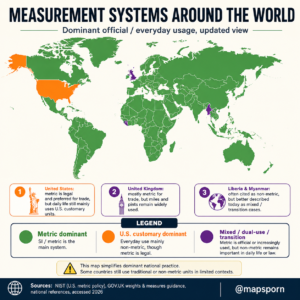
The United States is one of the few countries where non-metric units remain dominant in daily life.
This is not because America does not use metric.
In fact, metric is officially accepted and widely used in:
- Science
- Military
- Medicine
- Manufacturing
- International business
However, everyday life stayed with traditional units.
The History Behind America’s Measurement System
The American system comes from British measurements used before the United States became independent.
When the country was founded, these units were already deeply established.
Changing a national measurement system would have required replacing:
- Road signs
- Building standards
- School education
- Industrial equipment
- Consumer products
Because the existing system was already familiar, the transition was difficult.
The United States Tried to Switch to Metric
During the 1970s, the United States began a stronger push toward metric adoption.
The government promoted metric measurements through:
- Education programs
- Industry changes
- Public awareness campaigns
However, the change was never completed.
Many Americans continued using:
- Miles
- Feet
- Pounds
- Fahrenheit
because those measurements were already part of daily habits.
The United Kingdom: A Mixed System
The United Kingdom has an interesting situation.
Officially, the UK uses the metric system.
Most things are measured in metric:
- Food packaging
- Scientific work
- Weather reports
- Government documents
However, some traditional units remain common.
Examples:
Road distances
People still use:
- Miles
- Miles per hour
Human height
Many people describe height using:
- Feet
- Inches
Beer and drinks
Some traditional measurements remain culturally important.
The UK is a true example of a country transitioning between systems.
Liberia and Myanmar: Not Simple Non-Metric Cases
For many years, maps often listed Liberia and Myanmar as countries that did not use metric.
However, the reality is more complicated.
Both countries have experienced gradual metric adoption.
Liberia
Liberia has historical ties with the United States and has used American-style measurements in some areas.
However, metric units are increasingly used in:
- Government
- Education
- Trade
Myanmar
Myanmar has traditionally used local measurement systems.
But metric units are increasingly common, especially for:
- International trade
- Construction
- Science
Rather than being completely “non-metric,” both countries are better described as mixed-use or transition cases.
Why the U.S. System Survives
A measurement system is not only about mathematics.
It is also about culture.
Americans grow up understanding:
- A 10-foot room
- A 50-mile drive
- A 5-pound bag
- A 70-degree day
These numbers feel natural because people use them every day.
Changing the system would require changing habits across an entire society.
How Different Are the Systems?
Some conversions surprise people.
Distance
1 mile:
≈ 1.61 kilometers
A marathon:
26.2 miles
≈ 42.2 kilometers
Weight
1 kilogram:
≈ 2.2 pounds
A 100-pound person:
≈ 45 kilograms
Temperature
Common temperatures:
70°F
≈ 21°C
32°F
= 0°C
212°F
= 100°C
Why Does This Matter Today?
In an increasingly connected world, measurement differences can create challenges.
International companies must consider:
- Product labels
- Engineering standards
- Shipping requirements
- Consumer expectations
A car manufacturer selling globally must think about:
- Kilometers vs miles
- Liters vs gallons
- Celsius vs Fahrenheit
A small measurement difference can create major problems.
The Map’s Biggest Lesson
The world is mostly green on this map because metric has become the global standard.
But measurement systems are more than numbers.
They represent:
- History
- Technology
- Culture
- National identity
The metric system won internationally because it is simple and universal.
But the United States shows that old systems can survive when they become part of everyday life.
A measurement system is not just a tool for measuring the world.
It is also a reflection of how societies organize and understand the world around them.
Sources:
National Institute of Standards and Technology (NIST); UK Government weights and measures guidance; international measurement references.