My sister waited until the church was full before telling everyone I had abandoned our mother when she needed me most.
There were nearly eighty people inside St. Matthew’s that morning.
Neighbors.
Former coworkers.
Women from my mother’s garden club.
Men who remembered when she still taught piano lessons from our living room.
At the front of the church, beneath a spray of white lilies, rested the polished wooden casket.
My mother was inside.
And my sister stood beside it with one hand pressed dramatically against her heart.
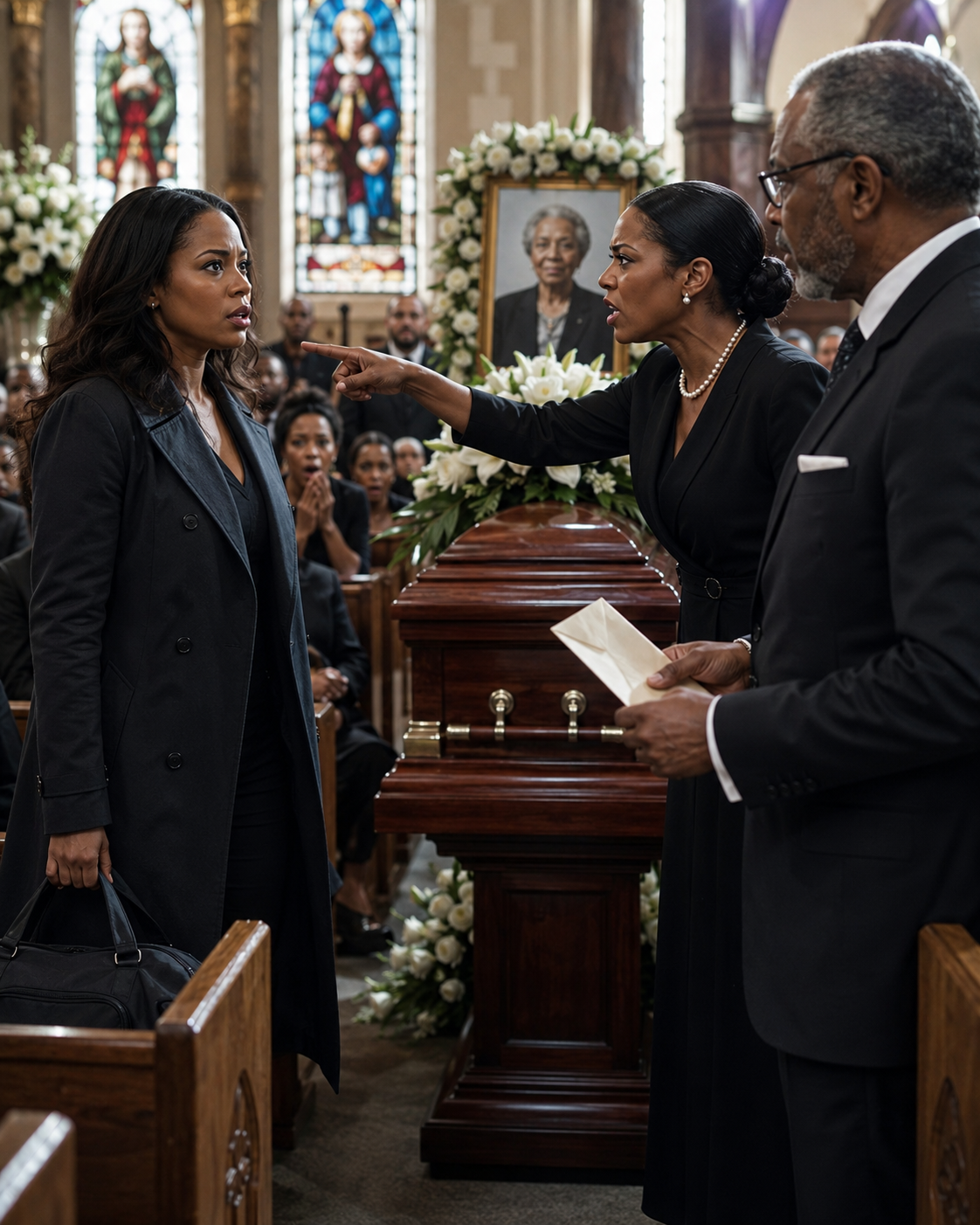
“She died asking for Rebecca,” Laura said.
Every face turned toward me.
I was standing alone in the back row.
Rainwater darkened the shoulders of my coat, and I was still holding the small overnight bag I had carried straight from the airport.
Laura’s voice broke at exactly the right moment.
“But Rebecca never came.”
A murmur moved through the pews.
Someone behind me whispered, “How could she?”
I looked at my sister.
She did not look away.
She had been waiting for this.
The Empty Chair
Beside the casket was a framed photograph of my mother at seventy-two.
She was smiling in her garden, one gloved hand resting on a rosebush.
In front of the photograph sat an empty chair.
It had been placed there for me.
At least, that was what I had thought.
Then Laura stepped down from the altar.
“You shouldn’t be here,” she said.
Her words echoed through the church.
I could feel every person watching us.
“I came as soon as I heard,” I said.
Laura laughed bitterly.
“As soon as you heard?”
She turned toward the congregation.
“Our mother spent her final months waiting for her youngest daughter to call.”
Several people lowered their eyes.
Others stared openly.
Laura continued.
“I fed her. I bathed her. I slept beside her when she was afraid.”
Then she pointed toward me.
“Rebecca sent flowers.”
My fingers tightened around the handle of my bag.
“I called.”
“Twice.”
“That isn’t true.”
Laura stepped closer.
“You always have an excuse.”
I looked past her toward our mother’s photograph.
For months, I had imagined walking into this church.
I had imagined touching the casket.
I had imagined saying goodbye.
I had not imagined having to defend myself first.
The Last Message
I reached into my coat pocket and removed my phone.
Laura shook her head.
“Don’t.”
“There are messages.”
“She could barely speak.”
“They were not from her.”
That stopped her.
Only for a second.
Then she recovered.
“What are you talking about?”
I opened the last voicemail I had received three weeks earlier.
The message was only seven seconds long.
A woman’s voice said:
“She doesn’t want to speak to you. Please stop upsetting her.”
The voice belonged to Laura.
I held the phone so the people nearest us could hear.
Laura’s face hardened.
“I was protecting her.”
“From me?”
“She became anxious every time you called.”
“I never spoke to her.”
“That was her choice.”
“No,” I said. “That was yours.”
A few people shifted uncomfortably.
Laura looked around the church.
Then she lowered her voice.
“You left us.”
“I took a job in another state.”
“You left.”
“I sent money every month.”
“Money isn’t love.”
The words landed hard.
Because once, I might have believed her.
The First Doubt
My mother had been diagnosed with heart failure eight months earlier.
At first, Laura called me every evening.
She told me what the doctors said.
She sent pictures of Mom smiling from her hospital bed.
She asked me to contribute to medications, home care, and renovations.
I transferred whatever she requested.
Then the calls stopped.
When I asked to speak with Mom, Laura said she was sleeping.
When I called in the morning, Mom was at an appointment.
When I tried video calling, Laura claimed the internet was unstable.
At first, I believed her.
Laura had always been the organized one.
The responsible one.
The daughter who stayed close to home.
I was the one who moved away.
The one who missed birthdays because of work.
The one people described as “independent” when they meant distant.
But after three weeks without hearing my mother’s voice, I called the house phone.
A man answered.
I hung up before he could say more.
When I asked Laura who he was, she said I must have dialed the wrong number.
I checked.
I had not.
The Locked Door
A month before my mother died, I flew home without telling anyone.
I rented a car at the airport and drove straight to the house where we had grown up.
The curtains were closed.
The garden was overgrown.
A black SUV sat in the driveway.
I knocked.
No one answered.
I called Laura.
She picked up on the fourth ring.
“Where are you?”
“Outside Mom’s house.”
Silence.
Then she said, “You should have told me.”
“I wanted to surprise her.”
“She’s not here.”
“Where is she?”
“At a rehabilitation center.”
“Which one?”
Another silence.
“Rebecca, this isn’t a good time.”
I looked through the front window.
There were two wineglasses on the coffee table.
A man’s jacket hung over the back of a chair.
And on the wall near the staircase, the framed photograph of our father was gone.
“Who’s inside?” I asked.
“No one.”
“I can see someone moving.”
Laura hung up.
Three minutes later, the black SUV backed out of the driveway.
A man I had never seen before was driving.
Laura sat beside him.
Neither of them looked at me.
What She Wouldn’t Tell Me
I followed them.
They drove twenty minutes outside town to a private care facility.
Laura went inside.
The man remained in the vehicle.
I walked to the reception desk and asked to see my mother.
The receptionist checked the computer.
Then she gave me a confused look.
“There’s no patient here by that name.”
I showed her a photograph.
She called another employee.
Neither recognized Mom.
I called Laura fourteen times.
She did not answer.
That evening, she finally sent a message.
Mom is resting. Please stop making this harder.
I wrote back:
Tell me where she is.
Laura blocked my number.
The next morning, I went to the police.
They told me that without evidence of immediate danger, they could not force Laura to disclose the location of an adult receiving care.
Mom had signed documents naming Laura as her medical contact.
I hired an attorney.
We sent letters.
We received no response.
Three days later, I had to return to work.
Two weeks after that, Laura emailed me.
Mom passed peacefully last night.
That was all.
In Front of Everyone
Back in the church, Laura folded her arms.
“You came here to create a scene.”
“No,” I said. “I came to bury our mother.”
“You lost that right.”
A woman in the front pew began to cry.
Laura turned toward the usher.
“Please take her outside.”
No one moved.
The usher looked at me, then at the casket.
“Laura,” he said softly, “maybe this can wait.”
“No.”
She pointed toward the church doors.
“She does not get to stand here pretending she cared.”
That was when a man near the altar rose from his chair.
He was tall, silver-haired, and dressed in a charcoal suit.
I recognized him as Mr. Doyle, the funeral director.
He held a cream-colored envelope.
“Mrs. Bennett,” he said.
Laura turned.
“Not now.”
“I believe it has to be now.”
Her expression changed.
“What is that?”
Mr. Doyle looked at me.
“Your mother left instructions.”
The Cream Envelope
Laura walked quickly toward him.
“She was confused near the end.”
Mr. Doyle did not hand her the envelope.
“She was very clear when she gave me this.”
“When?”
“Six weeks ago.”
The church became completely silent.
Six weeks ago, Laura had told me our mother was too weak to speak.
Mr. Doyle continued.
“She came to the funeral home herself.”
Laura stared at him.
“That’s impossible.”
“She arrived with another woman.”
“Who?”
Before he could answer, someone stood near the side aisle.
An elderly woman with short gray hair stepped forward.
I knew her immediately.
Mrs. Alvarez had lived beside us for nearly thirty years.
She had taught my mother how to make tamales.
My mother had taught her daughter piano.
Laura looked as though she had seen a ghost.
“You,” she whispered.
Mrs. Alvarez nodded.
“I drove Margaret here.”
What Our Mother Knew
Mr. Doyle opened the envelope.
Inside were three folded pages.
A small brass key slipped onto the table beside him.
Laura took a step backward.
“What key is that?”
Mr. Doyle unfolded the first page.
“This letter is addressed to both daughters,” he said.
Laura’s voice sharpened.
“You have no right to read private family matters.”
Mr. Doyle looked at her calmly.
“Your mother specifically instructed me to read it if Rebecca was prevented from attending the service.”
Every person in the church turned toward Laura.
Her face went pale.
Mr. Doyle began.
My daughters,
If this letter is being read aloud, then the thing I feared has happened.
Laura has tried to keep Rebecca away.
A gasp moved through the church.
Laura rushed toward him.
“That’s not her handwriting.”
Mrs. Alvarez stepped between them.
“I watched her write it.”
Laura stopped.
Mr. Doyle continued.
Rebecca, I heard every message you left.
I knew about every call.
I knew you came to the house.
My throat closed.
I gripped the back of the pew in front of me.
Laura shook her head.
“She was manipulated.”
But Mr. Doyle kept reading.
The Man in the House
Laura told me you were too busy to visit.
She told me you did not want the burden.
I believed her until Mrs. Alvarez showed me the messages you sent to her daughter, asking for help finding me.
Laura turned toward Mrs. Alvarez.
“You had no right.”
The older woman’s eyes filled with tears.
“Your mother was afraid.”
Laura laughed.
“Afraid of me?”
No one answered.
Mr. Doyle continued.
The man staying in my house is Laura’s husband, Eric.
They told me the repairs were necessary for my care.
They removed my bedroom furniture and moved me into the small room behind the laundry area.
They said the house would belong to them soon anyway.
Someone in the congregation whispered, “Dear God.”
I looked at Laura.
She did not deny it.
She only stared at the floor.
The Papers She Signed
The letter went on.
Laura brought documents for me to sign.
She told me they were insurance forms.
Mrs. Alvarez later discovered they transferred my house and savings into a trust controlled by Laura and Eric.
Laura raised her voice.
“It was estate planning.”
Mr. Doyle paused.
Rebecca Sloan, the attorney who had helped my mother years earlier, stood from the second row.
I had not noticed her before.
She held a folder against her chest.
“No,” she said. “It was not.”
Laura stared at her.
Rebecca stepped into the aisle.
“Margaret contacted me five weeks ago. The documents were prepared without independent counsel and signed under misleading circumstances.”
The man sitting behind Laura slowly moved away from her.
Laura looked around the church as though searching for someone willing to help.
No one moved.
Rebecca continued.
“The trust was revoked before Margaret died.”
Laura’s mouth opened.
“What?”
“The property transfer was canceled.”
“That’s impossible.”
“It was filed twelve days ago.”
Why She Stayed Quiet
Mr. Doyle unfolded the second page.
I did not confront Laura immediately.
I needed time.
I needed witnesses.
And I needed to make sure Rebecca could not be blamed for what happened next.
Tears blurred the page in his hands.
My mother had known.
She had known Laura was trying to turn everyone against me.
And instead of calling me, she had been gathering proof.
For a moment, anger cut through the grief.
Why hadn’t she trusted me enough to tell me?
Then Mr. Doyle read the next lines.
Rebecca, I wanted to call you.
I tried twice.
Laura took my phone.
I was ashamed that I believed her.
I was ashamed that I let you think I had stopped loving you.
I covered my mouth.
The church disappeared around me.
All I could see was my mother sitting alone in that small room behind the laundry area.
Listening to my voicemails.
Unable to answer.
The Last Request
Mr. Doyle turned to the final page.
Laura, I love you.
That is why this hurts.
You were not always cruel.
But somewhere along the way, your fear of being overlooked became permission to hurt everyone around you.
Laura’s face crumpled.
For the first time, she looked less angry than frightened.
You told yourself you deserved the house because you stayed.
You told yourself Rebecca deserved nothing because she left.
But love is not measured only by distance.
And care is not care when it becomes control.
Laura sat down heavily in the front pew.
Mr. Doyle read the final paragraph.
The brass key belongs to the piano bench.
Rebecca will know what to do with it.
Please let both my daughters attend my funeral.
Do not let anger be the last thing our family buries with me.
He folded the letter.
No one spoke.
The Piano Bench
After the service, I went to our mother’s house.
Laura did not come.
Rebecca Sloan accompanied me, along with Mrs. Alvarez.
The house looked different.
Furniture had been moved.
Pictures were missing.
Boxes labeled with Eric’s name were stacked near the stairs.
But the old upright piano still stood in the living room.
Dust covered the keys.
I sat on the bench and held the brass key in my palm.
When we were children, Mom kept sheet music beneath the seat.
I found the small lock along the side.
The key fit.
Inside were dozens of letters.
Some were addressed to me.
Some to Laura.
Some had never been sealed.
There were photographs, receipts, bank statements, copies of legal documents, and a small digital recorder.
At the bottom was a red notebook.
On the first page, my mother had written:
Things I need my daughters to know.
The Letters to Me
The earliest letter was dated seven months earlier.
Rebecca,
I know you think I do not answer because I am angry.
I am not angry.
I am tired.
Laura says you are busy, and I do not want to become another responsibility in your life.
But I miss your voice.
The next letter was written three weeks later.
You called today.
Laura told you I was sleeping.
I was sitting beside her.
I should have spoken.
I do not know why I didn’t.
Another letter said:
I listened to the message about your promotion three times.
I am proud of you.
I hope someone told you that.
I pressed the paper against my chest.
All those months, I had believed my mother had chosen silence.
But the silence had been filled with words.
She had written them down because she could not send them.
The Letters to Laura
The letters to my sister were different.
Some were angry.
Most were sad.
Laura,
You do not need to earn love by being the daughter who stayed.
You were loved before you did anything for me.
Another said:
I know you resent your sister.
But resentment is a debt that keeps charging interest.
Please stop paying it.
The final letter was short.
I forgive you.
But forgiveness does not mean I will leave you the tools to continue hurting people.
Rebecca Sloan explained that my mother had divided her estate equally.
The house would be sold.
Half the proceeds would go to me.
Laura’s half would be placed in a managed trust until she completed financial counseling and repaid the money she had taken.
The piano would remain with me.
My mother had protected Laura from losing everything.
And protected me from being erased.
Even at the end, she had tried to mother both of us.
The Closed Door
Laura did not contact me for three months.
She sold her car.
Eric left before the legal investigation was complete.
He claimed the trust had been Laura’s idea.
Laura claimed the opposite.
Eventually, both were charged with financial exploitation and fraud-related offenses.
The case did not end dramatically.
There were meetings.
Depositions.
Restitution agreements.
Laura avoided prison but received probation, mandatory counseling, and community service.
For a long time, I was furious.
Not only because of what she had done.
Because she had stolen my last months with Mom.
No court could return those.
No apology could place me beside my mother’s bed.
No legal agreement could give me one more phone call.
So when Laura finally wrote, I left the envelope unopened for two weeks.
Four Words
Her letter contained only four words.
I was jealous of you.
Underneath, she had written more.
She said she had spent her entire life believing I was the daughter Mom admired.
I traveled.
I built a career.
I left town without looking back.
Laura stayed and watched our mother praise every postcard I sent.
When Mom became sick, Laura saw her chance to become indispensable.
Then indispensable became powerful.
And powerful became cruel.
The letter ended:
None of that excuses what I did.
I only wanted you to know that it did not begin with hate.
It began with wanting to matter.
I read those lines several times.
Then I put the letter inside the piano bench.
Not beside Mom’s letters.
Underneath them.
Laura’s truth mattered.
But it did not get to sit on top of everything else.
The First Visit
Six months later, Laura came to see me.
I had moved the piano into my apartment.
It took up most of the living room.
Mom would have loved that.
Laura stood in the doorway holding a small potted rose.
She looked thinner.
Older.
Her hair, once always perfect, was tied loosely at the back of her neck.
“I didn’t know what to bring,” she said.
“You didn’t have to bring anything.”
“I know.”
Neither of us moved.
Then she looked past me toward the piano.
“Do you still play?”
“Sometimes.”
“Mom said you were better than me.”
I almost laughed.
“She told me you practiced more.”
Laura looked down.
“That sounds like her.”
I stepped aside.
She entered.
The Song We Forgot
For several minutes, we sat without speaking.
Then Laura touched one of the piano keys.
A soft note filled the room.
“Do you remember the duet?” she asked.
I did.
Mom had taught us when we were children.
Laura played the lower notes.
I played the higher ones.
We used to fight over who got the melody.
I sat beside her.
My fingers found the old pattern slowly.
Laura joined in.
We made mistakes.
We stopped twice.
At one point, she began crying so hard she could not continue.
I did not tell her everything was forgiven.
It wasn’t.
I did not tell her we could go back.
We couldn’t.
I only waited until she was ready.
Then we started the song again.
What We Buried
A year after our mother’s funeral, Laura and I returned to St. Matthew’s.
We brought a small plaque for the garden behind the church.
It read:
Margaret Bennett She taught us to listen for what was not being said.
Afterward, Laura asked if I wanted coffee.
We sat at a small café across the street.
There was no dramatic reconciliation.
No promise that we would become close.
Some wounds heal into scars.
Some become boundaries.
Some remain tender no matter how carefully they are touched.
But when we left, Laura held the door open for me.
And I waited for her on the sidewalk.
That evening, I sat at Mom’s piano and opened the bench.
Her letters were still there.
So was Laura’s.
I placed the brass key inside and closed the lid.
For months, I had believed my mother died with a locked door between us.
But she had left the key.
And in the end, she had left it for both of us.