Part 1: The Whisper
It was a Tuesday in late October, gray and cold enough that the sidewalks smelled like wet leaves and somebody nearby had already turned on a furnace. Lily’s birthday present sat buckled into my passenger seat, wrapped badly with too much tape and a ribbon that refused to lie flat. She was turning eight that weekend.
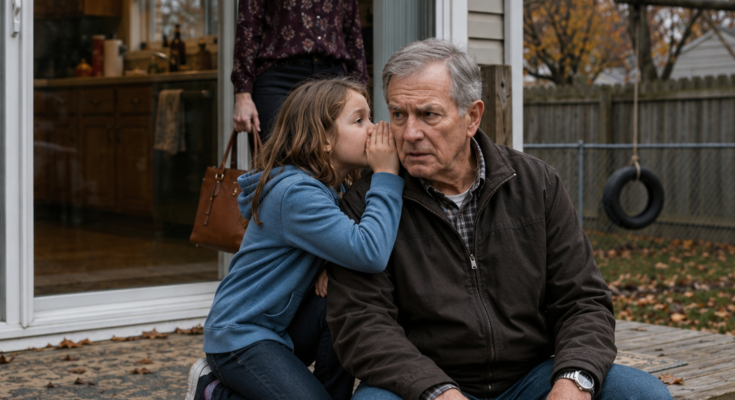
Natalie opened the door before I finished knocking. “Mark’s at work,” she said. No hello. The kitchen smelled sharply of lemon cleaner, and the whole house felt too quiet for a child who was supposed to be home. Through the sliding glass door, I spotted Lily sitting alone on the tire swing, her pink hood pulled up and her sneakers dragging through the mulch. When she saw me, she smiled. Then she checked the kitchen window. That bothered me more than the smile helped.
I carried the present outside and sat beside her on the back steps. Normally, Lily would have attacked birthday wrapping like it had personally offended her. Instead, she ran one finger along the tape. “You okay, kiddo?” “Yeah.” Too fast.
I spent most of my working life around bridges and retaining walls. The dangerous failures were rarely dramatic at first. Usually, something small changed where nobody was looking. Lily leaned against my shoulder. Then she whispered the question about her juice. “What things?” I asked, keeping my voice calm. “I don’t know. Mom says vitamins.” She picked at a loose thread on her sleeve. “But after I drink it, my legs get floaty. Then I sleep really long.”
I asked how long it had been happening. “Since summer, maybe.” She thought for another second. “Sometimes I don’t remember the morning.” A shape moved behind the glass. Natalie stood at the kitchen window watching us. Maybe two seconds. Then she walked away.
I gave Lily her present. I made the right noises when she opened it and fastened the little birthday bracelet around her wrist, even though my stomach had tightened into a knot. I did not confront Natalie. At the end of the street, I pulled over beside a mailbox with a peeling flag sticker and called the pediatric office. They had an urgent opening that afternoon.
At 12:17 p.m., I called Mark at work. “I’m taking Lily out for lunch. Meet me at the pediatrician’s office.” “Dad, what happened?” “Don’t call Natalie yet.” He stopped talking. Twelve minutes later, Natalie texted me: “She already ate.” I read it twice. Started typing. Erased it. Then I drove back.
Part 2: The Doctor’s Visit
Lily came outside in the same hoodie, carrying a half-finished juice box Natalie had handed her for the car. I put it untouched in the cup holder.
At 1:38 p.m., Lily sat on the exam table swinging her feet while the paper beneath her crackled. Mark arrived with his work badge still clipped to his belt. He looked irritated until Lily told the nurse, “The bedtime juice makes me floaty.” The nurse’s pen stopped. Mark looked at me. After that, nobody called me dramatic.
The doctor ordered blood work, urine testing, and a toxicology screen. He explained each step to Lily while she colored a purple house on the exam-table paper. Then we waited. Mark paced once, sat down, stood again, and finally asked whether Natalie could have mixed up a vitamin supplement. “I hope so,” I said. Neither of us believed it enough to repeat it.
At 3:52 p.m., the doctor returned holding several printed pages. The room had gone warm. Lily was balancing her purple crayon on one finger when it slipped and tapped the floor.
The doctor sat down heavily. He looked at Mark, then at me, then back at the papers in his hand. “Mr. Harrison,” he said, his voice barely above a whisper, “the toxicology screen shows the presence of a sedative in your daughter’s system. It’s not a vitamin. It’s a medication used for sleep disorders in adults. It’s not something that should ever be given to a child.”
Mark’s face went white. “Are you saying—”
“I’m saying someone has been giving your daughter a sedative without your knowledge,” the doctor said. “And based on the levels in her blood, it’s been happening consistently for several weeks, if not months.”
Part 3: The Confrontation
Mark sat down heavily in the chair beside me. His hands were shaking. “I don’t understand,” he said. “Why would anyone—” He stopped mid-sentence. His eyes went wide. “Natalie,” he whispered. “She’s been the one putting her to bed every night.”
I put my hand on his shoulder. “I know, son. I know.”
The doctor explained that the sedative was dangerous for children. It could cause memory loss, cognitive impairment, and even long-term damage if continued. Lily had been experiencing exactly those symptoms. The fatigue, the confusion, the memory gaps—all of it pointed to the medication she had been given every night for months.
“We need to call child protective services,” the doctor said. “And the police.”
Mark nodded slowly. “I know.” He looked at Lily, who was still coloring, oblivious to the storm brewing around her. “I’ll call them myself.”
We walked out of the office together. Mark carried Lily on his shoulders, and I held the door. Neither of us spoke. What was there to say?
We drove to the house. Mark told Lily to go to her room and play with her new birthday toys. She ran upstairs, happy and unaware. Then Mark sat down at the kitchen table and called the police. I stayed beside him, my hand on his back, as he explained everything.
Twenty minutes later, the police arrived. They asked questions, took notes, and requested copies of the medical records. Then they asked Mark to step outside while they spoke with Natalie.
We stood on the front porch, shivering in the cold, watching the sun sink below the rooftops. I didn’t know what to say to my son. So I just stood beside him and waited.
Natalie was taken into custody an hour later. She cried. She protested. She tried to explain that she had only been trying to help Lily sleep, that she didn’t mean any harm. But the evidence was clear. She had been giving a child a dangerous medication without her father’s knowledge or consent. It was a crime.
Mark didn’t speak to her as they led her away. He just stood there, staring at the empty doorway, his face a mask of shock and disbelief.
That night, I stayed with Mark and Lily. We ordered pizza, watched a movie, and tried to act normal. But none of us could stop thinking about what had happened.
A few weeks later, the truth came out. Natalie had been struggling with her role as a stepmother. She didn’t know how to handle Lily’s energy, her questions, her need for attention. So she had started giving her the sedative to make her sleep more, to make her easier to manage. It had started small, then escalated until it became a nightly routine. She never told Mark. She never asked for help. She just kept doing it, telling herself it was harmless.
But it wasn’t harmless. It had hurt Lily. It had broken Mark’s trust. And it had destroyed their family.
Lily recovered slowly. Her sleep improved. Her memory came back. Her energy returned. She started being a normal eight-year-old again. Mark was by her side every step of the way, working from home, taking her to therapy, and making sure she knew she was loved.
I visited often. I brought her presents. I played in the backyard with her and made sure she knew her grandfather was always there. But more than anything, I listened. I listened to her talk about her feelings, her fears, her confusion. I told her it wasn’t her fault, that she hadn’t done anything wrong, that there were some things even adults don’t understand.
“Grandpa,” she said one afternoon, “why did she do it?”
I took a deep breath. “I don’t know, kiddo. I think she was scared and didn’t know how to ask for help.”
“But she hurt me.”
“Yes,” I said. “She did. And that was wrong. She should have asked for help. She should have talked to your dad. She should have done a lot of things differently.”
Lily was quiet for a long moment. Then she said, “I’m not scared anymore, Grandpa. I’m okay now.”
I pulled her into a hug and held her tight. “I know you are, sweetheart. I know you are.”
Mark eventually divorced Natalie. It was a long, painful process, but it was necessary. He couldn’t trust her anymore. He couldn’t trust her with his daughter. And trust is the foundation of any family.
Mark and I started spending more time together. We went fishing. We fixed up the old shed in his backyard. We talked about things we had never talked about before. The bond between us grew stronger than ever.
Lily turned nine, then ten. She became an honor student, a talented artist, and a kind, thoughtful young woman. She never forgot what happened, but she didn’t let it define her. She was stronger than any of us could have imagined.
One evening, years later, I sat with Mark on his porch, watching Lily play in the yard with her friends. She was laughing, running, and full of life.
“Dad,” Mark said suddenly, “thank you.”
“For what?”
“For listening to her. For taking her to the doctor. For not letting it go. You saved her, Dad. You saved my daughter.”
I shook my head. “You’re her father, Mark. You’ve saved her every day since then. I just did what any grandfather would do.”
He put his hand on my shoulder. “You did more than that. You believed her. You acted. Most people would have ignored it. They would have said it was just a kid being dramatic. But you didn’t. You listened. And because you listened, she’s still here. She’s still whole.”
I looked out at the yard, at my granddaughter, my son, my family. And I knew Mark was right. I had listened. I had acted. And it had made all the difference.
Sometimes, the most important thing we can do is just listen. Listen to the quiet words. Listen to the whispers. Listen to the things people don’t want to say out loud.
Lily had whispered her secret to me. And because I listened, I was able to save her.
That’s the power of listening. That’s the power of paying attention. That’s the power of being present when it matters most. ❤️