PART 3
Delphine came to the house the next morning with a leather folder and a look on her face that told me she’d already guessed some version of what I was about to tell her. I walked her through the forged documents, the fraud department’s findings, the filing cabinet full of forty years of quiet generosity that Daniel had apparently decided to reclassify as an inheritance he was owed early.
“He’s not entitled to declare you incapacitated,” Delphine said, flipping through the bank’s copies. “This isn’t a gray area, Eleanor. This is elder financial abuse, attempted. We can report it to Adult Protective Services and the district attorney’s office, and frankly, given the forged medical letter, I’d strongly recommend we do.”
I thought about that for a long moment, looking out at the magnolia tree Robert had planted the year Daniel was born. “I don’t want him in handcuffs,” I said finally. “I want him out of my accounts. And I want to make sure this never happens again.”
“Then let’s talk about who does have access,” Delphine said.
There was only one answer, and we both already knew it. My granddaughter, Marisol — Daniel’s own daughter from his first marriage — was the only person in this family who still drove down from Charleston every other Sunday just to sit on my porch, no agenda, no requests, no folder of paperwork tucked under her arm. She brought me tomatoes from her garden. She fixed my email settings without being asked twice. She’d never once, in five years, mentioned my will.
By that afternoon, Delphine had drafted new documents: a revised power of attorney naming Marisol, a restructured trust removing Daniel entirely as beneficiary or fiduciary, and formal notice to First Savannah Bank that any further inquiries regarding my accounts from Daniel Whitmore should be treated as unauthorized and referred directly to my attorney.
Daniel called that evening. I let it ring twice before answering, the way I used to let a classroom settle before I spoke.
“Mom,” he said, his voice pitched into the warm, easy register he used when he wanted something, “there’s been some kind of mix-up at the bank. They’re saying I tried to close your account? I think someone up there completely botched the paperwork. I’m going to head down there tomorrow and get it sorted out.”
“Don’t bother,” I said. “I’ve already sorted it out myself.”
A pause. “What does that mean?”
“It means I saw the medical letter, Daniel. The one with the diagnosis I never received, from a doctor I’ve never met, notarized with a stamp that doesn’t belong to any notary in this county. It means I spent last night adding up forty years of checks with your name on them, and it came to $387,000. And it means as of this morning, you no longer have any legal standing over anything I own.”
The silence on the line told me more than any explanation he might have offered.
“Mom, I can explain—”
“You can try tomorrow,” I said. “In person. I’ll be on the porch.”
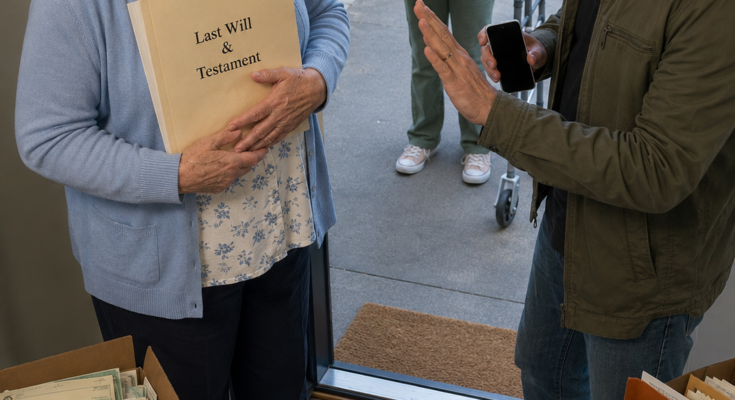
He arrived just after ten the next morning, driving too fast up my street the way he used to as a teenager late for curfew. He came up the porch steps already talking, already reaching for the practiced, wounded tone that had worked on me more times than I wanted to count over the years — how he’d only been trying to “protect” my assets, how a friend at a law firm had suggested it as a “precaution,” how he never meant for it to look the way it looked.
I let him finish. Then I set Delphine’s folder on the small table between us, the same table where Marisol and I ate tomatoes from her garden every other Sunday.
“I’ve already moved everything,” I said. “The power of attorney. The trust. All of it. It’s done, Daniel. It was done before you finished your first sentence on the phone last night.”
His face went through several stages — disbelief, calculation, and finally, something that might have been closer to shame than I’d seen from him in twenty years, though I no longer trusted myself to tell the difference between real shame and a new performance of it.
“You’re giving it to Marisol,” he said flatly.
“I’m giving it to the person who showed up,” I said. “That’s all it ever should have taken, Daniel. Just showing up. Not forging a doctor’s letter to take it.”
He didn’t have an answer for that. He sat on my porch steps for a long while, saying nothing, and eventually drove away the same way he’d arrived — too fast, and without looking back.
I still keep Robert’s Buick running. I still put the kettle on at eight. And most Sundays now, Marisol sits across from me on this same porch, asking nothing of me at all, which I have come to understand was the only kind of love that was ever actually worth $387,000 — and it turns out, it never cost a thing.