PART 3
“…Lieutenant Colonel Emily Whitfield.”
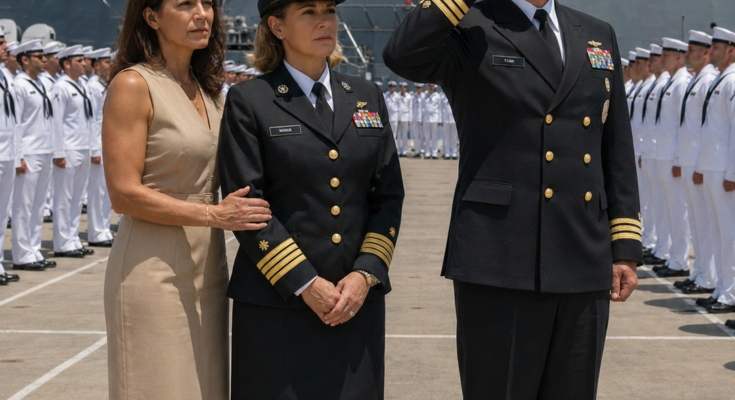
The name landed across the parade field like a dropped rifle. I heard Claire’s sharp inhale beside me. I heard my mother’s program slip from her fingers onto the pavement. I did not look at either of them. I walked forward, toward the stage, my boots striking the pavement in the same measured cadence I’d used in every formation for eighteen years, while four hundred soldiers and their families watched the sister they’d been told was an embarrassment step up to take command of the very unit her brother-in-law had just relinquished.
Andrew’s face, under the desert sun, had gone the color of the concrete beneath our feet. He’d known the incoming commander’s name for weeks, obviously — orders like this don’t arrive as a surprise to the officer being relieved. What he hadn’t accounted for was standing on a stage in front of his wife’s entire family and watching them learn it in real time, watching them realize that the woman he’d spent six years diminishing at Thanksgiving tables was about to formally, publicly, and permanently outrank the story he’d told about her.
The ceremony proceeded with full military precision — the passing of the guidon, the reading of orders, the salute — but I felt every eye in that audience recalibrating throughout it, my mother’s especially. I didn’t need to look at her to know her hand had gone to her mouth, that the cream suit and pearl earrings she’d worn for “her husband’s day” now framed a woman watching her carefully sorted family narrative collapse in under ninety seconds.
I gave my remarks briefly, the way I’d rehearsed — thanking the outgoing commander for his service, thanking the unit for their readiness, saying nothing personal, nothing pointed, because I didn’t need to. The record itself, the simple fact of standing where I now stood, said everything six years of whispered family concern had refused to hear.
Afterward, in the receiving line, my father approached first, his jaw working the way it had at the airport, except now there was nothing left to accuse me of proving. “I didn’t know,” he said quietly. “About any of it. The investigation. Any of it.”
“I know,” I said. “Nobody asked.”
My mother couldn’t speak at all. She just held my hand for a long moment, her eyes wet, something unspoken passing between us that we would need years, not one afternoon, to actually resolve.
Claire found me last, after most of the crowd had dispersed, Andrew nowhere in sight — reassigned already to the administrative tasks that come with relinquishing a command, tasks that conveniently kept him occupied and out of the reception line. She didn’t apologize. Claire has never been very good at that. But she stood in front of me in her pearls and her perfect hair, and for the first time in six years, she looked genuinely uncertain of her own footing.
“Is it true?” she asked. “What they’re saying? About the requisition?”
I opened my briefcase and handed her the file — every page, every finding, the redaction lifted, Andrew’s name where mine had once wrongly sat. I watched her read it standing on that parade field in the fading Texas heat, watched the version of her marriage she’d built for six years take the same kind of hit her mother’s version of me just had.
“I’m not telling you this to end your marriage,” I said. “That’s yours to sort out. I’m telling you because I’m done being the family’s convenient explanation for someone else’s mistakes.”
I didn’t wait for her response. I had a unit to run, and eighteen years of proving myself to the wrong people had finally, quietly, come to an end — not with an argument on a parade field, but with orders, a guidon, and a record that had been true the entire time, waiting for someone to finally read it.