My sister’s new boyfriend shook my hand like he was trying to crack a walnut.
He held on a second too long and squeezed a little too hard. While he did it, he looked me up and down, from my flannel shirt to my work boots and back up again, the way you’d look at a used car you had no intention of buying.
“And you must be the little brother,” he said.
Not Zach. Not “Nice to meet you.” The little brother.
His smile was about sixty percent teeth and zero percent warmth.
“Paige has told me all about you, buddy.”
Buddy. He called me buddy. Before the night was over he would call me buddy at least fifteen times, and every time it landed the way you’d talk to a golden retriever that had just learned to shake.
“I’m Graham,” he added. “Not Gray. Not G. Graham.”
He told me that within the first thirty seconds of meeting me. Looking back, it should have been my first clue that this Thanksgiving was going to be a special kind of awful.
He had walked into my parents’ house wearing a navy sport coat with a pocket square. Everybody else was in jeans and sweaters. My dad was in a Washington Commanders sweatshirt with a hole in the elbow. Graham came in holding a bottle of wine up like a trophy and went straight to my mother.
“Mrs. Hollis, a Willamette Valley Pinot Noir. 2018 vintage. Quite lovely on the palate.”
My mom, bless her heart, took the bottle, looked at it, and said, “Oh, that’s nice, honey. We’ve got Bud Light in the cooler if you want something cold.”
I almost choked on my water.
My girlfriend Karen elbowed me in the ribs. I coughed into my fist and pretended it was the dry air.
Graham didn’t laugh. He just smiled that thin smile and moved on around the room, shaking hands like a politician working a rope line. He called my brother Evan “counselor,” and Evan looked mildly amused. He complimented Evan’s wife Meredith on her earrings in so much detail it sounded like he’d studied jewelry appraisal. He crouched down and asked my niece and nephew where they went to school, then lost interest before they finished answering.
Then he came back around to me, as if he’d saved me for last on purpose.
“So, buddy. Paige tells me you’re in computers.”
“Something like that,” I said.
“Good for you.” He patted my shoulder twice. “Somebody’s got to do it.”
I didn’t say anything back. I smiled, nodded, and took a sip of my water.
The whole time, something was scratching at the back of my brain. Something about his face, his voice, and the way he carried himself, with an arrogance so polished it felt rehearsed.
I knew this guy.
I didn’t know him from Paige’s Instagram or from some party. I knew him from somewhere specific, and I couldn’t place it.
Not yet.
My name is Zach Hollis. I’m twenty-nine, and this is the story of the Thanksgiving that nearly ended my relationship with my sister. It did end her boyfriend’s whole personality.
You need some background first.
I’m the youngest of three. My sister Paige is thirty-four. My brother Evan is thirty-seven. We grew up in a mid-sized town outside Richmond, Virginia, in a two-story house with vinyl siding and a basketball hoop over the garage that my dad rehung about six times.
Dad was an electrician for thirty-five years, a union man, IBEW Local 666 out of Richmond. Mom worked the front desk at a pediatric dentist’s office for twenty-two years. She knew every kid in town by their cavities.
We weren’t rich, but we never went hungry. My parents paid off that house in 2019. Mom framed the final mortgage statement from Union Bank and hung it in the laundry room, where she said she could look at it every time she folded towels. My parents raised us to work hard, show up, and pay our bills on time.
Being the youngest came with baggage.
Paige and Evan were both academic stars. Paige got a full scholarship to UVA, went into pharmaceutical sales, and now makes the kind of money where she says things like “My financial advisor suggested” in casual conversation. Evan went into corporate law. He’s at a firm in D.C. with a corner office and a parking space with his name on it.
And then there’s me.
I went to community college, got a two-year degree in network administration, and spent most of my twenties working my way up in IT. It’s not glamorous, and it’s not the kind of career your parents brag about at church.
But I was good at it, and over time I built something real.
When this story takes place, I was a senior systems administrator at a cybersecurity firm in Reston. I made good money. I’d bought my own condo in Glen Allen in 2021 for $189,000, put twenty percent down, and refinanced when rates dipped. I drove a Ford F-150 I’d paid off fourteen months early because I hate owing anybody anything. My credit score was 806. I knew that because I check it every month, which tells you a lot about the kind of person I am.
I was doing fine. Better than fine.
But in my family, fine wasn’t really enough to get noticed.
Paige especially had a habit of treating my life like a cute little hobby. She never said anything outright cruel, but there was always an undertone. When I got promoted, she said, “Oh, that’s great, Zach. So you’re, like, the head computer guy now?”
She wasn’t being mean. That was the thing. She honestly thought that was my job.
I let it go, because that’s what I always did. I was the easygoing one, the one who laughed things off, kept the peace, showed up with a case of beer, and didn’t make waves.
So when Paige called me in early November and said she was bringing her new boyfriend to Thanksgiving, I didn’t think much of it.
“You’re going to love him,” she said. “He’s so driven. He’s sophisticated. He really challenges me intellectually.”
That sounded like a dating profile written by a guy who owned too many blazers. I kept that to myself.
“What does he do?” I asked.
“He’s in wealth management,” she said. “Private clients. High net worth. He’s brilliant with money, Zach. He’s already given me some amazing advice.”
I remember that sentence. I remember thinking it was a strange thing to be proud of four months into a relationship.
But I let that go too.
Mom had been cooking since Wednesday morning. Dad had set up the extra folding table in the dining room because we had a full house. Evan and Meredith brought their two kids. Karen came with me. She was a veterinary technician at an animal hospital in Mechanicsville, and the only person I knew who could stay calm while a Rottweiler bit her.
Then Paige walked in with Graham, and the whole house rearranged itself around him.
It started small.
We were all in the living room with Mom’s spinach dip and a cheese tray when Dad asked me how work was going. I told him we’d just finished a major security overhaul for a client in the defense sector. It had been six weeks of long nights, and I was proud of it.
I didn’t even finish the sentence.
“Defense sector, huh?” Graham said. “So what, you set up their Wi-Fi?”
He laughed like it was the funniest thing anyone had ever said.
Paige laughed too.
Dad gave that half-smile dads give when they can’t tell if something was a joke or an insult.
I let it go.
Then Graham turned his whole body toward my father, and his voice changed. It got warmer and softer, like he was settling in by a fireplace.
“Mr. Hollis, Paige tells me you’re retired now. Union electrician, right? Thirty-five years?”
“Thirty-five and a half,” Dad said. “But who’s counting.”
“That’s a real accomplishment. And I bet you’ve got a pension that’s just sitting there.”
Dad shrugged. “It’s not sitting. It pays me every month.”
“Sure, sure. But here’s what a lot of guys in your position don’t realize.” Graham leaned forward with his elbows on his knees. “Depending on the plan, sometimes you can take a lump sum instead of the monthly check. And if that lump sum is managed properly, in the right alternative asset classes, it can do a lot more for you than a fixed payment.”
Mom looked up from the cheese tray. “Oh, I don’t know about all that. We just keep it simple.”
“Of course. And simple is good.” Graham smiled at her. “Mrs. Hollis, you were at a dental practice for, what, twenty years? You probably have a 401(k) from that job too.”
“About a hundred and eighteen thousand,” Mom said, as casually as if she were reading a grocery list. “Our girl at the credit union says it’s doing okay.”
My stomach tightened. Mom tells strangers everything. She once told a Verizon customer service rep the story of her gallbladder surgery.
“Okay is fine,” Graham said gently. “But okay isn’t great. Tell you what. Why don’t I come by sometime in December and take a quick look at your statements? No charge. Family rate.” He winked at Paige. “Just to make sure nobody’s leaving money on the table.”
Paige beamed at him like he’d just offered to repaint the house for free.
Dad said, “Maybe,” in the voice he uses for door-to-door salesmen.
I watched Graham’s face while he talked to my parents. He wasn’t looking at them like people. He was looking at them like numbers.
That’s when the scratching in the back of my brain got louder.
Where did I know this guy from?
By the time Mom brought out the turkey, Graham had corrected my grammar twice.
The first time, I said, “Me and Karen are thinking about getting a dog.” He raised a finger and said, “Karen and I, buddy.” Then he smiled at the table like he’d done me a public service.
The second time, I said “less” when I should have said “fewer.” I honestly can’t remember what I was talking about. I just remember him saying, “Fewer. Countable nouns. It’s okay, it’s a common mistake.”
He told Karen that her job as a vet tech was “sweet,” in the voice you’d use for a kid’s crayon drawing. He explained to my father, a man who’d been pulling wire since before Graham was born, how real electricians were transitioning to smart home installation. Dad already knew that. He’d been doing smart home installs on the side for four years.
Then I mentioned that I was thinking about selling my condo and upgrading to a house. It had appraised in the summer at $268,000, and I had a decent amount of equity built up. I thought the timing might be right.
Graham leaned back in his chair and laced his fingers behind his head.
“Well, you know what they say, buddy. Buy low, sell high. But I imagine in your line of work the margins are a little tighter. Not everyone can play in the deep end.”
He said it so smoothly that if you weren’t paying attention, it almost sounded like friendly advice.
I was paying attention.
Karen squeezed my hand under the table. She could feel me tensing up.
“Don’t let him get to you,” she whispered.
I didn’t. Not yet.
Here’s the thing about me. I don’t pop off, and I don’t get loud. I’ve spent my whole life being underestimated, and I’ve learned that the best answer to someone who thinks he’s smarter than you is patience.
So I smiled, nodded, and let Graham have his performance.
After the turkey was carved, the conversation turned to careers. In my family that’s standard Thanksgiving fare. Evan talks about some big case his firm is handling, Paige mentions her latest sales numbers, and I share whatever’s going on with my job without expecting much of a reaction.
But Graham treated career talk as his personal stage.
“I’m a consultant,” he said, slowly, like he wanted my parents to have time to be impressed. “I work with high-net-worth individuals on strategic wealth management.”
Mom said, “Oh, that’s nice.”
Meredith asked which firm he was with.
Graham got vague. “I’ve been independent for a while now. Building my own brand. Working with select clientele.”
He dropped phrases like “portfolio diversification” and “alternative asset classes” until it stopped feeling like conversation and started feeling like a TED Talk nobody had signed up for.
Then he turned to me.
“So, Zach, buddy, walk me through what you actually do. Paige said something about computers, but I want to hear it from the source.”
I kept it short and factual. I told him I was a senior systems administrator specializing in network security, that I worked with government-adjacent clients, and that my team handled threat detection, infrastructure hardening, and incident response.
Graham nodded slowly, the way people nod when they’re just waiting for their turn to talk.
“So basically,” he said, “you’re the IT guy. The one people call when their printer jams.”
He grinned around the table like he expected a laugh track.
And Paige giggled.
She covered her mouth, but she giggled.
That one stung. The joke wasn’t clever, so that wasn’t why. It stung because my own sister had watched this man take shots at me all evening, and instead of saying anything, she laughed. It wasn’t a nervous laugh either. It was an “isn’t he charming” laugh.
Then the conversation drifted to travel, and Graham told us about Lake Como.
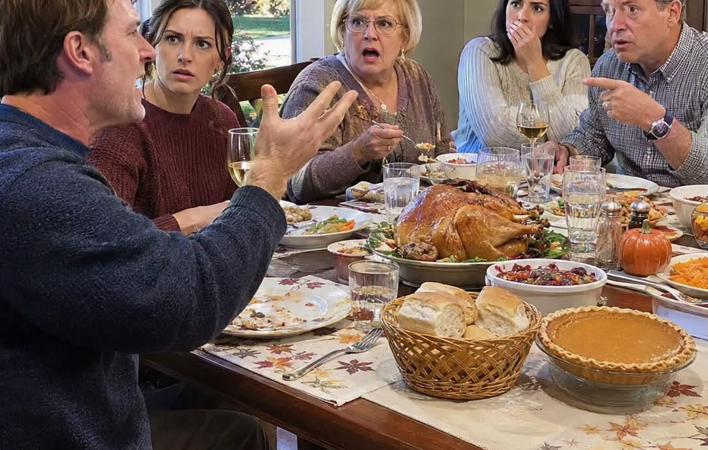
He’d gone over the summer. He told us about the villa, the private boat tour, and the locals-only restaurant where you apparently needed a personal invitation to get a table. He talked for five solid minutes without taking a breath. My nephew fell asleep against Meredith’s arm.
Then Graham looked straight at me.
“You ever been to Italy, buddy?”
“I’ve been to Myrtle Beach twice,” I said. “The seafood buffet at Captain Jack’s is pretty solid.”
He stared at me for two seconds, trying to figure out if I was joking. Then he gave the kind of laugh that’s really a sigh in a costume.
“Classic,” he said. “You’re a funny guy, Zach. Very blue-collar funny.”
Blue-collar funny. Like my sense of humor had a tax bracket.
Mom tried to change the subject by asking if anyone wanted more stuffing. God bless that woman and her tactical use of side dishes.
Graham wasn’t done.
Karen mentioned we’d been looking at shelter dogs. Graham immediately launched into a monologue about his French bulldog, Wellington. Wellington had cost four thousand dollars. Wellington went to a canine behavioral enrichment program that ran eight hundred dollars a month.
He actually said the words “behavioral enrichment program.” For a dog named Wellington.
Across the table, Evan caught my eye and raised his eyebrows a quarter of an inch. That’s the universal older-brother signal for “This guy is unbelievable.” That tiny bit of solidarity was the only thing keeping me sane.
But there was something else, and I filed it away. Lake Como villas. Four-thousand-dollar dogs. Eight hundred a month on enrichment. A man who was “independent right now” and “building his own brand.”
Where was the money coming from?
When the main course was over, everybody scattered. The kids went to the living room to watch a movie. Dad retreated to his recliner for what he calls “a strategic rest.” Meredith helped Mom in the kitchen. Karen went to the bathroom.
I stepped out onto the back porch for sixty seconds of quiet.
I didn’t get them.
The screen door creaked, and Graham came out behind me holding one of my dad’s Bud Lights. He’d turned his nose up at those two hours earlier. He leaned against the railing next to me like we were old friends about to have a heart-to-heart.
“Listen, buddy,” he said. “I want to be straight with you.”
I waited.
“I know guys like you. Salt-of-the-earth types. Hardworking, loyal, but not exactly built for the big leagues.” He took a pull of the beer. “And that’s fine. The world needs guys like you. Somebody’s got to keep the lights on while the rest of us build something meaningful.”
I’m not going to lie. That one hit different.
He wasn’t even pretending anymore. He was standing on my parents’ porch, drinking their beer, telling me to my face that I was small, that my life was small, and that everything I’d worked for was a supporting role in somebody else’s story.
Five years earlier, that might have gotten to me. There was a time when I carried a lot of insecurity about my path, about not going to a big university, about not having a career that impressed people at parties. But I’d done the work since then. Therapy. A lot of honest looks in the mirror. I’d built a life I was proud of.
So when Graham said that, it didn’t make me feel small. It made me furious. Not the explosive kind. The cold kind, the kind that sharpens everything.
And standing there in the yellow glow of my parents’ porch light, looking at his self-satisfied face, it finally clicked.
I knew exactly where I’d seen him.
Eighteen months earlier, my firm had been brought in to help with a forensic investigation.
A mid-sized investment company in Northern Virginia had collapsed practically overnight. Clients lost hundreds of thousands of dollars. The owner had been taking new investor money to cover old investors’ “returns,” inflating performance reports, skimming fees that were never disclosed, and moving cash into personal accounts.
When it fell apart, the owner closed the firm, scrubbed his online presence, and vanished before the lawsuits could pile up.
My team was hired to do the digital forensics. We recovered deleted emails, traced wire transfers, and rebuilt server logs from a backup drive someone had tried to wipe and hadn’t wiped well enough.
I spent three weeks inside that data. Three weeks of twelve-hour days in a windowless room in Reston with two monitors and a lot of cold coffee.
I saw his face over and over. It was in the company headshots, in promotional videos from the deleted website, and on the “About Us” page we restored from an archive. He wore his hair longer then and had a beard, but the smile was the same.
The name on the state filings was Graham Prescott.
Prescott Capital Advisers.
And I remembered something else, something I hadn’t thought about in over a year. Buried in the recovered emails was a message from an older client, a woman. She’d written it at two in the morning, with no greeting and no capital letters. She asked him why her account statement showed $180,000 when the bank told her there was only $11,000 left. She asked him to please call her back. She asked him three times in the same email.
He never answered her. We checked.
Now that man was standing on my parents’ porch, drinking my father’s beer, calling me buddy.
And an hour earlier, he had offered to come over in December and “take a look” at my parents’ retirement statements.
I felt my pulse spike, but I kept my face completely blank. I took a sip of my drink.
“You know what, Graham? You’re probably right,” I said. “I’m a simple guy. No big leagues for me.”
He clapped me on the shoulder. “No shame in it, buddy.”
“We should head in. I think Mom’s about to bring out dessert.”
He went in first. I stayed on the porch for another few seconds, pulled out my phone, and opened my work email. I searched the archived case files until I found what I needed: the summary report we’d filed, the list of client complaints that had become public record, and a story from the Northern Virginia Business Journal. I saved the article to my phone.
Then I took one long breath of cold November air and went back inside.
When I walked into that house, I wasn’t thinking about revenge. I wasn’t planning to humiliate Graham in front of everyone. I was thinking about my sister. She was clearly crazy about this guy, and she’d brought him to our family’s table because she thought he was special.
He was something, all right. Just not what she thought.
And I was thinking about Mom’s $118,000. About Dad’s pension. About “Family rate.”
Dessert was Mom’s pecan pie. I sat back down at the table.
Karen looked at me and knew right away that something had changed. I wasn’t tense anymore. I was calm, the kind of calm that made her nervous.
Graham was showing Paige a picture on his phone of some rooftop bar in Manhattan he wanted to take her to. She was smiling at him like he’d hung the moon.
Mom passed slices around. Small talk floated across the table. Dad came in from his recliner, drawn by the smell of the pie.
Then Graham, because he simply couldn’t stop being himself, went for one more round.
He looked across the table at me and grinned.
“So, buddy, what’s the endgame? You going to be fixing routers until you’re sixty? Or is there a master plan I’m not seeing?”