PART 2
“Claire… do you still have access to the original Silverline agreement?”
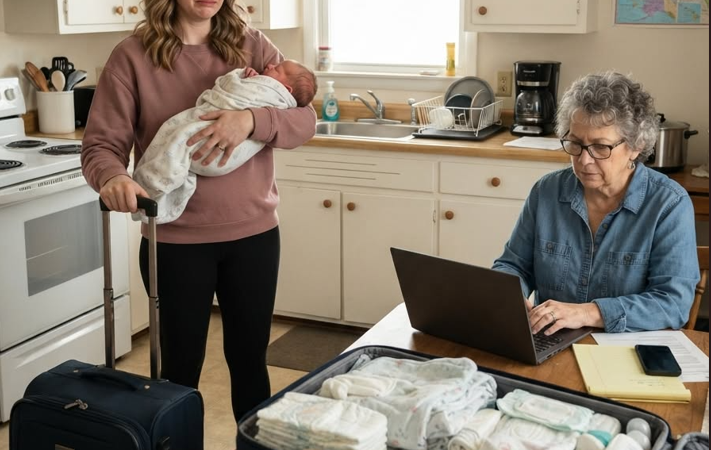
Mrs. Parker’s question made me stop rocking my son.
I looked down at the yellow legal pad between us.
“The investment agreement?”
She nodded.
“The one you signed before the wedding.”
My stomach tightened.
“I have my copy.”
“Where?”
I glanced toward my old suitcase.
“In there.”
Mrs. Parker leaned forward.
“Then get it.”
For a moment, I didn’t move.
My son, Noah, stirred against my chest, his tiny fist opening and closing beside his cheek.
I had spent the past two years feeling as though I’d forgotten everything about the woman I used to be.
The woman who could walk into a room full of executives and calmly explain why their numbers didn’t add up.
The woman who had earned her own money, negotiated her own contracts, and never apologized for asking a question.
Now I was sitting in my former mentor’s kitchen at six in the morning, wearing yesterday’s clothes and wondering whether my marriage had ended while I was preparing breakfast for people who barely acknowledged me.
“Claire,” Mrs. Parker said gently. “The agreement.”
I laid Noah in the portable bassinet she’d found in her guest room.
Then I opened my suitcase.
Beneath my work shoes and a stack of baby clothes was a blue folder.
I had packed it without thinking.
Or perhaps some part of me had known I would need it.
Mrs. Parker put on her reading glasses.
I handed her the folder.
She opened it.
Then turned to page seven.
Her finger stopped beside a paragraph.
She read it once.
Then again.
Finally, she looked up.
“Does Ryan know you kept this?”
I swallowed.
“I don’t think he remembers it exists.”
She removed her glasses.
“Well,” she said quietly, “I believe he’s about to remember.”
Three years earlier, before Ryan and I married, Silverline Holdings had been struggling.
The company was a regional supplier of commercial equipment and industrial materials.
Ryan’s father, Martin Calloway, had built it from a small warehouse operation into a business employing nearly two hundred people.
From the outside, it looked successful.
Inside, the company was carrying debt, dealing with delayed customer payments, and struggling to replace an outdated inventory system.
Ryan and I had been dating for almost a year.
I was still working as a senior corporate auditor.
Martin knew what I did for a living.
One evening, over dinner, he asked whether I could recommend someone to review Silverline’s internal reporting.
I told him I could refer him to an independent firm, but I couldn’t personally conduct an audit without properly addressing the professional and personal conflicts.
He appreciated the recommendation.
Eventually, Silverline hired outside consultants.
Their review revealed several operational problems.
The company needed better financial controls, more reliable inventory records, and additional working capital.
Martin approached me again.
This time, he wasn’t asking for professional services.
He was asking whether I wanted to invest.
I had recently inherited money from my grandmother, and I’d spent years building my own savings.
I wasn’t wealthy.
But I had enough to make a meaningful investment.
After obtaining independent legal and financial advice, I contributed eighty-five thousand dollars to Silverline.
In exchange, I received an eighteen-percent ownership interest in the holding company.
The agreement was documented.
Signed.
Dated.
And accompanied by a separate operating agreement detailing the rights of the members.
At the time, Ryan was delighted.
“Look at us,” he’d told me. “We’re building something together.”
His mother, Patricia, was less enthusiastic.
She called my investment “a little contribution.”
But Martin thanked me.
And for a while, everyone seemed pleased.
Then Ryan and I married.
Gradually, things changed.
At first, it was small.
His mother criticized my working hours.
Then she began suggesting I should focus more on our marriage.
Ryan complained that I spent too much time thinking about other people’s financial problems.
When I became pregnant, everyone seemed to agree that my career could wait.
I wanted to spend time with our baby.
That part was my choice.
But somewhere along the way, taking time away from work became an excuse for the Calloways to treat me as though I’d never had a career at all.
By the time Noah was born, I was cooking family meals, organizing appointments, and listening to Patricia explain that women with young children shouldn’t concern themselves with business matters.
I was still an owner of Silverline Holdings.
But nobody mentioned that anymore.
Not even Ryan.
Mrs. Parker looked down at the agreement.
“Claire, did you ever sell your interest?”
“No.”
“Sign a redemption agreement?”
“No.”
“Authorize Ryan to make ownership decisions for you?”
I shook my head.
She tapped the page.
“Then unless something has lawfully changed, you still have rights under this agreement.”
I stared at her.
For a moment, I couldn’t speak.
Then she turned another page.
“Your ownership interest also comes with certain financial-information and approval rights. We need a corporate attorney to examine the current records and determine how those rights apply.”
I swallowed.
“Mrs. Parker, Ryan’s family controls the company.”
She looked at me.
“I know.”
“They have expensive lawyers.”
“I know that too.”
I looked toward Noah.
“And I have a two-month-old baby.”
Her expression softened.
“Claire, nobody is asking you to go to war with a baby on your shoulder.”
She closed the folder.
“I’m asking you to stop assuming you’ve lost simply because your husband said one word.”
I stared at her.
Then she added, “And before anything else, you’re going to eat breakfast and get some sleep.”
I almost laughed.
That was Mrs. Parker.
Even when I worked under her, she could identify a fraudulent reimbursement claim and notice I’d skipped lunch in the same conversation.
She stood and began making toast.
I looked down at the blue folder.
For the first time since Ryan walked through our front door at 4:30 that morning, I felt the smallest piece of myself returning.
Not confidence.
Not yet.
But recognition.
I remembered who I had been.
And I remembered how to begin.
That afternoon, Mrs. Parker helped me find a family-law attorney named Rebecca Lawson.
She listened while I explained what had happened.
The late-night absences.
The household expectations.
Patricia’s treatment of me.
Ryan’s sudden announcement.
And the fact that I’d left with our infant son.
Rebecca was calm.
Practical.
She asked questions about where Noah was staying, his feeding schedule, our finances, and what arrangements might be needed while Ryan and I separated.
Then she asked something I hadn’t expected.
“Claire, has Ryan ever threatened to take your son away from you?”
I hesitated.
“Not directly.”
She waited.
“His mother has said things.”
“What kinds of things?”
I looked down.
“She says I don’t know how to raise a Calloway child.”
Rebecca wrote something down.
“She also says Ryan’s family has enough money to make sure Noah grows up properly.”
My voice broke.
“And once, when I disagreed with her, she told me I should remember who could afford the better lawyers.”
Rebecca looked at me carefully.
“Have you preserved those messages?”
“Some of them.”
“Good. We’ll review them.”
She explained that Ryan’s announcement didn’t automatically settle anything.
There were legal questions concerning custody, support, marital property, and our living arrangements.
We would address them through the appropriate process.
I nodded.
Then I asked the question I’d been afraid to ask.
“Could they take Noah because I don’t have the same money they do?”
Rebecca’s expression softened.
“Money alone doesn’t determine who should care for a child, Claire. The court considers the child’s welfare and the relevant facts. We’ll make sure your caregiving history and circumstances are properly documented.”
I looked down at my sleeping son.
For two months, I’d been awake with him almost every night.
I knew which way he liked to be held.
Which song settled him.
The little sound he made before he started crying because he was hungry.
Ryan had barely learned how to buckle the car seat.
Yet somehow, I’d allowed myself to believe his family’s money made them more entitled to our child than I was.
I wiped my eyes.
“Thank you.”
Rebecca nodded.
“Now let’s discuss your immediate finances and somewhere stable for you and Noah to live.”
The following day, I met with a corporate attorney, Daniel Brooks.
Mrs. Parker accompanied me.
Daniel reviewed my original investment documents.
Then asked what had prompted the meeting.
I told him about Ryan’s demand for a divorce.
I also described the financial irregularities I’d noticed during the previous several months.
A consulting company whose name appeared repeatedly in paperwork left on the dining table.
Large reimbursement claims that seemed inconsistent with the services described.
And references to a warehouse purchase Ryan had been discussing with his father.
Daniel listened carefully.
Then asked, “Do you have company records in your possession?”
“Only documents I was lawfully given as an investor, along with my own agreements and correspondence.”
He nodded.
“Good. Don’t try to access Ryan’s accounts or obtain records you’re not authorized to see. We’ll make formal requests for the information you’re entitled to receive.”
I understood.
I’d spent years working in auditing.
I knew the difference between evidence and suspicion.
And I knew that improperly obtaining documents could create an entirely new problem.
Daniel continued.
“Your operating agreement gives you certain rights regarding financial information and significant related-party transactions. We’ll need to examine whether those rights have been respected.”
I looked at him.
“Do you think something is wrong?”
He closed the folder.
“I think there are questions worth asking.”
Then he added, “And I think your husband’s family may be surprised that you’re asking them.”
He wasn’t wrong.
Ryan called that evening.
I was sitting beside Noah’s bassinet when my phone began ringing.
I answered.
“Hello, Ryan.”
For a moment, he said nothing.
Then he asked, “Where are you?”
“Somewhere safe.”
He sighed.
“Claire, don’t start being dramatic.”
I looked toward my son.
“Is that why you’re calling?”
“What?”
“To tell me I’m being dramatic?”
His voice hardened.
“Mom says you walked out and abandoned your responsibilities.”
I stared at the wall.
There it was.
His mother.
Not concern for Noah.
Not an apology.
Not even a question about whether I’d slept.
“Ryan, you told me you wanted a divorce.”
He sighed.
“I was trying to get your attention.”
I felt cold.
“What?”
“You’ve been distant. You don’t listen. You’re always exhausted.”
I looked at the baby.
Of course I was exhausted.
I’d given birth eight weeks earlier.
My body was still recovering.
I was awake several times a night.
And I’d spent that morning preparing breakfast for his entire family while he stayed out until dawn.
I took a breath.
“So you said divorce.”
He sounded irritated.
“I didn’t think you’d just leave.”
For several seconds, I couldn’t speak.
Then I asked quietly, “What did you think I’d do?”
He hesitated.
“I thought we’d talk.”
“At four-thirty in the morning?”
Silence.
“While I was holding our newborn son?”
He sighed.
“Claire, you’re making this harder than it needs to be.”
I closed my eyes.
Then he said something that changed the conversation.
“Look, my father has some paperwork that needs your signature. Can you come by tomorrow?”
I sat upright.
“What paperwork?”
“Just a company matter.”
My pulse quickened.
“What kind of company matter?”
Ryan hesitated.
“An ownership cleanup.”
I looked toward the blue folder on Mrs. Parker’s table.
“Ownership cleanup?”
“Yeah. We need to simplify things before the refinancing.”
My voice became very quiet.
“Does it involve my eighteen-percent interest?”
Silence.
A long silence.
Then Ryan said, “Who told you about that?”
I stared at the phone.
“Ryan, I signed the agreement.”
He sounded angry.
“I thought we’d already dealt with all that.”
“Dealt with what?”
He exhaled.
“Claire, you haven’t been involved in the business for years. It makes sense to remove you from the ownership documents.”
My hands began trembling.
“By having me sign something?”
“Yes.”
“For how much?”
He hesitated.
“That’s complicated.”
I took a breath.
“Then send the documents to my attorney.”
Another silence.
“You hired a lawyer?”
“Yes.”
His voice rose.
“Are you kidding me?”
“No.”
“Claire, we’re family!”
I looked toward Noah.
Then answered quietly.
“You remembered that when you needed my signature.”
He hung up.
I sat holding the phone for a long time.
Then I called Daniel.
When I told him what Ryan had said, he became very quiet.
“Claire, don’t sign anything.”
“I wasn’t planning to.”
“Good. Forward me any communication about this ownership cleanup. We’ll request the current membership records and supporting documents.”
I looked down at my son’s sleeping face.
For the first time, I understood why Ryan had chosen that particular week to demand a divorce.
And I suspected the timing had very little to do with our marriage.
Three days later, Daniel called.
His voice was different.
More serious.
“Claire, we received a partial response from Silverline’s counsel.”
I sat down.
“And?”
“There appears to be an internal document suggesting that you agreed to surrender your ownership interest last month.”
My stomach dropped.
“What?”
Daniel continued.
“It describes a voluntary redemption of your interest.”
I stared at the wall.
“I didn’t sign anything.”
“I know that’s your position. We’re requesting the complete original records and authorization history.”
My mouth went dry.
“Does the document have my signature?”
“An electronic signature appears on it.”
I felt suddenly sick.
“Daniel, I never approved that.”
“I understand.”
I looked toward Noah.
Then remembered something.
Three weeks before he was born, Ryan had asked to borrow my laptop.
He told me he needed to print some insurance forms.
I’d been lying on the couch with swollen ankles and a headache.
He’d asked for my password.
I’d given it to him.
At the time, I hadn’t thought anything of it.
Now the memory made my stomach tighten.
I told Daniel.
He listened.
Then said, “Don’t jump to conclusions yet. We’ll investigate what happened with the document and whether any valid authorization exists.”
I nodded.
But my hands wouldn’t stop shaking.
That afternoon, Patricia called.
I almost didn’t answer.
Then I decided I wanted to hear what she had to say.
“Claire.”
“Hello, Patricia.”
She didn’t waste time.
“Ryan tells me you’ve been speaking with attorneys.”
“Yes.”
She sighed.
“Really, dear. Is that necessary?”
I looked toward my son’s bassinet.
“Yes.”
“You’ve made things terribly awkward.”
I said nothing.
Patricia continued.
“We were willing to let you leave the marriage quietly. Ryan was even prepared to help you with some living expenses.”
I stared at the phone.
“How generous.”
She ignored my tone.
“But now you’re complicating company matters.”
I took a slow breath.
“Patricia, did you know someone submitted a document claiming I’d surrendered my ownership interest?”
Silence.
Then she said, “Claire, you were never really part of the business.”
I closed my eyes.
There it was again.
The familiar dismissal.
The same voice that used to tell me to make the gravy thinner and keep my opinions to myself.
I answered quietly.
“I invested eighty-five thousand dollars.”
She made a dismissive sound.
“That was years ago.”
“Yes.”
“And you married into the family.”
I looked down at my wedding ring.
“Patricia, my investment was a documented business transaction. My marriage didn’t erase it.”
Her voice sharpened.
“You need to be careful, Claire.”
I became very still.
“About what?”
“About making accusations you can’t prove.”
I took a breath.
“Then I’m sure an independent review will clear everything up.”
She hung up.
I sat quietly.
Then saved the call details and wrote down what had been said while it was still fresh.
Mrs. Parker watched me from across the kitchen.
When I finished, she nodded toward my notebook.
“That’s my girl.”
I almost laughed.
“I’m thirty-three years old.”
She smiled.
“And still one of the best auditors I ever trained.”
I looked down.
For the first time in months, I believed her.
The following weeks were exhausting.
Not dramatic.
Exhausting.
Noah needed feeding, changing, and comforting.
I attended appointments.
Spoke with lawyers.
Worked through temporary financial arrangements.
And slept whenever I could.
Some days, I felt strong.
Other days, I sat on Mrs. Parker’s guest-room bed and cried because I missed the marriage I’d believed I had.
I had loved Ryan.
That truth didn’t disappear because he’d treated me badly.
I remembered the man who brought soup to my apartment when I had the flu.
The man who proposed during a rainy weekend trip.
The man who cried when he heard our son’s heartbeat for the first time.
I couldn’t understand how that man had become someone who thought threatening divorce was an acceptable way to get his exhausted wife to cooperate.
Or someone who expected her to sign away a business investment without an explanation.
Mrs. Parker never told me I was foolish for loving him.
She simply reminded me to eat.
To rest.
And to stop apologizing for needing help.
One evening, while Noah slept in his bassinet, she sat beside me.
“Claire, can I tell you something?”
I nodded.
“Your career isn’t gone.”
My eyes filled.
“I haven’t worked in almost a year.”
“So?”
“I have a baby.”
She smiled.
“I noticed.”
I laughed through my tears.
She continued.
“You can decide when or whether you return to auditing. You can take your time. But don’t let those people convince you the years you spent building your skills somehow disappeared.”
I looked down at my hands.
For two years, I’d been treated as though I was useful only when I was cooking, cleaning, or agreeing.
It was hard to remember that I had once been respected for something else.
Mrs. Parker touched my shoulder.
“You are Noah’s mother.”
I nodded.
“And you’re also Claire.”
That night, I cried again.
But for once, the tears were not entirely about Ryan.
They were about the woman I was trying to find again.
Six weeks after I left the Calloway house, Daniel requested a meeting.
He sounded serious.
“We have enough verified information now to discuss the next steps.”
Mrs. Parker watched Noah while I drove to his office.
On the conference table were several folders.
Daniel sat beside an independent forensic accountant named Sarah Malik.
She looked to be about my age.
We shook hands.
Then Daniel began.
“Claire, we’ve obtained additional company records through formal requests and review. Some were supplied after Silverline’s outside counsel examined the ownership questions.”
I nodded.
Sarah opened a spreadsheet.
“We found several transactions involving a consulting company called Northcrest Advisory.”
My stomach tightened.
I recognized the name.
It was the company I’d noticed on the invoices months earlier.
Sarah continued.
“Silverline paid Northcrest approximately seven hundred thirty thousand dollars over the past eighteen months.”
I stared at the total.
Seven hundred thirty thousand.
“For what?”
“Strategic consulting, procurement support, and operational planning, according to the invoices.”
I frowned.
“Did they provide those services?”
Sarah looked at Daniel.
Then back at me.
“We’ve been unable to substantiate a significant portion of the billed work from the materials reviewed so far.”
She turned another page.
“Northcrest is also associated with an entity controlled by Patricia Calloway.”
I felt my stomach drop.
Ryan’s mother.
The woman who told me I didn’t understand business.
The woman who’d been criticizing my cooking while her company received hundreds of thousands of dollars from Silverline.
I looked at Sarah.
“Does Martin know?”
“We don’t yet know what he knew or authorized,” she replied carefully.
I appreciated that.
She wasn’t guessing.
She was following the evidence.
Then Daniel opened another folder.
“We also identified discrepancies in the records concerning your ownership interest.”
I took a breath.
“The electronic signature?”
He nodded.
“The available verification information does not establish that you authorized the purported redemption. There are significant questions about how that document was prepared and submitted.”
My hands began trembling.
“Who submitted it?”
Daniel hesitated.
“The records we’ve received identify an account associated with Ryan’s office as the source.”
For a moment, I couldn’t hear anything else.
I stared at the table.
Ryan.
My husband.
The father of my baby.
The man who had told me divorce was coming while I stood barefoot in the kitchen.
I took a shaky breath.
“Did he forge my signature?”
Daniel leaned forward.
“Claire, that is a serious allegation. What we can say is that there’s a document purporting to carry your authorization, and you deny signing it. We have grounds to challenge its validity and request further investigation.”
I nodded.
He continued.
“The company’s outside directors and counsel have been notified of the concerns. They are arranging an independent review.”
I sat back.
For years, I’d been the person on the other side of the table.
The auditor explaining what the records showed.
Now the numbers belonged to a family that had treated me as though I was incapable of understanding a simple business conversation.
I looked at Sarah.
“Is the company in trouble?”
She nodded slowly.
“There are financial-control issues that need to be addressed. The extent of any improper transactions will depend on the review.”
My stomach tightened.
“What about the employees?”
She looked surprised.
I explained.
“Silverline has nearly two hundred employees. People with families.”
Daniel’s expression softened.
“That is one reason an orderly independent investigation matters.”
I nodded.
Then asked, “What happens to my ownership interest?”
He looked at the original agreement.
“Unless a valid change can be established, we will continue asserting your rights under the operating agreement.”
I swallowed.
“And the proposed refinancing?”
“Any transaction that requires your approval under those documents will need to account for your position.”
For the first time, I understood something important.
I didn’t control Silverline.
I couldn’t walk into its offices and fire Ryan.
I couldn’t order a bank to stop lending money.
And I couldn’t declare his family guilty because I suspected they’d done something wrong.
But I could insist that my lawful interests be respected.
I could ask questions.
Demand documentation through the proper process.
And refuse to sign away something I owned simply because my husband wanted me to.
It was more power than I’d felt in years.
Two weeks later, Silverline’s board called a special meeting.
I attended with Daniel.
Mrs. Parker stayed home with Noah.
I wore the navy suit I’d once used for client presentations.
It was a little tight after childbirth.
I almost changed.
Then I looked in the mirror.
My hair was pulled back.
There were faint shadows beneath my eyes.
I was tired.
But I looked like myself.
I picked up my briefcase.
And went.
The conference room was on the fourth floor of Silverline’s headquarters.
I’d been there before.
Years earlier, Martin had invited me to a celebratory dinner after my investment was completed.
He’d stood at the head of the table and thanked me for believing in the company.
Now I entered the same room with an attorney beside me.
Ryan was already seated.
So were Patricia and Martin.
Three outside directors occupied the other side of the table.
The company’s legal counsel sat near the end.
When Ryan saw me, he looked startled.
Then irritated.
“Claire?”
I nodded.
“Ryan.”
He glanced toward Daniel.
“You really brought a lawyer.”
I sat down.
“Yes.”
Patricia leaned toward Martin and whispered something.
I couldn’t hear the words.
But I recognized the expression.
The little smile she wore whenever she thought I was about to embarrass myself.
The meeting began.
The independent directors explained that the company was reviewing concerns involving related-party transactions, accounting records, and the disputed ownership documentation.
Sarah presented preliminary findings.
She didn’t make accusations.
She explained the records.
The invoices.
The payments.
The missing support for services.
The ownership connections.
Then Daniel addressed the disputed redemption document.
He explained that I had not authorized the surrender of my membership interest and that the validity of the purported electronic signature was contested.
Ryan shifted in his chair.
Patricia looked toward the company attorney.
Martin remained silent.
Then one of the directors, a woman named Evelyn Grant, turned toward me.
“Ms. Lawson—excuse me, Mrs. Calloway—would you like to make a statement?”
I took a breath.
“Yes.”
My voice sounded steadier than I felt.
“I invested eighty-five thousand dollars of my own money in Silverline before my marriage.”
I looked around the room.
“That investment was documented. I received an ownership interest and rights under the company’s operating agreement.”
I paused.
“I did not authorize anyone to surrender those rights on my behalf.”
Ryan looked down.
I continued.
“For the past several months, I’ve been told I don’t understand the business and that I should simply sign whatever documents are placed in front of me.”
My eyes moved toward Patricia.
She stared back.
“But I do understand the importance of accurate records.”
I took another breath.
“And I expect my investment to be treated with the same seriousness as everyone else’s.”
The room was silent.
Then Martin finally spoke.
“Claire.”
I looked toward him.
He seemed older than I remembered.
His face was pale.
“I didn’t know there was a problem with your ownership records.”
I studied him.
I wasn’t sure whether I believed that.
But I knew enough not to accuse him without evidence.
“Then I’m glad it’s being reviewed,” I replied.
He nodded slowly.
Ryan suddenly leaned forward.
“This is all getting blown out of proportion.”
Evelyn looked toward him.
“Mr. Calloway, please allow the review process to continue.”
He frowned.
“Claire’s upset because we’re getting divorced. That’s what this is about.”
I felt my stomach tighten.
For a moment, the room became painfully familiar.
Ryan speaking.
His mother watching.
Everyone expected to believe I was emotional and unreasonable.
Then I looked at the financial statements in front of me.
And something settled inside me.
I turned toward him.
“Ryan, our marriage is a separate matter.”
He stared.
“I am not here because you asked for a divorce.”
I paused.
“I’m here because a document exists saying I surrendered an investment I never agreed to surrender.”
He opened his mouth.
I continued.
“And because company money appears to have been paid to an entity associated with your mother under transactions that need independent examination.”
Patricia’s cheeks reddened.
“How dare you?”
I looked at her.
“I’m describing the records.”
She turned toward Martin.
“Are you going to allow this?”
For the first time, Martin didn’t immediately defend her.
He looked at Sarah’s spreadsheet.
Then toward his daughter-in-law.
“Patricia,” he said quietly, “let them finish.”
She went completely still.
The review continued.
By the end of the meeting, the outside directors had approved additional independent examination of the transactions and financial controls.
The proposed refinancing was delayed while the company addressed the questions.
And the disputed ownership document would not be treated as an uncontested surrender of my interest.
There was no shouting victory.
No dramatic arrest.
No instant collapse of Silverline Holdings.
But something important had changed.
For the first time, the Calloways had to answer questions instead of dismissing the person asking them.
When the meeting ended, Ryan followed me into the hallway.
“Claire.”
I stopped.
He looked exhausted.
“Can we talk?”
I glanced toward Daniel.
He remained a short distance away.
“What do you need to say?”
Ryan ran a hand through his hair.
“Mom’s furious.”
I stared at him.
For a moment, I almost laughed.
His mother was furious.
Of course she was.
“Ryan, I have a baby waiting for me at home.”
He swallowed.
“I know.”
“Then tell me what you want.”
He looked down.
“I didn’t think it would get this far.”
My chest tightened.
“What?”
He leaned against the wall.
“The divorce.”
I stared at him.
He continued.
“I thought you’d come back after a few days.”
I felt cold.
“You told me you wanted a divorce.”
“I was angry.”
“At what?”
He looked away.
Then whispered, “You wouldn’t sign the company papers.”
For a moment, I couldn’t breathe.
I remembered the morning.
The cold kitchen.
Noah against my chest.
The pan on the stove.
The single word Ryan had used as though he were announcing a change in the weather.
Divorce.
I looked at him.
“Ryan, are you telling me you threatened to end our marriage because I wouldn’t sign away my investment?”
He covered his face.
“I was under pressure.”
“From whom?”
He didn’t answer.
I waited.
Finally, he whispered, “Dad wanted the refinancing done. Mom said the ownership structure needed to be simplified.”
My heart broke.
“And I was the problem.”
He looked up.
“No, Claire—”
“I wouldn’t sign.”
His eyes filled.
“So you thought threatening divorce would make me do it.”
He began crying.
“I thought you’d realize how serious things were.”
I stared at him.
Then said something I’d never imagined saying to the man I married.
“Ryan, I was eight weeks postpartum.”
He closed his eyes.
“I know.”
“I was exhausted.”
“I know.”
“I was standing in the kitchen holding our son.”
His shoulders shook.
“And you decided that was the moment to frighten me into doing what your family wanted.”
He began sobbing.
“I’m sorry.”
I looked at him.
For two years, I had tried to become the wife his family expected.
I cooked meals.
Kept the house running.
Made excuses when they insulted me.
And convinced myself things would improve after the baby arrived.
But Noah’s birth hadn’t changed how they treated me.
It had simply given them one more reason to tell me what I should do.
I took a slow breath.
“Ryan, I believe you’re sorry this became a problem.”
He looked up.
My voice cracked.
“But I don’t know whether you’re sorry for what you did to me.”
He started to speak.
I shook my head.
“Not today.”
Then I walked away.
The independent review took several months.
The findings were serious.
A substantial portion of the consulting payments could not be supported by legitimate services.
Some invoices appeared to overlap with work already performed by Silverline employees.
Other charges were routed through entities that had not been properly disclosed under the company’s internal policies.
The investigators also uncovered deficiencies involving approvals and documentation.
Patricia eventually resigned from her advisory role.
Ryan was removed from financial authorization duties while the company investigated his participation.
Martin remained involved with the company but agreed to a restructuring of its financial controls and independent oversight.
The company pursued recovery of certain payments and referred appropriate findings for further legal review.
Not every suspicion became a proven allegation.
Not every disputed transaction was fraudulent.
But enough had been established that Silverline could no longer operate as though the rules were optional.
The refinancing was renegotiated under stronger controls.
And my ownership interest remained legally recognized.
After an independent valuation and extended negotiations, the company offered to purchase my interest.
I wasn’t required to accept.
Daniel explained the options carefully.
I could remain an investor.
Or I could negotiate a properly documented exit.
For a long time, I considered both.
Part of me wanted to keep the investment simply because Ryan and his family had tried so hard to remove me from it.
But Mrs. Parker asked me one evening whether I wanted to spend the rest of my life tied financially to people who had hurt me.
I looked toward Noah, who was sitting in his infant seat discovering the extraordinary entertainment value of his own toes.
Then I smiled.
“No.”
She nodded.
“Then don’t make a permanent decision just to win an argument.”
I took her advice.
We negotiated a buyout based on an independent valuation, with payment protections reviewed by my attorney.
The final amount was substantially more than the eighty-five thousand dollars I’d originally invested.
It gave me financial stability.
Enough to find a comfortable home.
Enough to plan for Noah’s future.
And enough to consider returning to work on my own terms.
But the money wasn’t the part that made me cry when I signed the final agreement.
It was seeing my own name on the document.
Not as Ryan’s wife.
Not as Patricia’s daughter-in-law.
Not as someone whose role could be dismissed because she was a mother.
As the lawful owner of something I had worked and saved to purchase.
I signed.
Then handed the pen back.
And felt a weight lift from my chest.
My divorce from Ryan continued separately.
The corporate investigation didn’t automatically decide anything about our child.
We worked through financial disclosures, temporary parenting arrangements, and support obligations with the help of our attorneys.
Ryan wanted to be involved in Noah’s life.
I believed our son deserved safe, reliable relationships with the people who loved him.
But I also needed boundaries.
Ryan could no longer expect me to rearrange my life whenever his mother made a demand.
He couldn’t use financial pressure to control decisions about our child.
And the arrangements had to reflect Noah’s needs, not the Calloways’ desire to appear like a perfect family.
Eventually, we reached a court-approved parenting arrangement.
Ryan began spending scheduled time with Noah.
At first, he was awkward.
He had to learn the routines he’d left almost entirely to me.
How to prepare a bottle.
How to recognize when Noah was tired.
How to settle him without becoming frustrated.
Some visits went smoothly.
Others were difficult.
But little by little, Ryan began showing up as a father rather than assuming I would handle everything.
That didn’t repair our marriage.
And I didn’t pretend it did.
The divorce was finalized when Noah was just over a year old.
On the day I received the final documents, I sat at Mrs. Parker’s kitchen table.
The same table where I’d arrived at sunrise with a suitcase and a newborn.
She poured coffee.
Then placed a plate of toast in front of me.
“Hungry?”
I smiled.
“Always.”
She looked at the papers.
“It’s finished?”
I nodded.
“Yes.”
She sat across from me.
For a while, neither of us spoke.
Then she asked, “How do you feel?”
I thought about it.
“Sad.”
She nodded.
“And?”
“Relieved.”
Another nod.
“And?”
I looked toward Noah.
He was standing beside the sofa, holding onto the cushion with one hand.
He’d recently discovered how to pull himself upright.
He looked very proud of this achievement.
I smiled.
“Hopeful.”
Mrs. Parker reached for my hand.
“That sounds about right.”
A few months later, I moved into a small house.
Three bedrooms.
A fenced backyard.
A kitchen with enough sunlight that I could grow herbs on the windowsill.
Nothing like the Calloway mansion.
No elaborate dining room.
No enormous kitchen where I was expected to prepare meals for six adults before sunrise.
Just a comfortable home for me and Noah.
I hung my professional certificates in the study.
Placed my grandmother’s photograph on a bookshelf.
And bought a kitchen table with four chairs.
On the first evening, I made pasta.
Nothing fancy.
I ate while Noah sat in his high chair making a spectacular mess with mashed vegetables.
For a moment, I remembered that terrible morning.
The onions.
The coffee.
The food cooking for Ryan’s parents.
The cold floor beneath my bare feet.
And the single word that had changed my life.
Divorce.
I looked around my kitchen.
Then began crying.
Not because I wanted to return.
Because I could finally see how far I’d come.
I had left the Calloway house believing my marriage had failed and my future was uncertain.
Now I was sitting in a home where nobody criticized the temperature of the food.
Nobody questioned why I was tired.
Nobody told me that my professional experience didn’t matter.
I could simply be a mother.
And a woman.
And myself.
All at once.
When Noah was eighteen months old, I returned to work.
Not full-time immediately.
I accepted a consulting role with a firm specializing in internal controls and corporate compliance.
My first assignment was a small manufacturing company trying to improve its purchasing procedures.
I remember walking into the conference room.
Opening my laptop.
And looking at a spreadsheet filled with expense classifications.
My heart began pounding.
For a moment, I wondered whether I’d forgotten everything.
Then I noticed an inconsistency.
A vendor account that had been classified incorrectly.
A payment approval that didn’t match the company’s stated procedure.
Something familiar stirred inside me.
I asked a question.
The finance manager answered.
I asked another.
Then another.
And before I knew it, I was working.
Not as someone’s wife.
Not as someone’s daughter-in-law.
As Claire.
At the end of the meeting, the company’s chief financial officer thanked me.
“We’re glad you’re here,” he said.
I smiled.
“Thank you.”
Then I went to my car and cried.
I called Mrs. Parker.
She answered on the second ring.
“Claire?”
“I did it.”
She laughed.
“Did what?”
“I remembered how.”
There was a pause.
Then she said quietly, “Sweetheart, you never forgot.”
I sat in the parking lot with tears streaming down my face.
Because she was right.
My skills had never disappeared.
I’d simply spent two years in a house where nobody wanted me to use them.
Life became steadier after that.
I worked.
Raised Noah.
Built a small circle of friends.
And learned to enjoy quiet evenings without wondering who might come through the door and demand something from me.
Ryan and I remained in contact about our son.
Sometimes he apologized for what happened.
Sometimes he seemed genuinely ashamed.
He eventually moved into a smaller apartment and took a position outside Silverline’s financial management.
I hoped he would continue becoming a more responsible father.
But I no longer measured my happiness by whether he changed.
That was something he’d have to choose for himself.
Patricia occasionally tried to interfere with parenting decisions.
The first time she called to tell me how I should organize Noah’s birthday, I listened politely.
Then said, “Patricia, Ryan and I will make the arrangements.”
She became quiet.
Then asked, “Since when do you talk to me that way?”
I looked down at the birthday invitations spread across my desk.
“Since I remembered that I don’t need your permission.”
She hung up.
I didn’t call back.
And that was the end of that conversation.
For Noah’s second birthday, we had a small party in my backyard.
Paper decorations.
A homemade cake.
A few friends.
Ryan came for part of the afternoon under the arrangements we’d agreed upon.
Mrs. Parker brought balloons.
Noah was more interested in the wrapping paper than any of his presents.
At one point, he climbed onto my lap and placed a sticky hand against my cheek.
“Mama,” he said.
I kissed his forehead.
“Hi, sweetheart.”
He smiled.
Then pointed toward the cake.
“More.”
Everyone laughed.
I looked around the table.
At the people who had helped me.
At the little house I’d made our home.
At the birthday decorations I’d hung myself.
And I realized something.
Two years earlier, I’d been standing in a dark kitchen, exhausted and frightened, while my husband told me our marriage was over.
I had no idea what my future would look like.
I only knew I couldn’t keep living the way I had been.
Now I was watching my son celebrate his birthday in a home filled with people who treated me kindly.
And for the first time in a long while, I felt completely at peace.
Later that evening, after everyone left, Mrs. Parker stayed to help clean up.
I carried dishes into the kitchen while she folded the tablecloth.
Then she looked at me.
“Claire?”
“Yes?”
“Do you remember what I asked you the morning you came here?”
I smiled.
“The shareholder agreement?”
She nodded.
I laughed.
“I remember.”
She placed the tablecloth on the counter.
“You know, I wasn’t really asking about the agreement.”
I looked at her.
“What do you mean?”
She smiled gently.
“I wanted to know whether you’d kept something that belonged to you.”
My throat tightened.
She continued.
“Because when you walked into my kitchen that morning, you looked as though you’d spent years giving pieces of yourself away.”
I looked down.
“And I wanted you to remember there were still things nobody had the right to take.”
I began crying.
Mrs. Parker hugged me.
We stood in the kitchen for a long moment.
Then Noah called from the living room.
“Mama!”
I laughed through my tears.
“Duty calls.”
Mrs. Parker smiled.
“Some things never change.”
I picked up my son.
He rested his head against my shoulder.
And for a brief moment, I remembered holding him exactly that way at 4:30 in the morning.
The house quiet.
The stove still warm.
My marriage ending with one word.
I had been so frightened that morning.
But I hadn’t known how to show it.
People later told me I was brave for walking away.
I don’t remember feeling brave.
I remember being exhausted.
I remember wanting to protect my baby.
I remember knowing that if I stayed in that kitchen and begged Ryan to reconsider, I might lose whatever strength I had left.
So I packed.
I left.
And I went to the one person I trusted to help me think clearly.
That decision didn’t solve everything.
The divorce was painful.
The investigation was complicated.
The financial and legal processes took time.
And there were days when I wondered whether I would ever feel like myself again.
But slowly, I did.
Not because I ruined the Calloways.
Not because I proved I was smarter than my husband.
And not because the money I recovered made me important.
I had always been important.
Even when I was cooking before sunrise.
Even when I was holding a crying baby.
Even when I hadn’t slept properly in days.
Even when the people around me acted as though I had nothing to contribute beyond making their lives easier.
My worth didn’t disappear when I became a wife and mother.
And it didn’t suddenly return when I walked into a boardroom with an attorney.
It had been there all along.
I simply needed to stop letting other people decide whether it mattered.
Sometimes I still think about Ryan standing on the porch in his socks while I drove away.
He looked so certain I’d come back.
So certain that one word would frighten me into obedience.
He thought the threat of divorce would make me sign whatever his family put in front of me.
Instead, it finally made me ask questions.
And those questions exposed problems that had been hidden beneath years of confident explanations and expensive suits.
But the greatest thing I recovered wasn’t my ownership interest.
It wasn’t my career.
It wasn’t even my financial security.
It was the ability to make decisions without fear.
To say no.
To ask why.
To expect an answer.
And to build a home where my son would never have to wonder whether love was something he could lose by disappointing another person.
Last week, Noah climbed onto a kitchen chair while I was preparing breakfast.
He’s getting tall enough that I have to watch him every second.
He reached toward the bowl of strawberries.
I moved it closer.
He smiled.
Then asked, “Mama happy?”
I stopped.
For a moment, I couldn’t speak.
Two years earlier, I’d stood in another kitchen at almost the same hour.
Barefoot.
Exhausted.
Holding the same child while his father ended our marriage.
Now the morning sunlight was coming through my windows.
Coffee was brewing.
There were dishes in the sink.
And my little boy was looking at me with the serious expression children get when they’re trying to understand the world.
I crouched beside him.
“Yes, sweetheart.”
I kissed his cheek.
“Mama’s happy.”
He grinned.
Then handed me a strawberry.
“For you.”
I laughed.
“Thank you.”
He returned to his breakfast as though nothing extraordinary had happened.
But I sat there for a moment, holding that strawberry, feeling tears fill my eyes.
Because I finally understood what had changed.
I hadn’t needed to become a different woman.
I needed to come back to the woman I’d always been.
The one who worked hard.
Who trusted her judgment.
Who knew how to read the fine print.
Who could love deeply without surrendering every part of herself.
At 4:30 a.m., my husband told me he wanted a divorce because he believed fear would make me easier to control.
He didn’t know that the woman standing barefoot in his kitchen still owned eighteen percent of his family’s company.
And he certainly didn’t expect her to walk into a boardroom and demand an accounting of what had happened to her investment.
But that was never the ending I cared most about.
The ending I wanted was much simpler.
A safe home.
A career I could be proud of.
A little boy growing up surrounded by love.
And the freedom to sit down at my own kitchen table without waiting for someone to tell me what I was allowed to be.
Ryan gave me one word.
“Divorce.”
For a while, I thought that word meant the end of my life as I knew it.
Now I know it was the beginning of something else.
The morning he told me to leave was the morning I finally stopped disappearing.