PART 1 — THE HOUSE THAT WAS NEVER THEIRS
“Mom, Derek and I need you to stay away from the lake house this summer.”
My daughter said those words so casually that, for a moment, I thought I’d misunderstood her. I was standing at my kitchen sink, rinsing a coffee mug, when Lauren explained that her husband wanted the entire summer to himself.
“He needs privacy, Mom. He wants to feel like the place is really ours for once.”
I turned off the faucet.
“Lauren, you do remember that I own the house, don’t you?”
She sighed. “Please don’t make this about money. It’s just one summer.”
One summer. Nearly three months in the home my late husband had dreamed of owning, the home I’d spent years rebuilding after his death, the home whose mortgage, taxes, insurance, and repairs I’d paid for myself.
And now my own daughter was asking me to stay away so her husband could pretend it belonged to him.
I could have argued. I could have reminded her who paid eleven thousand dollars in property taxes every year, who replaced the roof, who repaired the dock, and who drove through snowstorms to make sure the pipes hadn’t frozen.
Instead, I said two words.
“Of course.”
Lauren sounded relieved. “Thank you, Mom. I knew you’d understand.”
“Oh, sweetheart,” I said quietly. “I understand more than you realize.”
What she didn’t know was that the following morning, I would make a phone call that changed everything. And what I didn’t know was that my son-in-law had been hiding a secret far worse than his sense of entitlement.
My name is Helen Brandt. I was sixty-six years old that spring, and I’d been a widow for fifteen years.
My husband, Paul, died of a heart attack in March 2011. He was fifty-four. One minute he was clearing snow from our front steps, and the next, he was gone. We’d been married thirty years, raised our daughter together, and spent most of our marriage saving for the future.
Paul had one particular dream.
“When I retire,” he used to tell me, “we’re getting a little cottage on Lake Geneva. Nothing fancy. Just a porch, two rocking chairs, and a view of the water.”
He even made a wooden sign for that imaginary cottage during a woodworking class.
BRANDT’S REST.
He carved the letters himself, slightly crooked, and kept the sign in our garage for six years.
He never got to hang it.
After his death, I struggled to find a reason to get out of bed. Lauren was away at college. Our house in Madison felt enormous without Paul. His coat still hung by the door, his coffee mug sat untouched in the cupboard, and every room reminded me of a future we’d never have.
Almost a year later, I drove to Lake Geneva without telling anyone.
I walked into a small real estate office, met a woman named Nancy Cole, and somehow ended up telling her everything about my husband.
Nancy showed me an old cottage on the south shore. It had two bedrooms, one bathroom, a sagging roof, rotten flooring, and a basement that smelled like something had died in it.
But it had a screened porch overlooking the water.
And standing on that porch, I could almost hear Paul saying, “Every single morning, Helen.”
I bought it.
For the next three years, I worked harder than I’d ever worked in my life. I sanded floors, painted walls, replaced rotten wood, and learned enough about plumbing to know when I needed a professional. A retired contractor named Walt helped me rebuild the dock, board by board.
I spent weekends at the cottage and weekdays working as a school librarian. I postponed retirement and took out a small mortgage to finish the renovations.
When the house was finally ready, I hung Paul’s wooden sign above the front door.
Then I bought two white rocking chairs.
One for me.
One for him.
For years, that cottage was where I felt closest to my husband. I drank coffee on the porch, watched the sunrise, and sometimes spoke to Paul as though he were sitting beside me.
Lauren knew all of this.
She’d visited countless times. She brought college friends, celebrated birthdays, and eventually married Derek Shaw on the lawn overlooking the lake.
I paid for the wedding tent.
Derek was a commercial real estate salesman with expensive watches, a polished smile, and a habit of talking about property values.
The first time he visited, he looked around the cottage and said, “You know, Helen, you could make a fortune selling this place.”
“It’s not for sale,” I told him.
He laughed. “Everything has a price.”
I should have paid more attention to those words.
After the wedding, Lauren and Derek began spending more and more time at the lake. At first, I was delighted. I wanted my daughter to love the house as much as I did.
Then little things started changing.
Their paddleboards appeared in my garage. Derek tied his fishing boat to my dock without asking. Lauren replaced my cushions with ones she preferred. Derek changed the Wi-Fi name to “Shaw Lake House.”
When I visited, they sometimes acted surprised to see me.
Once, I arrived on a Friday evening and found them occupying the master bedroom. I quietly slept in the smaller room rather than cause an argument.
Another time, I found a cigarette burn on Paul’s rocking chair.
Derek shrugged. “That was already there.”
It wasn’t.
But I let it go.
I kept telling myself that family was more important than furniture, and that a house filled with laughter was better than an empty one.
Then came that April phone call.
And suddenly, I understood how far things had gone.
The next morning, I sat at my kitchen table, looking at a photograph of Paul. I thought about the money, the work, the disrespect, and the way I’d slowly become a guest in my own home.
I also thought about something I’d been avoiding.
I was getting older. My knees hurt. The house required constant maintenance. That winter, I’d slipped on the icy porch steps and lain there for ten frightening minutes before managing to stand.
Perhaps it was time.
At eight o’clock, I called Nancy Cole, the same real estate agent who had sold me the cottage fourteen years earlier.
“Nancy,” I said, “are Bill and Judy Henderson still interested in buying my house?”
She went silent.
“Helen, are you serious?”
“I think I am.”
The Hendersons owned the neighboring property. They’d offered to buy my cottage several times, but I’d always refused.
Nancy explained that they wanted it for their daughter, Rachel, a thirty-six-year-old widow raising two little boys after losing her husband in a car accident.
They wanted Rachel and the children close to family.
I stared at Paul’s photograph.
A young widow with two children.
I remembered how lost I’d been after losing my husband. I remembered how that little cottage had helped me find my way back to life.
“Tell them I’m willing to sell,” I said.
Two days later, Nancy came to Madison with the paperwork.
But before we finished discussing the sale, she opened her laptop.
“Helen, there’s something you need to see.”
On the screen was a vacation rental website.
And there, beneath the words Charming Lakefront Cottage with Private Dock, was my house.
My yellow kitchen.
My bedroom.
My porch.
Paul’s rocking chair.
The listing had forty-one reviews.
The host was Derek S.
I stared at the screen, unable to speak.
“How long has this been happening?”
Nancy scrolled through the reviews.
“Almost two years.”
Then she opened the booking calendar.
Nearly the entire summer was reserved.
At six hundred and fifty dollars a night.
Suddenly, Lauren’s phone call made perfect sense.
Derek didn’t want privacy.
He wanted me gone because he’d been secretly renting out my home to strangers—and collecting the money.
For two years, he’d been turning the place where I went to remember my husband into his personal business.
And the summer my daughter had asked me to surrender?
It wasn’t going to be their romantic getaway.
It was going to be his biggest payday yet.
I looked at Nancy and said, “Please finish the sale.”
Then I picked up my phone.
Because before I confronted my daughter, there was someone else I needed to call.
My lawyer.
PART 2 — THE SOLD SIGN
Frank Molina had handled my husband’s estate fifteen years earlier. He was a careful, soft-spoken attorney who rarely raised his voice.
But when I showed him Derek’s rental listing, his expression hardened.
“Helen, did you ever authorize any of this?”
“Never.”
“Did you receive any of the money?”
“Not one dollar.”
He leaned back in his chair.
“Then we have a serious problem.”
I told Frank what I wanted. The unauthorized rentals had to stop, the guests needed to be refunded, and the sale to the Henderson family had to proceed without interference.
I didn’t want innocent families arriving with suitcases to discover they had nowhere to stay.
Frank contacted the rental platform and submitted proof of ownership. The listing was removed, upcoming reservations were canceled, and the company began investigating the payments.
We also preserved copies of the listing, booking history, and messages for legal purposes.
Frank advised me not to confront Derek until we’d documented everything.
So I waited.
The Hendersons agreed to purchase the cottage at a fair price, including most of the furniture. Their daughter Rachel was thrilled. She’d been living with her parents since her husband’s death, and the boys were desperate for a place where they could swim, fish, and have their own bedrooms again.
We scheduled the closing for June.
As it happened, Lauren and Derek planned to arrive that same weekend.
Over the next several weeks, Lauren continued calling me as though nothing had changed.
“Derek’s so excited, Mom. He says this is going to be the best summer of our lives.”
“I’m glad he’s looking forward to it.”
“We’re bringing the boat, the paddleboards, and a new barbecue. We might even redecorate the living room.”
“That sounds like quite a project.”
She never asked how I felt about missing the summer.
She never mentioned the rentals.
And every time we spoke, I wondered whether she knew what her husband had been doing.
A week before the closing, I drove to the lake one last time.
I packed Paul’s fishing rod, our wedding photograph, my mother’s quilt, and the kitchen knives I’d owned for thirty years.
I stood in the bedroom and looked out at the water.
Then I went onto the porch.
The two rocking chairs sat where they’d always been. I ran my hand over the cigarette burn on Paul’s chair and felt a sadness I couldn’t explain.
I wasn’t just leaving a house.
I was leaving the place where I’d learned how to survive without my husband.
The next morning, I took down the wooden sign above the door.
BRANDT’S REST.
I wrapped it carefully in my mother’s quilt.
Then I carried my coffee to the dock.
The lake was still. Mist hovered above the water. Somewhere in the distance, a loon called.
“I’m sorry, Paul,” I whispered. “I know this was our dream.”
I sat there for a long time.
Then a thought came to me.
Paul had never wanted a grand property or an impressive investment. He’d wanted peace. He’d wanted a place where the people he loved could be happy.
And perhaps the greatest way to honor that dream was to let someone else find the same peace I’d found.
“I think it’s time,” I said.
Before leaving, I placed a SOLD sign beside the driveway, where anyone arriving would see it immediately.
Attached to the sign was a sealed envelope.
On the front, I wrote one name.
Lauren.
The sale closed that Saturday morning.
By ten thirty, the house officially belonged to the Henderson family.
At two forty-five that afternoon, my phone buzzed.
Motion detected: Driveway.
I’d arranged to retain temporary access to the security camera with the new owners’ permission until it was transferred that weekend.
I opened the live feed.
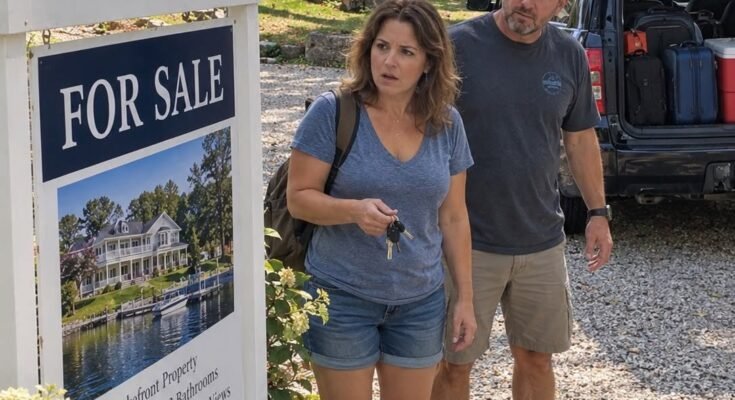
A silver SUV pulled into the driveway, towing Derek’s fishing boat. Paddleboards were strapped to the roof. The back was packed with suitcases, groceries, and coolers.
Derek climbed out wearing sunglasses and a Hawaiian shirt.
He stretched his arms as though he owned the entire lake.
Lauren stepped out carrying a grocery bag.
Then she saw the sign.
SOLD.
She stopped walking.
Derek came around the SUV, apparently wondering why she wasn’t moving.
Then he saw it too.
He removed his sunglasses.
For several seconds, neither of them moved.
Lauren approached the sign and noticed the envelope. She opened it and began reading.
I’d written:
Lauren,
The lake house has been sold. The Henderson family purchased it for Rachel and her two sons. I hope they’ll find the same happiness there that your father and I once dreamed of.
I also know about Derek’s rental business. I know how long it’s been operating, and I know about the reservations he made for this summer.
The unauthorized listing has been removed. The guests have been refunded. My lawyer is handling the financial investigation.
I don’t know how much you knew, sweetheart. That may be the hardest part of all.
I love you, and my door will always be open if you want to talk.
But I will never again ask permission to enter a home that belongs to me.
Love, Mom.
On the camera, Lauren read the letter twice.
Then she turned toward Derek.
He was staring at his phone, frantically tapping the screen.
Lauren held up the letter.
I couldn’t hear their conversation clearly, but I saw the moment Derek stopped arguing and looked away.
Then another vehicle entered the driveway.
It was the Henderson family’s white minivan.
Rachel stepped out with her parents. Two little boys climbed out of the back and immediately spotted the lake.
They ran toward the dock, laughing, their shoes pounding across the grass.
Rachel stood watching them, one hand pressed against her mouth.
Lauren looked from the children to the letter in her hand.
Then she walked over to Rachel.
They spoke briefly.
Rachel took my daughter’s hand.
A moment later, Lauren returned to the SUV.
Derek argued with Bill Henderson for several minutes before finally climbing back into the driver’s seat.
He reversed the trailer awkwardly, straightened it, and drove away.
I watched the two little boys sit at the end of the dock, kicking their feet above the water.
Then I closed the camera app.
And cried.
Not because I regretted selling the house.
Because somewhere between raising my daughter and trying to keep her close, I’d forgotten that loving someone didn’t mean letting them take everything.
That evening, at seven thirty, Lauren called.
“Mom,” she whispered.
“Hello, sweetheart.”
“How could you sell it without telling me?”
I closed my eyes.
“Lauren, did you know Derek was renting out my house?”
There was a long silence.
Then she said three words that broke my heart.
“Some of it.”
PART 3 — WHAT WE LEARNED TO KEEP
Lauren cried as she explained.
Derek had told her he’d rented the cottage a few weekends to help with their finances. His real estate commissions had dropped, and he claimed they needed extra income.
“He said we’d tell you eventually,” she whispered. “He said it wasn’t hurting anyone because you weren’t using the house.”
“And you believed that?”
“I wanted to.”
That answer hurt more than an excuse would have.
She admitted she’d known about some of the earlier rentals, but insisted she hadn’t known about the full summer schedule.
Then she told me something worse.
Derek had lost his job months earlier.
He’d hidden it from her, accumulated debts, and planned to use the summer rental income to keep his creditors away. Eventually, he hoped to convince me to transfer the cottage to Lauren as an early inheritance so he could borrow against it.
The house hadn’t simply become his source of income.
It had become his financial escape plan.
“Mom,” Lauren whispered, “I don’t know who I’ve been married to.”
“Where are you?”
“At a hotel. Derek’s downstairs. I don’t want to go home with him.”
I looked down the hallway toward her childhood bedroom.
“Then come here.”
She began crying again.
“After what I did?”
“Yes, Lauren. After what you did. I’m angry with you. You betrayed my trust, and we have a lot to work through. But you’re still my daughter.”
She arrived the next morning.
When I opened the door, she stood on the porch holding a small overnight bag. She looked exhausted, frightened, and suddenly much younger than thirty-four.
“Hi, Mom.”
I held out my arms.
She walked into them.
And for the first time in years, we held each other without pretending everything was fine.
The following weeks weren’t easy.
Lauren struggled with the collapse of her marriage. Derek called constantly, sometimes apologizing and sometimes blaming me for ruining his life.
Frank continued handling the unauthorized rental matter. Eventually, Derek, represented by his own attorney, agreed to repay the money he’d earned from my property. At my request, the repayment funds would go toward educational savings for Rachel’s two boys.
It wasn’t enough to undo the betrayal.
But I liked the thought that something good might come from money made by exploiting Paul’s dream.
In July, Lauren began divorce proceedings.
One evening, we sat together on my patio, watching fireworks rise above the neighborhood.
“I’m thirty-four,” she said, “and I don’t think I’ve ever learned how to stand on my own.”
“You’re learning now.”
“I’m scared.”
“I was scared when your father died.”
She looked at me.
“You always seemed so strong.”
I laughed softly.
“Lauren, I once put diesel fuel in my Subaru because your father had always filled the tank. It cost hundreds of dollars to repair.”
She laughed through her tears.
“And then,” I continued, “I bought a falling-down cottage and learned to rebuild it. Not because I was brave. Because I had to discover what I could do.”
She took my hand.
“Do you miss the lake?”
“Every day.”
“Do you regret selling it?”
I thought carefully before answering.
“Sometimes. I miss the porch. I miss the mornings. I miss feeling close to your dad. But I don’t regret choosing peace.”
Lauren leaned her head against my shoulder.
“Dad would be proud of you.”
“I hope so.”
“He would,” she said. “He used to tell me that houses were just wood and nails. It’s the people inside them that matter.”
I looked at her in surprise.
“Your father said that?”
“When Grandma’s house was sold. I cried because I thought we were losing her. Dad told me that the people we love don’t live inside buildings. They live inside us.”
I’d never heard that story.
But I needed to hear it.
A month later, Rachel called.
She wanted to thank me.
“The boys are different children here,” she said. “They’re swimming, fishing, laughing. My dad’s teaching them to bait hooks. Tommy caught his first bass last week.”
I smiled.
“Paul would have loved that.”
“And every morning,” Rachel continued, “I sit on the porch with my coffee and talk to my husband. I know it sounds strange.”
“No,” I whispered. “It doesn’t sound strange at all.”
She told me she’d found a little heart carved into the last board of the dock.
“Do you know who put it there?”
“A friend of mine. He helped me rebuild it years ago.”
“I’m keeping it,” she said. “Whatever happens to the dock, I’m keeping that board.”
After we hung up, I sat quietly for a long time.
Walt had carved that heart without explaining why.
Perhaps he knew that a house built with love would someday need to shelter someone else.
In September, I bought another cabin.
It was tiny, tucked away on a quiet lake in northern Wisconsin. It had one main room, a sleeping loft, a woodstove, and a porch just large enough for two rocking chairs.
No fancy kitchen. No expensive dock. No Wi-Fi worth mentioning.
And nobody else’s name on the property.
The cabin cost far less than I’d received from selling the lake house. I put much of the remaining money into my retirement savings, reserved some for Lauren’s future education, and established a scholarship in Paul’s memory for students who had lost a parent.
The Paul Brandt Memorial Scholarship.
I liked imagining that somewhere, a young person grieving the loss of a mother or father might receive a little help building the future they’d once dreamed of sharing.
By October, Lauren had moved into her own apartment and started working at a children’s grief support center. She was also exploring a master’s degree in social work.
She called one Friday afternoon.
“Mom, would it be okay if I visited the cabin this weekend?”
I smiled.
“Of course, sweetheart.”
“I’ll bring groceries.”
“Good. Because there’s not much here besides coffee and canned soup.”
She arrived that evening.
We spent three days fishing, walking through the woods, and playing cards beside the woodstove. She laughed more than she had in months.
On Sunday morning, I finally brought out the wooden sign I’d kept wrapped in my mother’s quilt.
BRANDT’S REST.
“Will you help me hang this?”
Lauren smiled.
Together, we carried the stepladder outside. She steadied it while I fastened the sign above the front door.
When we stepped back, it looked slightly too large for the little cabin.
The letters were still crooked.
And it was perfect.
“Dad would have loved this place,” Lauren said.
“Yes,” I answered. “I think he would.”
Before leaving, she looked at me.
“Mom, can I come back next summer?”
I pretended to consider it.
“For a week?”
“Maybe two?”
“You’ll need to bring your own groceries.”
“Deal.”
“And call first.”
She laughed.
“I always will.”
After she left, I sat on the porch with a cup of coffee.
There were two rocking chairs.
One was new.
The other was Paul’s old white chair, the one with the cigarette burn on its arm.
For years, I’d looked at that chair and seen only the person who wasn’t there.
But now Lauren’s forgotten sweater lay across its back. Her paperback book rested on the seat. She’d promised to return the following summer.
And for the first time, the chair didn’t feel like a symbol of everything I’d lost.
It felt like a reminder of everything I still had.
I watched the morning sunlight spread across the lake.
I’d once believed that keeping Paul’s dream meant holding on to the house we’d never gotten to share.
But I’d been wrong.
His dream had never really been about owning a particular piece of land.
It was about finding a place where we could be at peace.
I’d found that peace once. I’d lost it when I allowed other people to treat my kindness as something they were entitled to.
And now, finally, I’d found it again.
I looked at the crooked wooden sign above my door.
Then I looked at the empty chair beside me.
“Here we are, Paul,” I whispered. “A little smaller than we planned. A little later than we hoped.”
The lake shimmered in the morning light.
“But we made it.”
I sold the house my husband dreamed of, but I didn’t lose his dream. I finally understood it.
Because a home isn’t something you keep by letting people take advantage of you. It’s a place where love is welcome, respect is expected, and no one has to disappear to make somebody else comfortable.
And this time, I intended to enjoy my porch.
Every single morning.