PART 2 — The Waitress Who Remembered What Everyone Else Forgot
Walt picked up the folded receipt.
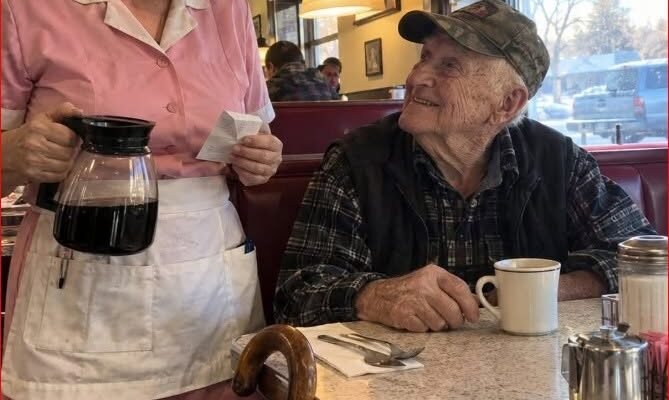
He had been coming to the Main Street Café for nearly fifty years, and in all that time, I had never seen him read anything so slowly.
He unfolded the paper, adjusted the glasses hanging from a cord around his neck, and stared at the three words written across the tip line.
GET A REAL JOB.
For several seconds, he didn’t move.
Then he looked up at my mother.
“Darlene, whose handwriting is this?”
Mom stood beside the booth with her coffee pot.
She didn’t answer immediately.
She simply reached over and filled his cup, leaving the usual half-inch of space at the top.
“Your son’s, Walt.”
The old man’s fingers tightened around the receipt.
“My Michael?”
Mom nodded.
“He came in Tuesday.”
Walt read the words again.
Then he took off his glasses.
I sat two booths away, pretending to study a newspaper I’d already read twice. I’d come because Mom had told me Walt would be there Sunday morning, and I wanted to understand why she had chosen to wait for him instead of confronting the man herself.
Now I was beginning to understand.
Walt carefully placed the receipt on the table.
“Did he give you trouble?”
Mom smiled faintly.
“Nothing I haven’t seen before.”
“That isn’t what I asked.”
She looked down.
“He sent his eggs back twice.”
Walt nodded slowly.
“And then he wrote this?”
“Yes.”
For a moment, the old man seemed to age another ten years.
He stared through the café window toward the empty street.
Then he whispered something I could barely hear.
“I thought I raised him better.”
Mom pulled the opposite chair out slightly.
“Walt, don’t do that.”
He looked at her.
“Don’t do what?”
“Make your son’s behavior your punishment.”
His eyes filled.
“He’s fifty-eight years old. If he hasn’t learned how to treat people by now, that’s his responsibility.”
Walt looked at her for a long moment.
Then he gave a small, sad smile.
“You always did have a way of telling me the truth without making me feel small.”
Mom patted his shoulder.
“Now, are you having breakfast or not?”
He looked down at the menu.
“I already told you.”
She smiled.
“The usual from 1979.”
He nodded.
“The usual.”
Mom turned toward the kitchen.
“Two eggs over easy, hash browns, rye toast, and one pancake on a separate plate.”
Walt closed his eyes.
“And don’t forget the apple butter.”
“As if I ever have.”
I watched her walk away.
Then I slid out of my booth and approached Walt.
“Morning, Mr. Bellamy.”
He looked up.
“Goodness. Look who’s here.”
He smiled.
“Your mother still making you eat breakfast?”
“Somebody has to.”
He chuckled.
I sat across from him.
For a moment, neither of us spoke.
Then I looked at the receipt.
“I’m sorry about what Michael wrote.”
Walt shook his head.
“Don’t apologize for my son.”
I hesitated.
“Mom said you’ve been ordering the same breakfast since 1979.”
He looked toward the kitchen.
“That’s right.”
“Why?”
Something changed in his face.
Not sadness exactly.
Something older.
He folded his hands on the table.
“My wife, Ruth, loved this place.”
I knew Walt had been widowed.
But I’d never heard much about his wife.
He smiled faintly.
“She ordered the same breakfast every Sunday. Two eggs, hash browns, rye toast, apple butter. And one pancake for our little boy.”
“Michael?”
Walt nodded.
“He was eleven.”
I looked down at the table.
“She died in November of 1979.”
His voice softened.
“Cancer.”
For a moment, he stared at the empty seat beside him.
“After the funeral, I couldn’t stand being in our kitchen on Sunday mornings. Everything reminded me of her.”
He gave a small shrug.
“So I brought Michael here.”
“Every Sunday?”
“Every Sunday.”
He smiled.
“He’d sit right there where you’re sitting, and we’d order Ruth’s breakfast.”
I glanced toward the kitchen.
“Mom didn’t start here until 1982.”
“No.”
Walt nodded.
“Mabel served us before that.”
He laughed softly.
“Your mother took over the morning shift after Mabel retired. First Sunday, I told her I wanted the usual from 1979.”
“What did she say?”
“She said, ‘Well, I wasn’t working here in 1979, so you’d better explain yourself.’”
I laughed.
That sounded exactly like Mom.
Walt smiled.
“I told her about Ruth.”
His eyes drifted toward the kitchen again.
“And she never forgot.”
Just then, Mom returned carrying two plates.
She placed the eggs, potatoes, and toast in front of Walt.
Then she set the pancake on the opposite side of the table.
In front of me.
“Here you go.”
I looked up.
“Mom, I didn’t order anything.”
“I know.”
She smiled.
“But Walt’s breakfast has always come with one extra pancake.”
Walt’s eyes filled.
He picked up his fork.
Then put it down again.
“Darlene?”
“Yes?”
“Do you remember the winter the foundry closed?”
Mom went still.
“Of course.”
“1983.”
She nodded.
“I remember.”
Walt looked at me.
“I lost my job that January.”
His voice trembled slightly.
“The foundry shut its doors. Ruth was gone. I had a thirteen-year-old son and less than forty dollars in the bank.”
I stared at him.
“I didn’t know that.”
“Most people didn’t.”
He looked down at the pancake.
“I’d bring Michael here on Sundays because it was the one thing that still felt like life before his mother died.”
He swallowed.
“Then one morning, I realized I couldn’t afford it anymore.”
Mom looked away.
Walt continued.
“I told Darlene we were just having coffee that day.”
He smiled sadly.
“She brought the usual anyway.”
I looked at Mom.
She had started wiping a perfectly clean section of counter.
Walt watched her.
“When I told her I didn’t have the money, she said the owner was running a special.”
Mom shook her head.
“Walt.”
He ignored her.
“Two breakfasts for the price of coffee.”
I stared at him.
“Seriously?”
He nodded.
“For almost three months.”
My mouth fell open.
Mom gave an embarrassed little laugh.
“It wasn’t that long.”
“Eleven Sundays,” Walt said immediately.
She looked surprised.
“You counted?”
“I counted everything back then.”
He reached into the inside pocket of his church coat.
Then he took out a worn leather wallet.
It was so old the edges had turned pale.
He opened it carefully and removed a folded piece of paper.
The paper looked fragile.
Yellowed.
Almost transparent along the creases.
He handed it to me.
It was an old café receipt.
Dated March 6, 1983.
At the bottom, in my mother’s handwriting, were four words.
PAID IN FULL. DARLENE.
I looked at Mom.
Her eyes had filled.
“Walt, why on earth did you keep that?”
He looked at her.
“Because that was the morning you told me Michael didn’t have to be hungry just because I was out of work.”
I couldn’t breathe.
Walt continued.
“You fed my boy when I couldn’t.”
Mom shook her head.
“It was a couple of breakfasts.”
“No.”
His voice became firm.
“It was more than that.”
He looked toward me.
“There was one Sunday Michael asked if he could take the pancake home.”
My throat tightened.
“Why?”
“Because he wanted to save half for Monday.”
I looked at Mom again.
Her expression had changed.
She remembered.
Walt continued.
“Your mother went into the kitchen and came back with a paper bag.”
He smiled through his tears.
“Two sandwiches, an apple, and a piece of pie.”
Mom covered her mouth.
“She told Michael the cook had made too much food.”
Walt shook his head.
“But I saw her put money in the register.”
The café seemed strangely quiet.
I could hear the refrigerator humming behind the counter.
The faint scrape of a fork against a plate.
And my own heartbeat.
Walt carefully folded the old receipt.
“That’s how I knew.”
Mom wiped her eyes.
“Walt, you eventually paid me back.”
“I know.”
He smiled.
“You tried to give it back.”
They both laughed.
Then Walt looked down at the newer receipt.
The one his son had written on Tuesday.
His smile disappeared.
“My boy grew up.”
He paused.
“Went to college. Got himself an important job. Started wearing suits that cost more than my first car.”
He looked at me.
“And somehow, somewhere along the way, he forgot who helped us get there.”
Mom sat down across from him.
For once, she wasn’t worried about taking a break during her shift.
“Walt, your son had a bad day.”
He looked directly at her.
“Don’t make excuses for him.”
She fell silent.
He continued.
“A bad day might explain being short-tempered.”
He tapped the receipt.
“This took thought.”
Then he said something I’ve never forgotten.
“Darlene, you didn’t spend forty-four years here because you couldn’t find a real job.”
His voice cracked.
“You spent forty-four years doing a real job that people like my son have forgotten how to respect.”
Mom started crying.
She quickly wiped her cheeks.
“Oh, hush. You’re going to make my customers think something’s wrong.”
Walt smiled sadly.
“Something is wrong.”
He put his glasses back on.
“And I intend to speak to Michael about it.”
I thought that would be the end of the story.
But twenty minutes later, the café door opened.
And the man in the expensive suit walked in.
Michael Bellamy.
The same man who had sent his eggs back twice and left my mother no tip.
He paused just inside the entrance.
His eyes moved across the room.
Then settled on Walt.
“Dad?”
Walt didn’t stand.
“Morning, Michael.”
Michael approached the booth.
“What’s going on? You said you needed to talk to me.”
Walt gestured toward the seat beside me.
“Sit down.”
Michael glanced at me.
Then at the empty pancake plate.
“I’ve got a meeting at nine.”
Walt looked at his watch.
“Then you’ve got forty minutes.”
Michael sighed.
But he sat.
Mom was standing behind the counter.
She saw him.
For just a moment, her expression tightened.
Then she picked up the coffee pot.
Because that was who my mother was.
Even after what he’d written, she was prepared to do her job.
When she reached the table, Michael looked up.
Recognition flashed across his face.
“Oh.”
Mom nodded politely.
“Good morning.”
He looked uncomfortable.
“Morning.”
“Coffee?”
He hesitated.
Then nodded.
“Please.”
Mom filled his cup.
“Cream?”
“No, thank you.”
She placed the pot back on the tray.
“Let me know if you need anything.”
Then she walked away.
Walt watched his son closely.
“Do you recognize her?”
Michael frowned.
“The waitress?”
Walt’s face hardened.
“Her name is Darlene.”
Michael looked confused.
“Okay.”
“Do you recognize her?”
Michael glanced toward the counter.
“I don’t know. She looks familiar.”
Walt nodded slowly.
“She should.”
Then he slid the folded receipt across the table.
Michael looked at it.
I watched his expression change.
First annoyance.
Then recognition.
Then embarrassment.
“Dad, where did you get this?”
“Darlene gave it to me.”
Michael immediately looked toward the counter.
“Why?”
Walt stared at him.
“Why do you think?”
Michael’s jaw tightened.
“It was a frustrating morning.”
I felt anger rise in my chest.
Walt remained calm.
“Was it?”
“Yes.”
“The eggs were wrong twice.”
Walt nodded.
“So you told her to get a real job?”
Michael sighed.
“Dad, it was just a stupid comment.”
Walt looked at him for a long moment.
Then he reached into his wallet.
And placed the old 1983 receipt beside the new one.
“Read that.”
Michael frowned.
“What is it?”
“Read it.”
Michael picked up the yellowed paper.
His eyes moved over the faded handwriting.
Then he looked up.
“Paid in full. Darlene.”
Walt nodded.
“Do you remember this place when you were a boy?”
Michael glanced around.
“Of course.”
“Do you remember the Sunday pancakes?”
A faint smile appeared.
“Sure.”
“Do you remember asking to take half of one home?”
Michael’s smile disappeared.
He looked at his father.
“Dad.”
“Do you?”
Michael swallowed.
“Yeah.”
Walt leaned forward.
“Do you remember why?”
For several seconds, Michael didn’t answer.
Then he looked down.
“Because we didn’t have much food.”
Walt nodded.
“That’s right.”
He tapped the old receipt.
“Darlene paid for our breakfasts during the months I was out of work.”
Michael’s head lifted.
“What?”
“Eleven Sundays.”
Walt’s voice remained steady.
“She fed us because she knew I was ashamed to ask for help.”
Michael stared at the old receipt.
Then toward the counter.
Mom was taking another customer’s order.
Smiling.
Writing something on her pad.
She had no idea what Walt was saying.
Or perhaps she knew exactly what he would say.
Walt continued.
“The woman you told to get a real job helped keep food in your stomach when I couldn’t.”
Michael’s face drained of color.
“Dad, I didn’t know.”
“No.”
Walt nodded.
“You didn’t.”
Then he leaned back.
“But here’s the part you need to understand.”
His voice became quiet.
“She wouldn’t have needed to feed you forty-three years ago for that note to be cruel.”
Michael stared at him.
“You could’ve written it to a stranger, and it still would’ve been wrong.”
Nobody spoke.
Walt looked down at the two receipts.
“One is from a waitress who earned her living honestly and used what little she had to help a family.”
He placed his finger on the newer one.
“And the other is from a man who earns more money than I ever dreamed of and used a restaurant receipt to make somebody feel worthless.”
Then he asked,
“Which one of those people needs to get a real job?”
Michael’s eyes filled.
For the first time, he had no answer.
I looked toward Mom.
She was carrying a plate of pancakes to an elderly couple.
She smiled as she set them down.
Then she asked whether they needed more coffee.
I wondered if she had any idea how many lives she’d touched in forty-four years.
Probably not.
People like Mom rarely keep track.
They simply show up.
Day after day.
Doing work that matters even when nobody applauds.
Michael wiped his face.
“Dad, I didn’t mean it like that.”
Walt shook his head.
“Then how did you mean it?”
Michael opened his mouth.
Closed it.
Then finally whispered,
“I don’t know.”
Walt nodded.
“That’s what worries me.”
For a while, the three of us sat quietly.
Then Michael stood.
He looked toward the counter.
“I need to apologize.”
Walt didn’t stop him.
But he said one thing.
“Don’t do it because she’s Darlene.”
Michael turned.
“What?”
“Don’t apologize just because she once helped us.”
Walt looked directly at him.
“Apologize because what you did was wrong.”
Michael nodded slowly.
Then he walked toward my mother.
I watched him approach the counter.
Mom looked up.
“Need something else?”
Michael stopped.
For several seconds, he seemed unable to speak.
Then he said,
“Mrs. Darlene?”
She tilted her head.
“Yes?”
He swallowed.
“I owe you an apology.”
Mom became still.
Michael continued.
“I was rude to you on Tuesday.”
“Yes,” Mom said quietly.
He looked embarrassed.
“I sent my food back twice.”
“That was your right if something was wrong.”
He nodded.
“But writing that on the receipt wasn’t.”
“No.”
Mom’s answer was simple.
Firm.
Michael looked down.
“My father told me what you did for us when I was a boy.”
Mom glanced toward Walt.
Her face softened.
“That was a long time ago.”
Michael shook his head.
“I know.”
His voice cracked.
“But I didn’t know.”
She looked at him.
“You were just a child.”
He nodded.
Then said something I hadn’t expected.
“I don’t remember being hungry as much as I remember Dad telling me things would be okay.”
Walt looked down at his coffee.
Michael continued.
“I guess that’s because people like you helped him keep that promise.”
Mom’s eyes filled.
Michael took a breath.
“I’ve spent a lot of my life thinking success meant getting far away from the kind of work my father did.”
He looked toward Walt.
“Or the kind of work you do.”
Then he swallowed.
“And somewhere along the way, I started treating people who work hard with their hands like they were less important.”
My mother stood quietly.
Michael continued.
“I’m sorry.”
Mom nodded.
“Thank you for saying that.”
He hesitated.
Then reached for his wallet.
“Can I leave you something?”
I stiffened.
Here we go, I thought.
A wealthy man trying to purchase forgiveness.
But Mom surprised both of us.
She gently raised one hand.
“Michael, put your wallet away.”
He froze.
“I just wanted to—”
“I know.”
She smiled sadly.
“But the problem wasn’t the tip.”
Michael looked confused.
Mom continued.
“I’ve gone home with empty pockets before.”
“I’ve worked shifts where I barely made enough to cover gas.”
“And I’ve had customers who couldn’t afford to leave anything.”
She looked directly into his eyes.
“That doesn’t bother me.”
Then her voice became firmer.
“What bothers me is somebody looking at an honest day’s work and deciding it makes the person doing it less worthy of respect.”
Michael lowered his eyes.
Mom continued.
“I’m sixty-eight years old.”
“I have worked here since I was twenty-four.”
“I’ve raised children.”
“Paid taxes.”
“Bought groceries.”
“Buried friends.”
“Helped customers celebrate births, anniversaries, graduations, and retirements.”
She looked around the diner.
“And I’ve served coffee to people who had just received the worst news of their lives.”
For a moment, her voice trembled.
“This is a real job, Michael.”
He started crying.
Mom nodded.
“I’m glad you understand that now.”
I felt tears running down my own cheeks.
Because in all my years watching Mom work, I’d never heard her speak so openly about what those years had meant.
Michael wiped his eyes.
“Is there anything I can do?”
Mom thought about it.
Then said,
“Yes.”
He looked up hopefully.
“Tell me.”
“The next time a waitress gets your order wrong, remember she’s a person.”
Michael nodded.
“And if you’re having a terrible day, don’t make her carry it home.”
His shoulders shook.
“Yes, ma’am.”
Mom smiled.
“Good.”
Then she picked up her coffee pot.
“Now, would you like something to eat?”
Michael let out a shaky laugh.
He looked toward Walt.
Then back at Mom.
“Actually, yes.”
“What’ll it be?”
He swallowed.
“The usual.”
Mom tilted her head.
“From 1979?”
Michael nodded.
“Yes, ma’am.”
Mom smiled.
“Coming right up.”
When she walked away, Michael returned to the booth.
Walt didn’t speak.
Neither did I.
Michael sat in the seat where he’d eaten pancakes as a boy.
His phone remained in his pocket.
For the first time that morning, he seemed completely present.
When the food arrived, Mom placed a pancake on a separate plate in front of him.
Michael stared at it.
Then covered his face.
Walt reached across the table.
He rested one weathered hand on his son’s wrist.
And for a moment, I saw two people sitting in that booth who were separated by nearly fifty years.
A tired father.
A frightened boy.
One plate of eggs.
One pancake.
And a waitress who had quietly helped them survive a difficult season.
Michael picked up his fork.
He took a bite of pancake.
Then laughed through his tears.
“Still the same.”
Mom smiled.
“Why change something that works?”
That Sunday became the beginning of something.
Not a perfect ending.
Michael didn’t suddenly turn into the kindest man in town.
People rarely change completely over one breakfast.
But he started trying.
The following Tuesday, he came back.
No suit.
Just jeans and a blue shirt.
He sat in Mom’s section.
When she approached, he smiled.
“Morning, Darlene.”
“Morning, Michael.”
“Eggs over easy.”
She raised an eyebrow.
“Are you sure?”
He laughed.
“Whatever way the cook makes them is fine.”
Mom chuckled.
“Don’t go getting sentimental on me.”
When he finished, he paid his bill.
Left an ordinary, generous tip.
And wrote something on the receipt.
Not a long apology.
Not a dramatic declaration.
Just:
Thank you for your work.
Mom brought that receipt home.
I was sitting at the kitchen table when she unfolded it.
She placed it beside the first one.
Get a real job.
Thank you for your work.
Two receipts.
Same handwriting.
Completely different meaning.
I looked at her.
“Are you going to keep both?”
She nodded.
“Why?”
Mom smiled.
“Because one reminds me that people can be cruel.”
She touched the second receipt.
“And the other reminds me that they don’t always have to stay that way.”
I sat quietly.
Then asked the question that had been bothering me since Tuesday.
“Mom, why didn’t you confront him yourself?”
She thought about it.
“I could’ve.”
“Then why wait for Walt?”
She sat across from me.
“Because I knew his father.”
I frowned.
“What does that mean?”
Mom folded her hands.
“I’ve watched Walt come into that café every Sunday since I was twenty-four.”
“I’ve watched him grow old.”
“I’ve watched Michael grow up.”
“And I knew there was a story behind that family his son had probably forgotten.”
She smiled sadly.
“I wasn’t trying to get revenge.”
“Then what were you trying to do?”
She looked down at the receipt.
“I wanted someone who loved Michael to remind him of the kind of man he used to want to be.”
That answer stayed with me.
For months afterward, Michael continued coming to the café.
Sometimes alone.
Sometimes with Walt.
He learned the names of the younger waitresses.
Asked about their families.
Stopped taking business calls at the table.
And whenever somebody treated the staff rudely, he became noticeably uncomfortable.
One morning, a customer snapped at a young waitress because his toast was burned.
I happened to be there.
Michael was sitting two booths away.
He looked up.
Then said quietly,
“Sir, she offered to replace it. There’s no need to talk to her that way.”
The man grumbled.
But stopped.
Mom saw the exchange.
She said nothing.
Just refilled Michael’s coffee.
But I noticed the little smile she tried to hide.
Walt eventually became too unsteady to drive himself.
Michael started picking him up every Sunday.
At first, they arrived at seven fifteen.
Then seven thirty.
Then eight, because Walt insisted on finding his seed cap before leaving the house.
Mom always saved the booth when she could.
And every Sunday, she brought them the usual.
Two eggs.
Hash browns.
Rye toast.
Apple butter.
And one pancake on a separate plate.
Walt never stopped calling it breakfast from 1979.
A year later, on Mom’s sixty-ninth birthday, Michael surprised her.
He didn’t bring an expensive gift.
Didn’t make a speech.
Didn’t hand her a check.
He brought Walt to the café carrying an old photograph.
It showed Main Street in the winter of 1983.
Snow along the curb.
A faded pickup truck parked outside.
And standing beside the café entrance was a young woman in a white apron.
My mother.
She was twenty-five.
Her hair was pulled back.
She was smiling.
Beside her stood a much younger Walt.
And a skinny teenage boy wearing a coat several sizes too big.
Michael.
On the back, Walt had written:
Darlene, thank you for making sure my boy never felt poor at your table.
Mom stared at the photograph for a long time.
Then she started crying.
Michael looked embarrassed.
“Dad found it in an old shoebox.”
Walt grinned.
“I find all kinds of things in shoeboxes.”
Mom laughed through her tears.
Then she placed the photograph beside the register.
It stayed there.
Customers asked about it.
Mom told them the story.
Not the part about the insulting receipt.
Not usually.
She told them about a father raising his son alone.
About a difficult winter.
About the Sunday pancake.
And about how people sometimes remember kindness decades after the person who offered it has forgotten.
Two years later, Walt passed away peacefully in his sleep.
He was ninety-three.
When Michael called Mom with the news, his voice broke.
“Darlene, Dad wanted you to know something.”
She sat down.
“What is it, sweetheart?”
“He said you were one of the reasons he never lost faith in people.”
Mom cried.
So did I when she told me.
At the funeral, Michael asked whether Mom would sit in the front row with the family.
She hesitated.
“Oh, Michael, that isn’t necessary.”
He looked at her.
“Yes, it is.”
Then he said something that brought tears to both their eyes.
“When Dad had nobody else, you helped him take care of me.”
He swallowed.
“You were part of our family long before I was old enough to understand what that meant.”
Mom took his hand.
And sat beside him.
After the service, Michael gave her a small envelope.
Inside was Walt’s old leather wallet.
He’d left it to Mom in a handwritten note.
She opened it carefully.
Tucked into one of the worn compartments was the receipt from March 6, 1983.
Still folded.
Still fragile.
Still bearing my mother’s handwriting.
PAID IN FULL. DARLENE.
On another scrap of paper, Walt had written:
I paid back the money years ago, Darlene. But I never found a way to repay the kindness. You gave my son breakfast when I was afraid I couldn’t give him enough. Thank you for treating us like we still had something worth being proud of.
Mom held the note against her chest.
I put my arm around her.
For a long time, neither of us spoke.
Later that year, Mom finally reduced her hours at the café.
She didn’t retire completely.
I tried to convince her.
“Mom, forty-four years is enough.”
She laughed.
“Who says?”
“Your knees.”
“They complain about everything.”
I smiled.
“Why keep working?”
She thought about it.
Then looked toward the photograph beside the register.
“Because I still like being here.”
And that was the answer.
She wasn’t trapped.
She wasn’t ashamed.
She wasn’t waiting for someone important to offer her a more respectable life.
She had built a respectable life right there.
One cup of coffee at a time.
Today, Mom is seventy-one.
She works three mornings a week.
Mostly because she enjoys seeing the regulars.
Michael still comes in on Sundays.
Sometimes he brings his daughter.
Sometimes his grandchildren.
He orders breakfast from 1979 and tells the children about the man who used to sit in that booth with a seed cap and an old church coat.
He tells them their great-grandfather worked hard.
Loved his family.
And never forgot the people who helped him.
Then he tells them about Darlene.
The waitress who fed a hungry boy without making him feel ashamed.
Last month, I stopped by the café and found Mom sitting with Michael after the breakfast rush.
She was laughing at something he’d said.
The old photograph was still beside the register.
And beneath it, in a small wooden frame, were two receipts.
The first one read:
GET A REAL JOB.
The second read:
THANK YOU FOR YOUR WORK.
I looked at Mom.
“You finally framed them?”
She smiled.
“Michael’s daughter did.”
I frowned.
“Why would you want that first one where everybody can see it?”
Mom looked at the frame.
Then at me.
“Because I want people to remember that words matter.”
She tapped the first receipt.
“Three words can make someone feel small.”
Then she pointed to the second.
“And five words can help somebody remember their dignity.”
I looked at her.
“But you already had dignity, Mom.”
She smiled.
“I know that, honey.”
Then she said something I’ll never forget.
“The apology didn’t give it back to me. I never lost it.”
I stood there looking at my mother.
Sixty-eight when the insult happened.
Forty-four years into a job she had performed with care.
A woman who had raised children, helped strangers, buried people she loved, and continued showing up before sunrise because others depended on her.
And I realized something.
The man in the expensive suit had thought a waitress was somebody whose life hadn’t turned out very well.
But in the end, the most important lesson his father taught him came from that waitress.
Not from a college.
Not from a corporate office.
Not from a business conference.
From a woman carrying a coffee pot in a small-town diner.
I used to think Mom should have confronted Michael that Tuesday.
Part of me still does.
I wanted to see her stand up for herself.
I wanted him embarrassed.
I wanted someone to tell him exactly what kind of person leaves no tip and writes something cruel on a receipt after another human being has spent twenty minutes trying to make his breakfast right.
But Mom understood something I didn’t.
She wasn’t interested in winning an argument with a rude customer.
She was interested in making sure he understood what he’d done.
And the person who could reach him was the ninety-one-year-old father who still remembered a waitress paying for breakfast when his little boy was hungry.
The lesson didn’t come from punishment.
It came from memory.
And perhaps that’s why it lasted.
Because when Walt laid those two receipts beside each other, he wasn’t simply showing his son that he’d been unkind.
He was showing him the difference between the man he had become and the people whose sacrifices had helped him get there.
A woman with an apron.
A father with calloused hands.
A cook working behind a hot grill.
People who rarely appeared in photographs celebrating success.
But without whom that success might never have happened.
My mother has served thousands of breakfasts during her years at the Main Street Café.
Most people don’t remember who poured their coffee.
Most don’t know the waitress’s name.
Many leave a few dollars and go about their day.
And that’s fine.
Mom never needed applause.
She simply wanted to work honestly, treat people decently, and come home knowing she’d done something useful.
But somewhere in that little café, on a cold Sunday in 1983, she helped a frightened father feed his son.
Forty-three years later, that same son told her to get a real job.
And his father reminded him what her real job had meant.
Some people measure a career by the size of the paycheck.
Others measure it by the title on the office door.
My mother measured hers by the people she served.
And when I think about that old receipt now, I don’t remember the insult.
I remember a ninety-one-year-old man in overalls, sitting in his favorite booth, ordering breakfast from 1979.
I remember him holding two pieces of paper.
One cruel.
One kind.
And I remember the words he said before his son arrived that Sunday morning.
“Your mother fed my boy when I couldn’t.”
He looked toward the kitchen.
Then smiled through his tears.
“That’s about as real a job as anybody ever had.”