PART 2 — She Destroyed My Boys’ Halloween. Then the Whole Neighborhood Found Out.
“What the hell did you do?!”
Mrs. Whitmore stood on her front porch, staring at the cardboard box I’d placed beside her welcome mat.
Inside were the decorations she’d destroyed.
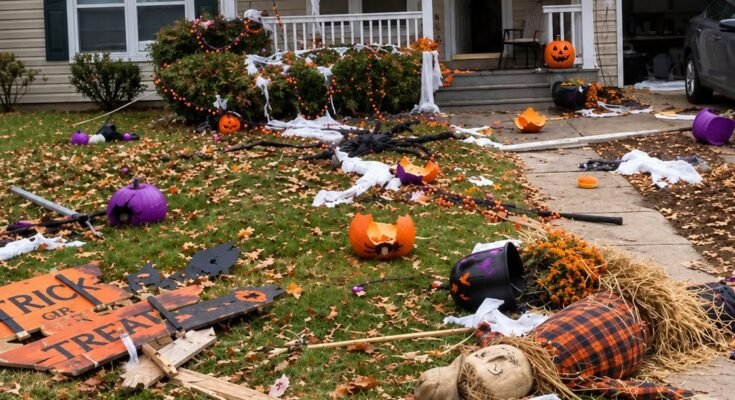
The crushed milk-jug lanterns, the torn ghosts, and the broken cardboard tombstones. I’d arranged them carefully, exactly as I’d found them scattered across my yard and stuffed into the trash.
But that wasn’t what had made her scream.
Resting on top was a photograph of my husband, Joel, sitting on our porch three years earlier with our two boys. They were surrounded by the very same Halloween decorations, laughing as he helped them paint faces on empty milk jugs.
I’d written six words across the back.
THESE WERE THEIR FATHER’S LAST HALLOWEEN DECORATIONS.
Mrs. Whitmore’s face had turned bright red.
“Get this garbage off my porch!”
I stood at the edge of her walkway.
“That’s what you called it, wasn’t it?”
She pointed at the box. “You have no right coming onto my property!”
I looked at her for a moment.
“Mrs. Whitmore, you came onto my property while I was at work. You cut down decorations my children made, smashed their lanterns, and threw away things their father helped them build before he died.”
She opened her mouth, but I continued.
“I brought the pieces here because I wanted you to see what you actually destroyed.”
Her expression changed slightly.
Then she glanced down at the photograph.
For the first time, she looked uncertain.
“I didn’t know your husband made those.”
I swallowed.
“You never asked.”
She looked away.
I bent down, picked up the box, and stepped back toward the sidewalk.
“And you didn’t need to know who made them to understand they weren’t yours to destroy.”
Mrs. Whitmore folded her arms.
“They were blocking my view.”
I turned toward the enormous red maple in her front yard.
Its leaves were brilliant that October, almost glowing in the late-afternoon sunlight.
Then I looked back at her.
“Your tree is beautiful, Mrs. Whitmore. I’ve always thought so. But my boys’ decorations were beautiful to them too.”
She said nothing.
I carried the box back across the street.
Behind me, I heard her front door slam.
I didn’t smile anymore.
Because the moment I stepped into our house, I found my youngest son sitting at the kitchen table with one of the broken lanterns in his lap.
Caleb was seven.
His older brother, Noah, was ten.
Both had inherited Joel’s dark hair and his habit of becoming very quiet when they were hurt.
Caleb looked up.
“Mom, can you fix his face?”
He held out the lantern.
It was a plastic milk jug with a crooked orange smile. Joel had drawn the face himself, adding one enormous tooth because Caleb was missing a front tooth that Halloween.
I remembered the three of them laughing so hard that Joel spilled paint on the kitchen floor.
He’d never completely removed the stain.
I still hadn’t either.
I sat beside Caleb and examined the cracked plastic.
“I can try, sweetheart.”
He nodded seriously.
“Daddy made this one.”
“I know.”
His bottom lip trembled.
“Why did she break Daddy’s pumpkin?”
I had no good answer.
Because she was selfish?
Because she didn’t care about other people’s feelings?
Because some adults think being older gives them permission to be cruel?
None of those answers seemed right for a seven-year-old.
So I put my arm around him.
“Sometimes people do something wrong because they’re only thinking about themselves.”
Caleb pressed his face against my shoulder.
“I miss Daddy.”
That was when I started crying too.
Noah stood in the doorway watching us.
He’d been trying to hold himself together since we arrived home.
But when he saw me crying, his eyes filled.
“Mom?”
“Yes, honey?”
“Did we do something bad?”
I looked at him in disbelief.
“What?”
He stared at the floor.
“Mrs. Whitmore said we were making the street ugly. Maybe we shouldn’t have put up so much stuff.”
My heart broke all over again.
I reached for him.
“Noah, come here.”
He sat beside us.
I wrapped my arms around both boys.
“You didn’t do anything wrong. Our decorations were on our property. They weren’t hurting anyone. And you worked hard on them.”
“But she hated them.”
I kissed the top of his head.
“Some people won’t like things you make, sweetheart. That doesn’t mean they’re allowed to destroy them.”
He thought about that.
Then asked quietly, “What would Dad have done?”
I smiled through my tears.
“Oh, your father would’ve had plenty to say.”
Caleb looked up hopefully.
“Would he yell?”
“Probably not.”
“Would he call the police?”
“Maybe.”
Noah leaned closer.
“What else?”
I thought about Joel.
His ridiculous Halloween sweaters.
The way he made decorations out of whatever was in the recycling bin.
His insistence that we never spend money on something we could build together.
Then I said, “I think he’d tell us to make something even better.”
Both boys looked at me.
“Really?” Caleb asked.
I nodded.
“Really.”
But first, I had something else to do.
I opened the security camera app Joel had installed beside our garage.
I hadn’t checked it in weeks.
The camera faced our driveway and front yard.
I scrolled backward through that afternoon’s recordings.
And there she was.
At 2:14 p.m., Mrs. Whitmore crossed the sidewalk carrying gardening shears and a large trash bag.
The footage was perfectly clear.
She cut down our ghosts.
Pulled the string lights from the porch railing.
Crushed the milk-jug lanterns beneath her shoes.
Then she gathered the cardboard tombstones and carried them toward our trash cans.
At one point, she picked up the crooked-tooth lantern.
She examined it for a moment.
Then stomped on it.
I stared at the screen.
That was the lantern Joel had made.
The one Caleb had just asked me to repair.
Something inside me went cold.
I saved the recording.
Then I called the police nonemergency number.
An officer arrived later that evening, took photographs, and watched the footage.
He explained how I could file a property-damage report and pursue restitution.
When I told him some of the decorations had been made by my late husband, his expression softened.
“I’m sorry your children had to see that.”
I nodded.
“Thank you.”
He looked toward Mrs. Whitmore’s house.
“Whatever disagreement she had with your decorations, she wasn’t entitled to come onto your property and destroy them.”
Those words mattered.
For an entire afternoon, my boys had been wondering whether they’d done something wrong.
Now an adult who wasn’t their mother had confirmed they hadn’t.
After the officer left, I tucked the children into bed.
Then I sat at the kitchen table.
The broken decorations were spread across the surface.
I picked up the crooked-tooth lantern and looked at the tiny paint stain Joel had left near its handle.
For a moment, I could almost hear him.
Honey, it’s Halloween. Things are supposed to look a little ridiculous.
I laughed softly.
Then I cried again.
Because grief is strange that way.
You can survive the funeral.
You can learn to pay the bills alone.
You can manage school pickups, broken appliances, and sick children.
Then one little plastic pumpkin breaks, and suddenly you’re standing in the middle of everything you’ve lost.
I stayed at that table until nearly midnight.
The next morning, I received a call from my neighbor Carla.
She lived three houses down.
“Is it true?” she asked.
“Is what true?”
“That Margaret Whitmore destroyed the boys’ decorations?”
I sighed.
“Yes.”
Carla went silent.
Then said, “Oh, absolutely not.”
I almost laughed.
“Carla, please don’t start a neighborhood war.”
“Who said anything about war?”
Her tone was suspiciously cheerful.
“I was thinking more along the lines of a community art project.”
I frowned.
“What?”
“You’ll see.”
Before I could argue, she hung up.
By lunchtime, the neighborhood group was full of messages.
Carla had posted a photograph of Noah and Caleb beside last year’s decorations.
She didn’t name Mrs. Whitmore.
She didn’t share the security footage.
Instead, she wrote:
Two boys in our neighborhood lost their father a few years ago. Every Halloween, they’ve kept his memory alive by making decorations together, just as they did when he was here. Sadly, their display was destroyed this week.
Some of us are getting together Saturday morning to help them rebuild. Bring cardboard, old sheets, paint, battery lights, or just a willingness to make something silly. Every child deserves a little Halloween magic.
I read the post three times.
Then the comments began appearing.
We’ll be there.
My husband has leftover plywood.
I have six clean milk jugs.
The kids and I would love to help.
Tell the boys we loved their ghosts.
Within two hours, twenty-seven families had offered to come.
I sat at the kitchen table staring at my phone.
Then I began crying.
Again.
Apparently, I had become the neighborhood’s official crying woman.
When Saturday arrived, I understood just how wrong I had been about one thing.
I thought the decorations mattered only to us.
At nine o’clock, cars began arriving.
Carla came first, carrying pumpkin muffins and two enormous boxes of supplies.
Mr. Lawson, a retired carpenter from the corner house, brought lumber.
Three teenagers arrived with paintbrushes.
A young couple brought extension cords and battery lights.
Someone carried a giant bag of old bedsheets.
Another neighbor brought pumpkins from his family’s farm.
By ten, our driveway looked like a Halloween workshop.
Noah stood on the porch staring.
“Mom?”
“Yes?”
“Are all these people coming to help us?”
I nodded.
He looked at the crowd.
“Why?”
Before I could answer, Mr. Lawson walked over.
He was seventy-three, with a gray beard and the kind of hands that told you he’d been fixing things for most of his life.
“Because your dad was a good man,” he said.
Noah stared at him.
“You knew my dad?”
“Sure did.”
Mr. Lawson smiled.
“Your father helped me repair my fence after that windstorm. Wouldn’t take a dollar.”
I remembered that day.
Joel had come home covered in mud.
He said Mr. Lawson had been trying to lift fence panels alone, and he couldn’t stand watching somebody do a two-man job by himself.
Mr. Lawson looked at Noah.
“He told me neighbors ought to look out for each other.”
My throat tightened.
“So today,” Mr. Lawson continued, “we’re looking out for you.”
Noah burst into tears.
Mr. Lawson pulled him into a hug.
I had to look away.
By noon, the front yard was full of laughter.
Caleb supervised a group of children painting pumpkins.
Noah helped Mr. Lawson construct wooden supports for the ghosts.
Carla organized a table where people made lanterns from milk jugs.
And I stood there watching the neighborhood give my boys something I hadn’t known they needed.
Proof that their father had left more behind than memories.
He had left kindness.
People remembered him.
And now that kindness was finding its way back to his children.
Around two o’clock, I noticed Mrs. Whitmore standing behind her front window.
Her curtains were pulled halfway aside.
She was watching us.
For a moment, I wondered what she was thinking.
Maybe she was angry.
Maybe embarrassed.
Maybe wishing we’d all disappear.
Then I realized something.
It no longer mattered.
We weren’t decorating to upset her.
We were decorating because my children loved Halloween.
That afternoon, the new display came together.
And it was magnificent.
Not because it was expensive.
Because every piece had a story.
There were wooden ghosts with silly expressions.
Pumpkins painted by neighborhood children.
A row of crooked cardboard tombstones.
Dozens of glowing lanterns.
And a large handmade sign Mr. Lawson had secretly prepared.
He called the boys over before showing it.
“Got something for you fellas.”
He lifted a cloth.
Underneath was a wooden sign painted black and orange.
JOEL’S HALLOWEEN CORNER
Where memories glow and neighbors come together.
I covered my mouth.
Noah stared.
Caleb whispered, “That’s Daddy’s name.”
Mr. Lawson nodded.
“Sure is.”
Caleb ran his fingers over the letters.
Then turned toward me.
“Mom, can we keep this forever?”
I couldn’t speak.
I simply nodded.
That evening, when we switched on the lights, cars slowed to admire the display.
Children pointed at the ghosts.
Parents took pictures.
And my boys stood in the driveway smiling so proudly that I could barely contain myself.
For the first time since Joel died, Halloween felt bigger than our grief.
It felt like a celebration of everything he’d taught us.
I thought the story would end there.
It didn’t.
Three days later, I received another visitor.
A woman about forty stood on my porch holding a small cardboard box.
She had dark hair, tired eyes, and a nervous expression.
“Are you Joel Mitchell’s wife?”
“Yes.”
“My name is Emily Whitmore.”
My stomach tightened.
“Whitmore?”
She nodded.
“Margaret’s daughter.”
I stared at her.
In eight years, I’d never seen Mrs. Whitmore with family.
Emily looked embarrassed.
“I came because I heard what happened.”
I folded my arms.
“If your mother sent you to ask me to take the decorations down—”
“No.”
She shook her head quickly.
“Actually, I’m here to apologize.”
I studied her.
“You didn’t destroy anything.”
“No.”
“But I’ve spent years pretending my mother’s behavior wasn’t my problem.”
She looked toward the decorated yard.
“I should’ve checked on her more often.”
I didn’t know what to say.
Emily continued.
“My father died nine years ago.”
I softened slightly.
“I’m sorry.”
“Thank you.”
She glanced toward the large red maple across the street.
“Dad planted that tree the year they bought the house.”
I looked at it.
The leaves had turned a deep crimson.
Emily smiled sadly.
“He used to sit beside the window every morning with a cup of coffee and watch the birds in it.”
Then she looked at me.
“After he died, Mom started doing the same thing.”
I began to understand.
The tree.
The window.
The strange obsession with her view.
Emily continued.
“Dad loved Halloween.”
I blinked.
“What?”
“He used to carve pumpkins every year.”
She smiled.
“Terrible pumpkins. Absolutely awful. Half of them looked like angry potatoes.”
Despite myself, I laughed.
“Joel would’ve liked him.”
Emily smiled.
“I think so.”
Then her expression became serious.
“After Dad died, Mom stopped putting up decorations. She stopped celebrating holidays. She barely left the house.”
She looked toward the tree again.
“I think that view became one of the last things she believed she could keep exactly the same.”
I stared at her.
For the first time, Mrs. Whitmore’s anger made some kind of sense.
Not that it was right.
It wasn’t.
But I understood how grief could make a person cling to things that other people didn’t recognize as precious.
Emily seemed to read my thoughts.
“I’m not telling you this to excuse what she did.”
“Good.”
“She was wrong.”
I nodded.
“Very.”
Emily looked down.
“Mom knows that now.”
I didn’t answer.
She held out the box.
“She asked me to bring this.”
Inside were three milk-jug lanterns.
Repaired.
I recognized them immediately.
One had the crooked smile Joel had drawn.
Another had enormous eyebrows.
The third was the pumpkin Caleb had made when he was four.
The plastic still showed cracks.
But someone had carefully reinforced the broken pieces and painted around the damage.
My eyes filled.
“How?”
Emily smiled sadly.
“Mom spent two evenings trying to fix them.”
I looked at her.
“Your mother did this?”
“She asked me to help.”
I touched Joel’s lantern.
The crooked tooth was still there.
“She couldn’t repair all of them,” Emily continued. “Some were beyond saving.”
I swallowed.
“That’s okay.”
Then Emily said something that made my chest tighten.
“She kept looking at your husband’s photograph.”
I looked up.
“She said she didn’t realize she was destroying something another family used to remember somebody they loved.”
I closed my eyes.
Then Emily added quietly,
“I told her not knowing didn’t make it acceptable.”
That mattered.
Because grief could explain Mrs. Whitmore’s behavior.
But it couldn’t excuse it.
I thanked Emily and took the box inside.
That evening, when the boys came home from school, Caleb nearly screamed.
“My pumpkin!”
He carefully lifted the repaired lantern.
Then held it toward the window.
“Mommy, look!”
I smiled.
“I see it.”
He studied the crack.
“It’s still broken.”
“A little.”
He thought about that.
Then said, “But it still works.”
I nodded.
“Yes, sweetheart.”
He smiled.
“Then we can keep it.”
I started crying again.
Noah looked at me.
“Mom, you’re doing it again.”
I laughed.
“I know.”
A few days later, Mrs. Whitmore came to our door.
This time, she knocked.
I opened it cautiously.
She stood there wearing her familiar green cardigan.
Her hands were clasped tightly in front of her.
“I’d like to speak with your boys.”
I didn’t move aside.
“Why?”
She looked at me.
“To apologize.”
I studied her.
Then said, “They may not want to talk to you.”
She nodded.
“I understand.”
“And if they don’t forgive you, you need to respect that.”
“I will.”
Something in her expression convinced me she meant it.
So I called the boys.
They came to the door together.
Noah looked suspicious.
Caleb hid slightly behind him.
Mrs. Whitmore’s eyes filled.
“Hello, boys.”
Neither answered.
She swallowed.
“I came to tell you that what I did to your decorations was wrong.”
Noah folded his arms.
“You called them junk.”
“Yes.”
“And you broke Daddy’s pumpkins.”
Her voice trembled.
“Yes.”
Caleb looked at her.
“Why?”
Mrs. Whitmore closed her eyes for a moment.
Then answered.
“Because I was angry about something that wasn’t your fault.”
He frowned.
“What?”
She looked toward her maple tree.
“I missed someone very much. And I let that sadness make me mean.”
Noah stared at her.
“That doesn’t mean you can break things.”
She nodded immediately.
“You’re absolutely right.”
His expression changed slightly.
Mrs. Whitmore continued.
“Your father made something beautiful with you. I should have respected that.”
She wiped her cheek.
“I’m sorry.”
For a long moment, nobody spoke.
Then Caleb stepped forward.
“Did you fix my pumpkin?”
Mrs. Whitmore nodded.
“I tried.”
He considered that.
“You did okay.”
She laughed through her tears.
“Thank you.”
Noah wasn’t smiling.
I could tell he was still hurt.
But eventually he said, “You can look at the new decorations.”
Mrs. Whitmore’s eyes filled.
“Really?”
He nodded.
“But don’t touch them.”
She smiled sadly.
“I won’t.”
That was the beginning.
Not instant forgiveness.
Not some magical transformation.
Just an elderly woman learning that apologies don’t erase consequences, and two little boys discovering they could stand up for themselves without becoming unkind.
The police report remained on file, and Mrs. Whitmore reimbursed us for the replacement supplies we’d purchased before the neighborhood stepped in.
She didn’t argue about the amount.
She didn’t ask me to withdraw my complaint as a condition of apologizing.
That mattered.
Real apologies are not bargains.
They don’t come with a demand that everything immediately return to normal.
Halloween night arrived cold and clear.
Our front yard glowed with orange and purple lights.
Children wandered up the walkway dressed as superheroes, princesses, monsters, and things I couldn’t identify without help.
Noah wore a homemade astronaut costume.
Caleb was a dinosaur.
I wore a witch’s hat Joel had bought me years earlier.
At around seven, Mrs. Whitmore appeared at the edge of our driveway.
She carried a bowl of candy.
“Would you mind if I handed some out?”
I hesitated.
Then looked at the boys.
Noah shrugged.
Caleb immediately asked whether she had chocolate.
Mrs. Whitmore smiled.
“Plenty.”
So I brought out another chair.
She sat near the porch and handed candy to children while Caleb enthusiastically explained which ghosts he had designed.
At one point, a little girl pointed toward Joel’s Halloween sign.
“Who’s Joel?”
Caleb answered proudly.
“My daddy.”
The girl looked confused.
“Where is he?”
I felt my chest tighten.
Before I could answer, Caleb said, “He died. But he taught us how to make all this stuff.”
The girl nodded solemnly.
Then said, “Your ghosts are cool.”
Caleb beamed.
Mrs. Whitmore turned her face away.
I saw her wipe a tear from her cheek.
And something inside me softened.
Not because I had forgotten what she’d done.
Because I could see she finally understood what those decorations meant.
The following year brought a surprise.
On October first, Mrs. Whitmore knocked on our door carrying a wooden sign.
She looked nervous.
“I have an idea.”
I raised an eyebrow.
“That sounds dangerous.”
She laughed.
Then held up the sign.
It read:
HAROLD’S MAPLE HALLOWEEN CORNER
I stared.
“Harold?”
“My husband.”
She glanced across the street.
“He planted that tree forty-two years ago.”
I smiled.
“It’s beautiful.”
She looked at me.
“I thought perhaps the boys could help me decorate it.”
For a moment, I couldn’t speak.
The same woman who had destroyed our Halloween decorations because they ruined her view now wanted to hang ghosts from the very tree she’d spent years protecting.
I finally laughed.
“Are you sure?”
She smiled.
“I’ve decided Harold would rather see children laughing beneath it than have me sitting at the window complaining.”
When the boys heard the idea, they were ecstatic.
Caleb immediately announced that Harold’s tree needed a giant spider.
Noah suggested hanging lanterns from the lower branches.
Mrs. Whitmore listened seriously.
Then said, “I suppose one large spider would be acceptable.”
Caleb grinned.
“His name is Professor Pickles.”
Mrs. Whitmore stared at him.
“That’s a terrible name.”
“It’s perfect.”
She sighed.
“Fine. Professor Pickles.”
By Halloween, the red maple had become part of the neighborhood display.
Little white ghosts hung beneath its crimson leaves.
Battery lanterns glowed along the walkway.
And Professor Pickles occupied a position of considerable importance beside the front steps.
Mrs. Whitmore sat on her porch every evening watching children admire the decorations.
She smiled more.
Complained less.
And started making pumpkin pie for the neighborhood decorating party.
The first time she brought one to my door, I couldn’t help laughing.
She looked puzzled.
“What?”
I smiled.
“Remember the pie I baked you?”
Her face reddened.
“Oh, dear.”
“The one you refused to accept?”
She groaned.
“I was dreadful.”
“Yes.”
We both laughed.
Then she handed me the pie.
“I hope this one is acceptable.”
I looked at the golden crust.
“Depends.”
“On what?”
“Does it taste better than mine?”
She narrowed her eyes.
“Absolutely.”
I burst out laughing.
Years passed.
The boys grew taller.
Noah became a teenager who pretended he was too old for Halloween but still spent every October helping build the decorations.
Caleb continued inventing increasingly ridiculous monsters.
And Mrs. Whitmore somehow became the most demanding member of our little decorating committee.
She insisted the ghosts hang evenly.
Complained when the pumpkins weren’t arranged properly.
And once made Mr. Lawson rebuild a sign because the lettering was crooked.
He told her she had missed her calling as a military commander.
She told him his carpentry needed supervision.
They became surprisingly good friends.
One October afternoon, I was helping Noah carry boxes from the garage when he stopped.
“Mom?”
“Yes?”
“Do you remember when Mrs. Whitmore broke everything?”
I looked at him.
“Of course.”
He nodded toward the red maple across the street.
“It’s weird, isn’t it?”
“What is?”
“She used to hate Halloween.”
I smiled.
“She did.”
“Now she’s worse than us.”
I laughed.
“Much worse.”
He became thoughtful.
“Do you think Dad would think it’s funny?”
I looked toward Mrs. Whitmore.
She was standing beneath the maple arguing with Mr. Lawson about the correct position for Professor Pickles.
I could almost hear Joel laughing.
“Yes,” I whispered.
“I think he’d love it.”
Noah smiled.
Then reached into the decoration box.
He pulled out the old milk-jug lantern with the crooked tooth.
The plastic was still cracked.
The repair was visible.
Its orange paint had faded.
He held it carefully.
“Should we make a new one?”
I looked at the lantern.
At the crooked smile Joel had drawn.
At the cracks Mrs. Whitmore and Emily had repaired.
Then I shook my head.
“No.”
Noah frowned.
“Why?”
I smiled.
“Because this one tells a story.”
He looked at it again.
Then nodded.
We placed a small battery light inside.
The old lantern glowed.
The cracks showed through the plastic.
But Joel’s ridiculous tooth was still there.
Just as he’d painted it.
That evening, Mrs. Whitmore crossed the street carrying two cups of cider.
She handed one to me.
Then stood beside the lantern.
For a long moment, she didn’t speak.
Finally, she whispered, “I’m glad you kept it.”
I looked at her.
“So am I.”
Her eyes filled.
“I wish I’d known your husband.”
I smiled sadly.
“He would’ve liked Harold.”
She laughed through her tears.
“I think they would’ve been trouble together.”
I looked across the street.
At the glowing maple.
At the children laughing beneath it.
At two homes connected by handmade ghosts, cracked pumpkins, and memories of men we’d both loved.
Then I said, “Probably.”
Mrs. Whitmore reached for my hand.
I let her take it.
Not because the past had disappeared.
Because she’d spent years showing us she wanted to be better than the person who had destroyed those decorations.
And eventually, I believed her.
Sometimes people ask why I didn’t simply get revenge.
Why I didn’t destroy her garden.
Or paint something ugly on her fence.
Or make sure the whole neighborhood hated her forever.
I understand the question.
Believe me, that first afternoon, I wanted her to feel exactly what my boys felt.
I wanted to see the smile disappear from her face.
And for a moment, when she came onto her porch and found that box of broken decorations, it did.
But watching someone feel ashamed isn’t the same thing as repairing what they broke.
Real justice required her to acknowledge the damage, accept consequences, and change the way she treated us.
And real healing required my boys to understand that one cruel person’s opinion didn’t determine the value of what they’d made.
They learned that when forty neighbors showed up with paintbrushes, milk jugs, cardboard, and kindness.
I learned something too.
After Joel died, I thought our little family had become smaller.
Two boys.
One mother.
One empty place at the dinner table.
But that Halloween showed me how wrong I was.
Joel had spent years helping neighbors without expecting anything in return.
He’d repaired fences, carried groceries, fixed porch steps, and made people laugh when they needed it most.
When our decorations were destroyed, those same people appeared in our driveway.
Not because we asked for money.
Not because we begged.
But because kindness has a way of returning when you least expect it.
And even Mrs. Whitmore, the woman who had caused the pain, eventually became part of that kindness.
Last Halloween, Caleb stood beneath Harold’s maple holding the old crooked-tooth lantern.
Mrs. Whitmore asked whether he wanted help hanging it.
He shook his head.
“No, thanks. This one goes on our porch.”
She nodded.
“Of course.”
Then Caleb smiled.
“But you can help me with Professor Pickles.”
Mrs. Whitmore sighed.
“That ridiculous spider?”
“Yep.”
She shook her head.
“Fine.”
And together, they carried the enormous cardboard spider across the street.
I stood on my porch watching them.
The evening air smelled of fallen leaves and pumpkin spice.
Children were laughing.
Orange lights glowed along our walkway.
And the old lantern Joel had made shone softly beside our front door.
I looked up at the sky.
“See that, Joel?” I whispered.
I could almost hear him answering.
Not bad for a few milk jugs, honey.
I laughed.
Then wiped my eyes.
Because there are some people you never stop missing.
But eventually, if you’re fortunate, you find ways to carry their love forward without letting grief take away every joyful thing they left behind.
Mrs. Whitmore once told me our Halloween decorations ruined her view.
She destroyed them because she thought the world outside her window belonged to her.
And five minutes after I returned the broken pieces to her porch, she screamed at me for making her look at what she’d done.
But the thing I remember most isn’t her scream.
It’s the evening, years later, when I saw her standing beneath her husband’s maple tree, helping my children hang ghosts.
She was smiling.
My boys were laughing.
And the decorations she once despised had become the thing that brought our street together.
She wanted a better view.
In the end, she got one.
Not because the ghosts disappeared.
But because she finally learned to see the love behind them.