My Mother Threw Me Out of the House I Had Been Paying For. Then I Discovered the Secret My Father and Aunt Had Been Hiding.
The first thing my father noticed when he walked into my apartment building wasn’t that I’d lost weight or that I looked exhausted.
It wasn’t that I hadn’t spoken to my parents in weeks.
It was the fact that I was no longer paying their mortgage.
And when he finally demanded an explanation, I looked him straight in the eyes and said five words I’d never imagined saying to the man who raised me.
**”I’m not your child.”**
He stared at me as though I’d slapped him.
But the real shock came a few minutes later, when I placed a folder on the table between us.
Because buried inside that folder was evidence of something my family had been hiding for years.
Something that explained why my mother could afford to talk about buying a new SUV while I was sacrificing my own future to keep a roof over her head.
And the person who knew the most about it had been sitting right beside us the afternoon she threw me out.
My Aunt June.
But I’m getting ahead of myself.
To understand how everything fell apart, you have to understand what my family had always been like.
I grew up in Matthews, North Carolina, in a modest house with white trim, a narrow front porch, and a backyard where my father grilled hamburgers every Sunday.
My mother, Sharon, was the kind of woman who cared deeply about appearances.
Her house was always spotless before company arrived.
She dressed carefully for church, sent handwritten thank-you cards, and never missed an opportunity to tell neighbors how successful her daughter had become.
But behind closed doors, success was something she used against me.
If I worked late, I cared too much about my career.
If I didn’t visit, I was selfish.
If I bought something nice for myself, I was wasting money.
And if I said no to a family request, I had apparently forgotten everything my parents had done for me.
My father was different.
At least, that’s what I believed for most of my life.
He was quiet, patient, and rarely raised his voice.
When my mother criticized me, he’d usually offer an uncomfortable smile and say, “You know how your mother gets.”
I used to mistake that for kindness.
It took me thirty-four years to understand that silence could hurt just as much as cruelty.
My mother’s older sister, June Whitaker, was another constant presence in our lives.
Aunt June showed up at birthday dinners, holiday gatherings, and Sunday cookouts.
She was practical, organized, and always seemed to know something about everybody’s business.
If someone needed help with taxes, insurance, or real estate, June knew somebody who could handle it.
My mother trusted her completely.
And my father seemed to appreciate her advice more than he appreciated anyone else’s.
I never thought twice about that.
Not until much later.
Four years before everything exploded, my mother called me on a Friday evening.
I was living in Charlotte, working in operations for a healthcare company, and trying desperately to save for a condo.
I’d finally reached a point in my career where buying my own place felt possible.
Then my phone rang.
“Natalie, honey?”
Her voice sounded strange.
“Mom? What’s wrong?”
She began crying.
Real, frightened crying.
She told me my father’s working hours had become unpredictable, their expenses had climbed, and they were behind on the mortgage.
“We might lose the house,” she whispered.
I remember standing in my tiny apartment kitchen, staring at the refrigerator while she spoke.
That house was where I’d spent Christmas mornings.
Where I’d done homework at the kitchen table.
Where my father had taught me to ride a bicycle.
The thought of strangers putting a foreclosure sign in the yard made my stomach turn.
“How much do you need?” I asked.
She hesitated.
Then she told me.
I transferred enough to cover the overdue payments and associated charges.
But I didn’t stop there.
The monthly mortgage was $1,780.
I knew my parents had been struggling, and I didn’t want another emergency call.
So I arranged an automatic payment directly through the mortgage servicing portal.
Every month, $1,780 would leave my account and go toward their house.
I told myself it was temporary.
Just until Dad got back on his feet.
When I explained what I’d done, my father hugged me.
“You’re a good girl, Natalie,” he said quietly.
My mother kissed my cheek.
“We’ll never forget this.”
**They didn’t forget. They simply became comfortable letting me continue.**
One month became six.
Six became twelve.
Eventually, four years had passed.
Forty-eight payments.
**$85,440 toward a house that didn’t belong to me.**
And that didn’t include the overdue balance I’d covered at the beginning.
Or the refrigerator I replaced when my mother complained that the old one made the kitchen look shabby.
Or the porch repairs I paid for after my father said he couldn’t afford a contractor.
I told myself that helping my parents was something to be proud of.
But slowly, the sacrifices began accumulating.
I stopped browsing condo listings.
I postponed vacations.
I kept driving my aging sedan long after I could have afforded another car.
Whenever coworkers talked about building equity, I smiled and changed the subject.
I didn’t want to explain that I was already paying a mortgage.
It just wasn’t mine.
The worst part was how my mother continued treating me.
At Thanksgiving, she asked why I was still renting.
“You’re thirty-four, Natalie. At some point, you have to start making grown-up decisions.”
I nearly laughed.
Instead, I swallowed the words rising in my throat.
At Christmas, she complained that I hadn’t bought more expensive gifts.
When I mentioned saving for a home, she told me I should stop wasting money on coffee and takeout.
All the while, the automatic payment kept leaving my account.
Month after month.
I convinced myself that was what love looked like.
Then came the Sunday afternoon that changed everything.
It was hot enough to make the patio stones shimmer.
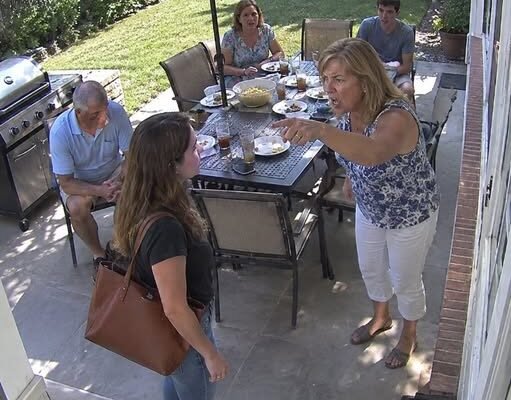
My parents had invited Aunt June, my cousin, and me over for lunch.
Dad stood near the grill wearing his faded blue polo shirt, his thinning gray hair damp with sweat.
Mom wore a pale green blouse and her usual gold cross necklace.
Her short chestnut hair was neatly tucked behind one ear.
I’d driven from Charlotte in jeans and a navy blouse, my dark hair pulled into a ponytail.
The afternoon began pleasantly enough.
We ate grilled chicken, corn, potato salad, and watermelon beneath the patio umbrella.
Then my mother started talking about refinancing.
“We’ve built up some equity,” she announced.
Aunt June glanced at my father.
He looked down at his plate.
Mom continued.
“I was thinking we could pull out a little cash. Maybe finally get me that SUV I’ve been wanting.”
She smiled.
“Lord knows I’ve earned something nice.”
I sat there with my iced tea halfway to my mouth.
A new SUV.
She was discussing borrowing against the house for a luxury while I was quietly paying the bill that kept the bank from taking it.
I wanted to say something.
But I’d learned that contradicting my mother in front of company never ended well.
So I stayed quiet.
Then her phone rang.
She checked the screen and brightened.
“Oh! It’s the loan officer.”
She answered on speaker.
Everyone continued eating as the woman asked routine questions about the refinancing application.
Then the loan officer said something that made my heart stop.
“Mrs. Sharon, there’s an issue with the mortgage payment history.”
My mother frowned.
“What issue?”
“Our records indicate that the payments for the past forty-eight months have consistently come from an external account.”
Nobody moved.
The woman continued.
“That account doesn’t belong to either borrower listed on the loan. We need to clarify who’s providing those funds.”
My mother went still.
Across the patio table, my father slowly raised his head.
**The expression on his face wasn’t surprise. It was recognition.**
And for some reason, that frightened me more than anything the loan officer had said.
Mom grabbed her phone.
“I’ll call you back.”
She ended the call.
Then she turned toward me.
“Natalie.”
I already knew what was coming.
“What is that woman talking about?”
I put down my glass.
“I’ve been making the mortgage payments, Mom.”
Her mouth opened.
Then closed.
“You’ve been WHAT?”
“When you called me four years ago, I covered the overdue amount. Then I set up automatic payments so you wouldn’t have to worry about falling behind.”
Aunt June stopped moving.
My cousin looked between us.
Dad lowered his eyes.
For one moment, I thought my mother might cry.
Instead, she stood up so violently her chair scraped across the patio.
**”YOU HUMILIATED ME!”**
I stared at her.
“Mom, I didn’t tell anyone.”
“You made us look like charity cases!”
“The bank asked where the payments came from. That’s all.”
“Don’t talk to me like I’m stupid!”
Her face was turning red.
“You come here from your little apartment in Charlotte, acting like you’re some big success, and you think paying a bill makes you better than your parents?”
I felt my chest tighten.
“I never said that.”
“Then why would you do this?”
“Because you asked me for help!”
“I asked my daughter for help! Not some arrogant woman trying to control our lives!”
Those words hurt in a way I couldn’t explain.
I looked toward Dad.
He was staring at the concrete beneath his chair.
“Dad?”
He shifted slightly.
“Let’s everybody calm down.”
That was all.
Not a defense.
Not an acknowledgment of what I’d done.
Just another attempt to make the uncomfortable moment disappear.
Mom pointed at me.
“You think money gives you the right to embarrass us?”
“No,” I answered, my voice shaking. “I thought money might keep you from losing your home.”
Aunt June cleared her throat.
“Sharon, maybe we should talk about this privately.”
Mom shot her a furious look.
Then she turned back to me.
“I don’t want to hear another word.”
I stood.
“Mom, please.”
“GET OUT!”
The entire backyard fell silent.
She pointed toward the gate.
**”GET OUT OF MY HOUSE AND NEVER COME BACK!”**
My cousin stared at his plate.
Aunt June pressed her lips together.
And my father did absolutely nothing.
I waited.
Just one second.
Then another.
Surely he’d stand up.
Surely he’d tell her that I was his daughter.
That I’d helped them when nobody else had.
That I didn’t deserve this.
But he wouldn’t even meet my eyes.
Something inside me went cold.
I walked through the sliding door and down the familiar hallway.
Family photographs lined the walls.
My childhood school pictures.
Holiday photographs.
My college graduation portrait.
In every photograph, we looked like a family that loved one another.
I entered my old bedroom and picked up the overnight bag I sometimes kept there.
The blue curtains from high school still hung in the window.
On the dresser sat a framed picture of my mother smiling proudly at my graduation.
I stared at it for a moment.
Then I picked up my bag and left.
When I walked back through the yard, my mother was still standing.
My father was still sitting.
I didn’t say goodbye.
The backyard gate clicked shut behind me.
And for the first time in my life, I didn’t turn around.
I cried most of the drive back to Charlotte.
Not loud, dramatic sobbing.
Just tears I couldn’t seem to stop.
I kept remembering the expression on my father’s face when the loan officer mentioned those forty-eight payments.
He hadn’t looked confused.
He’d looked worried.
At the time, I told myself he was simply embarrassed.
I didn’t understand what I’d really seen.
When I reached my apartment, I set down my bag and opened my laptop.
The mortgage payment portal was still bookmarked.
I logged in.
The next automatic transfer was scheduled.
$1,780.
I stared at the number.
Then I remembered my mother’s voice.
Get out of my house.
Never come back.
I moved the cursor to the cancellation option.
My finger hovered.
I was afraid.
Not of losing the money.
Of what stopping the payments would mean.
For four years, I’d confused being needed with being loved.
Now I was about to find out whether there was anything left between us when I stopped being useful.
**I clicked CANCEL.**
A confirmation number appeared.
I saved it.
Then I shut my laptop.
For the first time in forty-eight months, I wouldn’t be paying my parents’ mortgage.
The following weeks were strangely quiet.
My mother blocked my number.
My father sent occasional messages.
“How’s work?”
“Hope you’re doing okay.”
“Give us a call when you have time.”
None of them mentioned the backyard.
None contained an apology.
Then the next mortgage payment came due.
His messages changed.
“There’s something wrong with the mortgage portal.”
“Have you spoken to the bank?”
“Natalie, we received a notice.”
I read them without responding.
Then relatives started contacting me.
Apparently, my parents were having financial difficulties.
My mother was upset about some banking confusion.
My father was worried about the house.
Couldn’t I please call?
I knew exactly what they wanted.
They wanted the payments restored without having to discuss what had happened.
And part of me wanted to do it.
The old part.
The part that had spent years trying to earn love by making everyone else’s life easier.
But this time, I couldn’t.
One evening, I called my friend Lena, a real estate agent I’d known since college.
I didn’t tell her everything.
I simply asked how someone could check public property records.
“County records are online,” she explained. “You can usually look up owners, deed transfers, and property addresses.”
That conversation changed everything.
I had been reviewing my mortgage receipts, trying to understand just how much I’d sacrificed.
And I kept coming back to one question.
If my father had started working regular hours again, as my mother claimed, why had nobody ever offered to take over the mortgage?
Where had the money gone?
Curiosity turned into something more unsettling.
I searched public property records under my father’s name.
Most results were unremarkable.
Then I found one I couldn’t explain.
**Daniel Hall — property owner.**
The address wasn’t my parents’ house.
It was a brick duplex in Gastonia.
According to the recorded deed, it had been purchased twenty-seven months earlier.
That meant my father had acquired another property more than two years after I’d started paying his mortgage.
My hands turned cold.
I opened the scanned document.
Two owners were listed.
Daniel Hall.
And June Whitaker.
**My father and my mother’s sister.**
I sat motionless at my kitchen table.
Aunt June.
The woman who had sat beneath the patio umbrella while my mother called me an arrogant charity worker.
The woman who had told my mother to calm down.
She owned property with my father.
I checked the information again.
It wasn’t a misunderstanding.
There were tax records, a recorded deed, and public financing documents associated with the purchase.
I found an old rental listing showing that the duplex had been marketed as an investment property.
So my father had been building equity somewhere else.
And I’d been paying the mortgage on the home he shared with my mother.
I didn’t know whether their investment was profitable.
I couldn’t see their private bank accounts.
But the timing was impossible to ignore.
**My money hadn’t necessarily purchased the duplex directly. It had freed my father from paying his own mortgage while he invested somewhere else.**
And that made me feel sick.
I printed everything.
Forty-eight mortgage receipts.
The cancellation confirmation.
The county deed.
The property records.
I placed them in a folder.
Three days later, the front desk called.
My father was downstairs.
He’d never visited my apartment before.
Not when I moved in.
Not after my promotion.
Not on my birthday.
But when the money stopped, he suddenly found his way to Charlotte.
I met him in the lobby.
He looked older than he had at the barbecue.
His gray hair was uncombed, and his shoulders seemed permanently bent.
He didn’t hug me.
He didn’t apologize.
He sat down and asked, “Why did you stop paying the mortgage?”
For a moment, I couldn’t speak.
Not because I didn’t have an answer.
Because I had too many.
“That’s what you drove here to ask?”
He sighed.
“Natalie, we’re in a difficult situation.”
“You watched Mom throw me out.”
“She was upset.”
“She told me never to come back.”
“You know how your mother gets.”
I looked at him.
That sentence.
I’d heard it my entire life.
And suddenly, I understood how much damage it had done.
“No, Dad. I know how you get.”
His expression hardened.
“What does that mean?”
“It means you stand there while she hurts me. Then you expect me to make everything comfortable again.”
He looked away.
“We’re your parents.”
My voice became very quiet.
**”I’m not your child.”**
He blinked.
“What?”
“Not in the way that matters to either of you. I’m your daughter when the bills need paying. But when I need someone to defend me, suddenly I’m on my own.”
“That’s unfair.”
“No. Unfair is spending four years keeping a house from falling behind and then being ordered out of it like a stranger.”
He rubbed his forehead.
“Can we please focus on fixing the mortgage?”
And that’s when I reached for my bag.
I placed the folder on the lobby table.
He glanced at the first document.
Then the second.
His expression changed.
“Dad,” I asked, “if you and Mom couldn’t afford your own mortgage, whose house did you buy with the money you weren’t spending?”
His hand froze.
“Where did you get that?”
“Public property records.”
He sank back in his chair.
I turned the deed toward him.
“Twenty-seven months ago. A duplex in Gastonia.”
He swallowed.
“It’s an investment.”
“Then explain how you could afford to invest in another house while I was paying for yours.”
He didn’t answer.
I pointed to the second owner’s name.
“Who is June Whitaker?”
He closed his eyes.
“Your mother doesn’t know.”
I felt the lobby tilt around me.
“Doesn’t know what?”
He leaned forward.
“Natalie, please. Don’t tell Sharon until I can explain.”
“You want me to protect another secret?”
“You’re making this worse than it is.”
I almost laughed.
Then his phone vibrated.
It was lying faceup on the table.
A message flashed across the screen.
**June: Did Natalie find the deed? Don’t let her tell Sharon.**
My father snatched up the phone.
Too late.
I’d already seen it.
I stood.
“How long have you both been lying to her?”
“Natalie—”
“How long?”
His face crumpled.
“Please lower your voice.”
That was the moment I knew nothing had changed.
He still cared more about appearances than about what he’d done.
I picked up the folder.
“I’m not paying another cent.”
He stared at me.
“What are we supposed to do?”
“You’re going to have to figure that out.”
His voice broke.
“We could lose the house.”
I looked at him.
“And somehow, Dad, you’re still asking me to save you from choices you made.”
I walked toward the elevators.
Behind me, he called my name.
I didn’t turn around.
That evening, I copied the documents.
I wrote a letter to my mother.
It wasn’t angry.
It was almost painfully simple.
I explained that I’d paid the mortgage for four years.
I explained that the payments had stopped.
I told her I would not resume them.
And I included the public records showing Dad’s ownership of the Gastonia duplex.
I ended with one sentence.
**”I love you, Mom, but I cannot keep paying for a place where I am not welcome.”**
Because she had blocked my number, I sent the packet by certified mail.
Four days later, my phone rang.
An unfamiliar number.
I answered cautiously.
“Hello?”
“Natalie?”
My mother’s voice.
For a second, neither of us spoke.
Then she asked, “Is it true?”
My heart thudded.
“Which part?”
“The house in Gastonia.”
I closed my eyes.
“Yes.”
“Your father says it’s complicated.”
“Then he should explain it.”
Her breath trembled.
“He told me he’d started covering the mortgage again after you helped us.”
I gripped the phone.
“He never did.”
Silence.
Then she whispered, “I didn’t know.”
I believed her about that much.
But I couldn’t forget the backyard.
“You knew I helped when you were desperate,” I said. “And when the bank mentioned the payments, you chose to scream at me.”
“I was embarrassed.”
“Mom, you punished me for helping you.”
She began crying.
For once, I didn’t rush to comfort her.
After a long pause, she said, “Will you come to the house? I want us to talk.”
The old me would have agreed immediately.
Instead, I answered, “Only if Dad and June are there. And only if you understand I’m not coming to fix your mortgage.”
She was quiet.
Then she said, “All right.”
We met the following Saturday.
I nearly turned my car around twice on the way to Matthews.
When I pulled into the driveway, the house looked exactly the same.
The white trim.
The porch.
The flowers along the walkway.
The front door I’d walked through thousands of times.
But it no longer felt like home.
Mom opened the door.
Her short chestnut hair looked less carefully arranged than usual.
She wore no makeup.
She stepped aside without trying to hug me.
My father sat at the kitchen table.
Aunt June sat beside him.
And something about the way they were positioned made my stomach tighten.
There was an empty chair across from them.
I sat down.
Nobody offered me coffee.
Nobody asked how I’d been.
Mom placed the county deed on the table.
“Daniel,” she said quietly, “I want you to explain this.”
My father cleared his throat.
“June and I saw an investment opportunity.”
Mom stared at him.
“An investment opportunity?”
“The duplex was priced reasonably. We thought the rental income would help us in retirement.”
Aunt June nodded.
“It was a practical decision, Sharon.”
My mother turned toward her.
“You own property with my husband?”
June folded her hands.
“It’s business.”
“Why didn’t anybody tell me?”
Dad looked toward the window.
“We didn’t want to worry you.”
Mom laughed.
It wasn’t a happy sound.
“You didn’t want to worry me? You let me believe our finances had recovered.”
Dad said nothing.
I leaned forward.
“Where did the money for the investment come from?”
June answered before he could.
“We contributed savings.”
“Whose savings?”
My father shifted.
“Some of mine. Some of June’s.”
I looked directly at him.
“Would you have had those savings if I’d been making you pay your own mortgage?”
His silence was answer enough.
Mom’s face slowly changed.
“You told me you were handling the house payments again.”
Dad rubbed his hands together.
“I never said exactly—”
“Daniel.”
Her voice was sharp.
“Did you let our daughter pay our mortgage so you could buy property with my sister?”
He stared at the table.
Then he whispered, “It wasn’t supposed to happen like this.”
The room went silent.
June suddenly leaned forward.
“Everybody is making this sound sinister. Natalie volunteered to help. Nobody forced her.”
I looked at my aunt.
“You knew?”
She hesitated.
“Your father mentioned she was helping.”
“For how long?”
“That’s not really the point.”
“Four years, June.”
She looked away.
“Family helps family.”
I felt tears sting my eyes.
“Then where were you when Sharon threw me out?”
June’s expression tightened.
“It wasn’t my place to interfere.”
**”But it was your place to benefit from the money I was saving your business partner?”**
Nobody answered.
I turned to Dad.
“I need you to understand something. I didn’t give you money so you could invest it somewhere else. I helped because Mom was crying about losing this house.”
He looked at me.
“I know.”
“Then why didn’t you tell me you could take the payments back?”
His eyes filled.
“Because I was afraid the investment wouldn’t work if I did.”
I sat back.
There it was.
The truth.
Not complicated.
Not misunderstood.
He had known exactly what my sacrifice made possible.
And he’d chosen to keep benefiting from it.
Mom pressed both hands against her mouth.
For the first time, she seemed to understand the scale of what had happened.
But understanding wasn’t the same as repairing it.
June stood abruptly.
“This conversation has become ridiculous. Nobody stole anything from Natalie.”
I looked at her.
“You’re right. I authorized every payment.”
She seemed relieved.
Then I continued.
“But you both knew the reason I authorized them. And you let me keep believing my parents needed that money to survive.”
June’s relief disappeared.
Mom turned to my father.
“I want to know everything about that duplex. The financing. The rent. The expenses. All of it.”
Dad nodded weakly.
June protested.
“Sharon, you can’t just demand our business records.”
Mom stared at her sister.
**”You involved my husband and my daughter in your business. You made it my business.”**
For the first time that afternoon, Aunt June had nothing to say.
I stood.
Mom looked up.
“Where are you going?”
“Home.”
She flinched.
I picked up my bag.
“I came because you deserved to know the truth. But I don’t want to spend another afternoon watching everybody argue about money while pretending that’s all this is about.”
My father whispered, “Natalie, I’m sorry.”
I looked at him.
Those were the words I’d wanted for weeks.
Now they felt strangely small.
“What are you sorry for, Dad?”
His mouth opened.
Then closed.
I nodded.
“That’s what I thought.”
I walked outside.
This time, my mother followed me.
She stopped beside my car.
“Natalie.”
I turned.
Her eyes were red.
“I was wrong.”
I waited.
She swallowed hard.
“What I said to you that Sunday was cruel. You didn’t embarrass me. I embarrassed myself.”
I felt my throat tighten.
She reached for my hand, then stopped halfway.
“I don’t expect you to forgive me today.”
For the first time in years, she wasn’t making a demand.
She was acknowledging something.
“I need time, Mom,” I said.
She nodded.
“I know.”
Then she said something I never expected.
**”I’m going to find a way to take care of myself. And I’m not going to ask you to pay for it.”**
I wanted to believe her.
But this time, I would need more than words.
Over the following months, my parents’ financial situation changed dramatically.
Mom contacted the mortgage servicer directly.
She reviewed the account with professional help, learned what was actually owed, and stopped relying on Dad to tell her whether the bills had been paid.
She also met with an attorney.
I didn’t ask for every detail.
Their marriage and finances were their responsibility.
Not mine.
The refinancing application was abandoned.
The SUV was forgotten.
My parents eventually decided to sell the Matthews house rather than keep fighting to maintain a lifestyle neither of them could honestly afford.
With professional guidance, they addressed the missed payment and arranged the sale.
The house sold several months later.
The mortgage was paid from the proceeds.
Mom moved into a small rental townhouse.
She started working part-time at a community center.
Dad moved out separately.
He and Mom began discussing a formal separation and how to deal with the assets he’d acquired without her knowledge.
The Gastonia duplex remained part of that unresolved financial mess.
And Aunt June had become a name my mother could barely stand to hear.
I didn’t attend the final walk-through of my childhood home.
I couldn’t bring myself to watch strangers inspect the rooms where I’d grown up.
But Mom sent me a photograph of the empty kitchen.
Beneath it, she’d written:
“I finally understand that a house isn’t worth keeping if the people inside it are hurting each other.”
I stared at that message for a long time.
Then I replied.
“I hope you mean that.”
Our relationship didn’t magically heal.
There were awkward phone calls.
Long silences.
Moments when she slipped back into criticism and had to stop herself.
But she began asking about my life without immediately turning the conversation toward her own problems.
She asked about work.
My friends.
My plans.
And slowly, I began believing that perhaps something healthier could exist between us.
Not the relationship we’d had.
Something new.
Something with boundaries.
Meanwhile, I started rebuilding my own future.
The $1,780 that had once disappeared from my account every month now went into savings.
I created a separate fund labeled MY HOME.
The first time I transferred money into it, I cried.
Not because the amount was enormous.
Because it was finally mine.
I even scheduled a weekend trip to the mountains.
Nothing extravagant.
Just two quiet nights in a cabin where nobody expected me to cook, clean, pay a bill, or apologize for existing.
It felt like freedom.
I thought the worst revelations were behind us.
I was wrong.
One evening, about nine months after the backyard confrontation, my mother called.
Her voice sounded different.
Not angry.
Not frightened.
Almost hollow.
“Natalie, there’s something I need to tell you.”
I sat down on the couch.
“What happened?”
She took a long breath.
“Your father finally admitted why he really bought that duplex with June.”
I felt my stomach tighten.
“I thought it was an investment.”
“So did I.”
There was a long pause.
Then she whispered, “It wasn’t just an investment.”
I stopped breathing.
She continued.
“One of the units was supposed to provide rental income. The other was supposed to be their place.”
“Their place?”
Her voice broke.
“Daniel and June. Together.”
I stared at the wall.
“What?”
Mom began crying.
**”Your father and my sister have been having an affair for three years.”**
For several seconds, I couldn’t speak.
My father.
Aunt June.
The two people who had sat quietly while Mom screamed at me for exposing the mortgage payments.
They hadn’t merely been hiding an investment.
They’d been planning an entirely different future.
Together.
Mom told me Dad had finally admitted everything after she confronted him with inconsistencies in their financial records and messages she’d discovered during the separation process.
Their relationship had started not long after the duplex idea began taking shape.
They’d bought the property together.
They’d concealed their involvement from the family.
And they’d been discussing a permanent move once their finances were secure.
I felt physically sick.
“Mom…”
“There’s more.”
I closed my eyes.
“What more?”
She explained that Dad had admitted the refinancing discussion had frightened him for reasons entirely different from what we’d assumed.
Mom had believed refinancing would simply make a new SUV possible.
But Dad had been thinking about the house’s equity too.
He wanted access to money that might eventually help him separate from Mom without giving up the second property.
The loan officer’s question about the outside mortgage payments had threatened to expose the financial arrangement before he and June were ready.
That was why he’d looked so terrified at the Sunday lunch.
Not because he was embarrassed that his daughter was helping.
**Because the bank had asked a question that could unravel the life he was secretly building with his wife’s sister.**
I remembered Aunt June lowering her knife.
Her anxious glance toward Dad.
The way she’d told Mom to discuss everything privately.
For months, I’d believed she was simply uncomfortable witnessing a family fight.
Now I understood.
She’d been trying to stop the conversation before someone asked the wrong question.
And when Mom threw me out, both of them had allowed it to happen.
Because my disgrace provided a distraction from their deception.
I covered my mouth.
“Oh my God.”
Mom’s crying grew quieter.
“I keep thinking about what I said to you.”
“Mom, you didn’t know about them.”
“No,” she replied. “But I knew you were my daughter. And I still treated you that way.”
Her honesty hurt.
But it mattered.
We sat in silence on the phone.
Then she asked, “Do you think you’ll ever forgive me?”
I looked around my little apartment.
The same apartment she’d mocked.
The same place where I’d canceled the payments.
The same place where I’d finally begun learning what it meant to protect myself.
“I don’t know,” I said.
She was quiet.
Then she answered, “That’s fair.”
A few weeks later, Dad called.
I hadn’t spoken to him since the meeting at the house.
I considered ignoring the call.
But I answered.
“Natalie.”
His voice sounded exhausted.
“I know your mother told you.”
“Yes.”
He sighed.
“I never wanted any of this to hurt you.”
I felt anger rise in my chest.
“Dad, you watched me pay your mortgage for four years.”
“I know.”
“You bought a second property with Aunt June.”
“I know.”
“You watched Mom throw me out because she found out I’d been paying.”
He didn’t answer.
“And the entire time, you were having an affair with her sister.”
His breathing grew heavy.
“People make mistakes.”
I stared at the phone.
**”A mistake is forgetting someone’s birthday. What you did was a series of choices.”**
He began crying.
Once, that sound would have made me rush to comfort him.
This time, I let him cry.
He eventually whispered, “I thought I could keep everybody happy.”
“No, Dad. You thought you could keep everybody useful.”
Silence.
Then I said something I’d wanted to tell him since the afternoon in the lobby.
“You didn’t just let me pay for your house. You let me postpone building a life so you could secretly build another one.”
He said my name.
I stopped him.
“I hope you take responsibility for what you’ve done. But I can’t do that for you.”
Then I ended the call.
I didn’t feel victorious.
There was no satisfaction in discovering that my father had betrayed nearly everyone who trusted him.
I felt sad.
Angry.
And strangely relieved that the truth was finally outside the walls of that house.
Over time, Mom and I continued speaking.
She never asked me for mortgage money again.
She began apologizing without adding excuses.
When I told her about my savings fund, she didn’t criticize me.
She said, “I’m proud of you.”
And for once, she didn’t make my accomplishment about herself.
Several months later, she came to Charlotte to visit.
We had lunch at a small restaurant near my apartment.
When the check arrived, I automatically reached for my purse.
Mom gently put her hand over mine.
“No,” she said. “I’ve got this.”
I looked at her.
She smiled sadly.
“I think it’s about time I bought my daughter lunch.”
It was such a small thing.
A meal.
An ordinary afternoon.
But somehow, it meant more than all the grand promises she’d ever made.
As we walked outside, she stopped beside my car.
“Are you still thinking about buying a place?”
I nodded.
“Eventually. I’ve got a little money saved now.”
She smiled.
“Good.”
Then she added, “Make sure it’s somewhere you feel safe.”
I hugged her.
Not because everything was forgiven.
Not because the past had disappeared.
But because, for the first time, she seemed to understand that love wasn’t supposed to come with an invoice.
That evening, I returned to my apartment and opened my laptop.
I checked my savings account.
Another $1,780 had been added.
I looked at the balance and imagined my own front door.
My own kitchen.
A little porch where nobody could tell me I didn’t belong.
For years, I’d believed that keeping my parents’ house standing was proof that I was a good daughter.
But the truth was harder and simpler.
**I had been paying for a roof over people who wouldn’t stand up for me.**
My mother had thrown me out of a house I was helping keep.
My father had taken advantage of that help to build a secret future with my aunt.
And I’d nearly sacrificed my own life trying to make theirs comfortable.
I couldn’t change what happened.
I couldn’t recover those four years.
But I could decide what happened next.
I closed the mortgage records I’d kept on my computer.
Then I opened a real estate website.
For the first time in years, I wasn’t looking at houses I couldn’t afford because someone else’s mortgage came first.
I was looking at homes for myself.
And as I scrolled through the listings, I realized something that made me smile.
**My mother had told me to get out and never come back.**
**For once, I was going to respect her wishes.**
Not out of anger.
Not out of revenge.
But because I was finally ready to build a life where I didn’t have to purchase the right to belong.
The house I’d spent four years saving was gone.
The family secrets had been exposed.
And the people who’d depended on my silence could no longer hide behind it.
But my future was still mine.
**And this time, when I paid a mortgage, the name on the deed would be my own.**