Julian let out a sharp, panicked laugh.
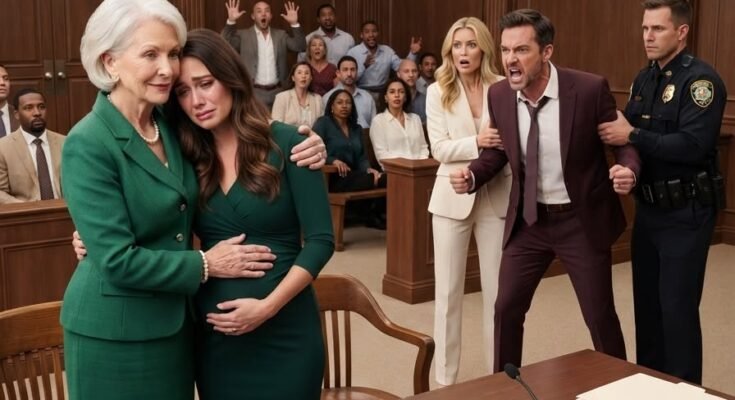
“Your daughter? Mrs. Sterling, Clara is an orphan!”
Eleanor slowly turned toward him.
The warmth vanished from her face.
“She was never an orphan.”
The courtroom became completely silent.
Even Judge Carter leaned forward.
Julian’s attorney rose.
“Your Honor, this is highly irregular.”
Eleanor didn’t even look at him.
The gray-haired attorney standing behind her stepped forward and placed a thick leather folder on the clerk’s desk.
“My name is Martin Hale. I represent Eleanor Sterling and the Sterling family trust.”
Judge Carter frowned.
“What exactly are you asking this court to consider?”
Martin opened the folder.
“Evidence that directly affects Mrs. Mercer’s financial disclosures, legal identity, and the judgment just entered.”
Julian’s smirk disappeared.
I stared at Eleanor.
“What is happening?”
Her eyes returned to mine.
“I owe you thirty years of answers.”
I took one step backward.
“You don’t even know me.”
Pain crossed her face.
“I know.”
She did not reach for me again.
That mattered.
For the first time all day, someone seemed to understand that I was allowed to decide who touched me.
Martin handed several documents to the judge.
A birth certificate.
Hospital records.
A DNA report.
Old court filings.
Then a photograph slid loose from the folder and landed faceup on the table.
I stopped breathing.
A young woman was holding a newborn.
The woman was clearly Eleanor.
The baby had a tiny hospital bracelet around her wrist.
On the back, written in faded ink, were the words:
CLARA ELISE STERLING — SIX WEEKS OLD.
My hands began shaking.
“No.”
Eleanor’s eyes filled.
“I have carried that photograph for thirty years.”
I looked at the birth certificate.
Mother:
Eleanor Grace Sterling.
Father:
Michael Bennett.
Bennett.
The surname attached to me when I entered foster care.
I had always assumed it belonged to people who had abandoned me.
I looked up.
“Who was Michael?”
Eleanor’s voice softened.
“Your father.”
“Where is he?”
Her face broke.
“He died when you were six weeks old.”
The courtroom disappeared around me.
All my life, I had invented explanations for why my parents had left.
Maybe they were addicts.
Maybe they were teenagers.
Maybe they hated each other.
Maybe they simply didn’t want me.
I had never imagined death.
Eleanor continued.
“My father hated Michael.”
“Why?”
“He was a mechanic.”
I blinked.
“That’s it?”
“To my father, that was enough.”
Eleanor had been twenty-two when she met him.
The only daughter of one of the wealthiest businessmen in the country.
Michael Bennett repaired delivery trucks.
Her father told her to end the relationship.
She refused.
When she became pregnant, he threatened to cut her off completely.
“So what did you do?” I asked.
“I left.”
That answer surprised me.
Eleanor’s voice trembled.
“Michael and I moved into a one-bedroom apartment over a laundromat.”
For the first time, a tiny smile appeared.
“We had almost nothing.”
Then it vanished.
“But we had you.”
Six weeks after I was born, Michael died in a highway accident.
Eleanor fell apart.
Grief.
Postpartum depression.
No money.
No family except a father who had been waiting for the chance to take control again.
“He told me he would help,” she whispered.
My stomach tightened.
“What did help mean?”
“He arranged treatment for me.”
“Childcare.”
“Legal papers.”
Eleanor looked sick.
“I signed documents while barely understanding what I was signing.”
I already knew where this was going.
“You gave me away.”
“No.”
Her answer came quickly.
“Never.”
Her father had arranged what Eleanor believed was temporary guardianship.
But while she was hospitalized, I was moved.
Records changed.
The private guardian disappeared.
Eventually, I entered foster care under Michael’s surname.
Eleanor spent years being told that I had been legally adopted.
That the records were sealed.
That the adoptive family wanted no contact.
“You believed that?”
“At first.”
Her voice hardened.
“Then I stopped believing anyone.”
Martin placed another stack of documents on the table.
Court petitions.
Private investigator reports.
Requests for sealed records.
Appeals.
Searches spanning decades.
My birth year appeared again and again.
Eleanor Sterling had been looking for me.
Not for weeks.
Not for months.
For thirty years.
I stared at one filing dated twenty-two years earlier.
Then another.
Then another.
My throat closed.
“You really looked.”
Eleanor’s face crumpled.
“Every year.”
I hated how badly I wanted to believe her.
Because hope felt dangerous.
Hope had betrayed me before.
“How did you find me?”
“A DNA match.”
Two years earlier, someone distantly related to Michael had uploaded genetic information to a genealogy database.
Eleanor’s investigators followed the connection.
Eventually, they reached me.
Or almost reached me.
“I only knew for certain three weeks ago,” she said.
“Three weeks?”
“Yes.”
“Then why didn’t you come immediately?”
Eleanor looked toward Martin.
His expression changed.
“We discovered Mrs. Mercer was in active divorce proceedings.”
I looked at him.
“So?”
“So we began reviewing public filings.”
He turned another document toward the judge.
“And discovered Mr. Mercer had made statements that concerned us.”
Julian jumped up.
“This is ridiculous.”
His attorney grabbed his arm.
“Sit down.”
Julian ignored him.
“She has nothing to do with this woman!”
Martin looked at him.
“That statement is particularly interesting.”
He removed another document.
A trust agreement.
Created thirty years earlier.
Beneficiary:
Clara Elise Sterling.
My name.
My real name.
Apparently, Eleanor’s father had created it after she began suing him over what happened to me.
Whether from guilt, fear, or an attempt to settle the dispute, nobody could say.
But he placed shares of Sterling Holdings into an irrevocable trust.
The beneficiary could not be located.
So the assets had remained untouched.
Until now.
Martin slid a valuation sheet toward me.
I stared.
Then stared again.
$48,730,000.
I laughed once.
A strange, empty sound.
“This can’t be mine.”
“It is,” Martin said.
Across the table, Julian sat completely still.
Forty-eight million dollars.
An hour earlier, I had been preparing to leave court believing I could barely afford diapers.
Now people were telling me I was wealthy.
But I didn’t feel wealthy.
I felt cheated.
Not financially.
Out of years.
Birthdays.
School plays.
Christmases.
The night I turned eighteen and aged out of foster care with two garbage bags and $143.
No amount of money could buy those back.
Eleanor seemed to read my face.
She didn’t smile.
Good.
Then Martin said,
“There is another issue.”
Julian’s attorney closed his eyes.
I looked at him.
“What issue?”
Martin produced several emails.
Three years earlier, Julian had discovered an old record while helping me replace documents for a passport application.
One document contained the name Sterling.
He searched it.
Then paid someone to investigate.
My heart stopped.
“Julian knew?”
“Not everything,” Martin said.
“But enough to suspect you might be connected to the Sterling family.”
Julian’s face turned gray.
I stared at my husband.
“You knew?”
“Clara—”
“You told me I came from nothing.”
“I only suspected—”
“You knew there might be something.”
He looked away.
Martin handed one last printout to Judge Carter.
It was a message Julian had sent his business manager eight months earlier.
If the Sterling connection turns out to be real, I need the divorce finalized before Clara discovers what she has.
My unborn son kicked hard.
I pressed a hand against my belly.
Julian had spent years telling me I was lucky he had married me.
Lucky he tolerated my background.
Lucky someone with no family had found him.
And all the while, once he suspected there might be money attached to my name, he began positioning himself to leave before I learned the truth.
I looked at him.
“You weren’t trying to leave me with nothing.”
He said nothing.
“You were trying to leave before I learned I had anything.”
His eyes dropped.
That silence told me everything.
Judge Carter called a recess.
The original financial ruling was suspended pending review of the newly discovered evidence and Julian’s disclosures.
But I barely heard the legal language.
I walked into a private conference room and started crying.
My attorney sat beside me.
“I don’t know what I’m supposed to feel.”
“You don’t have to know.”
“I had a husband this morning.”
“A terrible one, apparently, but I had one.”
“I thought I had no family.”
“I thought I had no money.”
“And now everyone keeps looking at me like I should feel rescued.”
My attorney shook her head.
“You are not required to feel grateful because someone discovered paperwork.”
That helped.
Then I asked the question that mattered more than forty-eight million dollars.
“Did she really look for me?”
“Yes.”
“How do you know?”
“Because some of those petitions were filed here.”
She showed me copies.
Denied.
Dismissed.
Unable to locate child.
Sealed records.
Another attempt.
Another failure.
Again.
Again.
Again.
Tears fell onto the pages.
Eleanor had failed to find me.
But she had not forgotten me.
Those were different things.
When court resumed, Julian looked very different.
No smirk.
No confidence.
No whispering threats.
His attorney requested time.
Judge Carter granted a formal review.
The divorce moved forward.
So did an investigation into Julian’s disclosures.
But none of that became the part of that day I remembered most.
What I remembered happened outside.
Eleanor was standing alone on the courthouse steps.
No security around her.
No attorneys.
No assistants.
Just a woman in white cashmere waiting in the cold.
I stopped several feet away.
She did not move toward me.
“Clara.”
I raised one hand.
“Please.”
She stopped.
“I can’t do this today.”
“I understand.”
“No.”
My voice cracked.
“I don’t think anyone understands.”
I pressed my hand over my stomach.
“I’ve spent my entire life learning not to need people.”
“And suddenly you walk into a courtroom and tell me you’re my mother.”
Eleanor’s tears began falling.
“I know.”
“I don’t know if I can call you that.”
“You don’t have to.”
“I don’t know if I forgive you.”
“I haven’t asked you to.”
That stopped me.
She reached slowly into her handbag.
“May I give you something?”
I hesitated.
Then nodded.
She handed me the photograph.
The young Eleanor.
The newborn me.
I turned it over.
The last morning I held you.
My knees weakened.
I sat on the courthouse steps.
Eleanor remained standing until I looked at her.
Then she sat several steps below me.
Not beside me.
She gave me space.
I stared at the picture.
“Did you love me?”
She started crying before she answered.
“Yes.”
“Then why didn’t you find me?”
The question hurt both of us.
Good.
Some questions should.
Eleanor wiped her face.
“I tried.”
I waited.
Then she added something I never expected.
“And I failed.”
No excuse.
No speech about her father.
No attempt to make thirty years of searching equal thirty years of parenting.
“I spent years telling myself that looking for you made me a good mother.”
Her voice shook.
“But searching didn’t hold you when you were sick.”
“It didn’t attend your graduation.”
“It didn’t protect you.”
She looked at me.
“So I won’t ask you to pretend my effort gave you the childhood you deserved.”
For the first time, I saw her not as Eleanor Sterling.
Not as a billionaire.
Not as the woman who had burst into court.
Just as someone who had failed terribly and knew it.
“What do you want from me?”
“A chance.”
“To do what?”
“To know you.”
She glanced toward my stomach.
“And if you allow it someday, to know him.”
My hand moved protectively over my baby.
Eleanor immediately looked away.
“Only if you want.”
My son kicked.
Hard.
I winced.
Eleanor’s eyes widened.
“Is he okay?”
“He does that when I’m stressed.”
A tiny smile appeared.
“You used to kick constantly.”
I stared at her.
“How would you know?”
“My mother complained about it through my entire pregnancy.”
For some reason, I laughed.
One tiny laugh.
Eleanor laughed too.
It wasn’t forgiveness.
It wasn’t reunion.
It was recognition.
Six weeks later, my son was born.
I named him Michael Daniel.
Michael for the father I never met.
Daniel after one of my foster fathers, who had treated me kindly during three difficult teenage years and taught me that not every man eventually walked away.
Eleanor did not appear at the hospital.
She sent one message.
Thinking of you. No need to answer.
Two days later, I answered.
Tomorrow. Two o’clock.
She arrived at 1:57.
Alone.
No enormous bouquet.
No entourage.
She carried one small stuffed bear.
When I placed Michael in her arms, her whole body began trembling.
She stared down at him.
Then at me.
“Thank you.”
Not:
My grandson.
Not:
Our family.
Thank you.
That was when our relationship actually began.
Not in court.
Not with money.
In a hospital room where neither of us knew what we were allowed to mean to the other yet.
Eleanor learned slowly.
So did I.
At first, she tried to solve everything with money.
“Do you need a house?”
“No.”
“A driver?”
“No.”
“A nanny?”
“No.”
Finally, one afternoon, I snapped.
“Stop trying to buy the years you missed.”
She went completely still.
Then nodded.
“You’re right.”
The following week, she called.
“Would you like me to bring dinner?”
I almost smiled.
“What kind?”
“Lasagna.”
“Did you make it?”
“No.”
“Good. Bring it.”
That was how trust grew.
Not through millions.
Through dinner.
Coffee.
Sitting with Michael so I could shower.
Listening when I talked about foster homes without trying to explain why she hadn’t been there.
Letting me be angry on days when anger returned.
Eventually, I learned things about her too.
She hated elevators.
Loved terrible detective shows.
Could negotiate a billion-dollar merger but somehow destroyed every houseplant she touched.
She cried the first time I called her Eleanor without bitterness.
Nearly two years passed before I accidentally called her Mom.
We were in my kitchen.
Michael had dumped applesauce onto his own head.
Eleanor was laughing so hard she had tears running down her face.
I handed her a towel.
“Mom, help me.”
The room stopped.
She stared at me.
I stared at her.
Then she began crying.
“Oh, please don’t.”
I pointed at her with the towel.
“You’re going to make me cry too.”
“I’m sorry.”
“You apologize too much.”
“I have material.”
That made me laugh.
She took the towel.
And we cleaned applesauce out of Michael’s hair together.
I never told her that was the moment something inside me finally settled.
Not healed completely.
Some things don’t heal into what they were before.
They heal into something different.
Julian disappeared from my daily life.
The divorce was finalized after full financial review.
He did not receive access to the Sterling trust.
I didn’t take everything he owned either.
I took what the law determined was mine and left the rest.
At our final mediation, he looked at me bitterly.
“You could ruin me.”
I shook my head.
“I don’t want to spend the rest of my life organizing myself around you.”
That was the last real conversation we ever had.
The money changed my life.
Of course it did.
Pretending otherwise would be ridiculous.
I bought a comfortable home.
Returned to school.
Created security for my son.
But the most important thing I eventually did with the money was create a foundation for teenagers aging out of foster care.
Housing.
Education.
Job placement.
Emergency grants.
And something I insisted on personally:
Every young person received a folder containing every legal document they possessed.
Birth certificate.
Medical records.
Identification.
Whatever family history could legally be recovered.
No one should enter adulthood knowing as little about themselves as I had.
At our first program graduation, a nineteen-year-old girl hugged me.
She had spent eleven years in foster care.
“Thank you,” she whispered.
“For what?”
“For not making us feel like charity.”
I went home and cried for an hour.
Years later, people still tell my story as though the extraordinary part was discovering I was the daughter of a billionaire.
They miss the point.
The money was shocking.
The courtroom was dramatic.
Julian’s expression was admittedly memorable.
But none of that changed me as much as learning one simple truth.
I had never been unwanted.
I had been lost.
There is an enormous difference.
Being unwanted means there was something about you people chose not to love.
Being lost means other people failed to keep you safe.
Children often confuse those things.
Sometimes adults do too.
I spent thirty years believing every person who abandoned me was evidence that something was wrong with me.
Then I became a mother.
One night, when Michael was about four, he climbed into my bed during a thunderstorm.
He pressed his face against my shoulder.
“Mommy?”
“Yes?”
“You won’t lose me, right?”
The question stopped my heart.
I wrapped both arms around him.
“I might lose sight of you in a grocery store.”
He giggled.
“Or at the park.”
“That’s not funny.”
“It’s a little funny.”
Then I became serious.
“But if I ever lose sight of you, I will look.”
“For how long?”
“As long as it takes.”
He seemed satisfied.
Within minutes, he was asleep.
I wasn’t.
I lay there thinking about Eleanor.
Thirty years.
As long as it takes.
The next morning, I called her.
She answered immediately.
“Everything okay?”
“Yes.”
“Michael?”
“He’s fine.”
“Then what’s wrong?”
“Nothing.”
I hesitated.
Then said,
“I know you looked.”
Silence.
“What?”
“For me.”
Her breathing changed.
“I know you looked.”
She began crying.
So did I.
“I couldn’t find you.”
“I know.”
“I should have.”
“I know.”
Then, for the first time, I said something I had not been ready to say on those courthouse steps.
“I forgive you.”
She didn’t speak for several seconds.
Then whispered,
“Thank you.”
I smiled through my tears.
“That doesn’t mean what happened was okay.”
“I know.”
“It doesn’t mean you get to stop bringing lasagna.”
She laughed.
“Never.”
On Michael’s fifth birthday, Eleanor gave me a framed copy of the photograph from the courthouse.
Someone had captured the moment we were standing several feet apart outside.
On the back, she had written:
THE DAY I FOUND MY DAUGHTER.
I stared at the words.
Then took a pen.
Eleanor frowned.
“What are you doing?”
I crossed out two words.
Now it read:
THE DAY WE FOUND EACH OTHER.
Her face collapsed.
“Oh no.”
“What?”
“You’re going to make me cry.”
“You cry constantly.”
“You’re cruel.”
“Runs in the family.”
She laughed.
Then hugged me.
And this time, I hugged her back without thinking.
That is the part of the story I remember now.
Not Judge Carter’s ruling.
Not Julian saying I came from nothing.
Not the forty-eight-million-dollar trust.
I remember standing in that courtroom believing I had no family.
No history.
No safety.
Nothing to give my unborn child except myself.
And strangely, that turned out to be enough.
Because money did not save me.
Eleanor did not save me.
A famous name did not save me.
They changed my circumstances.
But I saved myself when I stopped believing Julian’s version of my worth.
I built a life before I learned my mother was wealthy.
I survived foster care before I knew anyone had searched for me.
And I loved my son before I knew whether anyone else would ever choose us.
Julian’s final words had been meant to destroy me.
You came from nothing.
Now you’re going back to nothing.
He was wrong.
I never came from nothing.
I came from a complicated history.
From a father who died too soon.
From a mother who failed me and spent decades trying to find her way back.
From strangers who occasionally showed me kindness.
From foster homes that taught me what kind of mother I never wanted to become.
From every version of myself that kept going when nobody came through the door.
And when I finally walked out of that courthouse, I wasn’t returning to nothing.
I was walking toward the first life that truly belonged to me.