“What did you never tell me?”
Ben was still on his knees.
His hands dropped from my robe.
For several seconds, he couldn’t speak.
Then he said,
“I can’t have biological children.”
I stared at him.
The hallway seemed to tilt.
“What?”
“My doctors told me when I was seventeen.”
Behind him, Diane started crying harder.
I grabbed the doorframe.
“No.”
Ben nodded.
“I had surgery when I was a teenager. There were complications. They told me I was sterile.”
My mother’s hand touched my back.
I barely felt it.
Six years.
Six years of ovulation tests.
Appointments.
Tears.
Negative pregnancy tests.
Watching friends announce second and third pregnancies while I smiled and went home to cry.
Six years of wondering what was wrong with my body.
And my husband had known the entire time.
“You knew?”
My voice barely came out.
“Yes.”
“For six years?”
“Yes.”
Something inside me broke open.
“You watched me blame myself.”
His face crumpled.
“I know.”
“You watched me take medication.”
“I know.”
“You watched doctors run tests on me.”
“I know.”
“You let me believe I was the problem.”
“I was scared.”
I actually laughed.
It was a terrible sound.
“You were scared?”
Ben looked down.
“I thought you’d leave if you knew.”
“So instead you lied until I became pregnant?”
He covered his face.
“There’s more.”
Of course there was.
There was always more once someone began confessing years too late.
I stared at him.
“What?”
Diane stepped forward.
“Please understand, we never thought this would happen.”
I turned on her.
“You knew too?”
She froze.
That was answer enough.
I looked between them.
“You both knew I couldn’t get pregnant by him.”
Diane’s eyes filled.
“We believed that.”
My stomach dropped.
“Believed?”
Ben looked up.
“The doctors said the chance was essentially zero.”
“Essentially?”
“Not absolutely.”
My hand went instinctively to the railing.
Suddenly the world rearranged itself.
Evelyn.
His reaction at the hospital.
Diane’s disgust.
The immediate demand for divorce.
“You thought she wasn’t yours.”
Ben started crying.
“Yes.”
There it was.
After everything, the secret was horrifyingly simple.
Ben had spent six years hiding his infertility.
Then when I finally became pregnant, instead of seeing a miracle, he saw evidence that I had betrayed him.
I stepped backward.
“You thought I cheated.”
“Yes.”
“And you never said anything.”
“I was afraid.”
“You let me carry your child for nine months while believing I had cheated on you?”
He shook his head.
“I didn’t know what to believe.”
“You came to every appointment.”
“I know.”
“You cried when you heard her heartbeat.”
“I wanted her to be mine.”
My anger became so sharp it almost steadied me.
“And when she was born?”
Ben looked toward the floor.
“She had something.”
I frowned.
“What?”
Diane answered.
“The birthmark.”
For a moment, I didn’t understand.
Then I remembered.
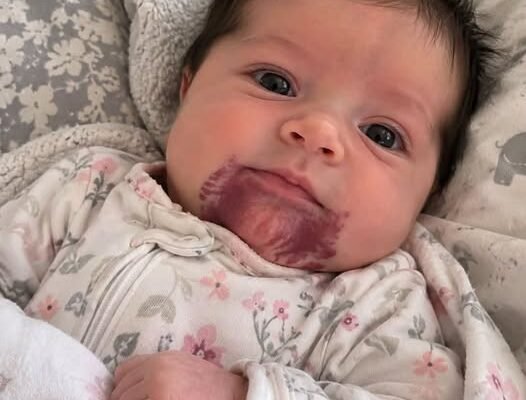
Evelyn had been born with a small reddish-brown mark high on the back of her shoulder.
The pediatrician had barely reacted.
He’d called it harmless.
Ben continued.
“My grandfather had the same mark.”
I stared at him.
“Exactly there.”
Diane whispered,
“And Ben’s father.”
My heart started pounding.
“You rejected her because she looked like your family?”
Ben shook his head desperately.
“No. That’s why we’re here.”
I stopped.
“What?”
He reached into his coat.
Then pulled out a folded envelope.
“I went back to the hospital after I left.”
My mother stiffened beside me.
“You did what?”
“I couldn’t sleep.”
His voice shook.
“I kept seeing her face.”
“I kept hearing her cry.”
He looked at me.
“And then Mom mentioned the birthmark.”
Diane lowered her head.
Apparently, she had seen it when the nurse changed Evelyn.
She remembered Ben’s father had one in the same place.
Ben did too, though his was lighter now.
Something he had never shown me because it sat beneath his shoulder blade.
“So you suddenly decided she might be yours.”
His face twisted with shame.
“Yes.”
I wanted to slam the door.
Instead, I said,
“And?”
“I called Dr. Harris.”
Our fertility specialist.
I gripped the doorframe tighter.
“What did he say?”
Ben handed me the envelope.
“He pulled my old records.”
My hands wouldn’t take it.
Mom took it for me.
Ben continued.
“The original testing when I was seventeen wasn’t as conclusive as I was told.”
I stared at Diane.
Her face collapsed.
She had known that part too.
“No.”
Diane covered her mouth.
“I thought I was protecting him.”
My mother spoke for the first time.
“From what?”
Diane looked at us.
“From hope.”
Nobody moved.
Ben had suffered testicular torsion as a teenager.
The surgery saved one testicle.
His first specialist told Diane that fertility was unlikely.
Very unlikely.
But not impossible.
A later follow-up recommended repeat testing as an adult.
Diane never took him.
Instead, she told seventeen-year-old Ben that he would never father children.
Why?
Because her husband—Ben’s father—had already died by then, and she was terrified her son would spend years clinging to a tiny possibility.
So she turned uncertainty into certainty.
And Ben carried that certainty into our marriage.
Then he passed it to me as a lie.
I looked at him.
“You never had another fertility test?”
He shook his head.
“Not until yesterday.”
My breath stopped.
Yesterday.
He reached into his pocket again.
This time he pulled out his phone.
“The preliminary results came back this morning.”
I didn’t want to hear it.
But I already knew.
Ben whispered,
“I’m not sterile.”
The hallway went completely silent.
He continued.
“My count is extremely low.”
“But not zero.”
My mother opened the report.
I couldn’t look at it.
Then Ben said the sentence that finally made my knees give way.
“Evelyn is almost certainly mine.”
Mom caught me.
Diane gasped.
Ben moved forward.
I held up one hand.
He stopped immediately.
“Almost?”
“A DNA test is already being processed.”
“You tested my baby without asking me?”
“No.”
He shook his head quickly.
“They haven’t touched her.”
“The doctor said my new fertility results, the pregnancy timing, and the family birthmark make paternity very likely.”
“He said we can do the test only if you agree.”
At least he had learned one thing in twenty-four hours.
Consent.
But I wasn’t relieved.
I was furious.
“You threw us out.”
Ben nodded.
“Yes.”
“You put our daughter’s things on the curb.”
“Yes.”
“You let me leave the hospital believing you hated her.”
He began sobbing.
“Yes.”
“And now you’re here because you think she might carry your blood.”
“No.”
His answer came quickly.
I stared at him.
Ben wiped his face.
“No. That’s why I came yesterday.”
He looked toward the stairs.
“I’m here today because I realized something before the test even came back.”
I said nothing.
“She shouldn’t have needed to be mine.”
That stopped me.
He continued.
“I spent six years begging for a baby.”
“And then I looked at that little girl and made my love conditional on whether she came from me.”
His voice broke.
“She had done nothing.”
“Neither had you.”
He sat back on his heels.
“I became the worst version of myself in one afternoon.”
I looked at Diane.
She was crying silently.
“And you?”
She nodded.
“I did too.”
Her voice trembled.
“When I looked at Evelyn, I thought someone had humiliated my son.”
She wiped her face.
“So I humiliated you instead.”
I didn’t comfort her.
She didn’t deserve comfort from me in that moment.
But I appreciated the honesty.
Ben looked up.
“I don’t expect you to take me back.”
That surprised me.
“I don’t expect you to forgive me.”
He swallowed.
“But please let me make sure Evelyn is safe.”
“She is safe.”
“I know.”
“With me.”
He nodded.
“Yes.”
Then he said,
“I want to support her whether the DNA says she’s mine or not.”
I almost laughed.
“That’s easy to say now.”
“I know.”
“Yesterday she was a disappointment.”
His entire face folded.
“I know.”
The silence afterward was brutal.
Then, from upstairs, Evelyn cried.
Every adult in the hallway froze.
It was a tiny newborn cry.
Thin.
Demanding.
Perfect.
Ben closed his eyes.
For six years, he had imagined hearing that sound in his own home.
Now he was standing outside my parents’ door listening to it from a distance.
He didn’t move toward the stairs.
Good.
He finally understood he had no automatic right to.
I looked at him.
“What did you mean when you said if you don’t see her, you’re finished?”
He stared at me.
“My doctor found something else.”
My stomach tightened again.
“What?”
He took a breath.
“The infertility wasn’t random.”
There was a hereditary condition in Ben’s family.
A rare clotting disorder.
Usually manageable.
Often never diagnosed.
But sometimes dangerous in newborns.
Ben’s father had apparently carried it.
So had his grandfather.
The records suggested Ben might carry the gene too.
And if Evelyn was his biological child, she needed testing.
Immediately.
That was why they had come in tears.
Not because they suddenly wanted to reclaim the baby.
Because a secret Ben should have told me before pregnancy might now affect her health.
I didn’t hesitate.
“Call the pediatrician.”
Within an hour, we were at the children’s hospital.
Not together as a married couple.
Ben rode separately.
Diane stayed behind after I told her I didn’t want her there.
For once, she listened.
Evelyn was examined.
Blood was drawn.
The waiting was unbearable.
Ben sat across the room.
He didn’t try to touch me.
Didn’t try to hold Evelyn.
Didn’t ask me to comfort him.
He simply waited.
Three hours later, the pediatric hematologist came in.
Evelyn had inherited the condition.
My heart dropped.
Then the doctor smiled gently.
“But we caught it.”
That sentence changed everything.
Her condition was treatable.
Manageable.
She would need regular monitoring.
Certain medications would be avoided.
We would need to inform doctors before surgeries.
But she could live a normal life.
I cried harder from relief than I had from fear.
Then the doctor added something else.
The genetic result also made Ben’s biological paternity overwhelmingly likely.
A formal paternity test later confirmed it.
99.99%.
Ben was Evelyn’s father.
He cried when he saw the result.
I didn’t.
By then, the question of biology had become strangely small.
He looked at me.
“I don’t know whether this makes anything better.”
“It doesn’t.”
He nodded.
“I know.”
That mattered too.
An answer is not an apology.
And a DNA result is not character.
When we left the hospital, Ben asked one question.
“Can I see her?”
I looked at the baby sleeping in my arms.
Then at him.
“From here.”
He nodded.
He stood several feet away.
And looked at his daughter.
Really looked.
Not searching for proof.
Not looking for family resemblance.
Just looking.
“She has your nose,” he whispered.
I almost smiled.
“That’s what my mother says.”
Ben laughed once through his tears.
Then Evelyn opened her eyes.
For a few seconds, father and daughter simply stared at each other.
Ben covered his mouth.
“I am so sorry.”
She yawned.
I don’t know why that nearly destroyed me.
Maybe because babies don’t understand betrayal.
They only understand warmth.
Food.
Safety.
The people who repeatedly show up.
Ben would have to learn that fatherhood worked the same way.
I did not go home with him.
I stayed with my parents.
A week became a month.
A month became three.
Ben attended every medical appointment he was allowed to attend.
He paid every bill without being asked.
He brought diapers to my parents’ house and left them on the porch when I didn’t want to see him.
He started individual therapy.
Then he told me something else.
He had been afraid of abandonment since childhood.
After his father died, Diane had taught him that certainty was safer than hope.
So he had built his life around avoiding humiliation.
When Evelyn was born, fear reached the conclusion before love had a chance.
That explained him.
It did not excuse him.
There is a difference.
Diane took longer.
Her first apology was full of explanations.
I stopped her.
“Don’t tell me why.”
She looked surprised.
“Tell me what you did.”
So she tried again.
“I called my newborn granddaughter a disappointment.”
Her voice broke.
“I treated you like an enemy hours after you gave birth.”
“I hid important medical information from my son for years.”
“And my choices helped create what happened.”
That was the first apology I could hear.
I still didn’t let her visit Evelyn immediately.
She waited.
For six weeks.
Then one afternoon, she came to my parents’ house carrying a small box.
Inside were photographs of Ben as a baby.
One showed the same birthmark on his shoulder.
Another showed Ben’s father holding him.
Diane sat at the kitchen table.
“I thought I was protecting my son by giving him certainty.”
She stared at the photograph.
“All I really did was teach him that frightening truths should be hidden.”
I looked at her.
“And I’m sorry that lesson reached you.”
Then she slid the box toward me.
“These belong to Evelyn someday.”
I accepted them.
That was all.
No hug.
No miraculous reconciliation.
Just the beginning of something less broken than before.
Ben and I remained separated for nearly a year.
People expected me to make a dramatic decision quickly.
Leave him forever.
Take him back.
Forgive.
Don’t forgive.
But none of those people had been sitting in my hospital bed when he rejected our daughter.
And none of them had spent six years building a marriage with him before that moment.
So I stopped listening to everyone except myself.
Ben never pressured me.
That helped.
When Evelyn was four months old, I allowed him to spend two hours with her at my parents’ house.
I stayed nearby.
He changed her diaper wrong.
The tabs ended up crooked.
She peed on his shirt.
I laughed before I could stop myself.
He looked at me.
For one second, we were us again.
Then the memory of the hospital returned.
My smile disappeared.
Ben saw it.
He didn’t pretend not to.
“I know.”
That was all he said.
Months passed.
Two hours became afternoons.
Afternoons became full days.
Ben learned Evelyn’s medication schedule better than anyone.
He kept notes from every appointment.
He took an infant CPR course.
Then another because he said he’d forgotten half of the first one.
He never again said:
She’s mine.
He said:
I’m her father.
I noticed the difference.
One phrase was possession.
The other was responsibility.
On Evelyn’s first birthday, we held a small party at my parents’ house.
Ben arrived early.
Diane brought a cake.
My parents decorated the backyard.
When everyone gathered around the high chair, Evelyn grabbed icing with both hands and rubbed it into her hair.
Everyone laughed.
I looked across the table at Ben.
He was crying.
Not loudly.
He caught me watching.
“Six years,” he said.
I knew what he meant.
Six years of waiting for that child.
Then one terrible day nearly destroyed everything.
After the party, he helped me clean.
When everyone else went inside, Ben remained on the porch.
“I need to ask you something.”
My body tensed.
He saw it.
“Not about coming home.”
I relaxed slightly.
He sat.
“I’ve spent a year wishing I could undo what happened.”
I didn’t respond.
“But I can’t.”
“No.”
“And I don’t want you to forgive me because I’ve behaved well for twelve months.”
I looked at him.
“Then what do you want?”
He took a long breath.
“I want to know if there’s anything left between us that you want to build.”
The question surprised me.
Not:
Do you still love me?
Not:
When are you coming home?
Do you want to build anything?
I looked through the window.
Evelyn was asleep against my father’s chest.
“I don’t know.”
Ben nodded.
“Okay.”
“And if the answer becomes no?”
“I’ll still be her father.”
That was the answer I needed.
Not because it meant I would take him back.
Because for the first time, I knew Evelyn’s relationship with her father no longer depended on mine.
Three months later, I agreed to marriage counseling.
We started from almost nothing.
Trust was gone.
So we stopped pretending we could restore the old marriage.
Our counselor said something I still remember.
“You don’t rebuild a burned house by pretending the fire didn’t happen.”
So we didn’t.
We talked about infertility.
Fear.
Money.
Diane.
The secrets.
My anger.
His shame.
The hospital.
Especially the hospital.
There were sessions when I hated him again.
There were sessions when he hated himself so much that I had to remind him that self-punishment was not the same as accountability.
And slowly, very slowly, something returned.
Not the marriage we had.
Something more careful.
Eighteen months after Evelyn was born, I moved back home.
Not because Ben asked.
Because I wanted to try.
Diane did not have a key anymore.
That was my condition.
Neither did anyone else.
Ben agreed before I finished the sentence.
The garbage bags were long gone.
My clothes were back in the closet.
But I kept one bag.
Folded.
In a drawer.
For a while, Ben hated seeing it.
Then he understood why I kept it.
Some memories shouldn’t control your future.
But neither should healing require you to erase the evidence of what taught you to protect yourself.
Years passed.
Evelyn grew into a loud, funny little girl who asked questions constantly.
At four, she wanted to know why Daddy cried every time he watched the video from her first birthday.
At five, she became obsessed with dinosaurs.
At six, she announced she was going to become a heart doctor because “Grandma says our family has weird blood.”
Diane nearly choked on her coffee.
By then, their relationship had changed too.
Diane became a loving grandmother.
Not because biology entitled her to the role.
Because she earned it over time.
She followed medical instructions.
Respected boundaries.
Never contradicted me in front of Evelyn.
And once, when another relative called Evelyn “Ben’s miracle baby,” Diane corrected them.
“She is her mother’s miracle too.”
I heard her.
I never told her how much that meant.
Maybe she knew.
On Evelyn’s seventh birthday, she came into our bedroom carrying an old photograph.
It was the picture I had sent Ben from the hospital.
Her tiny fingers wrapped around mine.
The one he never answered.
“Mom?”
“Yes?”
“Is this me?”
I looked at Ben.
He had gone still.
“Yes.”
“You were tiny.”
She smiled.
“Why is Dad not in it?”
There are moments parents know will come eventually.
We had agreed years earlier that we would never lie to her.
Not about her medical condition.
Not about the beginning of her life.
But truth should be given in portions children can carry.
Ben sat beside her.
“Because Daddy made a very bad mistake when you were born.”
She looked fascinated.
“What mistake?”
Ben swallowed.
“I got scared.”
“Of me?”
His face broke.
“No.”
He shook his head.
“Never of you.”
He looked at me.
Then corrected himself.
“Actually, I was scared, and because I was scared, I behaved as though you were the problem.”
Evelyn frowned.
“That doesn’t make sense.”
“No.”
Ben smiled sadly.
“It didn’t.”
“What did Mom do?”
He looked at her.
“She protected you.”
Evelyn nodded as though that were obvious.
“Mom does that.”
I nearly cried.
Then she climbed into my lap.
“Did you say sorry?”
Ben laughed through tears.
“About ten thousand times.”
“Did Mom forgive you?”
She looked at me.
I thought about it.
“Yes.”
Ben looked at me too.
Even after all those years, the word still mattered.
Then I added,
“But forgiving somebody doesn’t mean pretending they didn’t hurt you.”
Evelyn considered that.
“Like when Molly broke my crayon and said sorry, but I don’t let her use the glitter ones anymore?”
Ben burst out laughing.
“Exactly like that.”
She seemed satisfied.
Then she ran off to find her dinosaurs.
Ben and I sat quietly.
After a moment, he reached for my hand.
He still asked with his eyes before touching me sometimes.
I squeezed his fingers.
“I don’t deserve this,” he whispered.
I shook my head.
“Don’t do that.”
He stopped.
We had worked hard on that sentence too.
Love wasn’t a prize awarded to the deserving.
It was a choice made repeatedly by people who were free to leave.
I stayed because Ben changed.
Consistently.
Quietly.
For years.
Not because he was Evelyn’s biological father.
Not because six years of marriage obligated me.
And certainly not because apologies erased the worst day of my life.
I stayed because after destroying my trust, he stopped asking me to hand it back.
He rebuilt conditions where trust could grow again.
That distinction saved us.
Today, the photograph from Evelyn’s hospital room sits in a frame in our hallway.
Next to it is another photograph.
Evelyn at seven.
Missing a front tooth.
Standing between Ben and me with one arm around each of us.
Diane once asked why I kept the first photo where everyone could see it.
“Doesn’t it remind you of something terrible?”
I told her the truth.
“Yes.”
It reminds me of the day my husband failed me completely.
It reminds Ben too.
But it also reminds me of the woman holding that newborn.
Exhausted.
Terrified.
Abandoned.
And still strong enough to look at her daughter and decide:
I will never beg anyone to love you.
That woman didn’t know how her life would turn out.
She didn’t know whether her marriage would survive.
Didn’t know about the blood disorder.
Didn’t know Ben would spend years earning his way back into the family he nearly threw away.
She only knew one thing.
Her daughter deserved love without conditions.
And in the end, that became the standard for all of us.
Ben had waited six years to become a father.
But fatherhood didn’t begin when a DNA test proved Evelyn was his.
It began when he finally understood that being her father meant loving her even if no test ever had.
And motherhood taught me something just as important.
Protecting your child does not always mean closing a door forever.
Sometimes it means keeping it closed until the person on the other side learns how to knock.
Then deciding for yourself whether you’re ready to open it.